Borodin Method
Historical document, translated for reference. It reflects medical knowledge of the 1920s–30s and is not medical advice.
Summary
The Borodin Method is a technique for determining urea content based on its decomposition by brominated alkali into water, nitrogen, and carbon dioxide. The method uses a specialized apparatus and is applied for quantitative determination of urea in urine.
Encyclopedia article (1928–1936)
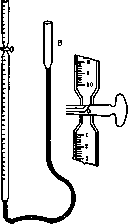
BORODIN METHOD for determination of urea, based on the decomposition of the latter by brominated alkali into water, N, and CO2: carbon dioxide is absorbed by the alkali, and the content of urea is calculated from the volume of N released. The determination is performed in a special Borodin apparatus, shown in the figure. Reagents: 1) in 1 liter of water, dissolve 30 g of caustic soda and to the liquid add after cooling 50 g of bromine; 2) saturated solution of table salt. Method of execution. The apparatus is filled with solution (2) through tube B until it flows out into A above the stopcock. The stopcock is closed and the salt solution is released from A through the side opening of the stopcock. 5 cubic cm of urine, diluted 5 times with water, are allowed to flow from A into B above the salt solution, with which the urine does not mix due to the difference in specific gravity. Then, in small portions, brominated alkali (1) is introduced into B until the release of gas bubbles ceases. After 30 minutes, the volume of gas is measured. From tables, the amount of urea corresponding to 1 cubic cm of N at the existing temperature and pressure is found. The method is sufficiently accurate and is used for quantitative determination of urea in urine. For blood, this method was modified by Saveliev.
Related articles
Mentioned in
Cite this page
“Borodin Method.” Soviet Medical Encyclopedia. English translation of Bolshaya Meditsinskaya Entsiklopediya, 1st ed. (Moscow, 1928–1936), ed. N. A. Semashko. https://sovietmedicalencyclopedia.pages.dev/article/borodin-method/