Pseudodementia
Historical document, translated for reference. It reflects medical knowledge of the 1920s–30s and is not medical advice.
Summary
This article from the 1928–1936 Soviet Great Medical Encyclopedia defines pseudodementia as a psychogenic condition characterized by a feigned state of stupidity or mental decline. It describes the clinical presentation, including theatrical behavior, incorrect answers to simple questions, and the contrast between apparent cognitive deficits and preserved practical functioning.
Encyclopedia article (1928–1936)
PSEUDODEMENTIA, false dementia, a morbid desire to portray oneself as stupid and ill. The concept was proposed by Wernicke to distinguish it from dementia as a consequence of organic brain damage. This morbid reaction, from the clinical group of psychogenias, usually develops as a result of accidents and during prolonged conflicts. As the main manifestation of pseudodementia, a complete or sharply pronounced loss of elementary knowledge is observed. Patients feel helpless, do not know how to do anything, do not remember anything, and when attempting to do so, are theatrically confused and resort to childish excuses. A constant demonstration of one's complete inability to think is characteristic. The attitude toward elementary mental arithmetic is indicative; errors such as 3x4 = 7 or 5x6 = 56 are common. The most common answer to everything is "I don't know." Good orientation in the surroundings, skillful observance of all one's own interests, etc., are in sharp contradiction with the dementia they exhibit. They are often depressed, hypochondriacal with absurd complaints, and exhibit sensory disturbances, tremors, and frequent
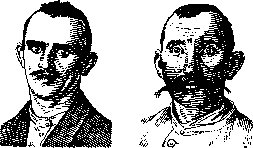
labile pulse. When examining the Romberg sign, patients fall without making any attempts to maintain balance. They speak in a slow, suffering voice. A facial expression in the form of a frozen mask, dull or stupid (see figure), or a simultaneous expression of dissatisfaction and suffering is characteristic; in general, facial expressions are always sluggish. Often, especially in places of detention, the portrayal of some kind of "insanity" is added to this. A one-time reward cures it faster than any other measures, which should be kept in mind during legislative and judicial formulations regarding pensions and compensation. Often, a radical remedy is to clarify the patient's situation and ignore the symptoms.
The illness can last up to a year or more. The course of prison pseudodementia is milder and more transient. Related to pseudodementia is the Ganser twilight state (see Ganser symptom). The pathogenesis is not easy to explain. The main role is apparently played by mechanisms of repression and autosuggestion, what Kretschmer calls hypobulia (primitive will), and at the root lie certain ulterior motives. It is characteristic that pseudodementia usually develops only after some time has passed since the trauma; apparently, some internal processing is necessary first. Pseudodementia usually arises in impulsive and unstable psychopaths who often did not have any hysterical traits in their character in the past. It is necessary to differentiate it from conscious pretense and from actual dementia, imbecility, and schizophrenia. Often, a gross organic disease becomes apparent only after the disappearance of the pseudodementia veneer.
Related articles
Mentioned in
Cite this page
“Pseudodementia.” Soviet Medical Encyclopedia. English translation of Bolshaya Meditsinskaya Entsiklopediya, 1st ed. (Moscow, 1928–1936), ed. N. A. Semashko. https://sovietmedicalencyclopedia.pages.dev/article/pseudodementia/