Colonial Animals
Historical document, translated for reference. It reflects medical knowledge of the 1920s–30s and is not medical advice.
Summary
This article defines colonial animals as complexes of individual organisms that are morphologically and physiologically linked, typically arising from incomplete asexual reproduction. It discusses the prevalence of colonial life among protozoa and multicellular organisms, noting how it often leads to a division of labor among individuals within the colony.
Encyclopedia article (1928–1936)
COLONIAL ANIMALS represent complexes of single organisms, or individuals, linked to one another morphologically and physiologically; these complexes usually arise as a result of incomplete asexual reproduction (Fig. 1). They are encountered both among Protozoa (Volvox and other flagellates, many peritrichous ciliates, e.g., Vorticella) and among multicellular animals—hydroid polyps. In the first case, each individual of the colony is represented by a single cell; in the second, it is a multicellular organism. The degree of physiological connection between the members of a colony is often revealed (e.g., in peritrichous ciliates) by the fact that irritation of one individual entails the contraction of the entire colony. A colonial lifestyle often leads to a division of labor among the individuals of the colony; most often, some individuals perform the function of sexual reproduction, while others perform all other functions (the flagellate Volvox, hydroid polyps, in which the sexual individuals, or medusae, formed on the colony may even separate from the latter). Sometimes the division of labor goes even further, and several types of individuals appear in the colony, differing in
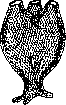
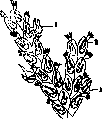
Figure 1.
Figure 2. Figure 1. A colonial sponge consisting of three partially fused individuals; the discharge openings of the individuals are visible at the top. Figure 2. Part of a polymorphic bryozoan colony consisting of ordinary individuals (2) and so-called avicularia (1). function and structure. Thus, in bryozoans, in addition to ordinary individuals, there may be two categories of protective individuals—avicularia and vibracula (Fig. 2). In siphonophores, a colony sometimes consists of 5–6 types of individuals. Accordingly, one distinguishes between monomorphic colonies—made of identical individuals—and polymorphic ones—made of several different types of individuals. It is reasonable to think that a sedentary lifestyle played a major role in the formation of colonies, since this phenomenon is most often encountered precisely in attached animals. Coloniality is observed among protozoa (some radiolarians, flagellates, ciliates), coelenterates [the majority of hydroid and coral polyps (Fig. 3), siphonophores], sponges, worms (almost all bryozoans), and some lower chordates (ascidians). Among them, only radiolarians, some flagellates, and siphonophores are free-swimming; all others lead a sedentary lifestyle. In the colony, as can be seen, coloniality is developed predominantly among the lower, more simply organized types of the animal world. The phenomenon of coloniality played a certain role in the construction of phylogenetic theories, insofar as colonial protozoa were accepted by some as forms transitional between unicellular and multicellular organisms (see Cell Theory).
V. Dogel.
Related articles
Mentioned in
Cite this page
“Colonial Animals.” Soviet Medical Encyclopedia. English translation of Bolshaya Meditsinskaya Entsiklopediya, 1st ed. (Moscow, 1928–1936), ed. N. A. Semashko. https://sovietmedicalencyclopedia.pages.dev/article/colonial-animals/