Coulomb
Historical document, translated for reference. It reflects medical knowledge of the 1920s–30s and is not medical advice.
Summary
This article from the 1928–1936 Soviet Medical Encyclopedia defines the coulomb as the practical unit of electricity and describes Coulomb's torsion balance used for measuring weak forces.
Encyclopedia article (1928–1936)
COULOMB, the practical unit of the quantity of electricity, equal to 3×10⁹ absolute electrostatic units. The latter is defined from Coulomb's law as follows: if two charged small spheres are placed at a distance r (in cm), the force f acting between them will be equal (in dynes) to f = ee'/r2, where e and e' are the magnitudes of the charges of the spheres in the absolute electrostatic system of units. If the charges e and e' are equal to each other, then f = e2/r2. If r = 1 cm and f = 1 dyne, then, as can be seen from the formula, e must also be equal to unity. From this follows the following definition of the absolute electrostatic unit: we take as the unit of charge such a charge which acts on another charge equal to it in magnitude and placed at a distance of 1 cm, with a force of one dyne. It is assumed here that the charges are concentrated on spheres with a radius negligibly small in relation to the distance between the spheres. For practical purposes, the above-mentioned unit is small, and the coulomb is taken as the practical unit, which, as stated, is 3×10⁹ times larger than the electrostatic unit. If the charges of two spheres are equal to 1 coulomb for each sphere and the spheres are placed at a distance of 1 km from one another, the force of their repulsion is about 900 kg. Coulomb's torsion balance (see figure) is a sensitive physical instrument designed for studying weak forces of interaction (electrical, magnetic, gravitational). It is a light rod suspended
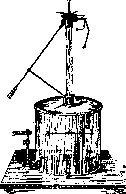
by the middle on a thin and long elastic thread (silver, aluminum, quartz). If the torsion balance is intended for the study of electrical interactions, the rod is made of an insulating substance and has a light ball made of elder pith at one end. If no force located in a horizontal plane acts on the ball, the rod occupies a certain equilibrium position in which the thread is completely untwisted. When a force acts on the ball, the rod turns; but at the same time, the thread is twisted, and an elastic force develops in it that counteracts this twisting. The rotation of the rod continues until the force causing it and the counteracting elastic force unwinding the thread balance each other out. On the basis of the laws of elasticity in torsion discovered by Coulomb himself, the angle of rotation of the rod in this equilibrium position will serve as a measure of the investigated
force of interaction.
Related articles
Mentioned in
Cite this page
“Coulomb.” Soviet Medical Encyclopedia. English translation of Bolshaya Meditsinskaya Entsiklopediya, 1st ed. (Moscow, 1928–1936), ed. N. A. Semashko. https://sovietmedicalencyclopedia.pages.dev/article/coulomb/