Oxidation
Historical document, translated for reference. It reflects medical knowledge of the 1920s–30s and is not medical advice.
Summary
A historical overview of the chemical concept of oxidation as defined in the 1930s, covering ionic processes, oxidation-reduction reactions, oxidation potentials, coupled oxidation, and autooxidation theories.
Encyclopedia article (1928–1936)
OXIDATION, a chemical reaction of adding oxygen or removing hydrogen. For ionic processes, a more expanded formulation is generally accepted: Oxidation is an increase in positive valence (charge) or a decrease in negative valence (charge) of an ion, e.g., Fe" -> Fe"' during the oxidation of ferrous salts into ferric salts or S" -> S0 in the transition from H2S to free sulfur. Oxidation means the loss of electrons. From the condition of general electroneutrality, it is necessary that a substance be present that adds an electron, thereby increasing its negative valence; it is called an oxidizing agent; it itself is reduced in the process (see Reduction). Thus, the processes of oxidation and reduction are closely linked and must proceed together. Example: SnCl2 + 2FeCl3 = SnCl4 + 2FeCl2, or (in ionic form) Sn" + 2Fe"' = Sn"" + 2Fe". In this reaction, the tin ion is oxidized, the iron ion is reduced; the iron ion is the oxidizing agent, the tin ion is the reducing agent. Balance of charges. From this, it follows that a strict balance of the number of accepted and donated charges must be observed. This provides a simple way to find stoichiometric coefficients for reacting molecules if the initial and final products are known. Let us have the reaction of oxidation of divalent manganese in the form of Mn(NO3)2 into heptavalent in the form of HMnO4 by means of PbO2, which is thereby reduced to Pb(NO3)2 in the presence of nitric acid. Oxidation-reduction can be depicted by a scheme (Mikhailenko): Mn" - 5(-) = Mn7'; 2Pb"' + 2(-) = Pb". To make the total number of incoming and outgoing electrons equal, the top line must be multiplied by 2, and the bottom by 5. From this, we have the reaction equation: 2Mn(NO3)2 + 5PbO2 + 6HNO3 = 2HMnO4 + 5Pb(NO3)2 + 2H2O. Oxidizing equivalent. The oxidizing equivalent n is the number of negative charges accepted by the oxidizing agent; in this example, the oxidizing equivalent of PbO2 = 2. Oxidation-reduction reactions are used, among other things, in volumetric analysis (see Oxidimetry). In the normal oxidimetric system, the number of grams equal to the molecular weight divided by the oxidizing equivalent in 1 liter of solution is taken as the unit of concentration. The oxidizing equivalent can vary depending on the conditions of the medium (see Oxidimetry).
Strength of oxidizing action. Equal concentrations of oxidizing agents of different chemical nature act differently, being capable of oxidizing one substance and being insufficient for the oxidation of another. Furthermore, a substance, being an oxidizing agent for one substance in one reaction, may appear as a reducing agent for another, stronger oxidizing agent in another reaction, e.g.: SO2 + 3H2 = H2S + 2H2O; 2SO2 + O2 = 2SO3. A measure of the strength of oxidizing action is the oxidation potential. If one constructs an element with a solution of an oxidizing agent at one chemically inert electrode and a reducing agent at the other, connects the solutions with a liquid conductor, and the electrodes with a wire, then a current will flow through the wire (Ostwald). Some electromotive forces (potentials) of such elements are given in the table (Ostwald, Bancroft). Electromotive forces are additively summed from the potentials of individual oxidizing and reducing agents, which is evident from the fact that the differences between adjacent numbers are constant. From this, the oxidation potentials of individual substances in volts (for ~1/7 molar solutions) were obtained: KMnO4 (H2SO4) -1.763; FeSO4 (H2SO4) -0.794; SnCl2 (KOH) +0.301. The speed of oxidation does not always correspond to the strength of the oxidizing action.
Coupled oxidation. The formation of intermediate products with a higher oxidation potential explains in many cases why an oxidizing substance (actor), acting on an easily oxidized substance (inductor), causes the simultaneous oxidation of a third substance (acceptor), which by itself does not oxidize or oxidizes with difficulty under the action of the actor (coupled reactions). This case differs from catalysis (see) in that with the cessation of the oxidation of the inductor, the oxidation of the acceptor ceases. The induction factor is called the molecular ratio of the acceptor and inductor that have reacted per unit of time. In typical coupled reactions, it is expressed by a small integer. Coupled oxidation reactions, besides the formation of an unstable form of oxidation, can also be caused by the formation of complex compounds of the inductor with the actor or with the acceptor, in general, when one process proceeds at the expense of the energy of another, and also during the formation of complex or insoluble compounds that remove products from the sphere of the reaction. During the oxidation of phosphorus, turpentine, and some other substances by oxygen, ozone is formed. Here, the energy released during oxidation proves sufficient to carry out the process O2 -> O3, which requires an expenditure of energy. Further examples of coupled oxidation reactions are as follows: Actor: O2, Inductor: SO2, Acceptor: As2O3; Actor: H2CrO4, Inductor: FeO, Acceptor: HMnO4; Actor: FeO, Inductor: HCl, Acceptor: H2CrO4; Actor: C2H2O4, Inductor: Indigo, Acceptor: H2CrO4; Actor: Tartaric acid, Inductor: MnO, Acceptor: HMnO4; Actor: As2O3, Inductor: MnO, Acceptor: Fe2O3; Actor: SO2, Inductor: Indigo, Acceptor: HClO3; Actor: CH2O, Inductor: As2O3, Acceptor: K2S2O8; Actor: FeO, Inductor: HNO3, Acceptor: Zn, Cd (met.); Actor: HMnO4, Inductor: Formic acid, Acceptor: NH4OH; Actor: H2O2, Inductor: FeO, Acceptor: HJ.
Oxidation by gaseous oxygen can proceed with varying intensity: slow oxidation, combustion, explosion. If the initial and final products are the same, then the amount of energy released will be the same in all these cases. Of the cases of slow oxidation, the most important is autooxidation (Traube, cf. also Schönbein's "activated oxygen"), the mechanism of which is closely related to coupled oxidation. Autooxidation is understood as the oxidation of bodies by gaseous oxygen, which occurs spontaneously, without any additional influences. According to the now generally accepted theory of Bach and Engler (Engler), the oxidation process proceeds in 2 stages: in the first, a whole molecule of oxygen is added and forms a peroxide (with the characteristic group -O-O-); it possesses a stronger oxidizing action than the oxygen molecule, and therefore it can oxidize a molecule of some other substance (coupled reaction) or the same one that was taken for oxidation (autooxidation): A+O2=A[O2]; A[O2]+B=AO+BO or A[O2]+A=2AO. E.g.: C6H5.CHO + O2 = C6H5.CO3H; 2C6H5.CO3H + benzaldehyde = 2C6H5.COOH (benzoic acid).
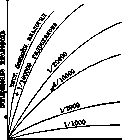
benzoyl + (C8H3ON)2 = 2C6H5COOH + 2C8H6O2N; C6H5.CHO + indigo benzoic acid isatin benzoyl hydroperoxide + C6H5.CHO = 2C6H5COOH. benzoic benzoic acid aldehyde In the case of the autoxidation of benzaldehyde, benzoyl hydroperoxide was isolated by Baeyer, which is a strong oxidizing agent. Jorissen found the induction factor, i.e., the distribution of oxygen between the aldehyde and indigo, = 1, as required by the theory. Autoxidation is characterized by its high sensitivity to negative catalysts. Bearing in mind that all living nature is constantly in contact with such a strong oxidizing agent as free oxygen, one can marvel at its stability in this respect and the precise regulation of oxidation (respiration). This is explained by the action of powerful resistances, namely the presence of oxidation-retarding catalysts (antioxygenes according to Moureu). The use of such retarders has great practical significance: a 1% addition of alcohol to chloroform is used to protect it from rapid contamination by harmful oxidation products; the addition of 0.1% phenol to acrolein allowed this unstable substance to be prepared in large quantities. Many such examples are known, for example: Substance Retarder Na2SO3 Benzyl, butyl alcohols, glycerin, benzaldehyde SnCl2 Mannitol, cresols, aniline Benzaldehyde Hydroquinone Oxalic acid Quinhydrone, resorcinol Adrenaline, alkaloids Sulfurous acid Paraffin Sulfur (at new t°) Fats and oils Phenols, tannin, saligenin, acetylthiourea, etc. Silk Tin salts, rhodanates Rubber Phenols For the retarding action, there are the following regularities (Moureu): retardation increases with the concentration of the retarder (Fig. 1). Retarders are substances themselves capable of oxidation. In some cases, substances change from retarders to accelerators: iodine is a retarder for the oxidation of benzaldehyde, but an accelerator for styrene. Accelerators, as a rule, change the reaction rate not very significantly (maximum several times), whereas retarders can practically completely suppress the reaction, continues
Figure 1. 2H2
+ C (amorphous) + C (amorphous) S
+ 2P
+ Mg
+ Accordingly, although this action is apparently not for an infinitely long time. It has been experimentally shown that autoxidation is closely related to polymerization and condensation (resinification). They share common catalysts. Autoxidation reactions are accompanied by luminescence and are light-sensitive. Determinations made by Backstrom for the autoxidation of benzaldehyde gave a chain length (see below) of tens of thousands of molecules for the first stage (A+O2) and significantly shorter in the second (A[O2]+A). The role of oxidation retarders reduces to the termination of chains in the first stage. Since the chains are very long, the addition of a very small amount of a negative catalyst is sufficient for this. Combustion occurs during rapid oxidation, accompanied by a flame. Many substances, when oxidizing, release a great deal of heat, for example: O2 = 2H2O + 136,000 cal. O2 = CO2 + 97,000 » 1/2O2 = CO + 29,000 » O2 = SO3 + 77,300 » 5O2 = P2O5 + 370,000 » O2 = MgO + 143,900 » for this reason, the temperature of the flame reaches very high values: hydrogen - 2,320°; CO - 2,430°; CH4 - 2,150°; a blowtorch on a mixture of H2 and O2 gives 3,000°, etc. In these cases, the rate of the combustion reaction depends, besides the length of the chains (see below), also on the heating of the entire mass of the burning gas. There also exists a so-called cold flame, at low pressures, when diluted with an indifferent gas. The total temperature of the burning mixture in this case is very low, but the energy of individual molecules, of course, remains very high. Here, the reaction rate depends exclusively on the propagation of chains. Theory of combustion. According to the kinetic theory (see), the velocities and energies of molecules at a given absolute temperature T are not identical and are distributed according to the Maxwell-Boltzmann law. Although the majority of molecules have an energy of the order of RT (R = 1.98 cal.), there is a small fraction {
of the total number of molecules with a very large excess of energy. Molecules of reacting substances colliding with each other enter into the reaction, but not all, only those possessing excess energy (activation energy, about 30,000 cal.). Thus, in order for molecules to react, it is necessary to supply energy beforehand. For example, for coal to ignite, it must be heated. The heat released during the reaction, by heating the mixture, can again provide the activation energy. Since the number of active molecules increases very rapidly with an increase in temperature, the reaction rate also increases rapidly, usually doubling with a 10° increase in temperature. With an increase in the temperature of oxidation from 200° to 2,200°, the reaction rate increases by 106 times. Combustion reactions are chain reactions. Each primary act of the reaction of a molecule with oxygen is the beginning of an energy chain: the molecule formed, at the first moment of its appearance, carries a very large energy; having collided with a molecule of the starting substance, it transfers its energy to it, this second molecule becomes active, reacts, the process repeats further and proceeds in a chain. Thus, the number of active molecules increases significantly compared to the initial one. The reaction rate constant (the number of molecules reacting per unit time at a pressure equal to one) W = n + aW, where n is the number of initially active molecules and a is the probability of activating a molecule that has collided with one that has reacted. Hence W = n/(1-a); 1/(1-a) is the chain length, i.e., the number of secondary reaction acts caused by the primary one. The chain length reaches values of the order of 104-106. If, in its progression, such a chain encounters molecules that, by absorbing energy, do not react further, e.g., molecules of a foreign substance (walls of the vessel), then the chain is terminated. Thus, the combustion rate depends on the diameter of the vessel. In capillaries (T), while heat removal is slow (proportional to T). At a temperature where heat input is no longer compensated by heat removal, an avalanche-like increase in rate occurs and, as a consequence, an explosion, combustion. This is the ignition temperature. Ignition temperatures in mixtures with air at atmospheric pressure: CO, CH4 - 650°, H2 - 550°, C2H2 - 450°, CS2 - 350°, PH3 - 100°. Dependence on pressure. When the combustion rate depends on the heating of the entire mass of gas (see above), the ignition temperature depends on pressure. The reaction rate according to the law of mass action is proportional to the pressures of the reacting gases and oxygen, and the heat input is proportional to the reaction rate. Let the pressure and reaction rate be small and the heat input Q as a function of temperature be expressed by curve 3, and heat removal by a sloping straight line (Fig. 2). If the oxidation reaction began at temperature T0, then the heat input is greater
Figure 2.
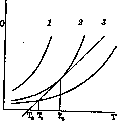
heat removal and the mixture heats up to Tx where these values become equal. Further heating will not occur, because the heat input is already less than the possible heat removal (the straight line is above curve 3). Thus, there is no explosion. At higher pressure, the condition is reached (curve 2) where the straight line touches the curve at point T2; above it, the heat removal remains less than the heat input, and the reaction rate increases extremely rapidly—an explosion occurs. If the pressure is even higher (curve 1), heat dissipation is always less than heat input, and an explosion occurs rapidly. Thus, there is a lower limit of flammability, depending on pressure. From these critical pressures, one can calculate the activation energy (Semenov). The lowering of the ignition temperature during compression, i.e., ignition by compression, is used in the Diesel engine. By injecting gasoline into air compressed to 50 atmospheres, its instantaneous ignition is caused; the gas temperature rises in this case to 1,000°. So-called antiknock agents (tetraethyl lead, etc.) raise the ignition temperature by terminating chains and allow the use of higher pressures. There are limits of flammability depending on the composition of the mixture. Combustion in mixtures with air occurs only at contents of: H2—from 10% to 70% H2, CO—from 16% to 75% CO, illuminating gas—from 8% to 25% gas. When there is too much of one component, combustion cannot propagate, as the energy released during the reaction between molecules is wasted without the propagation of chains. A similar diluting effect is produced by the addition of a non-combustible gas. It is further interesting that there exists an upper pressure limit for the combustion of mixtures, above which they do not ignite. Propagation of combustion. If one ignites a combustible mixture contained in a long (several meters) horizontal tube from one side, the propagation of combustion—initially slow and uniform—rapidly accelerates, producing oscillations, often sound. The final phase, which, however, is not always encountered, is the so-called explosive wave, i.e., a wave of compressed (up to 50 atm.) gas of very high temperature. Its propagation velocity is very constant and commensurate with molecular velocities, from which the latter can be calculated. Volumetric composition of the mixture: C2H2 + O2, velocity of explosive wave 3,530 m/s; CH4 + O2, velocity of explosive wave 2,900 m/s. It is remarkable that dry mixtures with oxygen (CO, sulfur vapors, P, C) do not burn (water content < 0.0001%). Oxidation with atomic oxygen. By passing oxygen through discharge tubes (3,000 V, 250 mA) at pressures of about 1 mm, one can obtain a gas containing up to 30% atomic oxygen (quite analogous to the production of atomic, 'active' hydrogen). During the dissociation of an oxygen molecule, 126,000 cal. are absorbed; it is clear that the atoms possess a large reserve of energy. Therefore, upon meeting with the vapors of most organic substances, they produce a very energetic oxidative effect, accompanied by luminescence. Contact catalytic oxidation. Solid surfaces can not only hinder oxidation (see above) but also accelerate it. The latter, catalytic action, depends to a significant degree on the chemical nature of the surface. The mechanism of this action can be different. 1) Centers can appear on the walls from which new chains begin, for example, due to the fact that the energy of adsorption or chemical action of the wall is sufficient to split a molecule and send the formed groups or free atoms into the volume, where they begin the chains. Such, according to Haber, is the mechanism of catalysis of an explosive mixture by quartz, which sends OH groups, always present on its surface, into the volume. Such a mechanism of oxidative reactions is especially probable due to their high exothermicity. 2) Another mechanism is recognized by Langmuir for the combination of CO and H2 molecules with oxygen on a platinum surface. Oxygen, adsorbed by platinum, decomposes into atoms remaining on the surface. The reaction occurs at every impact of a CO or H2 molecule from the gas phase with surface O atoms. The formed CO2 or H2O molecules fly away quickly, renewing the free space for the next similar cycle. These free spaces can be occupied unproductively by CO or H2 molecules or by molecules of reaction products, and then a decrease in the active surface occurs. Processes of catalytic oxidation have received enormous application in practice—surface combustion of fuel, the contact method for producing sulfuric acid, oxidation of ammonia to nitric acid, the Deacon process, methane conversion, production of acetaldehyde from alcohol, phthalic anhydride from naphthalene, benzoic acid from toluene, anthraquinone from anthracene, etc. Catalysts used are Pt, Cu, V2O5, MoO3, WO3, activated carbon, and other substances, usually possessing several degrees of oxidation. During the oxidation of organic substances, the primary process is usually dehydrogenation, and the hydrogen released during this is oxidized by oxygen to water. For example: CH3.CH2OH -> CH3CHO + H2; 2H2 + O2 -> 2H2O. That dehydrogenation is the first stage of the oxidation process is also postulated by Wieland. The role of water is essential in this. Thus, the oxidation of SO2 to SO3 according to Wieland occurs according to the scheme: SO2 + H2O = H2SO3; H2SO3 = SO3 + H2; 2H2 + O2 = 2H2O. Spontaneous combustion. Coal, grain, hay, oily rags from cleaning machines, etc., stored for a long time in large piles, often ignite by themselves. These fires occur because the heat developing as a result of slow oxidation gradually accumulates, since the inner layers are well heat-insulated. From this, the reaction rate gradually increases, which can lead to ignition. Finely divided Fe, Ni, etc. (for example, Ni reduced by hydrogen from oxide at 300°) ignite by themselves in air (pyrophoric metals). This is explained by the special activity of the surface, where, under these conditions, many atoms approach active atoms in their properties. Oxidation spreads rapidly, since small metal particles do not conduct heat well, which remains right there, accumulating. Regarding processes of oxidation in the organism—see Oxidative enzymes, Metabolism, Energy metabolism, Muscles.
Related articles
Cite this page
“Oxidation.” Soviet Medical Encyclopedia. English translation of Bolshaya Meditsinskaya Entsiklopediya, 1st ed. (Moscow, 1928–1936), ed. N. A. Semashko. https://sovietmedicalencyclopedia.pages.dev/article/oxidation/