Molecular Weight
Historical document, translated for reference. It reflects medical knowledge of the 1920s–30s and is not medical advice.
Summary
The article explains molecular weight as the relative weight of a substance's molecule, focusing on methods for determining molecular weight in gaseous and dissolved states through density measurements and various experimental techniques.
Encyclopedia article (1928–1936)
MOLECULAR WEIGHT is the relative weight of a substance's molecule. In addition to the possibility of existing in three different phases (see Aggregative state), substances have the ability to distribute themselves in one another, forming so-called solutions. According to van't Hoff, molecules of a dissolved substance at sufficient dilution behave similarly to molecules of rarefied gases, i.e., quite independently of each other, and indeed for dilute solutions, gas laws prove to be quite valid. In compressed gases and even more so in liquids, forces of cohesion between molecules manifest to a significant extent, causing deviations from ideal gas laws and leading to the formation of complex "polymerized" molecules. In solids, these forces of cohesion are most sharply expressed, individual simplest molecules are no longer distinguishable as separate individuals, and the entire crystal of a solid body can be considered as one huge molecule. Thus, when speaking of the molecular weight of any substance, it is necessary to keep in mind the state in which it exists. Since the gaseous state, and thereby the dissolved state, is most studied both theoretically and experimentally, the methods for determining molecular weight of gaseous (or vapor) and dissolved substances prove to be most developed. The basic equation of gaseous state is the Clapeyron equation pv=nRT(), where p is pressure, v is volume of gas, n is number of gram molecules, R is the gas constant, T is absolute temperature. Replacing n through the expression n -- (2), where G is the weight of a given volume of gas, and M is the weight of an individual molecule, we get the equation pv = jjRT (3), on the basis of which, purely experimentally, by measuring p, v, G and T, we can determine the relative molecular weight of a substance. It is customary to relate molecular weight to the weight of a hydrogen atom, which allows expressing molecular weight as the sum of atomic weights of elements entering into the molecule. Let us write equation (3) for a given gas {x} and for hydrogen, taken in equal volumes, at the same temperature and pressure: pv = mx- RT and pv= = ~RT. According to Avogadro's law, equal numbers of molecules are found in equal volumes of gases under the same conditions, therefore: |^=§|. Hence MX = ^MH,The ratio - of weights of two equal volumes of gas, one of which is taken as unity, is the density of the gas, in this case relative to hydrogen-Dff. Since molecules of hydrogen, as well as most elementary gases, contain 2 atoms, then MH = 2, whence MX = 2 Dff X- 2.14.37 Dair~ =28.74 Dair (5). Thus, experimental determination of molecular weight of gaseous or vapor substances reduces to determination of density of this gas. There exist several different methods for determining densities of gases (prov), based on different principles. Thus, the Dumas method consists in determining the weight of a known volume of gas. First, a flask (with an extended tube) filled with air is weighed, then a certain amount of substance is placed in it and immersed in a bath at a temperature above the boiling point of the substance, holding until vapor evolution ceases. The flask is sealed and simultaneously barometric pressure and vapor pressure (P) and temperature (t°) are noted. Knowing the volume of the flask, we know the weight of the air contained in it, from which we can calculate the weight of the empty flask. Knowing the weight of the empty flask and its weight with vapor, we determine the weight of the vapor of the substance in this volume under these conditions. Then relating this weight to the weight of an equal volume of air or hydrogen under the same conditions, we find the density of the gas (weight of 1 cm3 of air=0.001293 g, hydrogen-0.0000899 g at 0° and pressure 760 mm). Reduction of the weight of 1 cm3 of gas to experimental conditions is performed by the formula G = -ц^щ^щ» гДe G - the desired weight of 1 cm3 of gas (in this case air or hydrogen), G0-their weight under normal conditions, a-coefficient of gas expansion, t°-temperature of experiment.-The Hofmann method is based on the opposite principle and consists of the following: a weighed amount of substance in a sealed ampoule is placed in a vacuum above mercury in a barometric tube (the length of which is more than 760 mm). When heated from the outside, the ampoule bursts, the substance evaporates under reduced pressure and the volume of the resulting vapor is directly read from the scale of the barometric tube (fig. 2). However, the widest application is the method of W. Meyer. It consists of the following: a small weighed amount of substance is evaporated in a tube filled with air, the displaced air is collected and its volume is measured. The tube, into which the substance is introduced, is surrounded by a jacket filled with some liquid, the boiling point of which is at least 30° higher than the boiling point of the substance being studied. In its upper part, the tube has a branch connecting it with an apparatus for measuring the volume of displaced air (fig. 1). The upper end of the tube is equipped with a device allowing to introduce the test substance at the right moment. First, the liquid in the jacket is boiled until air evolution ceases and then the substance is introduced. It quickly evaporates and displaces a certain amount of air passing into the eudiometer. Its volume equals the volume of vapor formed in the tube during evaporation of the weighed substance, regardless of its own temperature. This method, like the Hofmann method, requires very little substance and is applicable at very high temperatures. In this case, glass apparatus is replaced by heat-resistant porcelain varieties, withstanding temperatures up to 1,700°. In the case if the substance reacts with oxygen of air, the apparatus is filled with some inert gas (nitrogen, hydrogen, argon).-Determination of densities of vapors and gases led to a number of important conclusions. Molecular weights of elementary gases under ordinary conditions turned out to be twice as large as their atomic weights, and consequently their molecules contain two atoms each. At higher temperatures their density begins
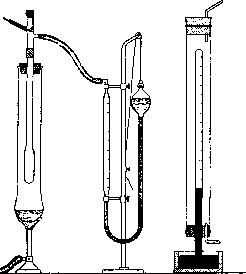
Figure 1.
Fig. 2.
decrease, which indicates their dissociation into atoms. The densities of metal vapors correspond to monatomic molecules, whereas the molecules of phosphorus, sulfur, and arsenic vapors contain more than two atoms and, with increasing temperature, break down into simpler molecules. Thus, sulfur at 500° is hexatomic (S6), and at 800° its molecules break down into S2. The determination of the molecular weight of dissolved substances is based on the application of gas laws to solutions. As shown by van't Hoff, for a dissolved substance one can write the same equation of state as for a gas under similar conditions, i.e., pv = nRT, where p is the osmotic pressure, i.e., the pressure exerted by the dissolved substance on a semipermeable partition. Extending Avogadro's law to solutions, van't Hoff showed that osmotic pressure, just like gas pressure, does not depend on the nature of the dissolved substance but only on the number of dissolved molecules, and is equal to the pressure that the substance would have if it were in a gaseous state under corresponding conditions. Consequently, if one gram-molecule of a substance is dissolved in one liter, the osmotic pressure will be equal to 22.41 atmospheres at 0° and 22.41 (1+at) atmospheres at t°. Thus, the measurement of osmotic pressure leads to the direct determination of the molecular weight of the dissolved substance. However, direct measurements of osmotic pressure are associated with great difficulties. Science is indebted to Raoult for the development of indirect methods for determining osmotic pressure, and consequently also the molecular weight of dissolved substances (see Cryoscopy). The following relationship exists between molecular weight and the depression of the freezing point or the elevation of the boiling point of a solution, expressed by the equation M=C·G/Δt, where G is the weight of the substance dissolved in 100 g of solvent, Δt is the depression of the freezing point or elevation of the boiling point, and C is a constant found empirically by Raoult, the so-called 'molecular depression' of the freezing point or 'molecular elevation' of the boiling point, a quantity related to the latent heat of fusion or vaporization by the equation C=q/T, where T is the absolute temperature of freezing (or boiling) of the pure solvent, and q is the latent heat of fusion or vaporization per 1 gram of solvent. For water, the molecular depression is 18.6, and the molecular elevation is 5.15. A large number of apparatuses have been proposed for measuring the depression of t° freezing or elevation of t° boiling, which are in principle identical. The most commonly used are Beckmann's apparatuses (see). The cryoscopic method is essentially possible only for such solutions in which only the solvent freezes, not the solution. However, when working with very dilute solutions, the Beckmann thermometer is replaced by a set of thermocouples connected to a sensitive galvanometer, which allows measurement of t° to 0.00001 of a degree. - The measurement of the molecular weight of dissolved substances has led to conclusions of important theoretical significance. Thus, by deviation from the above formulas, on the one hand the fact of electrolytic dissociation for electrolytes was established, and on the other hand the association of the dissolved substance, as well as its hydration or solvation, i.e., the combination of molecules of the dissolved substance with molecules of the solvent. It should be emphasized that the molecular weight determined by the above methods refers only to the dissolved state, and on the basis of ebullioscopic or cryoscopic data, no conclusions can be drawn about the molecular weight of substances in their pure state. Turning to the molecular weight of compressed gases and liquids, it should be noted that to this day there is no completely perfect and accurate method for their determination. Deviations from the theory observed for compressed gases and liquids give only indirect indication that we are dealing here with altered molecules. For example, according to Trouton's rule, the ratio of the molecular heat of vaporization to the absolute boiling temperature of a liquid is a constant value = C. The value C according to the II law of thermodynamics is related to the vapor pressure of the liquid by the differential equation dT/T = dq/L. Thus, by measuring the latent heat of vaporization, we have in our hands a method for determining the molecular weight of liquid substances, since L = M·l, where l is the latent heat of vaporization of 1 gram of the substance. However, Trouton's rule does not have universal value and is valid only for a small number of liquids, whereas for most of them the ratio L/T has its own special value, which alone indicates a difference in molecular weight in the liquid and gaseous states and significant association of liquids. More definite results are given by the method based on Eötvös' formula, expressing the relationship between molecular weight and surface tension γv2/3 = k(Tc - T), where γ is the surface tension expressed in dynes per cm, v is the molecular volume (=molecular weight × specific volume), Tc is the critical temperature, T is the temperature of the experiment, k is a constant independent of temperature, equal on average to 2.12. But in this case as well, for not all liquids does the coefficient k prove to be independent of t°. It is assumed that substances having a normal coefficient (not changing with t°) have in the liquid state a molecular weight equal to the molecular weight of the vapor. Liquids with a coefficient that changes with t° are called associated. Their molecular weight is obtained by multiplying the molecular weight of the gas by the so-called 'association factor,' which is calculated from the ratio of the normal constant to the value obtained experimentally. Alcohols, fatty acids, phenol, and water (with an association factor of 4) belong to the associated liquids. As for the molecular weight of solids, all the simplest particles of the crystal are so closely connected with each other that the movement of one causes the movement of the entire crystal as a whole. According to the latest views on crystal structure, atoms in crystals are held by the same forces as atoms in individual gas molecules, i.e., chemical forces, therefore we can consider the entire crystal as one molecule and take its weight as its molecular weight. At the present time, the absolute value of Avogadro's number, i.e., the number of molecules in a gram-molecular volume (22.41 liters at 0° and 760 mm pressure), has been established by a number of independent methods. It is equal on average from various determinations to 6.06×10²³. From this it is easy to calculate the absolute weight of a hydrogen atom. It turns out to be equal to 1.66×10⁻²⁴ g. Multiplying this number by the relative molecular weight of the substance, we find the absolute weight of its molecule.
L. Lepin. N. Shilov.
Related articles
Mentioned in
Cite this page
“Molecular Weight.” Soviet Medical Encyclopedia. English translation of Bolshaya Meditsinskaya Entsiklopediya, 1st ed. (Moscow, 1928–1936), ed. N. A. Semashko. https://sovietmedicalencyclopedia.pages.dev/article/molecular-weight/