Beckmann Apparatus
Historical document, translated for reference. It reflects medical knowledge of the 1920s–30s and is not medical advice.
Summary
This article describes the laboratory instruments designed by Ernst Beckmann for cryoscopy and ebullioscopy. It details the setup for measuring freezing point depression and boiling point elevation, as well as the specific design of the Beckmann thermometer used for precise temperature difference measurements.
Encyclopedia article (1928–1936)
BECKMANN APPARATUS (Beckmann). The Beckmann apparatus for determining the freezing point, i.e., for cryoscopy (see), consists (see Figure 1) of a test tube A with a side tube, which is inserted halfway into a wider tube B, serving as an air jacket for it. The apparatus is inserted into the lid of a thick-walled beaker C, which contains a cooling mixture having a temperature 1-2° lower than the freezing point of the liquid under investigation. A Beckmann thermometer (see below) and a stirrer are inserted into tube A.
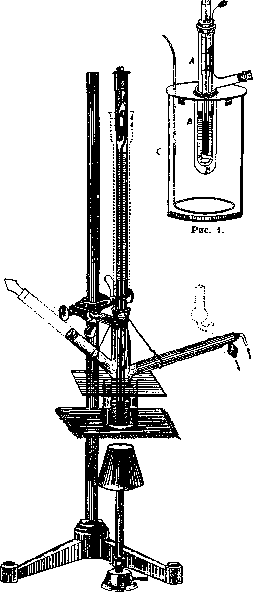
Figure 2.
The test tube A, with a weighed amount of solvent in it, is immersed directly without the jacket into the cooling mixture and, with slow stirring, the solvent is allowed to supercool. After quickly drying the outside of test tube A, it is transferred into the jacket B, which remains in the beaker C the entire time, and by rapid stirring, the solvent is allowed to freeze, thus determining its freezing point. After thawing, the substance under investigation is introduced in a specific amount through the opening of tube A, allowed to dissolve, and the freezing point of the resulting solution is determined. The difference between both readings will be the lowering of the freezing point of the solution (depression). The Beckmann apparatus for determining the elevation of the boiling point of a solution (ebullioscopy, see) consists (see Figure 2) of a vessel into which a Beckmann thermometer is inserted; the vessel has two side openings: one for a condenser and the other for introducing the substance under investigation. This vessel is placed on a copper mesh and surrounded by a glass cylinder, which serves as its air jacket. Around the latter, a sheet of asbestos is placed on the mesh; a similar sheet of asbestos is also placed on top of the cylinder—both sheets serve to prevent the heat current from reaching the thermometer directly from the burner. A weighed amount of solvent and glass beads (for uniform boiling) are placed in the vessel, and its boiling point is determined; it is then cooled, the substance under investigation is introduced, dissolved, and the boiling point of the solution is determined. The difference between the observed values will be the "boiling point elevation." Beckmann thermometer. In cryoscopy and ebullioscopy, it is necessary to measure temperature with an accuracy of up to a few thousandths of a degree, and the scale of the thermometer must be divided into hundredths of a degree. In order to be able to make readings in various temperature intervals without excessively lengthening the thermometer scale and by managing with a single instrument rather than a set of them, Beckmann designed a thermometer (see Figure 3) that allows for work within wide temperature ranges. In this case, the thermometer serves not for determining an absolute temperature, but for measuring the difference between two temperatures (e.g., the freezing point of a pure solvent and a solution). A feature of the thermometer is the expansion 'a' at the end of the capillary, which serves as a reservoir into which an excess amount of mercury can be transferred. To do this, the bulb of the thermometer is immersed in a bath whose temperature is 2-3° higher than that at which one intends to begin the measurement. A portion of the mercury will pass into reservoir 'a'. After removing the thermometer from the bath, the mercury thread is broken at the very top of the capillary with a short shake, after which the thermometer can be used. The reverse transfer of mercury from the reservoir into the capillary is achieved by inverting the thermometer and shaking it lightly. By carefully heating the thermometer, the mercury columns are allowed to join together and are then cooled slowly. In this process, the column does not break, and the mercury passes from the reservoir back into the capillary.
Related articles
Mentioned in
Cite this page
“Beckmann Apparatus.” Soviet Medical Encyclopedia. English translation of Bolshaya Meditsinskaya Entsiklopediya, 1st ed. (Moscow, 1928–1936), ed. N. A. Semashko. https://sovietmedicalencyclopedia.pages.dev/article/beckmann-apparatus/