Beck's Disease
Historical document, translated for reference. It reflects medical knowledge of the 1920s–30s and is not medical advice.
Summary
Beck's Disease is an endemic condition affecting residents of eastern Transbaikalia, characterized by joint deformities, particularly in the hands and elbows. The disease is associated with drinking water from certain sources and shows no evidence of contagion.
Encyclopedia article (1928–1936)
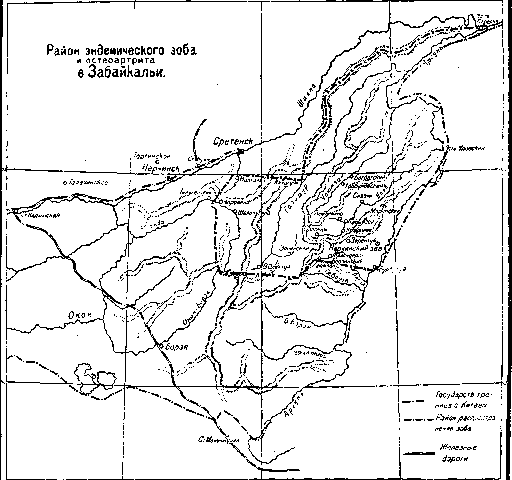
BECK'S DISEASE, a unique endemic disease prevalent among residents of eastern Transbaikalia (between the Shilka and Argun rivers, along the courses of the Urov, Uryumkan, Gazimur, Middle and Lower Borzy, and Unda rivers). The disease has the local name "Urovskaya Disease". It was first noted by N. I. Kashin in 1856 in his report "Description of Endemic and Other Prevalent Diseases in Urov". The disease was thoroughly studied and described by E. V. Beck (1865-1915), who conducted a complete examination of 3,153 people in 11 villages in 1899-1902, together with his wife, physician A. N. Bek. The results of the examination and the detailed clinical picture of the disease are presented in his dissertation "On the Question of Osteoarthritis Deformans Endemica in the Transbaikal Region", in which he reached the following conclusions: 1. In the Transbaikal region, between the Argun River and the Nerchinsk Ridge, there exists an endemic disease that manifests clinically (see Figure 1): thickening of the epiphyses, crepitus and limited mobility in the joints of the extremities, enlargement of the apophyses and crests; in some patients - short stature (9%), brachydactyly (18%), lordosis (1.4%), lateral deviation of the fingers. 2. The interphalangeal (see Figure 2) and elbow joints are most frequently affected, followed by the knee, wrist, ankle, hip, and shoulder joints. The condition is usually polyarticular and almost always symmetrical. The tissues surrounding the joints do not participate in the process. 3. The onset of the disease most often occurs between the ages of 8 and 15-20 years. Heavy labor during childhood and youth apparently predisposes to the disease. No correlation with nutrition was found. 4. Beck's disease develops insidiously (without general malaise and local inflammatory phenomena). Patients often complain only of fatigue and aching pains in the joints and muscles after work. 5. Radiographically detected: abnormal transparency, as if rarefaction of the epiphyses, their flattening in places of pressure from body weight, stretching of the apophyses and crests in the direction of action of strong muscles. The diaphyses show no visible changes. 6. Anthropological examination of six patients revealed: insignificant anomalies in the structure of the skull, good development of the chest cavity, relatively weak development of the lower extremities, short stature, some degenerative signs. 7. The neuropsychic sphere shows no sharp deviations from normal. In some patients, atrophy of individual muscles without reaction of degeneration is noted. 8. Sex, as a predisposing factor, apparently plays no role. 9. Heredity, if it plays a role, only in areas with endemicity. 10. The cause of the disease lies in some properties of drinking water, but it does not have a contagious nature. When moving to a healthy area, the patient does not serve as a source of spread of the disease, and the disease itself in him stops. The harmfulness of water is evidenced by the fact of unequal morbidity among residents of the same village who drink water from different sources: in s. Zolinskoye 33% of patients among those taking water from the river and 3.4% among those drinking from springs. Similar data were obtained in s. Bogdatskoye: 6.5% of patients among those drinking water from the Uryumkan River, 23.3% mixed water, 34.5% from springs and the Bogdati River. 11. The harmful agent may act directly through the blood or through the corresponding parts of the nervous system or through the thyroid gland. The influence of the thyroid gland is evidenced by the fact that in most villages, along with joint deformity, goiter is observed; but no definite connection with goiter was found. In 1910, I. A. Bagashev investigated the radioactivity of drinking water in the endemic area. Radioactivity in this area is generally very high - up to 290 Mach units in mineral springs and up to 10-20 Mach units in fresh water. In some villages, a connection between increased radioactivity and harmful sources was found, but this question remains open to this day. In 1924, N. L. Sakovich determined the number of patients with osteoarthritis to be 7-10 thousand. L. O. Dobrovolsky indicates various variations in the course of the disease process and cites a number of cases where, according to the anamnesis, the disease began with acute phenomena, often following some infectious disease: typhus, smallpox, scarlet fever, etc. Observations of 5 patients placed in the Chita hospital revealed in all cases: RW negative, lymphocytosis in the blood. Examination of drinking water in 15 villages showed a large amount of organic substances. At Irkutsk University, a commission for the study of Beck's disease has existed since 1925. The members of the commission go to the endemic focus every summer, working in the field of patho-anatomical research, anthropometry, blood research, etc. The State Microbiological Institute of the People's Commissariat of Health has been conducting research in the field of etiology since 1925 and accepts the infectious theory of the origin of Beck's disease. From the clinical side, B. d., in addition to the above, can be characterized, according to the latest (after E. V. Beck) observations, as follows: pain in the joints during movement, limitation of mobility in the affected joints up to ankylosis and complete immobility. Radiographically, a violation of the architecture of the trabeculae is detected. Upon opening the joints - atrophy of the cartilage cover, its disappearance, formation of rice-like bodies. In addition to external manifestations from the joints, in a greater or lesser number of patients, the following are noted: 1) endo-, peri-, and myocarditis, 2) senium praecox, 3) hypertrophy of the lymphatic apparatus, etc. In most cases, B. d. begins with an arthralgic stage (pain in the joints, their swelling, general malaise, sometimes an increase in temperature to 38°); subsequently, the disease proceeds chronically, without fever and is expressed in the progressive deformation of the joints. The duration of the development of the disease is 6-8 years; however, the disease can stop at any stage. According to many researchers, the basis of Figure 3. Map of distribution of the disease is multiple lesions of the endocrine glands. Dysfunction of the endocrine glands leads to disruption of biochemical processes in the spongy ends of bones, as a result of which deformation of the articular surfaces occurs. Some authors allow for primary lesions of the joints by a pathogenic agent. The etiology of the disease has not yet been clarified. Some researchers tend to consider the cause of B. d. to be certain mineral or metallic (mercury, lead) components of water in the water sources of the B. d. area. Others assume the existence of a whole range of unfavorable factors (sanitary, bio-social, climatic, etc.) that disrupt nutrition and give very diverse manifestations of the disease. Experimental studies conducted at the Microbiological Institute of the NKZdrav established that water taken from sources in the area of distribution of B. d. contains in its composition a certain agent capable of causing in animals characteristic of B. d. changes in the joints. This agent is destroyed by boiling, as well as when storing water at room temperature for 3 months. The experimental disease in rabbits can be maintained by passing blood from a sick rabbit to a healthy one. These experiments speak to a certain extent in favor of the living nature of the agent causing B. d. - The distribution of B. d. is limited to the above-mentioned geographical boundaries (see Figure 3); however, the endemicity undoubtedly has a tendency to capture new areas. B. d. spreads along the river courses, with different parts of the same villages differing sharply in the percentage of morbidity depending on different conditions of drinking water supply. Organic pollution of water sources plays a significant role in the development of the endemicity. The epidemiological features of B. d. give certain grounds to assume its infectious nature. Resettlement of the sick to areas free from endemicity, as well as cessation of the use of poor-quality water sources, lead to a halt in the development of the disease. The number of patients with polyarthritis, according to E. V. Beck, out of 3,153 people examined was 1,008, i.e. 32%, with the percentage of patients in individual villages ranging from 6.5 to 16.5. According to Sakovich's data, in 59 villages of the Nerchinsk plant area out of 31,652 inhabitants (16,458 people examined), there were 5,538 patients with B. d. (from 3 to 70%). A new area has been added - the basin of the Unda River. The morbidity in the settlements examined by E. V. Beck increased over 25 years from 3 to 37% and from 33 to 54% (Zola village). All tried methods of treatment have no effect on the course of B. d., with the possible exception of mineral radioactive baths at the Yamkun resort. Undoubtedly, preventive measures carried out by the People's Commissariat of Health in the form of an experiment and aimed primarily at improving the rural drinking water supply of affected villages are beneficial.
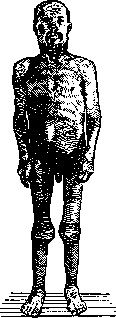
Figure 1.

Figure 2.
»8-
'££>
The distribution of B. d. is limited to the above-mentioned geographical boundaries (see Figure 3); however, the endemicity undoubtedly has a tendency to capture new areas. B. d. spreads along the river courses, with different parts of the same villages differing sharply in the percentage of morbidity depending on different conditions of drinking water supply. Organic pollution of water sources plays a significant role in the development of the endemicity. The epidemiological features of B. d. give certain grounds to assume its infectious nature. Resettlement of the sick to areas free from endemicity, as well as cessation of the use of poor-quality water sources, lead to a halt in the development of the disease. The number of patients with polyarthritis, according to E. V. Beck, out of 3,153 people examined was 1,008, i.e. 32%, with the percentage of patients in individual villages ranging from 6.5 to 16.5. According to Sakovich's data, in 59 villages of the Nerchinsk plant area out of 31,652 inhabitants (16,458 people examined), there were 5,538 patients with B. d. (from 3 to 70%). A new area has been added - the basin of the Unda River. The morbidity in the settlements examined by E. V. Beck increased over 25 years from 3 to 37% and from 33 to 54% (Zola village). All tried methods of treatment have no effect on the course of B. d., with the possible exception of mineral radioactive baths at the Yamkun resort. Undoubtedly, preventive measures carried out by the People's Commissariat of Health in the form of an experiment and aimed primarily at improving the rural drinking water supply of affected villages are beneficial.
Figure 3. Map of distribution of the disease.
Related articles
Mentioned in
Cite this page
“Beck's Disease.” Soviet Medical Encyclopedia. English translation of Bolshaya Meditsinskaya Entsiklopediya, 1st ed. (Moscow, 1928–1936), ed. N. A. Semashko. https://sovietmedicalencyclopedia.pages.dev/article/becks-disease/