Lordosis
Historical document, translated for reference. It reflects medical knowledge of the 1920s–30s and is not medical advice.
Summary
Lordosis refers to an abnormal inward curvature of the spine. This article discusses the normal development of spinal curvatures in humans, variations in posture, and pathological causes of lordosis including congenital anomalies, trauma, poliomyelitis, muscular paralysis, and rickets.
Encyclopedia article (1928–1936)
Lordosis, lordosis, is a backward curvature of the spine. Within certain limits, corresponding to the level, degree, and form of this curvature, lordosis is a normal curve of the spinal column. In the human embryo, due to the more intensive growth of the neural tube and surrounding parts of the trunk, the body on the 3rd month has a continuous convexity backward (Fig. 1a). Later, with the development of the occipital muscles, within this continuous kyphosis, a primary cervical lordosis forms. Then, still in the prenatal period, in connection with the formation of the pelvic ring and due to the fact that on one hand the weight of the abdominal viscera increases, and on the other hand the lumbo-sacral muscles strengthen, a sacro-lumbar lordosis arises. Thus, already in the spinal column of a newborn, the four main curvatures are weakly but distinctly expressed: cervical and lumbo-sacral lordosis, thoracic and sacral kyphosis (Fig. 16). A backward curvature or S-shaped curvature of the cervical region is also found in birds, the only animals that, like humans, walk on two legs. However, the lumbar lordosis, the supra-sacral curvature forming the anterior promontory, and the sacral kyphosis are characteristic exclusively of humans and are genotypic adaptations of the morphology of the spinal column to the function of upright standing and body movement. An innate S-shaped curvature of the spine develops further in childhood, but is finally fixed in various phenotypic forms and degrees only after the growth period is completed (Fig. 1c). When a child begins to sit, at first the angle of inclination of the pelvis hardly decreases, i.e., the pubis does not rise upward, reclination. The curvature of the promontory is weakly expressed, and the trunk is established in a continuous kyphotic curve. Then, due to exercise of the muscles that raise the head for orthoptic direction of the visual axes, and due to the development of the dynamic function of the upper extremities, the cervical lordosis forms and the thoracic kyphosis flattens. Somewhat later, through active balancing of the trunk over the pelvis, the lumbo-sacral lordosis is developed and intensified. After a year, when the child not only stands but walks independently, all these arcuate curvatures of the spine acquire a more lordotic character.
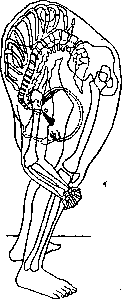
Figure 3.
In the habitual posture of an adult, excluding pathological factors, the cervical and lumbar lordosis are distinctly expressed. The depth of each varies within quite wide limits even in completely healthy people. One can consider the average norm to be that the radius of the cervical curvature is less than the lumbar, yielding to it by a maximum of 3-4 cm, but the lack of proportionality in the depth of the curves alone is not proof of disturbed statics. Posture is determined by hereditary constitutional factors, varies according to age and sex, and changes under the influence of professional-domestic factors. For an adult male, two postures can be recognized as basic: a completely straightened one and a weakened one. In the first, a plumb line dropped from the ear lies in the same frontal plane as the trajectory from the center of gravity of the entire supra-coxal mass of the body and as the lines connecting the centers of rotation of both hip, knee, and ankle joints. In the second (flaccid) posture, the pelvis is thrust forward from the trajectory of gravity of the overlying segment of the body, the pubis stands higher, the lumbar lordosis is deepened over the sacrum, flattened upward, and the thoracic section of the spine is more protruding backward. A variant of the first posture will be further flattening of the cervical lordosis and thoracic kyphosis, characteristic of military bearing, if the lumbar lordosis is simultaneously strengthened, or of the flat back of adolescents, porters of heavy loads on the head, and tailors—if the lumbar lordosis is moderately smoothed. A variant of the second posture is low standing and backward displacement of the pubis with a sharply expressed waviness of the profile of the back due to shortening of the radii of the lumbar lordosis, thoracic kyphosis, and cervical lordosis. Both variants do not reduce the working capacity of the individual. Generally, the S-shaped curvature of the spine has enormous significance for the statics and dynamics of the entire body. The column is transformed into a continuous spring, mechanically counteracting compression and tension in any, and not only in the longitudinal, direction. The spring function of the spring softens jolts when walking, especially when descending, and even more so when falling, facilitates climbing a mountain and significantly speeds up running and jumping. The great dynamic work of the spine is vividly evidenced by the excessive distribution of muscles at the level of the cervical and lumbo-sacral lordosis.
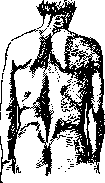
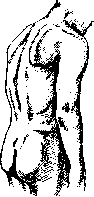
Figure 4.
Figure 5.
Pathological lordosis can be abnormal in degree or in localization of the curvature. Primary lordosis. A completely concave back as a constitutional developmental anomaly is rare and usually not in a severe form. Localized excessive lordosis is more often observed, when the depth of concavity exceeds 5-6 cm. However, the most common developmental defect should be considered the reduction of normal lordosis. If both lordoses (cervical and lumbar) disappear, there is a round back. If only the cervical lordosis is absent and the lumbar is deepened, one speaks of a convex-concave back. The first form progresses and requires treatment, the second can be stable. Secondary, or acquired lordosis are also abnormal due to too great or too small a curvature of the arc. Judgment about the degree of curvature based on a contour line drawn along the spinous processes is far from exact. In the cervical part, this line is more curved than the curvature of the anterior surface of the vertebral bodies. In the thoracic section, on the contrary, the ventral profile is more concave than the dorsal. The discrepancy is sharpest in the lumbar section: the apices of the spinous processes can lie almost on a straight line, while the vertebral bodies form a strongly convex forward arc. One should consider a case of lordosis pathological only on the basis of functional testing with research of the range and smoothness of movements. In Fig. 2, the possible excursions without muscular inhibition are depicted, and Fig. 3 shows what can be achieved through acrobatic exercises. It is seen, however, that even with such extreme lordosis of the vertebral chain, the thoracic kyphosis is not completely smoothed. The altered lumbar lordosis, deepened or, conversely, smoothed and lengthened, upward but depressed over the sacrum, is an objective sign of very frequent disorders known under the name of traumatic and rheumatic 'sciatica' (Fig. 4). Chronic professional trauma in workers who subject their spine to prolonged, excessive inclination load also over time change the profile of the back, bending it into a kyphotic curve with a low pelvic lordosis (Fig. 5).
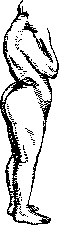
Figure 6.
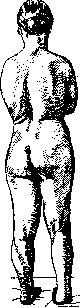
Figure 7.
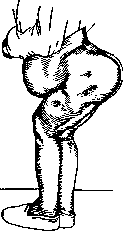
Figure 8.
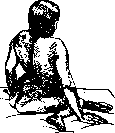
Figure 9.
The most frequent congenital anomalies of the legs—hip dislocation (Fig. 6) and clubfoot (Fig. 7)—cause lordosis due to disturbance of statics. In dislocation, the pelvis lacks normal support from below and is tilted forward. In clubfoot, there is lack of plantar support, the knees are hyperextended, the pelvis is tilted forward, and the trunk is thrown backward with a supra-sacral lordosis. In flexion contractures of the hip joint, the angle and limitation of mobility between the trunk and the leg are compensated by reverse curvature and greater swinging within the spinal column itself (Fig. 8). Especially severe forms of lordosis arise on a poliomyelitic basis (Fig. 9). If the erectors of the back are paralyzed, patients compensate for their action by mechanical influence of lordosis, i.e., by the force of gravity of the trunk tilted backward, regulating this passive force by active contraction of the straight and oblique abdominal muscles. Lordosis reaches degrees no less severe in paralysis of the abdominal muscles. Then, by contraction of m. ileo-psoas and tensor fasciae latae, the lumbar section of the spine together with the pelvis tilts forward and downward, the lordosis upward extends to the thoracic section and further passes into a steep convexity of kyphosis, strengthened by the weight of the head thrust forward. Thus, in both cases, equilibrium is established and maintained by the tone of the remaining muscles on one side and displacement of the trajectory of gravity to the other side. Therefore, one of the early signs of progressive muscular dystrophy (such as) is lordosis. In the origin of rachitic lordosis (Fig. 10), the main role is played by static-dynamic disturbances caused by curvature of the legs, flattening and lowering of the pelvis
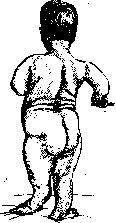
Figure 10.
of the ring, hypotonia of the muscles, and increased weight of an overweight child. Among the variety of scoliotic deformities of the spine, lordosis in combination with torsion (lordoscoliosis) is a common phenomenon in early and late cases, and is unfavorable in a prognostic sense (Figure 11). The pain syndrome and the atypical positions of the spine caused by it form the basis of the characteristic lordosis observed in sciatica and radiculitis (Fig. 12). Destructive changes in the spine due to infection or trauma lead to lordosis of abnormal form or abnormal localization. Tuberculosis, affecting the concave parts of the spine (Figure 13), can for a long time proceed in the form of a limited, fixed lordosis. More often, lordosis in spondylitises is formed above and below the hump as a compensation for kyphosis. The adaptive power of the organism is so great that a cervical hump is balanced by the disappearance of the normal thoracic kyphosis, up to its transformation into lordosis. Too intensive and prolonged traction treatment, while curing tuberculosis, can create a lordosis that prevents vertical standing (G. I. Turner). Another danger
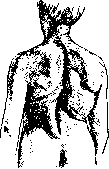
Figure 11.
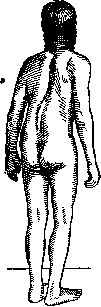
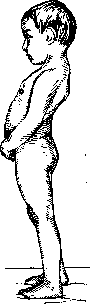
Figure 12.
Figure 13. of excessive lordosis lies in the so-called orthostatic albuminuria. A frequent developmental defect - the congenital absence of the bony fusion of the articular parts of the arch of L5 - under the influence of acute or chronic traumatic injuries leads to distortions of the sacro-lumbar joints, to rotational displacements, and to slipping of L5 (see Spondylolisthesis) with a characteristic step-like lordosis, with shortening of the lumbar region, and with elevation of the pubis. Another category and form of lordosis owes its origin to distortions or diseases of the sacro-iliac joint. In such cases, the sacro-lumbar angle is decreased by the posterior elevation of the sacrum, the lumbar lordosis is flattened, and the statics and especially the dynamics of the trunk and pelvis are disturbed. P. P. Dyakonov believes that on this basis there is a limitation of the respiratory excursions of the chest cavity and a predisposition to emphysema and disorders of cardiac activity. Undoubtedly, the question of occupational hazards of various types of standing work is closely connected with a more detailed study of the pathophysiology of lordosis.
Related articles
Mentioned in
Cite this page
“Lordosis.” Soviet Medical Encyclopedia. English translation of Bolshaya Meditsinskaya Entsiklopediya, 1st ed. (Moscow, 1928–1936), ed. N. A. Semashko. https://sovietmedicalencyclopedia.pages.dev/article/lordosis/