König Operation
Historical document, translated for reference. It reflects medical knowledge of the 1920s–30s and is not medical advice.
Summary
This article from the 1928–1936 Soviet Great Medical Encyclopedia describes the König operation, a surgical technique for creating a bone shelf over the femoral head in congenital and paralytic hip dislocations. It details the original procedure proposed by König, subsequent modifications by Albee and Lance, as well as indications and functional outcomes.
Encyclopedia article (1928–1936)
KÖNIG OPERATION (König) consists of creating a shelf over the femoral head in congenital and paralytic hip dislocations. König first put forward this idea at the 20th Congress of German Surgeons. In the author's original presentation, the operation to create a shelf is performed as follows: an arc-shaped skin incision is made; after dissecting the muscles, a bone-periosteal flap is carved out of the ilium with a chisel, which is turned downward and sutured to the capsule (Fig. 1). According to the author's idea, this flap should serve as an obstacle to the upward displacement of the luxated head during walking. Before the operation and in the postoperative period, König used traction to lower the head as much as possible. König found the immediate results satisfactory, but there is no long-term follow-up because both female patients operated on by him died shortly after from accidental infections. Although the author himself subsequently preferred other methods of surgical treatment for congenital dislocations, the idea of the operation, with significant changes in its technical aspect, penetrated the environment of surgeons and orthopedists again a few years later.
Since it is known that in paralytic dislocations the cause lies not only in the underdevelopment of the shallow acetabulum, but also in the relaxed capsule (loss of tone), it turns the operation into an intra-articular intervention, increasing the risk of the operation. Close in idea to König's operation are the methods of Albee and Lance. Albee in 1915, in cases of paralytic dislocations, also used a plastic method of creating a shelf, strengthening its base with the help of an autograft.
Good results are also given by the technically complex method of creating an artificial shelf according to Lance (Fig. 2). The head is preliminarily reduced, and the leg is placed in the Lorenz position. By Sprengel's incision, the tensor fasciae latae and the rectus femoris muscles are retracted anteriorly, and the tensor fasciae and the anterior part of the gluteus muscle are detached from the ilium. The capsule is exposed in the depth. With a wide trough-shaped chisel, a depression is made above the upper edge of the acetabulum, which curves in a half-moon shape around the site of attachment of the capsule to the acetabulum, and the joint is not opened. After creating a deep groove, the dissected part of the ilium is broken off downward with a thick chisel, and bone plates taken from the tibia are firmly hammered into the resulting groove. These plates do not require special fixation. Sutures on the muscles, a plaster cast in 90° abduction and 45° flexion at the knee. Wreden also uses an angular incision, creating a bone-periosteal shelf in a fan-like manner without opening the joint. Indications for the operation according to König's idea are as follows: paralytic dislocations, some congenital and pathological ones. It is most indicated in paralytic and some irreducible congenital dislocations, where there is no lordosis and where the displacement of the hip along the axis is sharply expressed. The operation is less indicated in pathological dislocations. The operation achieves good stability while maintaining mobility in the joint in paralytic dislocations, and in congenital dislocations
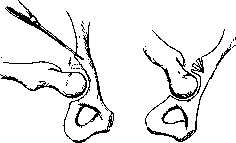
Figure 2.
Trendelenburg's sign is eliminated. Limb shortening is compensated to a certain extent if traction is applied preliminarily (as Dickson does) or reduction of the paralytic dislocation is performed. The König operation as an extra-articular intervention can well compete with open reduction of the hip in terms of lesser danger and favorable functional outcome.
Related articles
Cite this page
“König Operation.” Soviet Medical Encyclopedia. English translation of Bolshaya Meditsinskaya Entsiklopediya, 1st ed. (Moscow, 1928–1936), ed. N. A. Semashko. https://sovietmedicalencyclopedia.pages.dev/article/konig-operation/