CORSETS
Historical document, translated for reference. It reflects medical knowledge of the 1920s–30s and is not medical advice.
Summary
Corsets are orthopedic devices used for fixing the spine in a required position for treatment or consolidating results achieved by other methods. They can be made from various materials and are used for conditions like scoliosis, spinal fractures, and other spinal deformities.
Encyclopedia article (1928–1936)
CORSETS, orthopedic appliances prescribed for both diseases and curvatures of the spine. The purpose of a corset is to fix the spine in the position required for treatment or to complete (consolidate) the results achieved by other methods. With the help of corsets, in addition to fixation, partial unloading of the spine can also be achieved. Orthopedic corsets are all removable, unlike plaster corsets, which are not removable. Prescription of orthopedic corsets should be made after treatment has been completed, or when treatment cannot be applied. Corsets are made from various materials: wood shavings, liquid glass, aluminum, celluloid, enamel, gelatin glue, leather, and soft material (cotton, canvas), etc. When corsets are made of leather or soft material, steel or aluminum splints are additionally used. The most commonly used corsets are leather, fabric, and enamel corsets. Gelatin corsets are less expensive. Making leather and fabric corsets requires experienced orthopedic craftsmen; other types can be made by the resources of hospitals and clinics themselves. When starting to make a corset, it is necessary to have precise instructions as to which part of the spine it should serve, and what purpose the prescribed corset aims to achieve: fixation, unloading, or correction. The corset must be properly made and well-fitted. The corset is made from a plaster cast. A plaster cast (negative) is taken from the patient in the position of reclination, in a special Engelmann apparatus, by suspending the patient by the head or by the hands; when suspended, the patient must necessarily rest on the entire foot. The points of support—the pelvic bones (crests) and the lower rib arcs—must be carefully molded. From the negative, a positive is made, and from it the corset is made. During the making of the corset, fitting is necessary in standing, lying, and sitting positions. The corset must be put on in a lying position. Inside, the corset is lined with suede or some soft material. At the points of support, between the skin and the suede, a soft padding is made. The skin together with the padding is perforated for air circulation. The dimensions of the corset must strictly correspond to the dimensions of the torso. The act of breathing, as well as the organs of the abdominal cavity, should not be restricted by the corset. Movement of the legs, especially abduction, should not be hindered. The underarm crutches should not lift the shoulders and thereby exert pressure on the axillary vessels and nerves, since the purpose of the crutches is not active traction, but unloading and holding the torso in a reclined position. Many designs of corsets have been proposed. In diseases of the sacral, lumbar vertebrae, in spina bifida, in spondylolisthesis, and in other diseases of the lower end of the spine, a supportive corset is made, consisting of a leather or fabric case and metal splints or enamel (Fig. 1).


Figure 1.
Figure 2. In diseases of the upper lumbar and lower thoracic vertebrae, crutches are added to the supportive corset, consisting of a pelotte and a upright. The crutches run parallel to the axillary fossa forward, bypass the pectoral muscle, rise at the top to the level of the shoulder joint, and are pressed by the pelotte to the chest (Fig. 2). In diseases of the upper thoracic vertebrae, a supportive corset without crutches is made, which are replaced by a head holder. The latter consists of two arches, one of which embraces the lower jaw, the other—the back of the head, and both are connected to each other by means of screws. The head holder is fixed to the supportive corset (Fig. 3). Suspension of the head can also be achieved by means of a Glisson's loop, suspended from a hook fixed to the corset (Fig. 4). In cases of disease of the cervical vertebrae, the nature of the disease must be taken into account. If there are inflammatory diseases of the vertebrae, tuberculosis, osteomyelitis, fractures, then it is necessary to make a corset for the entire torso as well, with a head holder or collar. In other cases—with torticollis, paresis of individual groups of neck muscles—one can be limited to just a collar.
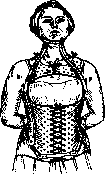

Figure 3.
Figure 4. The question of using corsets in scoliosis is unresolved, since it is not possible to achieve stable retention of the spine and ribs in the desired position with a corset alone. In scoliosis of a mild degree, a corset is used only in cases where the patient cannot undergo orthopedic treatment or it is insufficient. In severe cases of scoliosis, when intercostal pains appear and there is a large curvature, a supportive corset successfully alleviates the patient's condition and prevents further deformities. In some cases, a corset is prescribed for cosmetic purposes, and with constant wearing of it, sometimes even in severe cases, an improvement in the configuration of the chest is observed. The use of corsets in scoliosis should be associated with extensive use of mechanotherapy. The Gessing corset (Fig. 5) with a steel frame is widely used in scoliosis. The corset is equipped with elastic straps, or springing pelottes, which influence the deformation in a corrective manner. The application and direction of these straps in each individual case must be carefully considered, so as not to get negative results (increase in the rib hump) instead of the expected positive ones.
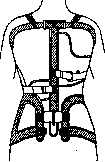
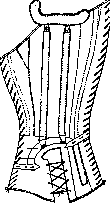
Figure 5.
Figure 6. A soft fabric corset does not interfere with breathing, the development of the body and musculature. Figure 6 shows a simple type of Schanz corset with a pelotte for the protruding part of the chest. In the use of corsets, the principle of individualization must be followed both in the choice of materials and in the system. The decisive factor in this is the nature of the disease, as well as the period of the disease.
Related articles
Mentioned in
Cite this page
“CORSETS.” Soviet Medical Encyclopedia. English translation of Bolshaya Meditsinskaya Entsiklopediya, 1st ed. (Moscow, 1928–1936), ed. N. A. Semashko. https://sovietmedicalencyclopedia.pages.dev/article/corsets/