Visceral Reflexes
Historical document, translated for reference. It reflects medical knowledge of the 1920s–30s and is not medical advice.
Summary
Visceral reflexes are responses originating from internal organs, classified into various types based on the responding organ. These physiological and pathological reflexes can affect multiple organ systems and are particularly important in understanding referred pain and organ interactions.
Encyclopedia article (1928–1936)
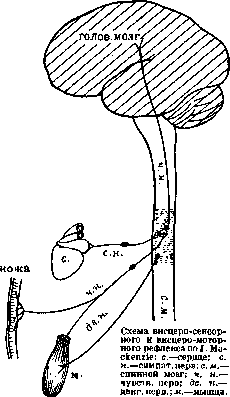
Visceral reflexes arise in internal (visceral) organs. Depending on which organ or system responds to irritation originating in an internal organ, visceral reflexes are divided into visceral-sensory, visceral-motor, visceral-vasomotor, visceral-secretory, visceral-visceral, and others. The reflex arc proceeds from the irritated organ along autonomic nerves through autonomic nodes and plexuses to the responding organ, to which it approaches either through the cerebrospinal nervous system (via rami communicantes) or, without entering the spinal cord, directly through autonomic pathways. The arc can be very short, for example, the reflex of secretion of digestive juices (visceral-secretory reflex) or movement of the stomach (visceral-motor reflex) when the mucous membrane is irritated by food, and very long, for example, when irritation from a pathological process in the uterus sometimes causes pain in the arm or pain in the kidneys causes pupil dilation. V.-r. are normally physiological, for example, the passage of food causes a series of V.-r. secretory, motor, vasomotor, which collectively carry out the synergistic action of all digestive organs, and pathological, arising from various irritations: acute inflammatory processes, chronic inflammatory conditions, tumors, foreign accidental bodies, stones in organs, displaced 'wandering' organs (prolapsed stomach, intestines, wandering kidney, incorrect position of the uterus), acute and chronic poisonings of various kinds, mechanical irritations (from compression by a corset, bandage), incarcerated hernias, temperature influences (hot water bottles, cold), in short, all kinds of processes and conditions that occur both in normal and especially in pathological states. V.-r. usually manifest together; with strong irritation, there is a tendency to spread to many organs and systems (generalization), for example, with kidney stones (renal colic) there are not only pain and hyperesthesia in the lumbar region, sometimes radiating to the testicles and penis (visceral-sensory reflex), but also vomiting, spasms of the bladder, defense musculaire (visceral-motor reflex), pallor of the face and the whole body (visceral-vasomotor reflex), profuse sweating (visceral-secretory reflex), changes in cardiac activity (visceral-visceral reflex). Visceral-sensory reflex (Mackenzie-perception of painful sensations on the periphery of the body in diseases of internal organs. The mechanism of the visceral-sensory reflex, according to Mackenzie, is as follows (see diagram): irritation transmitted from some internal organ (s.) along the sympathetic nerve (e. i.) to the spinal cord (s. m.), usually strong due to some pathological process, spreads in the corresponding segment of the spinal cord to neighboring nerve centers; if at the same time there is irritation of the nerves going from the skin to the spinal cord, it is perceived by the central nervous system as a painful sensation in the area of branching of the corresponding sensory nerve (ch. p.). Abnormally strong irritations from an internal organ can make the corresponding segment of the spinal cord excessively excitable for a long time (shaded area), which causes hyperalgesic zones in the area of distribution of nerves coming from this segment (see Head zones). Mackenzie explained the localization of pain in angina pectoris, stomach ulcer, etc., by the visceral-sensory reflex. Visceral-visceral reflexes are quite common, i.e., changes in the function of one organ under the influence of irritation of another. Of particular importance in clinical practice are reflexes from organs of the abdominal cavity to the heart and vascular system.
Any kind of irritation of internal organs, if sufficiently intense, causes disturbance of cardiovascular activity. The totality of V.-reflexes creates the general state of health-synesthesia.
K. Monakhov, P. Lukomsky.
Related articles
Mentioned in
Cite this page
“Visceral Reflexes.” Soviet Medical Encyclopedia. English translation of Bolshaya Meditsinskaya Entsiklopediya, 1st ed. (Moscow, 1928–1936), ed. N. A. Semashko. https://sovietmedicalencyclopedia.pages.dev/article/visceral-reflexes/