Litten's Sign
Historical document, translated for reference. It reflects medical knowledge of the 1920s–30s and is not medical advice.
Summary
This article from the 1928-1936 Soviet Great Medical Encyclopedia describes Litten's phenomenon, a clinical sign involving a moving shadow on the chest wall that reflects diaphragmatic excursion. It details the physiological mechanism, examination techniques with specific lighting requirements, and its diagnostic value in pulmonary and pleural diseases such as emphysema, pneumothorax, and pleural adhesions.
Encyclopedia article (1928–1936)
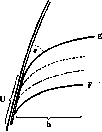
LITTEN'S PHENOMENON (Litten), the diaphragmatic phenomenon of L. (1892), is the visible expression of the gradual peeling away of the diaphragm, which contracts during inspiration, from the chest wall. In this process, its lateral parts, which stand high during expiration (see figure, line E) and adhere tightly to the chest wall, descend and peel away from it (line F).
Due to the negative pressure in the pleural cavity increasing during inspiration, this peeling away of the diaphragm is accompanied by the indrawing of the soft parts of the chest wall—the intercostal spaces—inward, which finds its visible expression in a linear shadow moving from top to bottom. The phenomenon proceeds in the form of a horizontal rectilinear shadow or wave, beginning at the start of inspiration in the anterior axillary and mammary line at the seventh rib and crossing the ribs at an acute angle. During deep breathing, this shadow travels down by 2-3 intercostal spaces (6-7 cm), and during superficial breathing, by 1-11/2 spaces (2-3 cm). The visible shadow in some cases is present along the entire circumference of the chest.
Diagram of diaphragmatic movements. During the expiratory phase (E) the diaphragm stands high, and its lateral parts, adhering firmly to the chest wall, are directed vertically (U), while the central, convex part lies horizontally (fl). During the movement of the diaphragm, the sinus, i.e., the phrenicocostal angle (s), does not change. ...cell; more often it is present only in a limited area in the axillary-mammary region. In this area, the phenomenon is most easily detected in the recumbent position. In the knee-chest position, it is sometimes possible to see this phenomenon on the back. To detect Litten's phenomenon, the patient is placed horizontally on a bed positioned transversely to the wall, which serves as the light source thanks to an existing window: the face is turned toward the light source. To obtain a linear shadow, the rays must be directed obliquely from the window onto the chest, at an acute angle. Hence it is clear that the light source must be located in such a place from which the rays can travel in this direction, i.e., in the direction of the head or lower extremities of the lying patient, but not from the side of him. If the shadow is not obtained, the bed can be turned in a somewhat oblique direction. To reveal the diaphragmatic phenomenon, it is necessary to breathe diaphragmatically and not purely costally. The clinical significance of Litten's phenomenon lies in the fact that it allows one to determine the excursion of the diaphragm and to detect pulmonary emphysema by the reduction of the excursion and the low position of the shadow. The shadow in this case reaches the very costal arch or disappears completely. Litten's phenomenon is of particular importance for detecting unilateral disease that impairs the movement of the diaphragm. The phenomenon is completely absent on one side in empyema, pneumothorax, and very dense, large pleural adhesions. Likewise, it is absent in croupous pneumonia of the lower lobe; in serous exudate, the phenomenon may be preserved, although weakened. With loose adhesions, the phenomenon may not disappear, but is always more or less weakened. In subdiaphragmatic abscess, the phenomenon is often preserved. This is important to know in view of the fact that in this disease dullness may occupy the region of the lower lobe of the lung: Litten's phenomenon in such cases is visible above the dullness, which proves that the dullness does not pertain to an organ of the thoracic cavity. In diaphragmatic hernias, the phenomenon is observed in the normal place, which makes it possible to exclude the possibility that a tympanic or metallic sound in the chest region in such cases is caused by pneumothorax. In pneumothorax, Litten's phenomenon is always absent.
Related articles
Mentioned in
Cite this page
“Litten's Sign.” Soviet Medical Encyclopedia. English translation of Bolshaya Meditsinskaya Entsiklopediya, 1st ed. (Moscow, 1928–1936), ed. N. A. Semashko. https://sovietmedicalencyclopedia.pages.dev/article/littens-sign/