Heating Pads
Historical document, translated for reference. It reflects medical knowledge of the 1920s–30s and is not medical advice.
Summary
This article describes the historical and contemporary use of various heating pads for therapeutic purposes, ranging from ancient methods like heated bran to modern electric devices. It explains the physiological mechanism of dry heat application and lists clinical indications for its use in treating inflammatory and painful conditions.
Encyclopedia article (1928–1936)
HEATING PADS have been used for therapeutic purposes since the time of Hippocrates. In ancient times, leather bags, ox bladders, clay and copper vessels filled with hot water or heated bran were used, and finally, poultices made of flaxseed or flour baked into hard cakes. Heating pads are also widely used at the present time. In everyday household use, bottles or jugs with hot water, heated plates, bricks, or irons are often used. - From
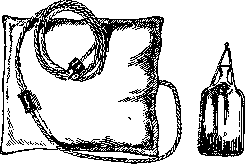
Figure 1.
Figure 2.
Of the special heating pads, the most commonly used are rubber bags (see Figure 2) and tin heating pads with hot water. The former deserve preference, as they are elastic and easily conform to the shape of the body. Such heating pads cool down quickly. "Thermo-compresses"—devices filled with sodium acetate—maintain temperature for a longer time. When heated, this salt dissolves in its water of crystallization, and upon subsequent cooling, it crystallizes again, releasing heat that maintains the temperature of the heating pad. Japanese heating pads retain heat for two hours. Their heat is maintained by a specially adapted smoldering coal inserted into a cartridge, which is placed into a flat tin heating pad covered with felt. Japanese heating pads are used primarily in ophthalmic practice. For prolonged thermal exposure, heating pads consisting of thin metal tubes are used, through which hot water constantly circulates, entering through one end of the tube and flowing out through the other. Electric heating pads possess great advantages. The simplest are tin boxes into which electric light bulbs are inserted. A more complex Stanger apparatus consists of a flexible electrically conductive fabric through which a current is passed. Lindemann electrotherms consist of a special alloy wire embedded between two thin layers of asbestos. Electric pillows (see Figure 1) are quite convenient, advantageously distinguished by their lightness and flexibility. They consume little electrical energy. Heating pads are placed directly on the skin or a towel is placed under the heating pad. It is necessary to remember that heating pads can sometimes cause burns, especially on the limbs, in persons with reduced general nutrition and marantic circulation. To prevent the development of burns and skin pigmentation, which appears at the site of prolonged use of heating pads, the skin can be lubricated with some fat. Sometimes heating pads are placed over compresses to enhance the effect of moist heat. Heating pads have an exclusively local effect, without affecting the organism as a whole. As the works of many authors (Winternitz, Peters, Quincke, Salomon) show, heat penetrates tissues only to a small depth. The effect of using dry heat depends not so much on the intensity of the temperature as on the duration of the procedure. The healing effect of heating pads is based, in all probability, on the fact that they reflexively cause relaxation of smooth muscles and active hyperemia with its analgesic, resolving, and trophic effect in internal organs, the vegetative nerves of which originate from the same segment of the spinal cord into which the sensory nerves of the given area of the skin enter (A. Neumann, G. Bergmann). Accordingly, the prescription of heating pads is indicated for inflammatory processes (appendicitis, cholecystitis, gynecological diseases, keratitis, etc.), for painful phenomena (colic, joint pain, neuralgia, etc.), and for chronic ulcerative diseases without a pronounced tendency to bleeding (gastric and duodenal ulcer). Goldscheider proposed combined treatment with massage and heating pads for various neuromuscular ailments; he performs massage with heated rollers filled with sodium acetate salt.
Related articles
Mentioned in
Cite this page
“Heating Pads.” Soviet Medical Encyclopedia. English translation of Bolshaya Meditsinskaya Entsiklopediya, 1st ed. (Moscow, 1928–1936), ed. N. A. Semashko. https://sovietmedicalencyclopedia.pages.dev/article/heating-pads/