Heating
Historical document, translated for reference. It reflects medical knowledge of the 1920s–30s and is not medical advice.
Summary
A comprehensive 1930s overview of heating systems for residential and public buildings, focusing on sanitary requirements, temperature standards, and the technical transition from local stoves to central heating.
Encyclopedia article (1928–1936)
HEATING, the warming of residential and other premises for the purpose of maintaining a specific temperature within them. Heating must have a technically correct design and satisfy a number of sanitary requirements. The basic sanitary requirements for any heating system are as follows: 1) to provide the room with a temperature specified for it; 2) to maintain the uniformity of the supplied temperature, not allowing its fluctuations to exceed established limits; 3) not to worsen the composition of the indoor air with heating products or by any other indirect influence; 4) not to contaminate the premises. Good heating must therefore maintain the required and, moreover, uniform temperature throughout the entire twenty-four-hour period. In residential premises, it is important to have a uniform temperature at a level of 1.5 meters from the floor (the level of a person's head). In higher layers of air in the room, the temperature is usually somewhat higher, and lower at the floor; however, the difference should not be too great (no more than 2–3° from the floor to head level). The temperature should also be distributed as uniformly as possible across the width and length of the room. The uniformity of temperature distribution depends on the structural features of the room and on the character, location, and operation of the heating appliances. In heated premises, the following internal temperatures should be maintained: a) Residential buildings: 1. Living rooms +18°; 2. Kitchens (without accounting for heat generated by cooking) +15°; 3. Bathrooms +22°; 4. Stairwells directly connected to the outside air and heated rooms +12°. b) Hospitals, clinics, sanatoria, etc.: 1. Hospital wards for adults +18°; 2. Wards for children +20°; 3. Wards for newborns +22°; 4. Special purpose rooms (maternity), dressing rooms, etc. +25°; 5. Operating rooms: according to the instructions of the responsible medical personnel; 6. Internal stairs and corridors +18°; 7. Spare stairwells +15°. c) Educational institutions, offices, clubs, theaters, cinemas, etc.: 1. Classrooms, offices, and workspaces for mental labor +16°; 2. Service rooms and teachers' rooms +18°; 3. General halls, internal stairs +15°; 4. Theater and club auditoriums before the start of attendance +16°; 5. Foyers, buffets, and smoking rooms +16°; 6. Service rooms and restrooms +15°; 7. Cinema premises intended for spectators, such as auditoriums, foyers, buffets, smoking rooms, and restrooms +16°; 8. Cinema service rooms +18°; 9. Stairwells directly communicating with the outside air and heated rooms +12°. d) Bathhouses: 1. Dressing rooms +25°; 2. Soap-rooms +30°; 3. Steam rooms +40°; 4. Swimming pool halls +25°; 5. Service rooms, restrooms +20°. e) Special purpose premises: 1. Red Army dormitories +18°; 2. Museums and art galleries +15°; 3. Colonial goods stores +12°; 4. Meat, vegetable, and dairy stores +5°; 5. Garages with production processes (inspection, washing, etc.) +10°; 6. Storage garages +5°. f) Industrial structures: In workshops and warehouses, depending on the nature of the premises and production conditions: a) light work +17–20°; b) heavier work +15–17°; c) work requiring significant expenditure of muscular energy +12–15°. In auxiliary premises: a) cloakrooms for outer clothing, dining rooms, eating and rest areas, washrooms +15–17°; b) showers and associated dressing rooms +24°; c) rooms for nursing +20–22°; d) restrooms +15°; e) rooms for warming workers who work outdoors +18°. The temperature standards of the premises must be ensured even at the lowest calculated outdoor temperature, which is usually taken as equal to the average January temperature + 0.6 of the difference between the absolute minimum and the average January temperature; for Moscow, for example, this calculated temperature is -30°. To maintain a normal temperature in the premises, the amount of heat supplied by the heating must be equal to the losses through walls, windows, floors, ceilings, and other external enclosures; the formula for calculating heat loss is: W = F · (ti - to) · K, in which: W is the heat loss per hour in calories; F is the area of the external enclosure in square meters; ti is the internal and to is the outdoor temperature in degrees Celsius; K is the coefficient of overall heat transfer of the enclosures and expresses the number of large calories lost through 1 m² of the enclosure surface of a given construction during 1 hour with a difference in air temperature of 1°C on both sides of it. The heat losses calculated by this formula for individual types of enclosures (walls, etc.) are added together, then additions are made to the resulting sum: a) depending on the orientation relative to the cardinal points—from 0% to 10%, and b) for the influence of wind—10% for an open location of the building. As a result, the total heat loss of the entire room per hour is obtained at the normal internal and the lowest calculated outdoor temperature. By summing the data for individual rooms, the heat requirement for the entire building is obtained. (Coefficients of overall heat transfer K for the most common building structures can be found in special manuals on heating installation.) The calculated temperature difference should be taken as: a) for floors located over crawl spaces not sunken into the ground, or over unheated basements with windows—at 50% of the maximum calculated temperature differences adopted for external enclosures; b) for floors over basements without windows—at 40%; c) for ceilings of upper floors, above which unheated attic spaces are located—at 80%. One of the most important sanitary requirements for good heating is that the heating should not spoil the air of the room. Air spoilage can result from smoke entering the room, as well as CO, which occurs with stove heating in the case of poor construction or malfunction of the stoves, as well as improper care of them. Carbon monoxide is also often a product of the decomposition of dust settling and scorching on the surfaces of stoves that have a high temperature. The permissible maximum temperature of heating surfaces is not fully established; some authors (e.g., Esmarch) allow temperatures up to 100–120°, however, the scorching of dust usually begins already at 80°. Therefore, horizontal surfaces on stoves should be avoided, especially on iron stoves and on central heating appliances (if they cannot be kept clean); smooth, especially enameled surfaces are preferable. All parts of heating appliances must be easily accessible and frequently and well cleaned of dust. The replenishment of heat lost by buildings is carried out by heating appliances located in the heated rooms. The heating appliances themselves receive heat from fuel burned either directly in them or in appliances located outside the premises. Consequently, every heating device consists of two parts: 1) the part in which thermal energy is extracted from the fuel, and 2) the part that gives off the received heat to the air of the room. The first is called a heat generator (firebox, boiler); the second is the heating appliance. If the heat generator and the heating appliance are connected together and are located in the heated room, then we have a local heating appliance; if the heat generator is located outside the heated rooms and is connected to the heating appliances by a network of pipes supplying the heat extracted in the generator to them, then such a device as a whole is called a central heating system. In sanitary terms, local heating is inferior to central heating; its main disadvantages are: a) the usual location near internal walls, which intensifies cold currents (drafts from windows); b) the difficulty of regulating heat output; c) the contamination of premises with fuel and ash; d) the high temperature of external surfaces (in metal stoves; iron parts of tiled stoves). If we add to this that local stoves require skillful care, take up a lot of space, and are more dangerous in terms of fire and carbon monoxide poisoning, it becomes clear that at present these stoves are being significantly displaced by central heating systems. The area of application for tiled stoves is small dwellings and village houses, small school buildings, etc. Even abroad, tiled stoves are still very common; for example, in Berlin, 90% of residential buildings are still heated by them. There are many types of good stoves, but the difficulty of constructing them from brick due to the poor development of the stove-making craft often results in unsatisfactory practical execution. In search of a solution, sanitary-technical thought has concluded that it is necessary to create "prefabricated stoves," i.e., stoves whose parts are all manufactured in a factory, and at the installation site, only the assembly of the stove according to a drawing is performed from these ready-made parts. However, ready-made and tested stoves do not yet exist, but there are projects and models that allow hope that this task will be resolved in the near future. Local heating appliances include fireplaces, Dutch stoves, Russian stoves, iron stoves, kerosene, alcohol, gas, and electric stoves. The sanitary assessment of all these local heating appliances is not the same. The fireplace is a very imperfect heating appliance. The heating of the room occurs almost exclusively due to radiant heat, which gives very uneven heating of the room, with a low fuel utilization coefficient (5–10%). The fireplace has no independent heating significance; at the same time, it provides vigorous ventilation of the premises.
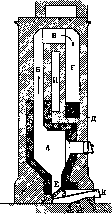
Dutch stoves are widely used for the heating of residential and even public buildings not only in the USSR but also abroad. These stoves possess a high heat capacity (they cool down slowly), and even during frosts down to -15°C, they are fired no more than once a day. The size of the stove is calculated based on the heat loss of the room also at -15°C. Firing lasts 2–3 hours. During this time, the stove accumulates a quantity of heat sufficient to cover the heat lost by the room for the entire subsequent period until the next firing. The coefficient of performance here reaches 75% with fuel boxes of a good system and with good maintenance; the heat transfer from 1 m2 of the stove surface for stoves in iron casings, plastered, or simple brick ones is: a) from external surfaces—220–250 calories per hour; b) from surfaces in chambers—150–200 calories per hour; for tiled stoves: a) from external surfaces—155–175 calories per hour. The Dutch stove (Fig. 1) consists of a fuel box (A) and smoke flues (B and G) connected to the chimney (D). The illustrated Lukashevich fuel box has a grate (E) on which the coals rolling down finish burning. The grate is movable by means of a lever (3) for cleaning out ash. Air for combustion enters through the ashpit (K). Fuel is loaded through the fire door in an amount of 75% of the total quantity; the remaining 25% is added when the stove has flared up well. There is only one ascending flue, while two or more descending ones are made (self-regulation of speed occurs in the descending channels because in the channels that cool more intensely, the gases become heavier and their speed increases). To increase the surface area that gives off heat to the room air, a chamber (I) is arranged between the smoke flues, through which room air is passed (inlet at the bottom of the chamber, outlet at its top). The stove is built of brick; the fuel box and part of the first smoke flue are lined
-4\
Figure 1. Section of a Dutch stove. The fireboxes are built of refractory brick. The outer surface of the stove either remains brick, is plastered, or is finished with tiles. From a hygienic standpoint, the best are stoves with tiled surfaces, which are easily cleaned and completely eliminate the possibility of dust accumulation (there should be no cornices or deep ornaments) when their surfaces are arranged vertically. Air chambers must be accessible. Stoves should not reach the ceiling; low (wide) stoves are better than tall ones; a distance of 15–20 cm between the stove and the wall of the room is desirable. Devices for controlling combustion in the stove consist of firebox, ash-pit, and flue doors, as well as cleaning and closing/regulating devices—dampers (vyushka), butterfly valves (baran), and slide gates. It is desirable to install airtight firebox and ash-pit doors to prevent combustion products (smoke, carbon monoxide) from entering the room; flue doors should be double-layered to prevent the condensation of liquid combustion products, streaks on the pipe, and rusting of the doors. Among the closing devices, the best is the vyushka damper, which provides a tight double seal. Slide gates are not distinguished by tightness; butterfly valves, being constantly in the flue, burn out quickly. The sanitary advantages of Dutch stoves (especially tiled ones) thus include the soft and uniform heating of rooms (the latter with stoves that are not too tall), significant heat capacity allowing for daily heating of the room with one or (during severe cold) two firings, and some ventilation of the rooms during firing. Among the general disadvantages of the Dutch stove, one must note: their slow warming during firing, their not entirely economical use of fuel, since their resulting heating effect under normal care does not exceed 30–40%, and the impossibility of regulating heat output by any means other than burning a specific amount of fuel. Brabbee suggests arranging heating with tiled stoves in combination with central heating even in large houses, providing heat via the central system up to +15°C, and above this, as well as at lower temperatures, during winds, etc., using stoves. In spring and autumn, in this case, only the stoves operate, and the central system is turned off. To accelerate the warming of stoves, so-called Utermark stoves are built, which are essentially Dutch stoves but of a lightened construction. They are laid from brick and have the same flue circuits, but their walls are thinner and they are not faced with tiles on the outside but encased in a sheet-iron jacket. Due to the smaller wall thickness, these stoves warm up faster, but their heat capacity is lower and they cool down faster. Therefore, they are more applicable in premises where it is not required to maintain a uniform temperature throughout the day and night, but it is sufficient to heat the room only for a time, e.g., in schools, shops. The so-called Russian stoves are widely distributed in old peasant life. As a heating device, they are very imperfect: their efficiency coefficient is low (no more than 30% for heating); they take up a lot of space. The reason for the wide distribution of Russian stoves is their versatility: they heat the room, food is cooked in them, bread is baked, grain is dried, and sometimes people even wash in them as in a bathhouse; people sleep on the stove, etc. With the change in peasant life at the present time, the need to maintain the Russian stove type in the village is disappearing; it is being replaced by more advanced and economical heating devices. To increase the heating surface of the stove and strengthen its action in winter, a so-called podtopok (auxiliary firebox) is sometimes added, so that two stoves are made from one: a Russian and a Dutch one. The heating surface of a Russian stove is calculated the same as a Dutch one. In view of the indicated impracticality of the ordinary Russian stove, types of improved Russian stoves with circuits have recently been proposed, through which the smoke from the stove passes before entering the chimney. Metal stoves. Their disadvantages: high temperature of the outer surfaces and the unpleasant effect of heat rays, which occurs with insufficient regulation and incorrect construction; unsatisfactoriness from a hygienic standpoint due to uneven heating of the room and severe scorching of dust when the stove becomes red-hot; rapid cooling of rooms after firing ceases. Metal stoves can be used mainly for premises requiring rapid heating and then only during specific hours (shops, meeting rooms, etc.). In residential buildings, the installation of metal stoves should not be permitted from a sanitary point of view. The following sanitary requirements should be applied to metal stoves: 1) absence of incandescent surfaces, which is achieved either by using a lining of refractory brick in parts of the stove subject to intense heat, or by installing special grates that prevent fuel from touching the heating surfaces; 2) uniform heat output; 3) continuous heating of the room with minimal care, which is achieved by supplying the stove with a filling cone containing enough fuel to maintain continuous combustion; 4) good regulation of the air flowing to the fire grate, as well as the chimney draft; 5) an easily cleaned smooth outer surface; 6) uniform heating of the room; special jackets often installed around stoves for the passage of room air are undesirable, as they promote increased scorching of airborne dust and are rarely accessible for thorough cleaning. Kerosene and spirit stoves are significant only as auxiliary ones. Their installation is simple, and they can be put into action immediately. There is no delivery of fuel or removal of ash, and care for them is limited to filling the reservoir. The space they occupy is insignificant. The stoves do not have exhaust pipes, and all gaseous products of combustion remain in the room; due to imperfect construction or careless operation, they therefore often emit a heavy smell of unburned fuel and make staying in such a room unpleasant and harmful, and therefore, for hygienic reasons, they cannot be recommended. In all the local heating devices mentioned above, the fuel materials themselves and their properties play a certain role (see Fuel). Gas heating possesses the same advantages: low cost of installation and simplicity of construction, cleanliness during stove operation due to the lack of need to bring in fuel and carry out ash; constant readiness for work and rapid heating; convenience of regulation. Along with this, it also has sanitary disadvantages: heating surfaces often have a temperature significantly exceeding the limit allowed by hygiene; dry distillation and combustion of dust occur on heating surfaces washed by room air; they do not possess heat capacity, as a result of which heat emission ceases when firing ends. Due to the easy flow of ordinary illuminating gas, severe cases of poisoning by it can be observed, as well as explosions if an accidental gas leak occurs through some damage in the gas pipe. Field of application: heating of premises that must be heated rarely but quickly (vestibules, etc.); as an auxiliary—with central heating systems, in sickrooms, and in transitional periods (spring, autumn); with a central water system—as a gas water-heating device for operation during sudden onset of cold in those periods when the system is not working. The most common gas stove designs abroad are a) gas radiators made of iron or cast iron; b) gas fireplaces; c) Junkers gas-air stove; d) gas fireboxes with incandescent attachments; e) gas tiled stove; f) central heating devices with gas auxiliary fireboxes for heating rooms in transitional periods. All gas stoves must have exhaust ducts designed for reliable operation under the most unfavorable conditions (high outdoor temperature), for which they should be built into internal walls. These ducts should consist of earthenware pipes, glazed inside, brought out above the roof, since water may be released from the combustion products (1 m3 of gas yields 1.1 kg of water upon combustion). Exhaust pipes must be equipped with devices protecting against "backdraft." Depending on the properties of the gas (the calorific value of which can fluctuate within wide limits), the useful amount of heat can be taken as 3,500 to 4,500 cal per 1 m3 of gas consumed. About 10–15% of the heat is lost when escaping into the chimney along with the combustion products. A mixture of gas with air is explosive at certain concentrations, namely between 94 volumes of air to 6 volumes of gas and 80 volumes of air to 20 volumes of gas. Electric heating possesses great sanitary advantages; however, due to the high cost of operation (several times more than with coal or gas), it is significant only as an auxiliary or in special cases, in the presence of cheap electricity from hydroelectric power plants, for heating steamship cabins, tram cars, etc. Both direct and alternating current can be used for heating.
The equipment is inexpensive, the design is simple, no chimney is required, there are no heat losses, the premises are not contaminated with fuel and ash, and the temperature of the heating surfaces, with good regulation, is low—70°–100°. With the correct distribution of electric heating appliances in a room, less heat is required for sufficient heating than with other methods of heating; the advantages also include constant readiness for operation, the possibility of automatic regulation, and the portability of the heating appliances. The following are used: a) lamp stoves with carbon filaments; b) resistance stoves, using resistance either in the form of wire wound on a coil covered by a grate, or in the form of plates freely radiating heat (better, since there is no grate to reduce heat emission); c) indirect action stoves (radiators), consisting of hollow elements with double walls joined into a single unit, inside which room air circulates. In newer installations, electric heating can also be made heat-accumulating: a) in water heating—by accumulating heat in well-insulated water containers; b) in tiled stoves—by heating the interior of the stoves. Central heating refers to systems of water, steam, and air heating. In all three cases, the heat required for heating a number of rooms is produced in one central location and then distributed to individual rooms by means of a heated medium (water, steam, air). The main sanitary-technical and economic advantages of central systems are as follows: a) heat generation occurs in a properly arranged boiler room, so that the maintenance of the furnace is limited only to this location, and the issue of delivering fuel to the rooms and removing ash from them is eliminated; b) coke is primarily used for firing the boilers, whereby combustion without smoke and soot is achieved; c) maintenance of the heating appliances is reduced to a minimum; d) small-sized water and steam heating appliances are installed directly under windows or near large cooling surfaces and intercept the currents of cold air coming from the windows (thereby eliminating drafts from the windows); e) finally, the heating appliances take up little space and the possibility of fire is excluded. The most significant advantage is that with central heating, it is possible to regulate the temperature in the rooms and ensure its uniformity. In practice, the following types of central heating are used: 1. Low-pressure water heating. 2. Medium-pressure water heating. 3. High-pressure water heating. 4. Low-pressure steam heating. 5. High-pressure steam heating. 6. Mixed heating. 7. Air heating. 8. District heating or long-distance heating. The heating appliances of various central heating systems differ so little from each other that by their appearance it is difficult, and sometimes impossible, to determine the heating system to which these appliances belong. These heating appliances must fully satisfy the following conditions: a) maintain a sufficient and uniform temperature in the heated room; b) allow for the regulation of the room temperature within certain limits; c) not worsen the sanitary conditions of the heated room. It follows from this that to select the most perfect heating for rooms with central systems, one should first of all: 1) choose the most suitable type of heating appliance and establish the size of its heating surface; 2) arrange it so that it provides uniform heating of the rooms without unpleasantly affecting our well-being, does not unnecessarily crowd the room, does not spoil its appearance, and allows for the easy maintenance of the cleanliness of its heating surfaces at all times. The central heating system itself is required to deliver heat to the heating appliances in full accordance with its consumption in the room, while maintaining a heating surface temperature that does not exceed sanitary standards. Heating appliances of central heating systems are divided by the material of their heating surfaces into a) cast iron, b) iron, and c) combined; in the latter, their metallic part, which serves for the movement of the heat-transferring medium, is lined on the outside with some less heat-conductive material. To obtain good sanitary conditions, it is necessary that: 1) the heating surface of the appliance be as vertical as possible; 2) the heating surface be perfectly even and, if possible, mirror-smooth; 3) the entire surface of the appliance be easily accessible for its maintenance, i.e., painting, wiping; 4) the heating appliances do not cause air currents unfavorable to people; 5) they neutralize cold air currents forming at cooling surfaces. In addition, a fully satisfactory heating appliance from a sanitary standpoint should not have a temperature above +70°, at which the sublimation of room dust begins. Low-pressure water heating appliances generally satisfy this condition, since their surface temperature exceeds 70° only during severe frosts, and at the average temperature of the coldest month, -1° in 70° corresponds to the temperature in the supply pipes at an external temperature of -10°. Steam heating always has a higher appliance temperature (about 100°), and therefore it should not be used for heating residential premises; combined appliances with a maximum surface temperature of 45°–50° deserve special attention from a sanitary point of view. Cast iron heating appliances are divided by the type of heating surface into a) smooth, b) ribbed, and c) mixed. Providing smooth cast iron surfaces with ribs is explained by the desire to 1) increase the heating surface and 2) lower the temperature of the heating surface. The temperature of a ribbed surface is not uniform. It reaches its maximum value in the smooth parts of the appliance—between the ribs—and its minimum at the edges of the ribs, i.e., in places with the greatest distance between the heat-transferring medium and the heating surface. Heat transfer by the ribs occurs from both sides of them, so both surfaces of each rib are taken into account when determining the size of the total heating surface of a ribbed appliance. Heat absorption of the rib from the heating medium occurs through thermal conductivity. The medium transfers heat to the smooth body of the appliance, and the ribs, being one with the body of the appliance, distribute the heat over their entire surface. If the ribs have a minimum thickness, then the cross-section of such ribs will be minimal, which may prove insufficient to conduct the entire amount of heat that is given off by the outer surface of the rib to the room air. Consequently, there is a certain ratio between the height of the rib and its thickness, which it is irrational to exceed in either direction. In practice, the height of the rib is taken as 50 mm, the expediency of which is confirmed by Rietschel's research. The distance between the ribs significantly affects the heat emission of the heating appliance. As this distance decreases, the movement of air between the ribs becomes more difficult and the amount of heat rays by which heat is transferred from the heated ribbed surface to the heated rooms decreases. In addition, too close an arrangement of the ribs makes it very difficult to keep the heating surface clean. The distance should be at least 25 mm; the entire surface of the appliance should be easily monitored by direct inspection, i.e., it should be what is called "visible." Thus, visibility is one of the most important conditions for the sanitary merit of an appliance. Radiators (Fig. 2) are smooth cast iron heating appliances that have found wide application in central heating. Each section of a radiator (in Fig. 2—9 sections) is a vertical hollow appliance equipped at the top and bottom with sleeves, by means of which individual radiator sections are connected to each other in groups of a certain size. The height of radiators varies; they are installed on legs (as shown in the drawing) or suspended on brackets embedded in the wall. They should be suspended at a distance of at least 200 mm from the floor and at least 100 mm from the wall. With such an arrangement, it is possible to sweep and polish the floor under the radiator, and it is possible to paint, wipe, and inspect the rear surface of the radiator, as well as to paint, wallpaper, and wipe the wall surface behind the radiator. Dark deposits from outgoing air currents, which are very common when the heating surface is located close to the wall, do not appear on the walls. When the radiator is located in a window niche, this maintenance is made more difficult. To further develop the heating surface of the radiator, they are sometimes made three- or even four-column; for greater visibility and accessibility of the heating surface—single-column. The distances between the columns of two adjacent sections are in practice taken as 30 and 50 mm at the narrowest point; at 50 mm, a hand passes between the sections, which significantly facilitates the maintenance of the appliance and the niche; the best from a sanitary point of view, but at the same time the most expensive, is a low, single-column radiator. Radiators are painted with fire-resistant oil paint.
The external surface of radiators must be smooth without any embossed patterns,

which are sometimes made for pseudo-artistic reasons. The connection of radiators to the pipeline is done either on one side or on two sides, i.e., inlet and outlet diagonally across the appliance; this does not affect the uniformity of heating of all sections in one group.
In recent years, iron radiators have appeared and are spreading due to their lightness; ceramic radiators with a glazed external surface have also appeared; in hygienic terms, the latter are impeccable even with low-pressure steam heating. The internal volume of a cast-iron radiator on average for our radiators is 9 liters, and the weight is 40 kg per 1 m2 of heating surface; consequently, when the water temperature in the radiator drops by 1°, about 14.0 calories of heat are released per 1 m2 of heating surface (9 x 1 + 40 x 0.13 = 14.2 cal.; here 0.13 is the specific heat of cast iron). The total amount of heat given off
Figure 2. 1 m2 of a radiator when cooling water from the initial temperature (+80°) to room temperature (by 60°) is over 800 calories; the maximum amount of heat that can be given off by 1 m2 of radiator heating surface per hour is about 400 calories, i.e., complete cooling of the radiator occurs with water heating in no less than 2 hours. With low-pressure steam heating, the steam temperature in the radiator is about 100°; the weight of steam per 1 m2 of radiator surface is 54 g; the heat release during condensation of this steam and cooling of the resulting water to room temperature is about 450 calories (40 x 0.13 x 80 + 0.054 x 600, where 600 is the amount of heat released during condensation of 1 kg of steam; 80 is the number of degrees by which the appliance cools). The maximum heat output of 1 m2 of radiator with low-pressure steam is about 700 calories per hour, so that complete cooling of the radiator occurs in 0.66 hours (450 : 700 = 0.66); thus, the sensitivity of the radiator to regulation with steam heating is 3 times greater than with water heating. Radiators are heating appliances that have almost displaced steel, cast-iron, and iron smooth heating appliances and significantly limited the use of ribbed appliances. Of the ribbed appliances, the most commonly used remain ribbed pipes (Fig. 3), which are a cast-iron pipe with flanges at the ends for connection to supply pipes (or other ribbed pipes) and circular ribs along the entire length. Figure 3. Ribbed pipe. The length of ribbed pipes is usually 2 m, 11/2 m, and 1 m. From a sanitary point of view, only a ribbed pipe having a heating surface of 2.6 m2 for a length of 2 m can be considered satisfactory, since its distance between ribs is 30 mm and the rib height is about 50 mm, which corresponds to the sanitary requirements mentioned above. Longitudinal ribs added for strength significantly worsen the visibility of the heating surface, blocking the rear surface of the ribs; a horizontal arrangement of longitudinal ribs is better in terms of visibility, but, by obstructing the movement of air between the ribs, it lowers the heat output. Ribbed pipes are thus not entirely satisfactory from a sanitary point of view, especially those equipped with frequent ribs. As a heating appliance, ribbed pipes find their main application in factories, plants, warehouses, arenas, greenhouses, and similar buildings that consume a lot of heat but, by their purpose, do not present particularly strict sanitary requirements. In addition to ribbed pipes and radiators, there are also ribbed batteries, flat ribbed appliances, and vertical ribbed appliances (stoves), but they are rarely used at present. The use of ribbed heating appliances is maintained mainly by their relative cheapness compared to smooth appliances. Furthermore, smooth iron pipes laid along external walls with a proper offset from them are also heating appliances; they provide satisfactory "visibility," especially of the upper surface which easily collects dust, and a uniform distribution of heat in the room; disadvantages include their higher cost compared to cast-iron appliances and unsatisfactory appearance; to prevent dark deposits from forming on the walls, pipes should be set at least 25 mm, and for steam pipes up to 50 mm, away from the walls. Vertical pipes (risers) are less perfect than horizontal ones. With a local increase in the diameter of the riser, a cylindrical stove is obtained; with water heating, it has a high heat capacity and is consequently not sensitive to regulation; to reduce heat capacity and increase the heating surface, it is usually equipped inside with one large or several smaller diameter pipes serving to heat the air circulating through these pipes; however, the heat output of the internal surfaces is lower than the external one, they do not have sufficient visibility, and cleaning them is more difficult. Cylindrical stoves are expensive and therefore, lacking special merits, have not found wide application. Their area of application is water heating systems for individual apartments, where their high heat capacity is useful during intervals between firings. From the description of heating appliances, it is clear that none of them fully possesses those sanitary qualities that would ensure the maintenance of proper cleanliness of the heating surface with its full visibility. Comparing central heating appliances with stoves in this regard, it must be admitted that the external surfaces of stoves are much more perfect than the surfaces of central system appliances. But since these stoves themselves have many disadvantages eliminated in central systems, the desire to give the heating surfaces of central heating appliances all the best qualities of stove surfaces becomes understandable. Combined or massive stoves meet this desire. By embedding a tubular heating appliance of a central heating system into one mass or another that possesses proper thermal conductivity and makes it possible to give the surface of the appliance the most perfect cladding, a combined heating appliance is obtained (Fig. 4): A—a heater made of iron pipes connected by welding, in which water or steam circulates; B—a heating mass that gives off heat to the room through its surfaces—concrete, brick, or special ceramic tiles; C—a regulating valve; D—cladding of heating surfaces (tiles, slabs, plaster); E—a sand layer. Combined heating appliances have indisputable hygienic advantages over metallic heating surfaces, and therefore their use is particularly appropriate in operating rooms, maternity wards, hospital wards in general, bedrooms, children's rooms, and similar premises where achieving perfection of the heating surface is one of the most essential requirements. In psychiatric hospitals, it is desirable to embed heating appliances into the partitions dividing the rooms, plastering them from the outside so that the wall surfaces do not differ in any way from the surface of the appliance. Moreover, massive appliances are applicable in premises where an abundance of organic dust does not allow the use of other appliances without danger or harm to those using the premises (smokeless powder factories, medicine factories, etc.). Combined heating appliances are also applicable for heating floors, e.g., in bathrooms, hydrotherapy clinics, so-called Roman baths, etc.; in this case, the floor temperature should not be higher than that allowed for walking on the floor. The maximum surface temperature of vertical massive appliances is 45° with water heating and 50° with steam heating. The floor temperature for walking barefoot is +35°, and for Roman baths +60°. Combined appliances have a high heat capacity, which allows them to be used with the periodic operation of a steam system. Sensitivity to regulation is approximately 4 times less than with water radiators. The most expedient placement of heating appliances in a heated room is to place them under windows, as they are the most cooling surfaces; such placement ensures a more uniform temperature in the room and limits the cold air currents descending along the external walls. However, when placing an appliance under a window, it is necessary to eliminate, if possible, the protrusion of the windowsill, which deflects the air rising near the appliance toward the room and subjects people near the window to the unpleasant effect of air with increased temperature and increased velocity. In addition, eliminating the windowsill improves access to the rear surface of the heating appliance. Placing a screen in front of the appliance improves its thermal properties.
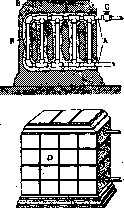
Fig. 4. Combined device. — The system of water heating consists of 1) a heat-absorbing heating surface (water boiler), 2) a network of circulation pipes for water distribution, and 3) heating surfaces that release heat. The idea of the design is as follows: imagine two vertical pipes connected to each other at the top and bottom; one of them receives heat from the outside at some point, and the other loses heat at a point located higher than the first. Then, due to the difference in densities caused by heating and cooling, both water columns will no longer remain in equilibrium, and the cooled column will descend while the heated column of water will rise. If the supply and loss of heat occur continuously, the water in the entire pipe system will also have continuous movement. The greater the vertical distance between the two aforementioned points, the more significant the pressure difference between the two water columns and the greater the speed of the water movement. The position of the heat-losing heating devices depends on the rooms being heated; therefore, it is recommended to place the heat-absorbing surfaces (boilers) as low as possible, i.e., in the basement. The devices used in practice (Fig. 5) consist of a boiler A, from which water is directed by means of a rising pipe to the highest point of the system, and from there through a distribution pipe to individual risers. The latter lead the water through heating devices to a collection pipe (return), which connects to the lowest point of the boiler. This is the scheme of the so-called overhead distribution. According to another scheme, the distribution pipe lies below the heating devices, and hot water is supplied to the heating devices by rising pipes. This is underfloor distribution. Both arrangements make it possible to disconnect each individual device from the water circulation independently of the others by means of a valve; the valves connect the heating devices to the pipeline, and thus the disconnection is done in the heated rooms themselves. A so-called single-pipe system is also used, in which the supply and return pipes are combined into one for all heating devices located one above the other, as shown in the diagram. With this arrangement, it is also possible to disconnect each individual heating device, but the water temperature in one device depends on the temperature in another, which is why the calculation of the device becomes more complicated; its advantageous side is the extremely simple laying of pipes; this is especially important in cases where the pipeline is run openly along the walls. The single-pipe system offers great advantages at high speeds in the risers (pumped heating), and in the heating of multi-story buildings with uniform use of premises. In each individual case, it must be decided which of the distribution systems—overhead or underfloor—should be used. When supplying water to heating devices from above, the system will be somewhat more expensive due to the common main pipe AB; if the distribution pipe lies in the attic, the heat that this pipe gives off if its insulation is insufficient will be lost; finally, its inspection is difficult. On the other hand, this arrangement has the advantage that water from the boiler can rise directly to the highest point of the system, so that its circulation will immediately begin in the most perfect manner. Overhead distribution is therefore expedient in all cases where the boiler is at a large horizontal distance from the nearest heating device and when the basement has an insignificant height. The advantages and disadvantages of underfloor distribution follow naturally from what has just been said. Since the entire water heating system is filled with water, which expands when heated, it is necessary to take measures so that a corresponding amount of water can exit the system and re-enter it after the influence of expansion ceases. For this purpose, a so-called expansion vessel of sufficient size, marked on the diagrams with the letter G, is connected to the highest point of the system. The entire system is filled completely with water so that no air accumulation can form anywhere, obstructing the movement of water. As a basic principle, it should be accepted: from the moment it enters the boiler, the water must have an upward direction to the highest point of the system, and from there a return direction, everywhere downward. With overhead distribution, the air released from the water is removed through the expansion vessel; with underfloor distribution, air accumulation can occur in the upper devices not connected to the expansion vessel and in their supply pipes. Therefore, these places must be equipped with devices for air removal, either in the form of air tubes going to the expander or in the form of air release valves. The field of application for low-pressure water heating is very extensive. Due to the significant heat capacity of water, even when a small mass of it cools by 20–30° (the usual amount of cooling), a fairly significant amount of heat is transferred to the air through the heating devices; on the other hand, the density of water changes sufficiently with a change in temperature so that the pressure difference of two water columns, whose temperatures differ by 20–30°, can set significant masses of water in motion in fairly narrow pipes. Since the pressure difference increases with the height of these water columns, the pipe diameters become smaller the higher the heat-releasing heating devices are located above the boiler. With sufficient insulation of the pipes supplying hot water, the horizontal distance of the boiler plant from the heated room can be allowed, depending on circumstances, up to 150 m and more. Since the boiler plant allows the desired water temperature to be maintained without difficulty (within certain limits), with water heating it becomes possible to have general regulation of the heat output of all devices located in the rooms by means of only the appropriate management of the furnace—i.e., a great sanitary advantage, unattainable to such an extent with any other heating system. As special merits, one should also point out the absolutely silent (when correctly executed) operation of low-pressure water heating and the almost unlimited durability of a carefully constructed system. Due to the high heat capacity of water, water heating has an inherent disadvantage consisting in the fact that a kind of inertia manifests itself during the heating and cooling of the water. Therefore, water heating is not recommended in all cases where, for example, in assembly halls, theaters, etc., rapid heating of the premises before use and rapid cooling after use are required. As a disadvantage, the danger of pipes and heating devices freezing in winter under negligent supervision should also be pointed out. By correctly determining the volume of water in the heating devices (it should be as small as possible), the influence of inertia during the heating and cooling of water can be significantly weakened, and the danger of freezing can also be prevented. Thus, low-pressure water heating is suitable, more than any other system, for those premises in which pleasant, uniform, and soft heat is required around the clock (residential buildings, schools, hospitals, museums, greenhouses, etc.). In this case, however, only low-pressure, and not medium-pressure, water heating should be used; the construction of the latter system is somewhat cheaper, but on the other hand, at low external temperatures, the water will heat above 100°, which partly reduces the merits of the heating and at the same time introduces the disadvantage that the danger of explosion will not be absolutely excluded. Water heating, especially low-pressure, of all existing central heating systems, provides the most pleasant heat, since the water in the boiler is heated only in accordance with the external temperature, on average not higher than 50–60°; in this respect, it thus fully meets hygienic requirements. When designing the system, care should be taken for a large heat capacity (heat reserve), which can be achieved either directly due to a large water content in the boiler, making temporary interruptions in firing unnoticeable, or by constructing a firebox with a reserve of fuel material, which enters the firebox as needed, maintaining continuous firing. In the case of intermittent firing, the daily duration of heating at the lowest external temperature should be approximately three hours, and the total firing time at the average winter temperature—only six hours. Boilers for water heating are equipped with a device for regulating the draft, a thermometer for measuring the water temperature, as well as valves for supplying water and draining it from the boiler and system. From 1 m2 of the boiler's heating surface, heat is obtained: with iron boilers—7,500 cal. per hour, with cast-iron boilers—6,000 cal. per hour. Regulation of heat output can be general, by changing the intensity of the firing, or local, in each individual room by changing the amount of water flowing through the heating devices.
If a combustion regulator is present, the reduction of the furnace intensity is performed by means of this regulator, which is set by the stoker according to the heat consumption. The stoker can monitor the heat consumption either by visiting the heated rooms or without leaving the boiler room by having an electric thermometer before his eyes. It is recommended to install electric thermometers with every system. Local regulation of heat in individual rooms is achieved by changing the amount of water flowing through the heating appliances using valves, gate valves, and taps. The most perfect are double-regulation taps. For the construction of the pipeline, iron pipes are mostly used; they can be bent over a fire, cut, and fitted according to the requirements of the building itself. Usually, the following are used: thick-walled gas pipes (sleeve-jointed) up to 65 mm in internal diameter and smoke-tube pipes welded by a patented method (patented flange pipes) with an internal diameter from 57 mm. Medium-pressure water heating differs from low-pressure water heating only by the higher temperature of the water (up to 120°C). In view of the high temperature of the heating appliances and the possibility of increased dust scorching, as well as burns, from a hygienic standpoint it cannot be recommended for residential premises. The temperature difference between the supply and return water is 30–50°C. The external difference from low-pressure water heating consists in the fact that the expansion vessel is made closed. The high-pressure water heating system (Perkins) represents a closed pipeline with an internal diameter of 23 mm and an external diameter of 33 mm. A part of the pipeline, coiled in the form of a serpent, is located in the furnace and represents the boiler; a part is laid in the rooms and serves as the heating appliance; the remaining part is the connecting pipeline. The water temperature in the system is 150°C (sometimes 200°C), therefore this system is inapplicable in residential premises and is used only for industrial buildings, being very convenient here, as it makes it possible to obtain gradually increasing heating and drying from low to high temperatures. The heat output from 1 m2 of heating appliance is 900 calories per hour, with a water drop of 150°C in the supply pipes and 80°C in the return pipes. To the system of water heating with natural circulation also belongs floor-by-floor (apartment-by-apartment) heating, in which both the boiler and the heating appliances are located on one floor (i.e., at the same height). The advantage of this system is its independence from the heating of the entire house, which allows each apartment to be heated both in time and intensity in full accordance with its needs. The disadvantages include higher cost and a lower coefficient of efficiency with more complex maintenance. Pump heating represents ordinary water heating in which a pump is installed on the main return line to stimulate water circulation. Sanitary-technical advantages: heating of large buildings located over an extensive horizontal territory from one place; the possibility of general regulation of all heated rooms from one central boiler room; heating of rooms and buildings located below the boiler; use of pipes of smaller diameters and therefore cheaper; freedom in laying pipelines (if good air removal is ensured); a single furnace; centralization of fuel and ash transport; the possibility of using low-grade fuel in the central boiler room; simplified maintenance; more convenient supervision of the system; the possibility of using the heat of exhaust gases with forced draft. Disadvantages: the use of pumps requiring maintenance and repair, as well as the consumption of electricity. Pump heating should be used in cases where calculations indicate significant savings in operation (including depreciation) and good maintenance of the machines is ensured. It can certainly find application in hospitals, sanatoria, homes for the mentally ill, settlement houses, in the case of using waste heat, and in long-distance heating systems. The construction is in essential features the same as in the low-pressure water heating system with natural circulation. The energy of water turnover in a system with an upper arrangement of pipes can be increased by adding steam to the water in the rising pipe heated to 100°C (Reck system). In this way, the difference in the weight of the water in the supply and return pipes is significantly increased, and the energy determining the water circulation is substantially raised. Such a large increase in the amount of energy makes it possible to use pipes with a smaller diameter, increase the total length of the pipes, and also manage their arrangement more freely, as well as the installation of heating appliances. The latter can be placed at the same height as the boiler, or even lower. Since, to avoid shocks in the heating and various disturbances in it, steam should not be allowed to penetrate into the heating system itself, the steam should be separated from the water before it enters the distribution pipes, i.e., it should be condensed. Devices for separating and condensing steam complicate the system, therefore such systems are resorted to only in special cases (e.g., when heating individual floors). Individual systems of heating with accelerated turnover are very diverse in their design; some of them are distinguished by significant complexity. The great expectations placed on these systems of heating with accelerated turnover were not realized, and at the present time, pump heating systems have completely displaced them. District heating is arranged to serve large groups of buildings not too far from one another, large blocks, and entire streets. Such a supply of heat from one center to entire districts has received the name "teplofikatsiya" [district heating/combined heat and power] in the USSR, at—
HEATING, in which the waste heat of electric power stations is most widely used; in this case, they are designed as combined heat and power plants. Currently, the low-pressure steam heating system has gained the widest distribution (Figure 6). The total amount of heat contained in steam at high pressure differs little from that at low pressure, but as pressure increases, the specific volume of steam decreases significantly. Therefore, high-pressure steam is used to transport steam over long distances, so as to 1i ! Jl ] Lm ./ Figure 6. Low-pressure steam heating. Overhead distribution: a—water level in the boiler; ab—maximum working pressure; c—air removal from the system. manage with narrow, inexpensive pipes. To protect against severe cooling, steam pipes are covered with poor heat conductors (insulation). This reduces heat loss in the pipes to 1/7 of the amount of heat lost when using uninsulated pipes. These losses are expressed in the form of settling (condensing) water, for the removal of which from the steam pipes special pipes are used. A distinction is made between high-pressure steam heating, low-pressure steam heating, exhaust steam heating, and vacuum heating (heating with reduced pressure). The vacuum heating system presupposes the presence of a steam engine or an air pump. Independent vacuum heating installations with their own air pumps are rarely used in Central Europe. Their temperature is below 100° depending on the degree of steam pressure. High-pressure steam heating is not used for residential buildings, but only for factory buildings. But even here, due to the difficulty of sealing pipe joints and heating appliances at high pressure and in view of the associated dangers, the pressure in the steam boiler is usually reduced beforehand, and work is done with steam having no more than 2 atmospheres of gauge pressure (3 atmospheres absolute). The reduction of pressure is carried out by means of special, so-called reduction valves. Along with ribbed appliances, smooth iron pipes are used as heating surfaces, which are laid in long lines along the walls; they are also suspended at head height in workshops and workrooms. A pipe for removing the formed water is attached to the end of the heating pipe. It is advisable to return the condensation water back to the steam boiler. Regulating the heat output of individual high-pressure appliances is very difficult, as it is impossible to set the steam shut-off valves as precisely as is necessary for the desired increase or decrease in the flowing quantities of steam. The conduction of steam and the removal of condensation water occur through separate pipe systems. To avoid interference from condensation water forming in the steam pipes, the steam from the boiler is led upward by the shortest route (main steam pipe), and then branched out, with individual pipes led off with a certain fall. A variation of high-pressure steam heating is the so-called circular heating (first implemented by Kranz). In it, the steam pressure is not reduced; the steam is in a system consisting entirely of smooth pipes and is under the full pressure of the steam boiler. The device on the descending (outlet) pipe is arranged so that the condensation water automatically falls back into the boiler. Low-pressure steam heating is very convenient for heating individual buildings and in this respect competes with hot-water heating. Each of these systems has its own advantages and disadvantages, which are of decisive importance when choosing a system. The positive sanitary aspects of low-pressure steam heating primarily consist in the rapid heating of the appliances and reliable regulation of heat output, provided that all appliances are in operation. If, however, some of the appliances are turned off, the piping proves to be too wide for the rest, as a result of which steam begins to penetrate through some appliances into the condensation pipes, and from there into other heating appliances, thus disrupting the regulation. To eliminate this inconvenience, special apparatuses are used that maintain a constant level of condensation water in the appliances, but in such a case there is a possibility of the latter freezing. Steam heating appliances, which heat up quickly when steam is admitted, cool down just as quickly when its admission is stopped; in view of this, systems with continuous firing are usually arranged. Low-pressure steam heating differs from hot-water heating in the cheapness of the initial installation, but, on the other hand, the not always avoidable noise of flowing steam represents a rather important sanitary disadvantage of this system. Furthermore, since the temperature of steam is never below 100°, in systems of ordinary design, the regulation of the heat output of heating appliances can only be done by means of local regulation of the steam inflow, but not centrally by changing the steam pressure, similar to how it is done in hot-water heating by changing the temperature of the water in the boiler. Since steam is lighter than air, when in full operation the appliances are heated over their entire surface; when the steam inflow is reduced, the heating surface also decreases, starting from the bottom. Thus, with a low heat demand, only the upper part of the appliances is heated, which of course unfavorably affects the uniformity of heat distribution in the rooms. On this basis, tall heating appliances should not be used for low-pressure steam heating. In the heating appliances of the 27» Körting system, steam enters not from the top, but from the bottom; it mixes with the air in the appliance, and the mixture circulates inside the latter; thanks to such a design, uniform and not too strong heating of the entire surface of the appliance is achieved. But in this case, the heating appliances must have a shape that would allow the installation of such a device. Regarding the regulation of heat output by heating appliances, steam heating is thus significantly inferior to hot-water heating. As for freezing, in steam heating only the condensation pipes can freeze. In addition, freezing easily occurs in those systems that can cool below 0° during a break in firing (air heating, etc.). Freezing specifically takes place when steam is admitted, because upon entry, the steam quickly condenses into water, which immediately freezes in the cooled system. While the piping of hot-water heating has almost unlimited durability, the condensation pipes of steam heating are subject to rust. To protect condensation pipes from rust, they are either made of copper (but this is expensive) or the system is filled with boiled water at the end of the heating season. Due to the fact that the steam pressure in low-pressure steam heating is insignificant, the condensation water is returned to the boiler by gravity, i.e., without the help of any intermediate apparatus. Only water is in the condensation pipes, and all the steam condenses before reaching them. It goes without saying that the water in the condensation pipes stands at a higher level than in the boiler, and that the water column is higher the greater the steam pressure in the boiler. The water column must of course not penetrate into the heating appliances, and therefore the steam pressure in the boiler must be lower the smaller the vertical distance from the boiler to the appliances. This latter circumstance, as well as the ease of regulating the heating appliances and the noiseless operation of the system at low steam pressure, makes it necessary to choose this pressure as low as possible. In practice, it has been gradually reduced and is now sometimes taken as equal to 0.05 atmospheres and lower. Such pressure is maintained before the valves of the heating appliances, whereas in the mains the pressure may be somewhat higher (0.1–0.2 atm.). The noise produced by flowing steam mainly occurs during a sudden drop in pressure, consequently when steam enters the heating appliances. The higher the steam pressure before the valves of the latter, the more significant the pressure drop and therefore the smaller the free passage area of the valves is taken. Steam from the boiler, just like water in hot-water heating, first enters the distribution main, which is laid either above or below the heating appliances, and moreover with a slope in the direction of the steam movement. If the distribution main is located below the heating appliances, devices for removing condensation water from it are installed on it. From the distribution main, steam goes to the heating appliances through descending and ascending risers; other risers remove the condensation water formed in the appliances. The risers for condensation water below the heating appliances (in the basement floor) are connected to a collection condensation main, which in turn is connected to the boiler. The collection main can lie above or below the boiler; it is usually located above the boiler so that it can simultaneously serve to remove air from the system.
Steam for heating can be obtained either from iron or cast-iron boilers, or as reduced high-pressure steam, or as exhaust steam from steam engines operating without condensation (i.e., with the discharge of exhaust steam). The installation of low-pressure steam boilers is not subject to any special restrictions if the steam pressure in them does not exceed 0.5 atm gauge, except for the requirement that they have devices that automatically prevent the possibility of the pressure rising above this limit (a safety or outlet standpipe 5 meters high, etc.). The insulation of steam pipes must necessarily have a lower (inner) layer about 10 mm thick made of kieselguhr. Vacuum heating is the name given to a system operating with steam having a pressure of less than 1 atmosphere absolute. The American systems that originally received this name are similar to ordinary low-pressure steam heating, in the condensation lines of which a pressure below atmospheric is maintained. In Europe, vacuum heating has not gained popularity due to the absence of truly multi-story buildings; as ordinary heating, it offers no advantages, and its operation is more complex than ordinary steam or water heating. Steam-water heating is nothing other than an ordinary low-pressure water heating system in which the water is heated not directly by the action of fire, but by means of steam. Such heating is advantageously used for those buildings where water heating is desired, but which, due to their vastness, require the arrangement of several separate systems with only one central boiler plant. This heating system is particularly suitable in cases where steam is also used for other purposes or when it can be piped from a central point to several separate buildings. The entire steam-water heating system is divided into low-pressure water heating and steam heating; each of these is calculated and arranged according to the rules set forth above. The steam used for heating the water does not come into direct contact with it but gives off its heat by means of special heating surfaces. Since the transfer of heat from steam to water occurs very energetically, the heating surfaces, and consequently the boilers, can have relatively small dimensions. Steam heating surfaces in most cases take the form of pipes located in the water heating boiler. Steam heating with local steam-water heating units is an attempt to combine the advantages of steam and water heating in one design—rapid heating with sufficient heat capacity. Steam is used to heat heating units located in the rooms that are filled with water. Regulation of the heat output of the units is performed by changing the height of the water filling the units; steam enters the space above the water; the unit has one or more overflow pipes for the removal of the formed condensation water; steam also enters through this same pipe. It is currently used very rarely. Air heating is a conventional heating system (stove, steam, water, or other) in which the maintenance of the room air temperature is performed by heating units located in a separate chamber outside the heated rooms. The room air is sucked into ducts or pipes, conducted by them into the chamber, heated there to the required (higher) temperature, and returns to the room, where it cools to room temperature, giving off the heat stored in the chamber to compensate for the cooling of the room. Depending on what heats the air, a distinction is made between 1) fire-air (with a fire furnace), 2) steam-air, and 3) water-air heating. All three systems can operate in 3 ways: 1) air is taken from outside, heated, gives heat to the room, and is discharged outside (fresh air heating); 2) air is taken from the room, heated, gives heat to the room, and goes back to the chamber for heating (recirculated air heating); 3) a combination of both methods. Only the 2nd method, i.e., working with recirculated air, is purely for heating; the 1st and 3rd methods perform ventilation of the rooms simultaneously with heating. In all types of air heating, natural (under the influence of temperature difference) or forced (using fans) air movement can be used. In the first case, the arrangement depends on the outside temperature and wind; therefore, only an arrangement using fans is completely reliable. Advantages of air heating: low cost of installation; ease of regulation; absence of heating units in the rooms; rare and simple repairs; low metal consumption. Its disadvantages are 1) the difficulty of servicing rooms with significantly different temperature conditions from one chamber and 2) the additional consumption of electricity with mechanical induction. The passage of air through closed ducts, if they are well-constructed and maintained, is not a disadvantage. From a hygienic point of view, air heating is significantly inferior to water and low-pressure steam heating. For heating the air in air heating chambers, so-called calorifiers are usually used, which must deliver very large amounts of heat with the smallest possible volume and moderate temperature of the heating surfaces. As a calorifier for fire-air heating, we use a brick calorifier, shown in the drawings. The calorifier (Fig. 7) consists of a voluminous firebox connected by an ascending flue to a horizontal distribution duct feeding vertical wells, the lower openings of which fall into a horizontal collection duct connected at one end to the chimney and at the other to the firebox ashpit. The main heating surface is concentrated in the wells. The thickness of the well walls: when lined with iron or tiles, the thickness of the brick wall is 1/4 brick; without lining, purely brick—1/2 brick. The heat output from 1 m² of the well surface is taken as 240 calories per hour. 1 m³ of the calorifier mass stores 30,000 calories of heat. The efficiency coefficient of the calorifier is 0.7. In steam-air and water-air heating, ordinary heating units can serve to heat the air; however, due to the required compactness, usually only 1) tubular heaters made of closely spaced smooth pipes, between which the heated air is drawn at high speed, and 2) plate heaters (Junkers type), consisting of iron pipes through which steam or water moves, are used.
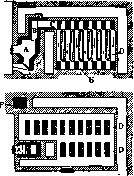
Figure 7. Section of a brick calorifier: A—firebox; B—ascending flue; C—distribution duct; D—smoke wells; E—collection duct; F—chimney.
These heaters consist of pipes with flat plates mounted on them. The entire element is coated with zinc to achieve a metallic bond between the pipes and the plates. Air is drawn at a significant speed (6 or more meters per second) through the narrow gaps between the plates (4 mm) and manages to warm up in the process. Due to the fact that the fast-moving air remains in contact with the heated surfaces for only small fractions of a second, the air spoilage occurring on the surfaces of the heating devices is significantly reduced. Plate heaters, despite their low weight and small dimensions, possess very high heat transfer. To regulate the temperature of the heated air, the heaters are equipped with a duct through which part of the air can be directed to bypass the heater; mixing with the air that has passed through the heater occurs before and within the fan. Air-heating chambers must be kept in the strictest cleanliness. The ducts of air heating must be accessible for cleaning; their inner surface must be smooth. Ducts are made of galvanized sheet iron, glazed clay pipes, or wood. Devices for air intake, purification, and humidification in the case of heating with fresh or mixed air do not differ from ventilation devices. The temperature of the air supplied to the room should not exceed 40°–50°C; when supplied to the area where people are present, it should be no higher than +25°C. Heating of large premises refers to a type where heating is performed by separate heating units, usually operating on steam. Each unit represents a small separate system of circulatory heating and consists of a heater, a fan, and a motor, joined together by a common casing forming a heating chamber. These units set the air into vigorous motion and at the same time deliver the required amount of heat to the room. The temperature of the supplied air is allowed up to 60°C (provided it enters zones where there are no people); the exit speed from the unit is up to 5 m/s; the units are placed at a height of about 2.5 m from the floor. Experience has shown that such a unit can serve an area of 20 m2. Placing the units at the exterior walls allows for the suction of outside air as well, thus achieving ventilation of the room. The problem of heating buildings, residential and otherwise, and heating entire cities and settlements is currently a massive economic and socio-hygienic task, closely linked with the general economic construction of the country. On one hand, major questions regarding the extraction and distribution of the country's fuel resources are raised here; on the other hand, the rationalization of the heating systems themselves, where the first place can now be given to its most centralized forms. Both sets of questions in the USSR are now pushed into the most relevant areas of the country's planned economy. The sanitary advantages of these centralized systems are obvious; at the same time, they are a powerful lever for the actual socialist restructuring of everyday life.
Related articles
Mentioned in
Cite this page
“Heating.” Soviet Medical Encyclopedia. English translation of Bolshaya Meditsinskaya Entsiklopediya, 1st ed. (Moscow, 1928–1936), ed. N. A. Semashko. https://sovietmedicalencyclopedia.pages.dev/article/heating/