Showers
Historical document, translated for reference. It reflects medical knowledge of the 1920s–30s and is not medical advice.
Summary
An overview of medical shower procedures (douches) using water, steam, or gas under pressure, detailing their physiological effects, various types such as the Charcot and Scottish showers, and therapeutic indications from 1930s balneotherapy.
Encyclopedia article (1928–1936)
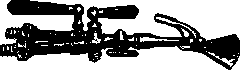
SHOWERS, procedures consisting in exposing the patient's body to jets of water, steam, or gas under moderate or strong pressure. Water showers were first introduced into medical practice by Fleury, and later in 1874 they were described by Beni-Barde under the name douche mobile. They gained widespread use only since the time of Charcot, who adopted reflex redness—i.e., hyperemia of the skin—as the criterion for the usefulness of the shower's action, and increased the pressure of the jet to achieve it. Depending on the method of application and the effect on the organism, a whole range of varieties is distinguished: they are used in the form of rain, as a widely dispersed pulverizing, fan-shaped, or condensed jet. Mathieu introduced the so-called "thread-like" or "needle" shower (douche filiforme), in which water emerges from a fine opening at the end of a pipe in the form of an extremely thin jet. Depending on the direction of the jet, showers can be ascending, descending, horizontal, or inclined; by the degree of pressure—weak and strong; by temperature—cold, warm, hot, constant temperature, alternating, progressive, or decreasing; by the site of action—general, local, and localized (in the latter, some point on the patient's body is subjected to particularly intensive action, e.g., the nape of the neck, the liver area, the spleen, etc.). The duration of the shower ranges within fairly wide limits, from 10–15 seconds to 3–4 minutes; the average pressure of the jet, which can generally satisfy all therapeutic requirements, is 2–21/2 atmospheres; however, some raise the jet pressure in individual cases up to 4–5 atmospheres (Winternitz). The temperature of the water used also ranges within the widest limits, from the lowest to the highest tolerated without danger to the skin. A shower in which cold and hot water fall onto the body surface in rapid succession bears the special name of the "Scottish" shower. Its technique is as follows: first, a hot jet (40–45°C) is directed at the patient for 15–20 seconds, and then a cold one (12–15°C) for the same duration. This alternation of hot and cold jets is repeated for 1–2 minutes several times. This procedure slows the rhythm of heart contractions and accelerates the number of respirations; blood pressure rises. Indications for the Scottish shower: neurasthenia, atony of the abdominal wall, obesity, uric acid diathesis, and rheumatoid diseases of both joints and muscles. The hot water jet is often replaced by a steam jet. It is necessary to ensure that the steam jet is, if not completely dry, at least without an admixture of hot water, which can burn the patient. Showers can sometimes be combined with each other (Fig. 1) or
Figure 1. Combined nozzle for flat fan-shaped and jet showers.
with other hydrotherapeutic procedures. The most frequently used in therapy is the horizontal jet shower, not quite correctly called the Charcot shower (Fig. 2). By changing the water temperature, pressure, direction of the jet, or duration of the shower, the physician can easily obtain the most desired effect with this shower. Water in this shower is ejected in the form of a jet from a metal nozzle fitted onto a rubber hose 0.5–1 m long. The patient stands at a distance of 2–3 m from the shower apparatus. The operator first directs a fan-shaped dispersed jet, and then a condensed one, successively to the back, side, chest, abdomen, and legs. To provoke a more intense reaction, especially in anemic individuals, it is recommended to proceed somewhat differently: before the shower, the patient is warmed up somewhat—regardless of whether in a general light bath, in a dry-air cabinet, or simply by rubbing the body with a rough cloth or coconut mitt. After the shower, the patient throws on a warmed dry coarse-cloth sheet, with which they dry their face, chest, and abdomen, while the shower assistant rubs their shoulders, back, lower back, and legs. Such rubbing after a shower is strongly recommended for patients who cannot warm up for a long time after the procedure. Figure 2. Triple-revolver or swivel nozzle for a jet shower, fan-shaped, and dispersed.
Figure 3. Nozzle for a rain shower: a—opening in the mesh; b—casing; c and d—fixing screw and tube; f—thread on the casing; g—screwed-on mesh with holes; h—holes in the tube.
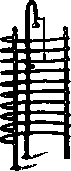
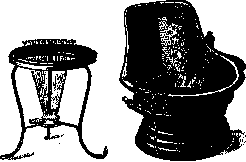
In addition to the jet shower, its modifications are used in practice. Rain shower (Fig. 3). Water falls in the form of rain under low pressure from a height of 1–11/2 m from a round sieve with a diameter of 10–20 cm. Such showers, falling on the patient's body from above, are often used to prepare particularly impressionable, nervous individuals for stronger procedures. Circular shower, shower-capilla (Fig. 4), or Manteldusche, consists of a number of tubes bent in the form of circles with numerous drilled holes and arranged horizontally. Water is ejected from these holes in the form of thin thread-like jets directed toward the center of the circles where the patient is located. The pressure under which the water flows out of the tubes must not be very high; otherwise, the jets, striking the skin with force, can cause droplets of blood to emerge from it. The ascending shower (Fig. 5) consists of a tripod with a seat circle. At the base of the apparatus, there is a tube from which a dispersed jet of water is forcefully ejected upward in the form of a fountain. The person taking this procedure sits on the device, and the jet thus acts mainly on the perineum and adjacent areas. These showers were introduced into medicine by J. Witte and recommended (Bransford-Lewis) for chronic prostatitis, hemorrhoids,
<"
Figure 4. Shower-capilla.
Figure 5. Sitz or ascending shower. Figure 6. Sitz bath in combination with a back shower. neurasthenia sexualis, and prolapsus ani. For a more tonic effect, they are usually applied moderately or very cold (10–12°C) and for 2 to 5 minutes. A gradually cooled shower is a warm shower whose temperature is gradually reduced from 30° to 20–10°C. The foot shower aims to divert blood from the head in case of congestion in the cerebral vessels or to prevent an influx of blood to it, which can occur with the sudden initial action of water, often observed in particularly sensitive, nervous people. The plantar shower has a twofold action: local and general. The latter depends on the location in the soles of many plexuses of sensory and motor nerves and a double network of blood vessels. Thanks to the reflex caused by the water jet, changes in blood circulation and an energetic diversion of blood to the lower extremities appear; in view of the above, the plantar shower is very useful in cases of blood stasis in the head, chest, abdominal, and urogenital organs. Among local showers, the cold occipital shower also deserves attention; due to its sharp effect on the rhythm and depth of respiration, it is used against asthmatic attacks as well as in diseases of the meninges. So-called combined procedures are often used, e.g., Charcot shower with a rain shower, high and low pressure shower, Charcot shower and full or partial bath (Fig. 6), etc. It has been established experimentally that combined procedures act significantly more energetically than each individually. The combination of a shower with massage should be especially noted. The jet under significant pressure is directed to individual parts of the body, which are simultaneously kneaded or massaged by a separate person. In showers on the spinal column, the jet is directed straight at the spine or on both sides of it. In the first case, they cause a sharp general excitation, while in the second, on the contrary, a calming effect is observed. Showers on the lower part of the spine act predominantly on the sexual nerve centers, as well as on the nerve apparatus of the abdominal organs and lower extremities. Showers on the upper part of the spinal column influence mainly the organs of circulation and respiration. During showers on the chest and abdominal regions, special caution is necessary to avoid trauma to the soft organs contained within them. Showers on the abdominal region are indicated for active or passive hyperemia of the kidneys, liver, spleen, as well as for constipation caused by both spasm and intestinal atony. In habitual constipation, a jet of water is often introduced into the rectum through special Arzberger or Winternitz devices. The latter is a kind of catheter a double courant, over which a thin fish bladder or rubber balloon is stretched. By regulating the inflow or outflow of water, the balloon can be stretched to any degree and thereby produce a kind of massage of the rectal walls. This procedure is especially useful for atonic constipation. In well-appointed balneological institutes, the control of showers is carried out from a single location, the so-called "shower console." The physician standing on it can put one or another shower into operation, regulate the water temperature and its pressure (Fig. 7). Depending on local conditions, the piping for steam, hot and cold water is arranged along the ceiling of the room, along the walls,
or under its floor. It is most advisable to install them openly, as it is easier to detect
d;]

in a human being consists of thermal and mechanical irritation of the skin by water. The combination of these irritations acts on the corresponding surface of the body, i.e., on the nerve apparatus and vessels embedded in the skin. It should be noted that the vasoconstrictor nerves are significantly more sensitive to these stimuli than the vasodilators, and therefore the irritation of the former appears earlier and more sharply than that of the latter. In the reaction, two moments or periods should be noted: the primary, which is the result of direct irritation of the vasoconstrictor nerves by the water jet, regardless of whether it is cold or hot (it is only important that the difference between it and the body temperature be quite large), and the secondary, which is a response to this irritation—a secondary or response reaction. In the first moment of the action of the shower, the vasoconstrictor nerves are irritated, the vessels constrict, blood rushes from them into the internal organs, as a result of which the skin becomes somewhat pale. With a more prolonged action of this stimulus, the primary constriction of the vessels may be replaced by their dilation due to a weakening of their tone or even due to complete paralysis of the vascular walls; in this case, the primary anemia of the skin may be replaced by its passive hyperemia. A reliable assistant is found in the second stimulus—the mechanical one—in the pressure of the jet. With its support, even if the lumen of the vessels expands, it is with the complete preservation or even strengthening of the contractile capacity of the latter and with an increase in their tone (Winternitz, excitation of the Hutchinsonian "skin heart"). The effect of the shower as an energetic hydrotherapeutic procedure varies significantly depending on the method of its execution, the duration of its action, the temperature of the water, and the height of the jet pressure. Following the application of a short-term shower, the tactile and thermal sensitivity of the skin increases. More prolonged showers can, on the contrary, lower its sensitivity in all respects. Cold showers strengthen the contractile capacity of both smooth and striated muscles, while warm ones and those of weak pressure reduce it.
Cold showers strengthen intestinal peristalsis, while warm ones soothe it. A stronger and sudden irritation by a cold or hot jet reflexively causes increased inhalation, increased lung ventilation, oxygen absorption, and carbon dioxide excretion. Heart activity under the influence of cold showers accelerates at first, but soon the acceleration is replaced by a slowing down. Conversely, a warm jet causes a slowing down at first, and then a slight acceleration. Heart contraction after cold is strengthened, and after heat, it is weakened. Under the influence of cold showers, pulse tension and blood pressure increase, the rise of the pulse curve becomes almost vertical, and the beats slow down; lukewarm showers do not affect the pulse, while warm or hot ones accelerate it and significantly lower the pressure. Cold showers increase nitrogen metabolism, strengthen appetite, improve sleep, cause a rise in strength, and improve general well-being. Strasser and Kuthy claim that under the influence of cold showers, the alkalinity of the blood increases, and under the influence of warm ones, on the contrary, its acidity increases. Already from this brief overview, it is clear what a diverse influence these procedures have on the body; by modifying them, it becomes possible to satisfy the most diverse indications through the use of showers. The choice of one or another shower is a matter of the physician's personal discretion, who must be strictly guided by the individual characteristics of the patient, the state of their nervous system, the nature of the disease, and the degree of its development. There is no place here for a template or stencil. The field of application for showers is primarily functional disorders of the nervous system, among which neurasthenia, hysteria, psychasthenia, etc., occupy the main place. In this same group, it is necessary to include patients suffering from impotence on the basis of functional disorders of the nervous system. Showers have an excellent effect in cases of metabolic disorders and disturbances in the functioning of the gastrointestinal tract, especially in chronic constipation based on atony or a spastic state. Here, a strong shower, directed at the abdominal area and breaking up into thousands of small sprays that strike the abdominal walls with force, can be likened to some extent to an abdominal massage, i.e., tapping or applying a multitude of small but strong blows. There are no absolute contraindications for the use of showers; on the contrary, there are quite a few relative ones. Among the latter, one can point, for example, to pulmonary tuberculosis with a tendency to hemoptysis, valvular heart defects, and general vascular sclerosis. However, by changing the elementary factors of this complex hydrotherapeutic agent (e.g., jet pressure and water temperature), it is possible to dose its action and commensurate it with the degree of development of the disease, the state of the patient's nervous system, and the ability of the latter to respond to irritation with a response reaction. Special caution is required when using showers in cases of aortic aneurysm and in clearly expressed sclerosis of the cerebral arteries with preceding embolism or apoplexy. In the latter cases, it is better to completely abandon the shower, as even with all precautions, there is no guarantee against the possibility of a recurrence of a stroke.
L. Veingerov. Nasal shower, or irrigation of the nasal cavity using an irrigator or siphon, was first introduced into the number of therapeutic agents by Weber (1864). It differs from infusions and injections in that with a nasal shower, the liquid flowing through the nose is in contact with the mucous membrane continuously for a longer time and under greater pressure. The use of a nasal shower is indicated in those cases of abnormal discharge where thorough cleansing of the nose from thick secretion and crusts is necessary in chronic hypertrophic and atrophic rhinitis; it is contraindicated in acute processes in the nose. The benefit of the nasal shower also lies in its influence on the nerve endings of the mucosa, on the vasomotor nerves, and on secretion directly or reflexively. Pure water irritates the nasal mucosa and can cause exacerbations and inflammation; the most commonly used are: physiological NaCl solution, 1% sodium bicarbonate, 1-2% boric acid, a weak solution of potassium permanganate, and at resorts—mineral waters, seawater, etc. The amount of liquid for one session is 1-2 glasses, with a temperature of about 22-25°C. When using a nasal shower, it is necessary to observe a number of conditions to avoid complications, especially severe ones involving the ears (inflammation of the middle ear). The height of the jet flowing through the rubber tube should not exceed 40-50 cm, and the nozzle inserted into the nostril should not close it tightly. Due to the reflexive elevation of the soft palate, a light jet of the solution, washing the nasal cavities and the nasopharynx, flows out through the other nostril. If this does not happen, the liquid flows into the lower parts of the throat and causes coughing and swallowing movements, during which the Eustachian tube opens. To prevent water from entering the middle ear, exceptional skill and attention are required each time, therefore, nasal showers should not be used for children. During the shower, the patient breathes through the mouth. After irrigation, it is forbidden to blow the nose for 10 minutes. Instead of a nasal shower, irrigation with a syringe, syringes, special funnels, or baths is used for the same purpose, but even with these devices, the danger of contracting ear disease is not excluded. At the present time, most doctors have completely abandoned the nasal shower and, in case of need, introduce liquid into the nose in small portions, for example, with teaspoons or a spray bottle. Drawing water in from the palm is especially dangerous. It has been proven that water does not enter the accessory nasal sinuses. Von Stein (1907) proposed a carbon dioxide shower, the jet of which is directed from a cylinder through special nozzles into the nasal cavity; it constricts the cavernous tissue, stops acute rhinitis, restores the sense of smell, and is useful in acute inflammation of the nasal sinuses. The healing effect is associated with its anesthetic property. L. Works.
The article "Showers" (Part 2 of 2) covers the physiological effects, therapeutic applications, and specific types of showers, including the nasal shower.
This concludes the translation of the article "Showers" from the Great Medical Encyclopedia.
Related articles
Mentioned in
Cite this page
“Showers.” Soviet Medical Encyclopedia. English translation of Bolshaya Meditsinskaya Entsiklopediya, 1st ed. (Moscow, 1928–1936), ed. N. A. Semashko. https://sovietmedicalencyclopedia.pages.dev/article/showers/