Medical Observation Stations and Points
Historical document, translated for reference. It reflects medical knowledge of the 1920s–30s and is not medical advice.
Summary
This article describes the Soviet system of maritime sanitary control established in the 1920s to prevent the introduction of infectious diseases via international shipping. It details the infrastructure, staffing, and operational procedures for inspecting, isolating, and disinfecting vessels arriving from abroad.
Encyclopedia article (1928–1936)
MEDICAL OBSERVATION STATIONS AND POINTS, established, mainly, on sea coasts for the sanitary protection of maritime borders against the introduction of infectious diseases into the country. In view of the special sanitary-epidemiological conditions of maritime transport, the sanitary protection of maritime borders has long been a subject of special concern for states all over the world. A whole series of international measures for the sanitary protection of borders against the introduction of infectious diseases was established by the Paris Sanitary Convention in 1903 and confirmed by the sanitary conventions of 1912 and 1926 (see Conventions). According to the "Provisional Regulations on the Sanitary Protection of the Borders of the USSR" of 1925 (for the implementation of measures for the sanitary protection of the maritime borders of the USSR), the union republics established maritime Medical Observation Stations, at least one on the coasts of each of the seas along which the state border of the USSR passes; in all other most frequently visited ports of the USSR, maritime Medical Observation Points were established. In less frequently visited ports, the duties of Medical Observation Points may be assigned to local port medical-sanitary supervision bodies. Medical Observation Stations and Points must have the following sanitary facilities: isolation stations, an observation bathhouse, a laundry, a laboratory with 4 departments (plague, sanitary-hygienic, bacteriological, and clinical), an admission ward, a pharmacy, a disinfection installation, and deratization equipment, then floating (boats, motor launch) and land transport means, and, finally, service facilities—a kitchen, sheds, and premises for personnel; the points, however, must have an isolation ward, showers or a bath, field-type laboratories (bacteriological and sanitary-hygienic), a disinfection chamber, equipment for the disinfection and deratization of ships, and a pharmacy. The staff of a station or point is as follows: a manager, duty doctors and medical assistants, a laboratory manager, a laboratory technician, a business manager, orderlies, a disinfection squad, a rat-extermination squad, and housekeeping personnel. Maritime Medical Observation Stations, having the necessary sanitary installation, equipment, and staff, can accept all kinds of ships (passenger, tug, pilgrim) dangerous due to one infection or another for complete sanitary processing. Medical Observation Points, as they have incomplete sanitary equipment and limited staff, cannot accept all ships arriving at the port for sanitary processing; they do not accept: a) ships on which there are or were during the sea voyage patients with plague or cholera, b) ships having on board in general more than 10 patients with infectious diseases; these ships are directed by the Medical Observation Points to the nearest Medical Observation Station. According to the "Provisional Regulations on the Sanitary Protection of the Borders of the USSR," all ships arriving from abroad are divided according to their sanitary condition into infected, suspected, and uninfected. A ship is considered infected if it has patients with plague, cholera, yellow fever, typhus, or relapsing fever and smallpox, or if there were cases of cholera, plague, or yellow fever within the last 7 days, relapsing fever within the last 8 days, and typhus and smallpox within the last 14 days before arrival at a USSR port. A ship is considered suspected if there were cases of cholera, plague, yellow fever, typhus or relapsing fever, and smallpox when the ship left the port of departure or during the voyage, but there was not a single new case of the named diseases (for cholera, plague, and yellow fever within the last 7 days, for relapsing fever within the last 8 days, and for typhus and smallpox within the last 14 days before arrival at a USSR port). A ship is recognized as uninfected if, arriving even from an infected port, it had no cases of plague, cholera, yellow fever, typhus, relapsing fever, and smallpox either upon leaving the port of departure, or during the sea voyage, or at the moment of arrival at a USSR port. Depending on the category of the ship (infected, suspected, and uninfected), the Medical Observation Station and Point apply certain sanitary measures to the ships, according to the "Provisional Regulations on the Sanitary Protection of the Borders of the USSR." In particular, the following duties are imposed on Medical Observation Stations and Points.
1. Meeting by the duty doctor for the purpose of conducting a sanitary inspection of ships arriving at the port and departing for foreign voyages. Each ship that has arrived from abroad at a USSR port stops at the place indicated to it by the port authorities and hoists a yellow flag on the foremast, and if there is a patient with an infectious disease on the ship (plague, cholera, yellow fever, smallpox, typhus, or relapsing fever)—a black flag. The ship remains under the yellow or black flag until the moment it is granted the right of "free pratique" from a sanitary point of view by the duty doctor of the station or point. Until the sanitary inspection of the ship is conducted, no one, except the pilot, may board or leave the ship; until the permission of the duty doctor of the station or point is given, no authorities may issue any orders regarding the disembarkation of passengers, unloading of goods, livestock, etc. 2. To conduct an interrogation of the ship's captain and the ship's doctor (if there is one on the ship) to clarify the sanitary conditions of the arrived ship; the answers of those questioned are entered into a printed form of the questionnaire of the established format, signed by the captain and the ship's doctor. The information obtained is verified by the doctor of the station or point by examining sanitary documents (sanitary patent, documents certifying the implementation of sanitary measures in the port of departure or intermediate ports). 3. Upon clarifying the sanitary conditions of the ship by questioning the captain or the ship's doctor and checking the documents, the representative of the Medical Observation Station or Point (duty doctor) conducts a sanitary inspection of the ship's premises, and depending on the sanitary conditions, classifies the given ship (guided by the "Provisional Regulations on the Sanitary Protection of the Borders of the USSR") into one or another category of sanitary condition and either immediately issues the ship sanitary permission for the right of free pratique (voyage) or orders the ship to carry out certain sanitary measures, guided by the current regulations. 4. Persons arriving from areas infected with plague, cholera, yellow fever, typhus, relapsing fever, or smallpox, as well as persons who themselves declare their illness, or whom other passengers point out as sick, are subject to a medical examination. In the case where a ship is recognized as "infected," all persons are subject to a medical examination; the ship's crew and passengers. 5. Patients discovered on the ship (with plague, cholera, yellow fever, typhus, relapsing fever, or smallpox) are isolated and transported to the shore to special isolation premises at the Medical Observation Station or Point. Patients with other infectious diseases are sent to the appropriate medical institution. 6. Persons who have come into contact with patients with plague, cholera, or yellow fever are placed in observation premises at the Medical Observation Station or Point. During observation, the persons under observation undergo complete processing—washing in a bath, disinfection, disinsection. Medical-sanitary service and food for those under observation are provided at the station or point free of charge. The period of observation is set at 5 days for plague and cholera, and 6 days for yellow fever. In some cases, observation is permitted on the ship itself with the consent of the captain and provided that there is a doctor and a disinfection chamber on the ship. 7. Establishment of medical observation (see) for persons arriving on infected ships. 8. Sanitary processing of the ship. Disinfection, disinsection.
1-gates; 2-wickets; 3-water reservoir for 550,000 liters; 4-morgue; 5-sheds; 6-pumping station; 7-bridges; 8-stables; 9-premises for experimental animals; 10-laboratory; 11, 12, 13, 18-premises for station staff; 12-observation booth; 14-infectious disease barracks; 15-somatic hospital; 16-ice house; 17-pier; 19-kitchen; 21-laundry; 22-storehouse; 23-guard observation tower; 24-chancellery; 25-upper observation building; 26-lower observation building; 27-power station; 28-boiler room; 29-baths; 30-disinfection and disinsection premises.
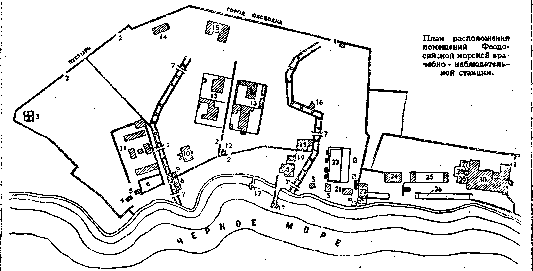
MEDICAL OBSERVATION STATIONS AND POINTS
and deratization on ships are applied in cases provided for by the "Provisional Regulations on the Sanitary Protection of the Borders of the USSR" (to infected and suspected ships). In addition, disinfection and disinsection may be applied in cases of a clearly unsanitary condition of ships and upon the establishment of overcrowding of passengers. Ship premises, cargo, luggage, etc., may be subjected to disinfection and disinsection. On ships infected with cholera, drinking and ballast water are subjected to disinfection. Disinfection and disinsection of the ship's crew and passengers (washing in a transit bath, disinfection and disinsection of linen, clothing, luggage) are carried out in premises adapted for this purpose at Medical Observation Stations and Points. Deratization (see) is applied in cases provided for by the "Provisional Regulations on the Sanitary Protection of the Borders of the USSR" and, in addition, upon the discovery of an abundance of rats on a ship or mass mortality among them—in the case of the discovery of plague-infected rats on a ship. Furthermore, the station or point applies measures against the movement of rats from the ship to the shore and vice versa, for which shields, funnels, mooring discs, etc., are attached. 9. Administration of prophylactic vaccinations against cholera and smallpox to the crew and passengers. 10. Sanitary-educational work among the crew and passengers. In the USSR, there are the following stations possessing all the necessary installations and means for receiving ships in accordance with the International Sanitary Convention and Art. 33 of the "Provisional Regulations on the Sanitary Protection of the Borders of the USSR": on the coast of the Black Sea—in Feodosiya (see figure), Odessa, Novorossiysk (under construction to replace the former Plague Town and Medical Observation Point), and Batum; on the Caspian Sea—in Baku, Krasnovodsk, and the 12-foot roadstead in Astrakhan; on the Baltic Sea—in Leningrad (under construction to replace the Medical Observation Point); on the White Sea (Northern Dvina)—in Arkhangelsk; on the coast of the Pacific Ocean—in Vladivostok. - Maritime Medical Observation Points, possessing devices and equipment ensuring, in case of necessity, the application to ships of sanitary measures in accordance with the International Sanitary Convention and the "Provisional Regulations on the Sanitary Protection of the Borders of the USSR," are the following: on the Black Sea—in Nikolaev, Kherson, Yevpatoriya, Sevastopol, Yalta, Kerch, Tuapse, Poti, Sukhumi; on the Sea of Azov—in Rostov-on-Don, Taganrog, Mariupol, Berdyansk, Yeysk, Temryuk; on the Caspian Sea—in Makhach-Kala (formerly Petrovsk) and Lenkoran; on the Baltic Sea—in Kronstadt, Shlisselburg; on the Arctic Ocean—in Murmansk; on the Pacific Ocean—in Tetyukhe, Samarga, Sovetskaya Gavan, Bolsheretsk (Kamchatka), Petropavlovsk (Kamchatka), Aleksandrovsk (Sakhalin), and Nikolaevsk-on-Amur.
Related articles
Mentioned in
Cite this page
“Medical Observation Stations and Points.” Soviet Medical Encyclopedia. English translation of Bolshaya Meditsinskaya Entsiklopediya, 1st ed. (Moscow, 1928–1936), ed. N. A. Semashko. https://sovietmedicalencyclopedia.pages.dev/article/medical-observation-stations-and-posts/