Sanitary-Quarantine Point
Historical document, translated for reference. It reflects medical knowledge of the 1920s–30s and is not medical advice.
Summary
This article defines the Sanitary-Quarantine Point (S.-p. p.), a preventive institution tasked with mass sanitary processing of civilians and military units. It details the points' strategic locations, their role in preventing infectious disease importation, and their operational procedures, including medical inspection, disinfection, and isolation of contagious cases.
Encyclopedia article (1928–1936)
Sanitary-Quarantine Point is a sanitary-preventive institution that performs the task of mass sanitary processing of arriving and moving masses of civilian population and military units; simultaneously with mass sanitary processing, the sanitary-quarantine point ensures the possibility of identifying contagious patients and persons suspected of infectious diseases during its work. Thus, S.-p. p. serve the purpose of protecting a given populated area (industrial center, new construction, etc.) from the importation and spread of contagious diseases by significant groups of population arriving in it or passing through it (conscripts, arriving for territorial mobilization, moving military units, workers heading to or arriving at industrial construction sites, seasonal work, etc.). The locations for establishing S.-p. p. are: a) major junction and transit points of railway and water communications; b) large urban and industrial centers to which masses of workers arrive due to their economic and economic importance; c) points of beginning and developing construction; d) agricultural points with constant arrival and departure of seasonal labor; e) populated areas having strategic importance; f) medical observation stations and points organized at the state borders in case of border closure due to the danger of importing infections; and g) other points where protecting them from infection importation represents special interest for the state. During the years of imperialist, and then civil war, the construction of S.-p. p. took place primarily along the main lines of mass movement by railway and water communications and at points of defensive significance. In the subsequent recovery and reconstruction period, the need for developing a powerful network of S.-p. p. in industrial centers and regions of development of certain industries (coal, chemical, etc.), in points of new construction, in places connected with mass recruitment and movement of labor force, and in individual large cities (Moscow, Leningrad, Kharkov, Sverdlovsk, etc.) was revealed. By eliminating or reducing the number of imported cases of contagious diseases, S.-p. p. help local sanitary authorities conduct a systematic struggle against the spread of infection. During the first five-year plan and the beginning of the second, the number of S.-p. p. grew noticeably (e.g., in the RSFSR there were 62 S.-p. p. in 1931, 125 in 1932, and 166 in 1933). By their design and sanitary-technical equipment, S.-p. p. must give full possibility to conduct simultaneous mass sanitary processing of people and things found with them within the shortest time, ensure appropriate medical inspection of those arriving at the point, identify from their midst persons requiring individual sanitary processing, as well as patients and persons suspected of infectious diseases. The maintenance of identified patients and suspects at the S.-p. p. should not pursue therapeutic purposes directly, but only preventive ones, and therefore it should be as brief as possible (not more than a few hours), ensuring only the possibility to organize the correct direction of patients to the appropriate medical institution. Only the remoteness of the latter or the insufficiency of beds in it can cause the necessity to include in the functions of S.-p. p. bed maintenance of identified patients, which forces one to classify such a type of institution as an isolation S.-p. p. (see Isolation-Quarantine Points). Thus, S.-p. p. has the following circle of tasks regarding those arriving at the point: a) to accept and register, organizing short-term maintenance of the arriving (waiting, food, lodging) until the moment of sanitary processing; b) to ensure the arriving with medical inspection and in case of necessity first medical aid; c) to conduct sanitary processing (haircut, shower washing) of people, disinsection (and in case of necessity disinfection) of their clothing and linen and simultaneously reliable disinfection of luggage (without allowing its damage or significant delay); d) to organize individual sanitary processing of persons identified during medical inspection (e.g., scabies, etc.); e) to conduct isolation measures and subsequent evacuation of persons intended to be sent to medical institutions; f) to conduct vaccinations with appropriate registration (the latter is especially important for the purposes of subsequent control) against smallpox, the first vaccination against typhoid fever, etc., in accordance with epidemiological indications. It is advisable to place arriving parties (or individual groups from their composition) according to sanitary-epidemiological indications, distributing them after sanitary processing to temporary housing (for the duration of the possible incubation period) on the territory of the S.-p. p. in special observation barracks, usually simultaneously enlisting them for work (duration of stay up to 10-12 days). This order also ensures the most complete coverage of the arriving with subsequent preventive vaccinations (e.g., the 2nd and 3rd vaccinations against typhoid fever). However, it should be noted that with pronounced fluidity of labor force or with the movement of significant masses (military units, refugees, etc.), this measure is not always justified, since in these cases, firstly, it is not possible to have living space of necessary dimensions, and secondly, such barracks can be populated with permanent residents in a short time. In such cases, it is more expedient to regulate temporary isolation of newly arriving persons in places of their permanent residence by distributing each party to specially allocated premises with ensuring them with necessary medical-sanitary supervision and regime. Compulsory identification and distribution into isolated premises require, in this case, working persons suffering from various infectious and other diseases representing a danger to others (e.g., trachoma, scabies, etc.). It should be considered desirable to service persons undergoing sanitary processing with simultaneous washing of their dirty linen found with them; however, this can be realized only at S.-p. p. of large capacity, where the equipment of the laundry part can be fully mechanized and thus the simultaneous issuance of washed linen upon completion of the sanitary processing process is ensured. In accordance with the described volume of work, S.-p. p. contains the following parts: 1) waiting barracks (at railway and water points, in addition, arrival platforms), 2) premises for reception, disinfection of luggage, storage and issuance of it in clean form, 3) sanitary pass with all its necessary constituent parts, 4) appropriate premises, equipment and apparatus for medical-sanitary inspection and service of the arriving (medical offices, stretchers for patients, thermometers, syringes, etc.), 5) transport for transporting patients, 6) sanitary-technical and heat-power installations (water supply, sewage, boiler houses and water-heating installations, etc.), service premises (for transport, fuel, property), guard huts, yard toilets, etc. One must distinguish S.-p. p. from the so-called sanitary passes, in which the limited functions do not give the possibility to conduct work on mass sanitary processing in such an expanded form as S.-p. p., and the work of pass baths as an object replacing S.-p. p. should be considered even less effective. Both of these latter institutions, as is seen from the above, carry out only one of the tasks included in the duty of S.-p. p. as a more powerful and comprehensive sanitary-preventive institution. Depending on the nature of the S.-p. p. contingents served, significance and other features of the populated area, one should distinguish types of S.-p. p. serving transport, intended for service of military units, as well as arriving contingents in cities, industrial centers, new constructions, sovkhozes, etc., keeping in mind that the general capacity of S.-p. p. and the volume of individual elements included in its composition are determined by the features of each of the named points. Special attention should be given to the nature of mobile sanitary-quarantine points.
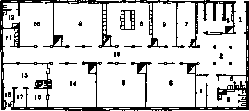
Figure 1. Waiting Barracks: 1-arrival entrance; 2-lobby; 3-locker room; 4-service; 5-women's toilet; 6-men's toilet; 7-personnel; 8-room for 25 people; 9-first aid room; 10-children's room; 11-washstand; 12-children's toilet; 13-corridor; 14-snack bar; 15-food service room; 16-dishwashing sink; 17-storage room; 18-entrance and exit of canteen personnel.
passing points (train) on railways, which make it possible to change the territory of their activity by moving such specially equipped train compositions along the line (the same applies to floating sanitary-passing points or sanitary-observation stations on waterways of communication). Modern design and construction1 of sanitary-quarantine points pursue the task of ensuring the correct execution of all technological processes occurring according to a strictly constructed schedule of movement and time under conditions of separating dirty processes from clean ones, which in turn ensures high efficiency of work both of the point as a whole and of its individual elements. The main sanitary-technical requirements are as follows: 1) The territory allotted for a sanitary-quarantine point must guarantee the possibility of dividing it into two isolated parts from each other, so that when allotting places for individual buildings, the functional connection between them must be strictly taken into account, as well as the rational direction of movement of human and material flows (it is necessary to avoid counter-movements between them). 2) The layout of the main link - the sanitary passing point - must provide full possibility of coordinated work of cells leading to the processing both of people (group and individual shower baths) and of things (the disinsection part of the passing point). 3) Sanitary-technical equipment of a sanitary-quarantine point and special equipment (disinfection and disinsection installations, laundry, etc.) must fully correspond to the throughput of the serviced links and give the possibility of maximum effective exploitation of them. 4) The heating system (water-heating installations, heating) must be calculated for heating water in tanks, heating all premises and ensuring the necessary thermal regime of chamber installations taking into account the most intense moments of work of a sanitary-quarantine point and its individual parts. As an approximate and typical project of a sanitary-quarantine point of medium power (waiting barracks for 100 people, a sanitary passing point with a capacity of 48 people per hour, with a number of beds for short-term isolation - 4) in Fig. 1 and 2 is presented the project developed by the disinfection bureau CIEM of the NKZdr RSFSR and approved by the Scientific Technical Council of NKHoz. A very responsible part of a sanitary-quarantine point is its disinsection part. In a sanitary-quarantine point of small power (with a capacity of the sanitary passing point of 30-40 persons per hour) the question is solved by installing the simplest disinsectors of one or another system, for example, the Levinson and Chernoschekov system and others; a sanitary-quarantine point, which is more powerful and has high-pressure steam, is expediently equipped with more complex apparatus, for example, disinsectors working on the principle of hot moving air (such installations ensure reliability of disinsection, preservation of things and are not dangerous from a fire point of view - see Disinfection Chambers). Disinsection of luggage at a sanitary-passing point is carried out by the most effective for these purposes gas method, for which a sanitary-quarantine point is equipped with a separate link - an outdoor gas chamber for processing things with cyanide, chloropicrin and others with corresponding premises - for storing things before and after processing. When organizing work at a sanitary-quarantine point it is necessary to strictly coordinate with each other processes coinciding in time (washing of people, disinsection of things and washing of linen) and sequentially following one after another (waiting of arrivals in barracks and transition to the sanitary passing point, haircutting, medical examination and undressing, etc.), to isolate dirty processes from clean ones, distributing the work of personnel to processes serving clean and dirty premises; to provide the necessary hygienic regime, especially for personnel engaged in dirty processes of work. All the indicated requirements for individual groups of workers and individual persons are regulated by the corresponding rules of internal order, the basis for the development of which should be the schedule of work established for the given sanitary-quarantine point.
Related articles
Cite this page
“Sanitary-Quarantine Point.” Soviet Medical Encyclopedia. English translation of Bolshaya Meditsinskaya Entsiklopediya, 1st ed. (Moscow, 1928–1936), ed. N. A. Semashko. https://sovietmedicalencyclopedia.pages.dev/article/sanitary-quarantine-point/