Sanitary Station
Historical document, translated for reference. It reflects medical knowledge of the 1920s–30s and is not medical advice.
Summary
A sanitary station is a comprehensive social-hygienic and sanitary institution that includes all elements of sanitary-epidemiological work, with the task of improving populated areas and living conditions, providing qualified sanitary services to the population, and preventing and combating acute infectious diseases.
Encyclopedia article (1928–1936)
Sanitary Station, a unified complex social-hygienic and sanitary institution, which includes all elements of sanitary-epidemiological work and has as its task the practical work on improving populated areas and living conditions, qualified sanitary service to the population, and the prevention and combat of acute infectious diseases. S. s., being one of the most perfect organizational and technical forms of organizing sanitary affairs, eliminate the previous fragmentation of sanitary forces, provide a technical base for sanitary-epidemiological work and thereby raise sanitary affairs technically to the highest level. In their structure and nature of activity, they correspond to the new forms and tasks of socialist healthcare. For the first time, S. s. as a new universal and complex form of organizing sanitary structures was proposed by the VI All-Ukrainian Sanitary Council in 1927. In 1931, S. s. were approved by the Council of People's Commissars of the Ukrainian SSR. In 1932, the I All-Union Conference on Healthcare Planning and Workers' Rest (Moscow) approved the organizational structure of S. s. The greatest development of S. s. in the USSR at the present time has occurred in Ukraine, where as of January 1, 1933, there were 131 of them. Functions of S. s. Regardless of its type and size, each S. s. in the territory it serves must, to one degree or another, perform the following functions: 1) social-hygienic, sanitary and epidemiological study of its district (group of districts, area, city); 2) development and planning of all health-improving, sanitary and anti-epidemic measures; 3) management of all current sanitary-epidemiological affairs; 4) sanitary service to workers in the field of: a) general sanitary supervision, b) communal sanitation, c) housing hygiene, d) nutrition hygiene, e) industrial sanitation, f) sanitary education; 5) sanitary-technical and hygienic consultation for the population, institutions, economic bodies and organizations; 6) implementation of mass health-improving measures; 7) organization of the self-activity of workers; 8) development of local mandatory sanitary regulations and control over their implementation; 9) prevention, combat and elimination of epidemics: a) preventive vaccinations, b) early diagnosis of infectious diseases, c) disinfection and disinsection, d) mass and group sanitary treatment of the population, e) detection and combat of bacillary carriers, f) isolation and hospitalization of patients with acute infectious diseases, g) detection, sanitary treatment and improvement of foci, h) anti-malarial measures, i) combat with rabies and helminthic diseases; 10) conducting chemical, bacteriological and serological research.
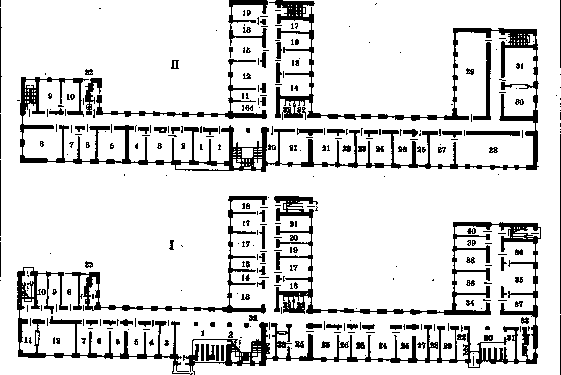
Figure 1. Central urban sanitary station. First floor: 1-entrance with vestibule; 2-concierge; 3-research reception; 4-machine bureau; 5-office; 6-head of station; 7-head of household; 8-accounting department; 9-supplies; 10-household room; 11-preparation room; 12-meal room; 13-waiting room; 14-helminthological office; 15-manipulation office; 16-malarial office; 17-laboratories; 18-laundry; 19-supplies; 20-household room; 21-examination room; 22-restrooms; 23-registration; 24-waiting room; 25-vaccination; 26-head of vaccination department; 27-preparation room; 28-household room; 29-supplies; 30-entrance with vestibule; 31-concierge; 32-showers; 33-restrooms; 34-head of epidemic bureau; 35-waiting room; 36-epidemiological office; 37-hospitalization room; 38-disinfection duty room; 39-supplies; 40-household room. Second floor: 1-sanitary police; 2-attached physicians; 3-waiting room; 4-population self-activity; 5-public authorized representative; 6-head of bureau; 7-secretary; 8-meeting room; 9-local committee; 10-cell; 11-head of sanitary bureau; 12-waiting room; 13-sanitary-housing physician; 14-sanitary physicians; 15-sanitary-food physicians; 16-sanitary technicians; 17-secretary; 18-supplies; 19-head of statistics bureau; 20-statistics room; 21-hygienic consultation; 22-room for club activities; 23-room for visual aids; 24-head of sanitary inspection; 25-employees' room; 26-head of sanitary-hygienic bureau; 27-employees' room; 28-smoking room; 29-hall; 30-museum; 31-book repository; 32-reading room; 33-restrooms.
Classification of S. s. Depending on the territory served, S. s. are divided into the following types. A. In districts. 1. Inter-district S. s.-an oblast institution serving a group of districts (8-10) with highly qualified sanitary, sanitary-technical, laboratory and anti-epidemic assistance, directing the activities of district S. s., eliminating the largest epidemic outbreaks in districts. 2. District urban S. s. (Fig. 2). Organized in large cities for sanitary-epidemiological service of administrative districts of the city (district councils) with a population of 100,000 people and more. 3. Area urban S. s. Organized and included in the system of the corresponding unified dispensary (or polyclinic), serves an area of the city or suburban zone with a population of about 25,000 residents, conducts all health-improving, sanitary and anti-epidemic work in its territory, having for this purpose the necessary sanitary-epidemiological personnel and installations in its composition. In less large and small cities, the function of the central urban S. s. is performed by one of the district or area S. s. Structure of sanitary stations. S. s. of all types basically have one standard construction: 1) administrative-economic part; 2) sanitary department: a) sanitary bureau, b) sanitary-hygienic laboratory, c) sanitary-educational base; 3) epidemic department: a) epidemic bureau, b) bacteriological laboratory, c) vaccination department (point, detachment), d) disinfection base (disinfection station, disinfection point, disinfection brigades), e) isopropunkt for sanitary treatment, f) epidemic equipment (infectious beds), g) transport, h) malarial department (point, detachment), i) Pasteur department (point). Depending on the type of S. s. and its capacity (industrial and rural district), its structure may be more or less complex. Technical equipment of S. s. All S. s. must be sufficiently technically equipped. Basically, this equipment should consist of: 1) sanitary-bacteriological laboratory, 2) disinfection station, disinfection chambers, disinfection inspectors, 3) isopropunkt, mobile bath-laundry installations, 4) sanitary-educational exhibitions, visual aids, libraries, 5) reserve epidemic beds, 6) transport. The degree of this equipment depends on the type and size of the S. s.

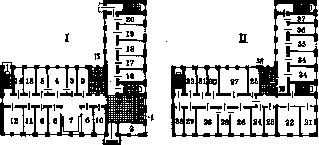

Personnel of sanitary stations. S. s. must have a quantitatively sufficient and qualitatively differentiated personnel: sanitary physicians of general sanitary services and (in cities and industrial districts) specialists (epidemiologists, housing-communal, food, sanitary educators), assistant sanitary physicians, laboratory assistants, vaccination and disinfection personnel. Below is a standard staff of S. s. with full deployment of their structure and activities (at the end of the second five-year plan in the Ukrainian SSR): San. stations physicians assistants vaccination disinfection other Total Inter-district sanitary station....... District sanitary station......... Area sanitary station in district .... Central urban sanitary station . . District urban sanitary station .... Area urban sanitary station .... Construction of S. s. The large-scale and diverse in character work of S. s., their structure and technical equipment require placement in buildings built according to certain standard designs. In Figs. 1 and 2 are shown standard designs adopted in Ukraine (developed by the standardization and design department of the All-Ukrainian Institute of Social Healthcare).
Related articles
Mentioned in
Cite this page
“Sanitary Station.” Soviet Medical Encyclopedia. English translation of Bolshaya Meditsinskaya Entsiklopediya, 1st ed. (Moscow, 1928–1936), ed. N. A. Semashko. https://sovietmedicalencyclopedia.pages.dev/article/sanitary-station/