Disinfection Stations
Historical document, translated for reference. It reflects medical knowledge of the 1920s–30s and is not medical advice.
Summary
Disinfection stations are institutions equipped with disinfection apparatus for treating various items and materials, forming part of a comprehensive sanitary system. The article describes their historical development, structural requirements, and operational components.
Encyclopedia article (1928–1936)
Disinfection stations, points, are institutions in which disinfection apparatuses (chambers) are installed for the disinfection of various items and materials. D. s. are part of the complex of sanitary institutions that constitute
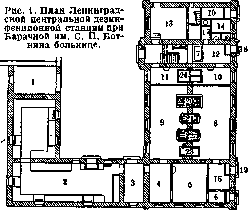
1-storage for disinfectants and materials; 2-storage for disinfected items; 3-room for issuing disinfected items; 4-station office; 5-director's office; 6-waiting room for persons bringing contaminated items to the station; 7-concrete tank for soaking linen; 8 and 9-contaminated and clean halves of the disinfection station-work hall; 10-loading area for contaminated linen; 11-unloading area for disinfected linen; 12-receiving room for items from the hospital; 13-laundry for staff, with adjacent stairs to the second floor; 14-shower room for sanitary processing of disinfectors; 15-dressing room for disinfectors of the contaminated half; 16-receiving room for items arriving from the city; 17-dressing room for disinfectors of the contaminated half; 18 and 19-entrances to the contaminated half; 20-cabinet-type apparatus of the Krupin system; 21-cylindrical apparatus of the Krupin system; 22-universal vacuum apparatus of the Taranukhin system; 23-formaldehyde chamber for disinfection according to Flügge; 24-disinfection boilers (2).
the so-called "disinfection service" of a given locality. This complex includes: 1) D. s., 2) disinfection detachments or disinfection bureaus, 3) isolation huts (see) or apartments, 4) sanitary-check points or sanitary-check baths, 5) various types of transport for contagious patients, infected items, etc., 6) workshop for repairs, 7) laboratory for control of disinfectants, 8) school for training disinfection personnel. Among these institutions, disinfection stations are the main ones operationally uniting all the named institutions.-The establishment of the first public-use stations dates to the beginning of the 1880s, a time when disinfection science had just received its scientific foundation. In Russia, the first public-use D. s. was opened in 1883 in St. Petersburg, at the Barracks Hospital. This D. s. was under the direction of Dr. Krupin, who widely developed its activities. In those same years, D. s. began to open in a number of other cities (Berlin-1886, Paris-1889, Milan-1889, Odessa-1887, etc.). In the establishment of D. s., the following requirements must be observed: 1) complete division of the institution into 2 parts: contaminated (dirty) and uncontaminated (clean), with the arrangement that all activities of the institution be subordinate to this division; 2) personnel on the contaminated half must be provided with reliable cleansing after completion of work, for which a "lock" must be arranged; 3) the contaminated half must have a room for receiving, sorting, and registering items arriving for processing; 4) there should also be a room for persons accompanying items to the station and for their sanitary processing; 5) the clean half of the D. s. must have: a) sufficient space for work, b) a room for the office, c) a room for storing items being disinfected, disinfectants, and small auxiliary equipment, d) a room for the physician, head of the institution, for a museum and for a laboratory. With the D. s., space must be provided for a boiler room, for fuel storage, and a number of other auxiliary institutions (workshop, garage, shed, apartments for staff, etc.).-The development of plans for large D. s. is now satisfactorily resolved; many examples of such an arrangement can be pointed out [Milan, Paris (new), Berlin-Schöneberg (new) and Neukölln (new), connected with an isolation house and equipped with a powerful processing station for sanitary processing of schoolchildren, Leningrad at the Barracks Hospital (see fig. 1), etc.]. It is much more difficult to arrange D. s. for small populated places. Corresponding plans were developed by Levashov. The scheme of Levashov's stations can be considered suitable for serving the population of small cities (less than 50,000 people). In fig. 2 is presented a project of a D. station with an isolation house, developed by the sanitary-epidemiological department of the People's Commissariat of Health of the RSFSR, and in fig. 3-a project of a disinfection point. Based on the experience of the world war, it can be considered necessary when building D. s. to present the following requirements: 1) a fully equipped D. s. for small cities should have an apparatus for disinfection with live steam, a formaldehyde apparatus (preferably steam-formaldehyde) and a boiler for disinfection of linen, as well as a tank for preliminary soaking; 2) Japanese-type chambers, when properly equipped under conditions of skillful use, satisfy almost all practical requirements; their advantage is that in addition to disinfection they can ensure the extermination of insects; 3) for proper disinfection, the appropriate design of D. s. buildings is extremely important, for which a) the building in which the apparatuses are located must be divided into 2 completely separate parts-contaminated and clean; b) at the contaminated half, a "lock" for personnel must be arranged, consisting of rooms for personnel cleansing, a shower compartment, a special undressing room and dressing room, and a toilet; c) all disinfection chambers must have an exit (doors) to both the clean and contaminated halves; d) all rooms of the station must be light and well heated;

I vta sh
he best is separate for the contaminated and clean halves. With D. s., a disinfection bureau for residential disinfection, carried out by visiting infected apartments and other premises, should be equipped. This bureau should be provided with personnel, disinfectants, and equipment. Railway disinfection stations can 3 be stationary and mobile. Mobile D. s. are usually arranged in a car and equipped with a universal vacuum apparatus and boiler or a steam-formaldehyde chamber and boil- "S 7 J
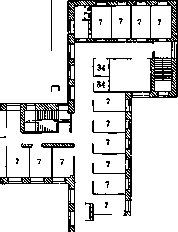
II floor
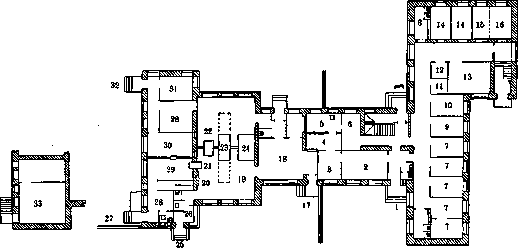
Figure 2. Design of a disinfection station and isolation building: 1-entrance to the isolation ward; 2-waiting room; 3-examination room; 4-changing room; 5-bathroom; 6-dressing room; 7-rooms for those being isolated; 8-washroom; 9-clothing storage; 10-office; 11-closet; 12-linen room; 13-dining room; 14-office premises; 15-buffet; 16-kitchen; 17-entrance to the dirty section; 18-sorting room; 19-infectious disease ward; 20-fireplace; 21-disinfection tank; 22-disinfection chamber; 23-steam chamber; 24-Japanese chamber; 25-entrance to the infectious disease ward chamber; 26-airlock; 27-entrance to the laundry; 28-room for storing linen; 29-laundry room; 30-room for the head of the station; 31-watchman; 32-service entrance; 33-boiler room; 34-storage room. d) operation of the chambers should be carried out from the clean side; 4) the station building should be designed so that it can easily be expanded if necessary to install new equipment; 5) it is extremely advisable to jointly organize D. s. and a public bath (shower), which should be designed according to the type of a public bath (shower); entrances to the bath and disinfection station should be isolated from each other (see Baths); 6) D. s. should be under the management of a special physician or a physician from the infectious disease ward of a hospital; 7) D. s. should be served by trained personnel, preferably a physician. To the car in which the disinfection equipment is installed, another car is attached for medical-sanitary personnel, for isolating the patient and for transporting him to a key medical institution. Railway mobile disinfection stations have special significance during wartime, when the disinfection car is usually included in a special sanitary block consisting of a disinfection car, a bath car (shower), a barber car and a laundry car. In addition to the core of cars-the 'block'-a number of cars of auxiliary service and the corresponding staff of disinfection and sanitary personnel are attached. -Port D. s. exist to serve the needs of ports; they are of 2 types: stationary land-based and mobile floating. The type of mobile floating D. s. can be the Hamburg floating disinfection station, equipped on the steamer 'Disinfector', supplied with a large universal vacuum apparatus, a gas generator for producing Giemsa and Nocht gas, a laboratory, all necessary disinfection equipment and personnel. -The organization of disinfection service in rural areas has been inadequately developed both in the West and in the USSR. Attempts to organize disinfection service in rural areas have been made in France and Belgium. Rural areas are served mainly by mobile disinfection installations with the appropriate staff, equipment and materials that allow for reliable disinfection. For our rural practice, the type of mobile disinfection kits 'mobile disinfection stations' is the most acceptable, and depending on local conditions, these mobile D. s. can be mounted on automotive or wheeled chassis. Automotive disinfection installations have the following advantages: 1) transport capacity; 2) rapid movement. The composition of such a mobile D. s. kit should include a mobile disinfection chamber, equipment for residential disinfection, hydro-lances, etc. -Among the existing stations in the USSR, the disinfection station at the Barracks Hospital named after S.P. Botkin in Leningrad deserves description. The station consists of two independent departments-main and auxiliary, located in separate permanent buildings, connected by a common infectious courtyard and a separate entrance from the street. Each of the buildings is equipped with all the installations necessary to work independently. In the main building are located the following apparatus: 2 steam apparatus of the Krupin system (cabinet-shaped and cylindrical), a vacuum apparatus of the Taranukhin system, a formaldehyde chamber, 2 disinfection tanks, each for disinfecting 328-410 kg of dry linen. The auxiliary department of the station has three apparatus of the Krupin system (1 cabinet-shaped, 2 cylindrical), a steam-formaldehyde chamber of Japanese design with a capacity of 35 m3, two disinfection tanks, each for 328-410 kg of dry linen. On the infectious side of both departments, a bath for washing with solutions and a tank for soaking contaminated linen in alkaline solutions are installed.
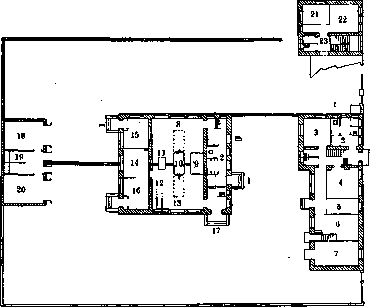
Figure 3. Design of a disinfection point: 1-entrance to the airlock; 2-airlock; 3-watchman; 4-office; 5-storage of chloride of lime, etc.; 6-storage of chemicals; 7-shed; 8-infectious disease ward; 9-Japanese chamber; 10-steam chamber; 11-disinfection tank; 12-drying room; 13-clean section; 14-head of station; 15-delivery; 16-issue; 17-entrance to the clean section; 18-infectious transport; 19-stalls; 20-clean transport; 21-duty personnel; 22-orderlies; 23-washroom. Lit.: -Bartashevich Yu., Rail-road disinfection chamber-cars and cars-isolation apartments, Journal of the Society for the Protection of People's Health, 1908, № 4-5; Camera systems V., Disinfection organization of the Kharkov railway junction, Hygiene and sanitation of transport, 1924, № 1-3; Korchagin V., On the organization of military railway disinfection detachments, Doctor's Newspaper, 1907, № 27; Krupin S., The first city disinfection chamber at the Barracks Hospital in memory of S.P. Botkin in 1883-1893. SPB, 1894; Levashov V., Urban disinfection chambers and conditions for public use of them, Proceedings of the IX Congress of the Society of Russian Physicians in memory of Pirogov, vol. II, SPB, 1905; Navrotsky, Historical essay on the development of disinfection in Saratov, Saratov Herald of Health, 1927, № 10; Collection of reports of the disinfection station of the Odessa provincial health department for 1918-22, ed. by L. Gromashewsky, Odessa, 1923; same for 1923, Odessa, 1926; Padanovsky P., Leningrad infectious-repair brigade, Essays in sanitary affairs, collection 4, L., 1928; Posadsky S., The first disinfection laundry train, Russian Doctor, 1917, № 38-42; Ferrari P., Organization of public disinfection in Milan, SPB, 1911 (bibliography); Chistyakov G., On the question of standardizing the premises of disinfection stations, Hygiene and epidemiology, 1926, № 2; he same, The problem of reorganizing the disinfection service in Moscow. Moscow Medical Journal, 1927, № 7; Yakovenko V., Disinfection and disinsection of railway rolling stock at the sanitary-disinfection station of the South-Western (Warsaw) railway, Hygiene and sanitation of transport, 1923, № 1; Guttmann P. u. Merle e H., The first public disinfection station of the city of Berlin, Quarterly Journal of Forensic Medicine, 1886; Paris L., The new disinfection station of the Recollets, P., 1911; Municipal disinfection service of the city of Paris, P., 1900; Sannemann K., The service of the port physician in Hamburg, Archive for Shipping and Tropical Medicine, Vol. XXII, Supplement, Lpz., 1918. See also bibliography for the article Disinfection. Ya. Okunevsky.
Related articles
Mentioned in
Cite this page
“Disinfection Stations.” Soviet Medical Encyclopedia. English translation of Bolshaya Meditsinskaya Entsiklopediya, 1st ed. (Moscow, 1928–1936), ed. N. A. Semashko. https://sovietmedicalencyclopedia.pages.dev/article/disinfection-stations/