Isolation Houses
Historical document, translated for reference. It reflects medical knowledge of the 1920s–30s and is not medical advice.
Summary
This article from the 1928–1936 Soviet medical encyclopedia details the history, purpose, and operational structure of isolation houses. It explains their role in epidemic control, including the isolation of healthy contacts, disinfection, and the management of carriers.
Encyclopedia article (1928–1936)
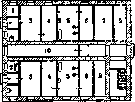
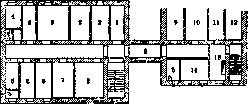
ISOLATION HOUSES, or apartments, also called isolators, occupy a special place among isolation institutions of other purposes, since I. d. serve a definite purpose in the system of anti-epidemic measures, namely the isolation of healthy people from epidemic foci. Along with the isolation of patients and the disinfection of their belongings and premises, measures were already raised and carried out in former times with regard to those people who had contact with patients of infectious diseases or arrived from infected localities. As early as the 15th century in Italy during plague epidemics, healthy people were expelled from infected houses beyond the city limits to specially arranged huts for this purpose for the usual 'quarantine' period, i.e., for a period of up to 40 days. With the development of international relations, many states began to organize a quarantine service in their ports, one of the main elements of which is observation in case of an epidemic of all arriving healthy persons on the ships themselves or on the shore in specially arranged isolation premises—so-called 'quarantines.' The organization of such quarantines was formalized by the International Sanitary Congress of 1852 in Paris. Some of the quarantines were calculated for large masses of arrivals, for example, the El-Tor quarantine on the Red Sea, capable of accommodating up to 12,000 pilgrims. On the other hand, the creation of I. d. was also brought about by the development of anti-epidemic measures in large European cities, mainly in connection with the widespread practice of disinfecting dwellings by fumigating them with sulfur gas and formaldehyde, for which the apartment to be disinfected had to be vacated of the people in it. For the temporary accommodation of the latter, I. d. already arose in the 80s of the 19th century in a number of cities, such as Vienna, Brussels, Stockholm, Basel, Zurich, London, etc., connected with disinfection institutions. The necessity of subjecting the inhabitants of infected apartments to personal disinfection is noted further in the Austrian and Prussian instructions of 1887 on the performance of disinfections in foci of infectious diseases, although both these instructions do not yet establish the mandatory requirement of separate I. d. The later circular of the Swiss Federal Council, requiring that when cholera appears in all localities with a dense population, 'a house be chosen which could serve as a refuge for healthy people from the cholera focus, since the removal of persons from such a focus brought good results everywhere, especially in Basel and Zurich,' is more consistent, the Federal Council promising to bear one-third of the expenses for the establishment of shelters for healthy people at the state expense. Furthermore, I. d. in some cities developed partially in connection with hospitals for convalescents. Thus, in Gothenburg (Sweden), one pavilion of the infectious hospital, designed for 20 beds, served simultaneously for 'convalescent patients and residents from infected dwellings, in which disinfection measures were at that time taken.' The discovery of bacteriomania, the study of the role of carriers, and the necessity of fighting the latter as disseminators of infection set before I. houses the task of participating in the possible neutralization of healthy carriers of infection, either by their isolation for a short time or by teaching and training chronic carriers to instill in them sanitary skills that ensure, as far as possible, their lesser danger to those around them. Finally, institutions of the I. d. type, being more adapted than ordinary hospitals for serving persons who appear in the ordinary sense of the word 'healthy,' often take upon themselves the task of short-term sanitary treatment of such categories of carriers of the infectious beginning as helminth carriers, patients with scabies, suffering from pediculosis ('Entlausungsstellen' in Germany after the war), etc. Thus, the circle of activity of I. d. at present covers: a) personal disinfection and disinsection, b) the provision of temporary shelter for inhabitants of disinfected dwellings, c) the isolation of persons in the incubation period, d) the isolation of acute carriers, e) the teaching of sanitary skills to chronic carriers, f) the isolation of convalescents until the end of the infectious period, g) the elimination of certain of the above-mentioned pathological states of an infectious nature, amenable to short-term therapeutic or sanitary influence. This circle of tasks determines the place of I. d. in the general system of medical-sanitary organization, as well as their construction and order of functioning. The most expedient is such a construction of I. d. when they enter into the composition of a disinfection-anti-epidemic organization, forming with the latter a single disinfection-epidemiological station (plan of such an institution see in the article Disinfection Stations). Only in this case can the organic connection of I. d. with housing and chamber disinfection, necessary for their correct functioning, be ensured. PLAN OF THE 1ST FLOOR

PLAN OF THE 3RD FLOOR
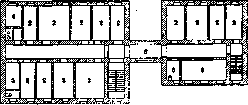
Plan of the Leningrad isolation house: 1st floor: 1 and 2 - reception for isolation and sanitary treatment for scarlet fever and for diphtheria; 3 - waiting room before sanitary treatment; 4 - changing room; 5 - shower; 6 - dressing room; 7 - office; 8 - doctor's cabinet; 9 - house committee room; 10 - canteen; 11 and 13 - dirty and clean linen room; 12 - caretaker's room; 14 - manager's apartment. 2nd floor: 1 - vaccination point; 2 - ward for isolates; 3 - waiting room after sanitary treatment; 4 - isolation box; 5 - toilet; 6 and 7 - men's and women's dressing rooms; 8 - connecting corridor; 9 - ward for isolates in connection with pediculosis; 10 - waiting room after sanitary treatment in connection with pediculosis; 11 - buffet; 12 - storeroom; 13 - kitchen; 14 - nurses' room. 3rd floor: 2 wards for isolates; 3 waiting room after sanitary treatment; 8 connecting corridor. The isolation house is connected by a corridor with the transport for transporting infectious patients, the disinfection bath, and the infectious hospital. It is also necessary to ensure the isolation house with laboratory service. The internal construction of I. houses must be calculated for the constant presence (or at least the possibility of appearance at any moment) of infected people, the position of which, compared with the conditions of an infectious focus, is complicated by the fact that these infected people feel quite healthy and are therefore extremely prone to communication with each other, with the outside world, etc. Based on this, the order of 'light' compared with stationary medical institutions of maintenance and equipment of I. d. must be resolutely condemned. The maintenance of isolates in their own clothes, insufficient medical and in particular medical service for them, the use of common toilets, common dishes, etc., all these simplifications of the regime open the way for the most undesirable consequences. Applying to the tasks of I. d. and a number of local conditions in each individual case, it is nevertheless necessary, as a general rule, to note the desirability of implementing a normal hospital regime in the sense of the possibility of preventing the spread of infection among isolates, the presence of premises for individual isolation, which sometimes appears completely necessary, the provision of isolates with separate toilets, the implementation of a perfect system of disinfecting dishes, linen, household items and the wards themselves, etc. On the other hand, in view of the fact that I. d. serve people subjectively healthy, the regime of their internal life must possess certain specific features facilitating the stay in isolation of those persons found in them. The presence of a library, educational personnel to serve the children kept in I. d., the introduction of reasonable entertainment, games, crafts, handicrafts, etc., permissible from an epidemiological point of view in each individual case, can play a considerable role in this regard. In a number of larger cities of the USSR [Leningrad (see figure), Odessa, Rostov-on-Don, etc.] there are I. d., but there is no full unity in their structure and identity of functions. In a more primitive form, I. d. serve only as a shelter for residents of disinfected apartments.
Related articles
Mentioned in
Cite this page
“Isolation Houses.” Soviet Medical Encyclopedia. English translation of Bolshaya Meditsinskaya Entsiklopediya, 1st ed. (Moscow, 1928–1936), ed. N. A. Semashko. https://sovietmedicalencyclopedia.pages.dev/article/isolation-houses/