Pilgrims
Historical document, translated for reference. It reflects medical knowledge of the 1920s–30s and is not medical advice.
Summary
A historical examination of pilgrims and pilgrimage practices, particularly within Islam and the annual Hajj to Mecca, detailing the socio-economic exploitation, sanitary conditions, and role of religious intermediaries.
Encyclopedia article (1928–1936)
PILGRIMS, religious worshippers embarking on a distant journey to "holy places." (According to Orthodox custom, pilgrims traveled to Palestine, from where they brought back palm leaves as a keepsake, hence the name "palomniki" [from the Russian word for palm].) Another name is "pilgrims" (from the French pelerin). Muslim pilgrims usually head to Iraq, Palestine, Persia, but chiefly to the Hejaz—to Mecca for the worship of the "sacred" black stone of the Kaaba and to Medina to the tomb of the "prophet" Muhammad. According to the religious code of Muslims, every Mohammedan without distinction of sex is obliged at least once in his life to make a pilgrimage to Mecca, called "hajj" in Arabic. Having completed... of the gold left by the pilgrims in the Hejaz itself. Standing at a low cultural level, ruthlessly exploited, the Muslim masses of the colonial countries, who are held captive by their clergy, annually supply the merchants of religious dope with a large number of these victims, and until recently many tens (in former years even hundreds) of thousands of pilgrims flock to Mecca to participate in the celebrations taking place before the "sacred" Mount Arafat on the ninth day of the last month of the Muslim (lunar) year. In connection with the peculiarities of the lunar calendar, the day of the hajj every subsequent year falls according to the solar calendar 12 days earlier than
the pilgrim who has completed the pilgrimage receives the title of "haji," which gives him respect among orthodox Muslims. Wishing to increase their glory, hajis are in the habit of painting their journey to the "holy country" in all the colors of fantasy. To these stories is added the agitation of special agents heading from the Hejaz to all ends of the world for the recruitment of pilgrims. For the inhabitants of the Hejaz, the pilgrimage is the main source of income: every step of the pilgrim on the "holy" land is paid for in full-weight gold; the holy places are an arena of unbridled deception and robbery of pilgrims and malicious extortion. The fleecing of pilgrims begins long before approaching the Hejaz: steamship companies, branches of suspicious banks, all kinds of suppliers, and agents of the colonial powers profit off the pilgrims, into whose hands the lion's share passes.
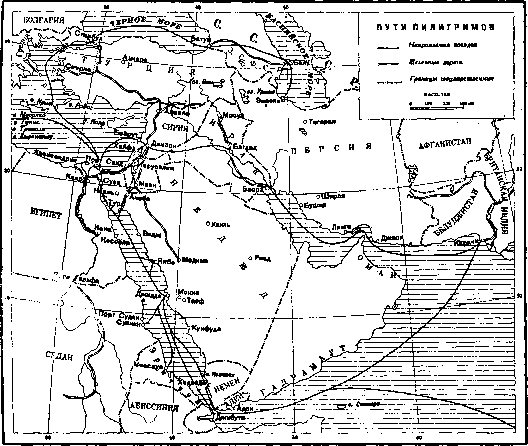
in the previous year, thus completing a 33-year cycle, according to which the Hajj moves from the summer months to the spring, then winter, autumn, summer months again, etc. This circumstance is not without epidemiological significance. The movement of Muslim pilgrims to Mecca usually occurs by sea or caravan routes. By sea, pilgrims arrive from the south via Bab el-Mandeb from the Dutch East Indies, Straits Settlements, British India, China, Afghanistan, Persia, Iraq; from the north—from Turkey (currently the performance of the Hajj by Turkish citizens is prohibited), Syria, Palestine, from the Balkan countries, from the northern coast of Africa; from countries located along the shores of the Red Sea: Egypt, Sudan, Eritrea (pilgrims from Central and West Africa also transit through these countries), Somalia, and Yemen. The sea route to the Hejaz until the mid-19th century presented significant sanitary dangers. The number of passengers on fragile sailing vessels often decreased significantly on the long journey from Singapore or other distant harbors as a result of hardships and epidemics. With the introduction of steamship communication, the number of pilgrims from India and the Sunda Islands increased significantly. All countries from the ports of which steamships with pilgrims are directed have special rules fixing the minimum sanitary conditions on pilgrim steamships. These rules generally correspond at present to the provisions of the International Sanitary Convention of 1926 and contain a number of additional points on the accommodation of pilgrims, provisions supplies, etc. Despite these rules, the sanitary condition of pilgrim steamships is still not always sufficiently satisfactory. On some steamships, the number of pilgrims exceeds the number stipulated by the norms. The treatment of pilgrims by shipowners, for whom the inarticulate mass of ignorant people, which the majority of pilgrims are, represents merely an object of profit, is distinguished by extreme heartlessness. In former years, there were repeatedly cases when pilgrims, urged on by boatmen striving to transport as many people as possible, slipped from the gangplanks and fell into the water. Not infrequently, "death ships"—old vessels fit only for scrap—are still somehow equipped for the transport of pilgrims. On many ships, deratization certificates turn out to be long overdue, etc. Overland in former years, caravans moved from Egypt, Damascus, from Persia (Baghdad), from Najd, from Asir, and Yemen. The travel conditions for distant caravans, e.g., from Damascus, were extraordinarily difficult: about 40 days through a waterless desert with a difference between day and night temperature of up to 25–35°. Great relief was brought by the Hejaz Railway, built shortly before the World War, which shortened the journey from Damascus to Medina to three days. With the destruction of this road (during the World War), overland traffic Damascus–Medina almost ceased. The largest percentage of pilgrims arrives in the Hejaz from the Dutch East Indies; they are usually called Javanese, although by no means all of them are natives of the island of Java. They make up about 1/4 of the total number of pilgrims. The next largest groups are Indians and Egyptians. The total number of pilgrims in recent years is as follows: 1927—129,000, 1928—99,000, 1929—89,000, 1930—85,000, 1931—45,000. Before the World War, a certain number of Muslim pilgrims also came from Russia. Pilgrims arriving in the Hejaz from all corners of the Muslim world carry their diseases with them. Crowding, the absence of elementary hygienic conditions and habits, severe overexertion, and colossal insolation during mass movements through the "sacred" points (Arafat, Mina) create favorable conditions for the spread of epidemic diseases among pilgrims. And indeed, in former years during the Hajj, severe epidemics repeatedly broke out, which were then disseminated to the countries to which the pilgrims returned, and from there throughout the world. Of the epidemic diseases whose spread is associated with the Muslim pilgrimage, first place rightfully belongs to cholera. The global epidemic focus of cholera—British India—annually supplies a large number of pilgrims. Secondary cholera foci are also located in countries whence pilgrims come (Iraq, Afghanistan, Persia). Over the last 50 years before the war, i.e., from 1860 to 1913, cholera epidemics resulted in about fifteen major outbreaks among pilgrims in the Hejaz. In the epidemic of 1907–08, 20,000 pilgrims died of cholera. In 1912, at the height of the epidemic, 800–1,000 people died daily. The global foci of plague also lie within the confines of the Muslim world (Bombay, Mesopotamia, Kashgaria, Yunnan, Anglo-Egyptian Sudan). Small outbreaks of plague have until recently been observed in the immediate vicinity of the Hejaz, in countries from which pilgrims come (Egypt, Algeria, Tunisia, Morocco, Iraq). Small outbreaks of bubonic plague among pilgrims were observed over the last fifty years in 1889, 1897, 1898, 1899, and 1900. In Mecca itself and in Medina, there were no cases of plague. No introduction of plague by pilgrims into other countries was observed. In connection with the development of air communication in recent years, the threat of the spread of yellow fever in the Hejaz is acquiring a certain reality, since the vector of yellow fever (the mosquito Aedes argenteus) is found in huge quantities in Jeddah and Mecca, and the distance from the foci of the latest outbreaks of this disease (Senegal, Lagos, Accra, Togo) can be covered by airplane in a very short time. The sanitary danger presented by the Muslim pilgrimage has called to life a whole series of measures of an international character, formalized by corresponding international conventions. In most pilgrimage-source countries, the strictest regulation of pilgrim movement is currently carried out; before boarding steamships, pilgrims are given vaccinations against cholera, smallpox, dysentery, and typhoid fever. On the Red Sea, three main and several minor quarantine stations have been established. The main points are: the quarantine station of the Egyptian Maritime and Quarantine Sanitary Board in El Tor on the Sinai Peninsula, Kamaran Island in the southern part of the Red Sea (a quarantine station managed on the basis of a special agreement by England and Holland), and three quarantine islands off the city of Jeddah (the port of Mecca). Pilgrims returning from the Hejaz heading to Mediterranean ports are disembarked at El Tor, and the first one or two thousand are examined for the presence of the cholera vibrio in their excrement. In case of a negative result, the Hajj is declared clean; in case of the detection of cholera vibrios, pilgrims, beyond the three-day observation period stipulated in the absence of an epidemic, are subjected to observation for up to five days from the day of the last illness. A stay in the El Tor quarantine camp is associated with great unpleasantries for pilgrims: the premises are overcrowded several times over the norm; men are housed intermixed with women, physical actions and all sorts of insults are practiced. Regarding Kamaran, the well-known connoisseur of the Arab world Christiaan Snouck Hurgronje wrote at the end of the 19th century: "The quarantine system pursues no other purpose than extortion... Whoever has observed such things at close range may even doubt the power of truth. But pilgrims gradually get used to the fact that in the name of the common good, before entering Jeddah, they must for a time be confined on an unhealthy island where they pay double for everything, pay additional quarantine fees, and whence they not infrequently take away fever." At present, these words retain their force to a significant degree. Quarantine institutions on the Red Sea are to a greater extent sources of income than a guarantee against the spread of infections; there is no complete coverage of pilgrims, the effectiveness of disinfection measures leaves much to be desired. The irrationality of the modern arrangement of quarantine affairs is a continuation of traditions established from the very beginning of the organization of quarantine measures regarding the pilgrimage. On the part of the European powers, there have been and are tendencies to make the Hajj an object of special influences and, under the flag of sanitary measures beneficial to humanity, to carry out measures of a far from medical character. The latest sanitary conferences on the pilgrimage (in Beirut in 1929, in Paris in 1930) discussed predominantly resolutions concerning the regulation of the movement of pilgrims and control over them; even questions of pilgrim vaccination were resolved not so much from the point of view of their effectiveness as regarding the possibilities associated with them of strengthening police control over pilgrims, who are forced to report repeatedly for vaccinations. The result of these conferences was the creation of a local agreement of the countries of the Near East on uniform measures for servicing pilgrims during their transit through these countries. Turkey, Persia, and the USSR do not participate in this agreement. A vivid example of the subordination of sanitary bodies to political goals is the activity of the Egyptian Maritime and Quarantine Sanitary Board and its institutions, in which the decisive vote, contrary to the statutes, belongs not to Egypt, but to the powers controlling all economic and political life on the Red Sea.
Recent years have provided blatant examples of the use of quarantine measures regarding pilgrimage for political purposes, fighting against the national movement among Muslim peoples, hindering the spread of communist ideas, and applying economic pressure on the Hejaz (which is an object of special attention by imperialist powers in connection with the passage of the Mosul-Haifa oil pipeline near its borders). In recent years, the world crisis, which caused a drop in demand for rubber mined in the Dutch Indies and the depreciation of Egyptian cotton, as well as the national liberation movement in British India, have led to a sharp reduction in pilgrimage from the English and Dutch colonies and from Egypt; the influx of pilgrims from other countries has also decreased significantly. According to the latest report for 1931 by the Egyptian Council, the number of pilgrims has sharply decreased "thanks to the economic crisis which is raging throughout the world." As the same 1931 report states, there were no pilgrims at all from Persia and North Africa.
Sh. Moshkovsky. The special regulations of the 1926 International Sanitary Convention regarding pilgrims concern the following issues: to persons and objects destined for the Hejaz or the Kingdom of Iraq and subject to embarkation on a pilgrim ship, the provisions of Article 13 of this convention ("Measures in infected ports upon the departure of ships") apply even when the port of embarkation is uninfected. If there is a case of plague, cholera, or another epidemic disease in the port, embarkation on pilgrim ships is carried out only after these persons have been subjected to observation. The transportation of pilgrims over long distances is permitted only to ships with mechanical propulsion. The International Sanitary Convention further provides for the sanitary regime applied to ships with pilgrims heading to the Hejaz from the south. Pilgrim ships coming from the south to the Hejaz must first stop at the Sanitary Station in Kamaran and undergo the sanitary regime. Uninfected ships receive free pratique after a medical inspection of the pilgrims and sanitary measures—a shower or bathing in the sea, disinfection of dirty laundry, and bacteriological examination. The duration of all these sanitary measures must not exceed 48 hours. Uninfected ships are released after medical inspection from the specified measures in the following cases: if the pilgrims have been immunized against cholera and smallpox, if the prescriptions of the International Sanitary Convention have been strictly fulfilled, and if there have been no cases of plague, cholera, or smallpox on board. Ships suspected of plague or cholera are subjected to the following regime: pilgrims are disembarked for a shower or bathing in the sea, dirty laundry is disinfected, and, if necessary, a bacteriological examination is performed. The duration of these measures must also not exceed 48 hours. Infected ships, i.e., those having on board cases of plague or cholera, or having had cases of plague after more than 6 days from embarkation, or cholera within 5 days, or on board which plague-infected rats were discovered, are subjected to the following measures: sick persons are isolated in a hospital, the remaining passengers are disembarked and isolated in the sanitary station for 6 days for plague and five days for cholera; dirty laundry, utility items, clothing of passengers and crew are disinfected, and the ship is disinfected. Uninfected, suspected, and infected ships upon arrival in Jeddah are subjected to medical inspection on board, and under favorable conditions the ship receives free pratique. To pilgrim ships coming from the north from Port Said and heading to the Hejaz, the following measures apply: If no cases of plague or cholera have been ascertained either in the port of departure or in its environs, and if there has not been a single case of plague or cholera during the crossing, the ship is admitted to free pratique. If cases of plague or cholera have been ascertained in the port of departure or in its environs, or if a case of plague or cholera occurred during the crossing, the ship is subject at the sanitary station in El-Tor to the rules established for ships coming from the south and stopping in Kamaran. After this, the ship receives free pratique. The measures taken regarding pilgrim ships returning back toward the north consist in the fact that each such ship is obliged to head to El-Tor to undergo observation there and the necessary sanitary measures. Ships carrying pilgrims back and heading to the Mediterranean Sea pass through the Suez Canal only under quarantine status. To pilgrims returning toward the south, the same measures apply. In the event of the appearance of contagious diseases among them, the pilgrim ship must stop in Kamaran to undergo medical control there. The Egyptian Sanitary and Quarantine Council, in accordance with the convention, periodically sends sanitary reports and information on the pilgrimage and the sanitary condition of the Hejaz and the localities through which the pilgrims passed to the sanitary authorities of the interested countries and to the International Office of Public Hygiene. Rules for the transportation of pilgrims on ships from the Black Sea ports of the USSR, established in 1928: Muslim pilgrims may travel from the ports of the USSR on pilgrimage to the ports of the Hejaz and return from there only through Black Sea ports that have equipped marine sanitary stations. At the specified sanitary stations, pilgrims, both before departure for the pilgrimage and upon return from the pilgrimage, are subjected to medical and sanitary measures established by the People's Commissariat of Health in accordance with the resolution of the International Sanitary Convention. The transportation by sea of Muslim pilgrims from the Black Sea ports of the USSR to the Hejaz and back can be undertaken by those ships that have received a certificate from a special port pilgrim commission on the suitability of the ship for transporting pilgrims (a port sanitary doctor participates in this commission). Every ship carrying pilgrims must have a doctor (if the number of pilgrims exceeds 1,000, a second doctor is appointed). The doctor is appointed to the ship 10 days before the ship's departure. During the transportation of pilgrims, special sanitary norms must be observed regarding their accommodation on the ship and the availability of sanitary and sanitary-technical devices. Each pilgrim must account for 1.5 m2 of free space, and an additional 0.5 m2 per pilgrim is allocated on the upper promenade deck. On every pilgrim ship, a room adapted for providing medical aid to pilgrims and receiving the sick must be allocated, and there must also be a medicine chest with the necessary medications, vaccines, and disinfectants according to a special list of the People's Commissariat of Health, as well as a bacteriological laboratory. For stationary patients, there must be an infirmary designed for 5% of the total number of pilgrims on the ship with 3 m2 of free space for each infirmary bed. In addition, the ship must have equipment for setting up a temporary infirmary on deck at the rate of 2% of the pilgrims. Outpatient and inpatient treatment and the supply of medications are provided free of charge. In addition to the ship's doctor, a pilgrim ship must have 2 medical assistants per 500 pilgrims and 2 orderlies per 1,000 people. The ship must have a steam-formalin chamber. Embarkation of pilgrims on the ship is permitted no earlier than 3 days before the departure of the ship to sea. In recent years, almost exclusively transit pilgrims have come from the USSR (from Afghanistan, from Western China). Pilgrimage to "holy" places (Palestine, Jerusalem) ceased completely from the beginning of the revolution due to the elimination of religious prejudices. (See also Conventions, Quarantines).
A. Metaxa.


0g
med., 1928, № 3; Rules for the Sanitary Protection of the Borders of the USSR, official publication of the People's Commissariat of Health of the RSFSR, M.-L., 1932; Rapports sur le pèlerinage, publiés par le Conseil sanitaire, maritime et quarantenaire d'Egypte, Caire, from 1928 (annually). See also literature to the articles Convention, Quarantines.
Related articles
Mentioned in
Cite this page
“Pilgrims.” Soviet Medical Encyclopedia. English translation of Bolshaya Meditsinskaya Entsiklopediya, 1st ed. (Moscow, 1928–1936), ed. N. A. Semashko. https://sovietmedicalencyclopedia.pages.dev/article/pilgrims/