Deratization
Historical document, translated for reference. It reflects medical knowledge of the 1920s–30s and is not medical advice.
Summary
Deratization is the systematic extermination of rats and mice, focusing on prevention through building modifications and sanitation measures to eliminate food sources and shelter. This 1930s Soviet medical approach emphasizes building rat-proof structures and implementing sanitary practices to combat rats as disease vectors.
Encyclopedia article (1928–1936)
660 Deratization (from Latin de- negative prefix, and rattus-rat), rat extermination. The fight against rats and mice has been conducted for a long time and by the most diverse means (poisoned baits and various physical methods), but only in recent decades have the correct paths to the radical extermination of rats been established, based on the study of their biological properties. This methodology was developed and is now widely applied due to the sanitary significance of the fight against rats as carriers of plague. Recently, a number of infections transmitted by rats (such as acute infectious jaundice, etc.) have also been identified. In addition, the economic damage caused to the national economy by rats amounts annually to hundreds of millions of rubles. The basis for the fight against rats in populated areas is the deprivation of their food and shelter. Only when carrying out this 'prevention' can the extermination of rats give reliable and lasting results. The methodology of D. was developed mainly with application to the gray rat (pasyuk), the most dangerous and powerful pest; but it is generally also valid for fighting the black rat and the house mouse. Preventive measures consist of 1) ensuring rat-proofing of buildings and technical conduits, 2) protecting properties from colonization by rodents from outside, and 3) observing a number of general and special sanitary rules aimed at depriving rodents of food and drink, as well as secluded corners for them to build their burrows.
The foundations of rat-proofing buildings. In the basements of residential properties and in premises of the food industry and trade, floors should be made of very hard materials: a concrete base 8-12 cm thick, covered on top with a 3 cm layer of cement or asphalt, tiles, bricks, or crushed stone. Floors should be tightly fitted into exterior walls, which for a distance of about 100 cm below the floor level and about 50 cm above it should be made of brick or stone, bonded with cement, or of concrete. This prevents the possibility of rats digging under the walls or penetrating through the lower underground part. Wooden floors should be constructed from two rows of tightly fitted boards at least 4 cm thick, between which a continuous mesh of thick galvanized wire with a mesh diameter of no more than 2 cm is laid. The mesh should be extended
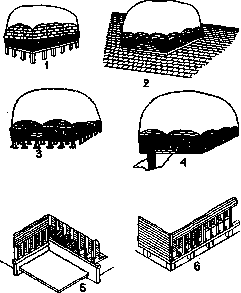
Figures 1-4. Commercial platforms with a fence of galvanized iron [1-on brick pillars; 2-on a concrete base; 3-on wooden supports; 4-with an iron fence, buried in the ground to a depth of at least 70 cm). Figures 5 and 6. Rat-proof buildings.
onto the exterior walls to a height of at least 40-50 cm and nailed with boards. All operational openings (ventilation, windows, hatches, etc.) should be protected with cast iron or thick wire narrow-mesh grilles, all unnecessary openings (around pipes, etc.) should be cemented. Door thresholds should be covered to a height of about 50 cm with metal sheets or wire mesh and equipped with automatic closing devices. Light-type buildings without basement premises, as well as warehouses and commercial platforms, can be constructed on piles or brick supports raised at least 70 cm above ground level. Hollow walls in new buildings are filled with broken or cheap brick or a mixture of cement with ash. In old buildings, hollow spaces between beams are lined at a height of at least 50 cm with sheet iron. According to Bogomolov, it is recommended to fill hollow walls with sawdust or peat mixed with 7-10% by weight of CaCO3, which makes them poisonous for rats. Warehouses can be constructed at ground level on solid concrete foundations with a fence of galvanized iron about 70 cm high. (Types of rat-proof buildings and warehouses are illustrated in figs. 1-6.) - Rat-proofing of technical conduits. Ventilation openings should be closed
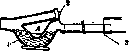
Figure 7. Water barrier: 1-water siphon; 2-opening for ventilation pipe; 3-joint point of house sewer with street network.
with cast iron grilles or strong metal meshes with a mesh diameter of no more than 2 cm. All voids and cracks along the course of water supply, sewer, gas, and ventilation pipes should be filled with cement. Sewer channels should be constructed of smooth cement pipes, kept in complete order, and have no cracks or holes. Old, non-operational channels, where rats particularly like to nest, are subject to destruction. Downspout and sewer pipes and channels are the most convenient paths for rats to enter a property. Special significance is attached to the points where the house sewer connects with the street sewer and downspouts (see figure 7). To protect against rats in the sewer
network, special 'barriers' are installed (see figures 8 and 9). Rat burrows and tunnels should be filled with broken glass or tarred gravel.-To protect against contamination by rodents from outside, rat-proof buildings are trenched around with a narrow cemented ditch about 70 cm deep and 15-16 cm wide. In yards and on sidewalks, wooden decks should not be allowed. General and special sanitary rules for protecting properties from rats. In addition to buildings, shelters for rats and mice are stacked goods and supplies, piles of firewood and boards, accumulations of all kinds of refuse and junk. Materials and goods should be stored on platforms raised 70 cm above the floor or ground level. All food products, food residues, and food waste should be stored in a manner inaccessible to rats. Garbage pits or
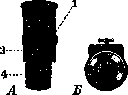
FRONT VIEW TOP VIEW Figure 8. Metal barrier. A-longitudinal section: 1-bronze barrier grille; 2-sleeve; 3-inspection well; 4-sewer pipe. B-cross section.
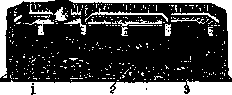
Figure 9. House sewer pipe (1) with broken sleeve (2) and metal barrier (3) installed in the inspection well.
the boxes must be rat-proof, close tightly, not be overloaded, and be subjected to systematic disinfection with solutions of tar, crude carbolic acid, chloride of lime, petroleum residues, or a mixture of tar and petroleum. The most rational method is the storage and removal of waste in well-lockable metal boxes. Absolute cleanliness and order usually drive away rats. It is very useful to arrange warehouses for storing food products away from drinking water sources or to remove drinking water sources from warehouses. Improper maintenance of small animals in living quarters or near them often provides rats and mice with a large amount of food and leads to their multiplication. Therefore, it is unacceptable to keep animals in apartments, on staircases, in attics, and in basements. Rat extermination is carried out by biological, chemical, and physical methods. Biological methods: the use of animals that are natural enemies of rodents and pathogenic microbes. Cats and certain breeds of dogs (fox terriers, pinchers, dachshunds, etc.), specially trained, provide valuable assistance in the fight against rats and mice. Castrated cats are particularly suitable for protecting warehouses. For the purpose of exterminating harmful rodents, practical use is made of the so-called "rat and mouse typhus bacteria," which represent various variants of microbes from the paratyphus B and Gartner group. It is recommended to use freshly prepared broth cultures (period of 1-2 days). If several days are required to obtain the bacterial preparation, it is better to use cultures on a solid nutrient medium (on agar). Before use, cultures must be protected from light and high temperatures. The method of using bacterial preparations is simple. One liter of broth culture is used to impregnate about a thousand pieces of rye (not sour) or wheat bread, or 1-2 kg of rye flour is mixed with the broth culture to the consistency of stiff dough, from which small pellets are formed. The impregnated baits are laid out in the area to be baited. According to Betz, for rat extermination, the broth culture can be poured into flat dishes and placed around the premises. When using solid bacterial preparations, which are sold in glass test tubes, the bacteria are washed off the agar with a solution of table salt (one teaspoon of NaCl per 1 liter of water), the agar with the remaining microbes is crushed in the liquid, and the entire contents of the test tube are diluted in the ratio of 1-2 test tubes of agar culture to 1 liter of NaCl solution. Baits from the resulting liquid suspension of bacteria are prepared in exactly the same way as from the broth culture. One liter of broth culture or 1-2 agar test tubes is sufficient for baiting an area of 400-450 m2. Baiting is repeated 1-2 times after 7-10 days. Complete extermination of rats with bacterial preparations is not achieved, since among rats there is always a greater or lesser percentage of individuals not susceptible to the infection. The sometimes observed temporary disappearance of rats is explained by the flight of surviving animals from the baiting site, to which they usually return again after some time. In the fight against rats, the bacterial method is unreliable; better results are obtained in the fight against mice. Since the use of bacterial preparations does not exclude the possibility of infection of people and domestic animals, the following preventive measures must be observed. 1. Weak and sick persons, especially those suffering from diarrhea or prone to it, must not be allowed to prepare bacterial baits or to distribute them. 2. Persons entrusted with the preparation of preparations and the distribution of baits impregnated with them must not during
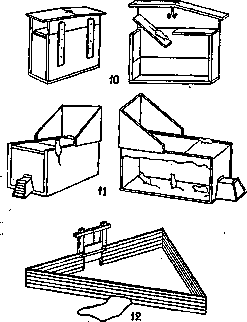
Figure 10. Zurner's trap - in the above-ground part consists of a passage open at both ends, the bottom of which consists of two falling and automatically closing platforms and a wooden box lined inside with galvanized iron, which is buried in the ground. Figure 11. English trap-box with a falling platform. Figure 12. German trap for mass rat catching. It is made of wooden boards in the form of an isosceles triangle. In the middle of one of the walls there is a falling door, operated from a distance with the help of a string. In the other wall there is an opening leading to a special box, into which rats are thrown when the trap closes.
work, smoking or touching the mouth with fingers. 3. Upon completion of work, persons engaged in them must thoroughly wash their face and hands with warm water and soap. 4. All dishes used for preparing and distributing bacterial baits must be boiled in a hot soda solution. 5. It is forbidden to use and prepare bacterial baits in kitchens and other rooms where food is prepared. 6. Bacterial preparations should not be used in dormitories, hostels, hospitals, and orphanages, nor for mass operations in cities and settlements. Physical methods: hunting, traps, and snares. Groups of people with sticks or weapons in hand, usually accompanied by dogs, surround a specific area and, gradually moving from the periphery to the center, drive out rats from all directions and kill them. Individual properties are surrounded by a solid portable fence from corrugated sheet iron, at least one meter high above ground and buried in the ground to a depth of about 7 dm. 48 hours before hunting, baits with chemical poisons are distributed, sewer openings are covered with metal mesh, all hiding places are opened, i.e., floorings above cellars in ground or basement floors are lifted, rat burrows in the ground are dug up, etc. Traps and snares, when properly used, can serve as a useful auxiliary method in the fight against rats. This method is economical and safe from a sanitary point of view. While working with traps and snares, it is desirable to make it as difficult as possible for rats to access food products. Traps and snares must be kept clean. One should not touch traps with bare hands. It is advisable to camouflage traps by throwing bags, saddlecloths, straw, or the like over them and giving the camouflage as natural an appearance as possible. Only the entrance to the trap, directed from the direction from which rats appear, is left open. It is advisable to place several baits with a sharp, attractive smell for rats in the trap at the same time. For this purpose, the following are particularly suitable: ham, fried fat, garlic sausage, cheese, smoked fish, biscuit crusts, and various kinds of edible kitchen scraps. In winter, rats are well caught on fresh vegetables and fruits. The "versh" (a type of trap) is especially practical for group rat catching. Various types of traps are shown in figures 10-12. Chemical methods. When using the poisoned bait method, one should follow the following general rules: several days before distributing the poison, stop or make it difficult for rats to access food products. Baits are prepared and distributed with spoons or with the help of other auxiliary items, without touching them with hands. It is useful for some time to scatter baits without poison until rodents get used to taking them without fear. Distribution should be done at night, if possible, not entering the premises until morning. Poisoned baits freely placed in open areas should be removed during the day and redistributed at night. The poison is distributed in places most frequently visited by rodents. In properties, main attention should be paid to cellars, attics, house sewers, stables, places for storing products and waste, and garbage dumps. If possible, poisoned baits are placed in rat runs and burrows. Poisons dangerous to humans and domestic animals are recommended to be mixed with baits in the form of dough and placed in so-called rat feeding boxes. In advance, for several days, bait without poison is placed in the box to accustom rats to taking food from there. Skillful camouflage of poisons with appropriate selection of baits and giving the latter special taste and olfactory attractiveness for rats is one of the main tasks, the correct solution of which often determines the success of chemical deratization. The composition and form of baits, as well as the type of poison, should be changed in repeated operations. Baits made from spoiled or poor quality products are often not taken by rats, especially on food warehouses. Various poisons are used to make poisoned baits. Prescriptions and methodology for preparation and use are described in special guides (see literature). Only the most tested and reliable methods are given here: As2O3 (arsenic anhydride) in powder form, mixed in the amount of 10-20% with rye bread crumbs and fats, with chopped meat, with pressed curd and sugar, and other baits. For mice - 5% As2O3 in semolina porridge or in a mixture with cheese and oil scraps. For mice, pieces of wheat bread soaked in a 3-4% solution of NaAsO2 with the addition of sugar or molasses and coated on the outside with butter or lard are also used. - Yellow phosphorus - in the form of 1-2% dough or crackers. Rats take quite well bait from slices of rye bread spread with 0.5-0.7% phosphorus dough and topped with a layer of sour cream or a mixture of beef and pork lard (1:1). - Barium carbonate (BaCO3) is used in the form of 10-20% dough, biscuits, or pills and in the form of 50% barium oil mixed with rendered lard or oil with the addition of lard, spread on slices of rye bread. - Thallium sulfate (Zeliopraeparate F. Bayer) in the form of 3-4% paste, spread on various baits, or in the form of wheat grains impregnated with poison. - Strychnine. The most suitable baits when using strychnine are grains of cereal crops, sunflower seeds, fruits (grapes, melons, etc.) and vegetables. Approximate poison concentration 0.5-1%. - Sea onion is widely used in the West as a preparation with low toxicity for humans and domestic animals in the form of crushed leaves, squeezed juice, or extract in combination with various baits. - Of suffocating gases, cyanide compounds (HCN, CICN and cyclone O), CCl3NO2 (chloropicrin), SO2, CS2, and CO are used to destroy rats and mice (for the technique of their application - see below: deratization of ships and control of field rodents). In populated areas, suffocating gases are mainly used for driving out rats during hunting or for destruction in non-residential buildings or outside buildings. Regulation of the fight against harmful rodents. The question of the extermination of harmful rodents cannot be resolved within the limits of individual and economic interests. Success in the matter of deratization on a large scale depends primarily on the correct organization of the matter. In various civilized countries, the fight against rodents is conducted by state institutions, self-government bodies, and public associations. In England, deratization is compulsory. Under the 1919 law (amendment to the 1909 law), administrations are given special powers for compulsory deratization. Along with the state, the fight against rats in England is conducted by so-called "rat clubs". The latter base their activities on the principle of competition. Prizes reach hundreds of pounds sterling (up to 300 or more). In Denmark, the 1925 law is in effect, providing for compulsory deratization in all populated places. In the U.S.S.R., the fight against rodents is regulated in individual states and is conducted in parallel by health and agriculture authorities. Special attention is paid to rat-proofing of dwellings, warehouses, and other buildings. In Portugal, deratization is compulsory for the population under the threat of an increase in the income tax rate. On the island of Formosa, deratization gives citizens the right to participate in a lottery. In France, Italy, and some other countries, deratization is regulated by the state only in ports and on ships. In the cities of Germany, starting from 1920, periodic days (weeks) of compulsory deratization - "rat days" - are organized. In the USSR, the fight against rats is not yet regulated. In May 1928, the First International Conference on the Fight Against Rats was convened in Paris and Le Havre, and the organization of the International League for the Fight Against Rats was planned.
I. Lyugason. Fight against field rodents. Various field rodents (field mice, voles, ground squirrels, tarabagans, etc.) are pests of agricultural crops and moreover play a large role in the occurrence and spread of plague and some other diseases. To combat rodents as pests of plants, efforts are made to introduce a system of agriculture that disrupts the normal life of rodents, favors the multiplication of natural enemies of rodents, and applies various extermination measures. Extermination measures against field rodents are divided into mechanical, chemical, and bacterial. Mechanical measures of control (catching rodents with traps, flooding burrows with water, shooting, etc.) achieve little. Sometimes they are connected with the desire to use the valuable furs and fat of rodents, thus turning into a hunting industry (tarabagan, suslik, ground squirrel, etc.). The agricultural significance of this industry is small, but from a sanitary point of view it can pose great danger if plague epizootics among rodents occur in the given area. The chemical method of extermination with its two variations (method of poisoned baits and gassing method) is the most reliable and widespread. The method of poisoned baits is used mainly for combating small species of field rodents; it is distinguished by its low cost, simplicity of application, and gives a high mortality rate. With proper precautions, the danger of this method for domestic animals, birds, and people is negligible. As poisons, white arsenic, sodium arsenite, and nitric strychnine are used. In the USSR, arsenic preparations are used first due to their low cost and availability. To poison 1,000 burrows of field mice, 10 g of sodium arsenite, 10 g of sugar, honey, or molasses, and 400 g of baked bread are taken. The baked bread, pre-cut into small pieces (0.4-0.5 g piece), is soaked in a 3-4% solution of the poison. One worker in a day poisons, depending on conditions, from 2 to 4 hectares. The best time is early spring. Abroad, nitric strychnine is most widely used. As bait, wheat grains are used, first soaked in water and then in a solution of strychnine. According to Schander and Meyer, for 1 kg of grain, 1 g of nitric strychnine, a little fuchsin, and 800 cm3 of water are taken. According to Traut, for combating ground squirrels, millet soaked in a solution of nitric strychnine (1:400) is recommended, with 4-6 g of grain taken for poisoning one burrow. To achieve high mortality among ground squirrels, repeated poisoning is recommended. With wide application of the bait method with strychnine, peasants are supplied with already dressed grain. The cost of material for poisoning one ground squirrel burrow is about 0.1 kopecks. Other poisons (phosphorus, barium carbonate, thallium sulfate, gypsum, etc.) have not found application in the fight against field rodents. The gassing method of extermination is used mainly for destroying large species of rodents and especially ground squirrels. Here it is necessary to mention carbon disulfide, sulfur dioxide, chloropicrin, and chlorine. Carbon disulfide is most widely used. In the USSR, for poisoning ground squirrels with carbon disulfide, a ball of wool soaked with the poison is introduced into the burrow of the ground squirrel to the depth of the first joint on an iron hook, after which the entrance to the burrow is plugged with a bundle of straw or grass, covered with several shovelfuls of earth, and the burrow is trampled down. The balls are rolled in advance from wool or tow (from 400 g of wool about 1,000 balls are made), placed in a bottle with even edges, and poured with carbon disulfide. If the entrance to the burrow is oblique and long (more than 50 cm), the first joint is broken and the ball is thrown into the second joint. About 4 g of carbon disulfide is used for poisoning one burrow. With the help of carbon disulfide in the USSR, hundreds of thousands of hectares are cleared of ground squirrels annually. The best results this method gives in spring, while the soil has not yet cracked. Sulfur dioxide finds application for poisoning ground squirrels and other rodents with the help of special apparatuses in which sulfur burns, and the resulting sulfur dioxide is blown into the burrow by bellows or pump. Besides low productivity, the disadvantage of this method is the need for expensive apparatuses. A modification of this method are the widely advertised abroad Horra apparatuses, in which the burning of S occurs not at the expense of O2 of the air, but at the expense of impurities added to S (nitrates). The use of chloropicrin for combating field rodents in recent years in the USSR has made great progress. Two methods of using chloropicrin have been proposed: introducing its vapors into the burrow with the help of a special apparatus and poisoning burrows with swabs soaked in chloropicrin. Only 1-1.2 g of chloropicrin is used for poisoning one burrow, and the method gives high mortality of rodents and is more reliable than carbon disulfide. The negligible consumption of material for poisoning a burrow, in the absence of the danger of ignition and explosion, which greatly hinders the widespread introduction of carbon disulfide in rural areas, promises a great future for the new method. The chlorine method of combating rodents cannot compete with the carbon disulfide and chloropicrin methods in terms of profitability. From 10 g to 15 g of chlorine is used for poisoning a ground squirrel burrow, and due to its rapid penetration deep into the burrow, subsequent covering with earth can be dispensed with. The high cost of work by the chlorine method is based on the large consumption of material, the high cost of cylinders, their frequent repairs, and the difficulty of transportation. At present, the chlorine method is almost not used in the USSR. At one time, great hopes were placed on the bacterial method of combating field mice and mouse-like rodents. However, experiments conducted in this direction showed that the spread of artificial epizootics, if they occur, is over a very small area. Moreover, the cost of bacterial culture is higher than the cost of poisons. To make bait on a microbial culture, rye flour is kneaded into a thick dough. About 2 kg of flour goes into 1 liter of culture. The prepared dough is rolled into sausages, from which pieces the size of a forest nut are cut off. One liter of culture is enough to poison 1,000 mouse burrows. The use of the bacterial method for combating ground squirrels has not yet been successful.
G. Ugryumov. Deratization of ships. D. of ships is carried out in the USSR (on the basis of an order of the NKPS of June 29, 1928) in ports by chemical, mechanical, or bacteriological methods under the guidance and supervision of a physician of an observation station or post (see Medical-observation stations). D. is carried out before and after unloading the ship, avoiding damage to goods, iron parts, and machinery. Delay of the ship for carrying out D. for more than 24 hours is not permitted. D. must begin with the lowest compartments of the ship. In case of finding plague rats, the tearing of linings, partitions, etc., is permitted. In addition to D., applied in cases provided for in the 'Regulations on the Sanitary Protection of Borders' (every 6 months), the ship must be subjected to mandatory D. in cases provided for in Art. 28 of the International Sanitary Convention of 1926 (foreign-going vessels). D. is carried out mainly by suffocating gases: sulfur dioxide, sulfur-sulfur anhydride, carbon monoxide, carbon disulfide, and hydrocyanic acid. Sulfur dioxide, SO2, is obtained either by burning lump S in portable apparatuses at the rate of: 10 kg S per 100 m3 of space in the USSR (Shanshiyev), 5 kg in Germany (Kirstein and Rudolf) and 4.8 kg in America (Hasselmann), or by burning it in the Clayton apparatus.
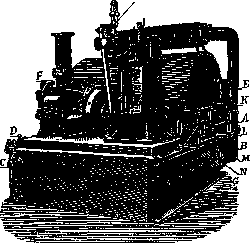
Figure 13. Clayton apparatus: A and F - taps for gas release; B and B - openings for thermometer; C - water inlet into condenser; E - air tube; G - condenser; J - lever; K - lever 'to room'; L - lever 'to generator'; M - lever 'fresh air'; N - lever 'to condenser'. (Clayton). The gas produced by the Clayton apparatus consists mainly of sulfur dioxide (SO2), N and a small amount of sulfur oxides. It is fatal not only for rats and insects, but also bactericidal. When brought to a concentration of 8-10%, it also serves for extinguishing flames. Because of this, small Clayton apparatuses have been installed abroad on hundreds of ships, and special steamships for disinfecting other ships, equipped with Clayton apparatuses, exist in 60 ports of the world (see figure 13). The disadvantages of this method of D. consist in that it damages most cargoes; D. of a ship requires considerable time (24 hours), and the gas itself is expensive. In 1924, the Clayton firm (Compagnie G. S. S.-Clayton, Paris) began to produce improved apparatuses producing sulfur-sulfur anhydride (SO2+SO3). This gas, due to the presence of SO3 in it, does not cause damage to fabrics, metals and other objects treated with it. For D. of ships with carbon monoxide, the firm 'Julius Pintsch' in Berlin has built two ships 'Disinfector' and 'Gas Ship', operating in Hamburg and Stettin. The gas produced by these ships (Nocht-Himza apparatus) consists of carbon monoxide (CO) 4.95%, carbon dioxide (CO2) 18.0% and nitrogen (N) 77.5% (according to Kirshchtein and Rudolf). The active principle of this gas is CO, enhanced by the complete absence of oxygen. Due to the complete absence of smell and the slight chemical activity of its components, this gas is indifferent to the cargo being treated and does not cause it any harm. Its action is fatal to rats. It is inexpensive and requires little time for treatment. Its disadvantages are: lack of insecticidal and bactericidal properties, danger of operation and high cost of the apparatus. In this apparatus, CO is obtained from incomplete combustion of coke in the generator. The Nocht-Himza apparatus installed on the 'Gas Ship' consists of a generator, steam boiler, condenser and purifier (scrubber) and a steam engine, which serves to drive the exhauster and water pump. Thanks to this, the apparatus can operate independently. The ship to be deratized is placed in a location where rats cannot get ashore. The 'Gas Ship' is placed along its side. After inspecting the holds through ventilators and other appropriate openings, a large number of sleeves 20 arshins long are lowered into the holds. After people have been removed, the ship's compartments are locked, part of the sleeves are connected, the apparatus is put into operation and fills the ship with gas. Ventilation of the compartments is then carried out partly naturally (ventilation), partly artificially with the help of an exhauster. The possibility of using the ship again is established by testing on animals (mice and rats). - In addition to the above methods, in Germany ships are deratized either with the patented preparation 'Sulforkose' or with a mixture replacing it, consisting of 90 parts carbon disulfide, 6 parts denatured alcohol and 4 parts water. For 100 cubic meters of space, 15 liters of this mixture are burned (the mixture is highly flammable, and only very experienced and reliable disinfectors are allowed to work with this mixture). The mixture is burned in special apparatuses; under the action of this gas, the ship remains for at least three hours. D. of ships with hydrogen cyanide is carried out by the usual method also used in the USSR for disinfection of railway cars (see Disinfection of cars) or by the American method, i.e. with gas consisting of 30% CNH and 60% cyanogen chloride. The mixture for obtaining the gas is as follows: sodium cyanide 4 g, NaCl 3 g, talc 2 g, pure HCl 176 cm3 and the same amount of water (per 1 cubic meter of space). For obtaining hydrogen cyanide, the preparation cyclone B (Zyklon B) is now widely used, which represents a thickened stabilized liquid HCN in silica scale and has the appearance of a reddish-brown granular powder. This powder is packed in hermetically sealed tins, opened with an ordinary can opener. The powder is scattered on the floor of the room to be deratized. In doing so, it completely releases HCN, so that only a non-toxic residue remains. The essential advantage of cyclone should be considered that it contains organic compounds of bromine and chlorine, which strongly irritate the mucous membranes of the eyes and nose, so that even uneducated people recognize the presence of the dangerous gas by its pungent smell and can timely protect themselves from it. All ventilation channels, hatches, windows, doors on the ship are hermetically sealed; drinking water, washing water, as well as all liquids in open vessels are removed from the ship. All people leave the ship. Two hours after the start of gas release, all compartments are opened for ventilation. Vessels with residue solution are neutralized by adding lime solution. The duration of ventilation should be at least 20 hours. After the completion of cyanidation, a benzidine test is performed (see Disinfection of cars), after which entry to the ship is permitted.
Related articles
Mentioned in
Cite this page
“Deratization.” Soviet Medical Encyclopedia. English translation of Bolshaya Meditsinskaya Entsiklopediya, 1st ed. (Moscow, 1928–1936), ed. N. A. Semashko. https://sovietmedicalencyclopedia.pages.dev/article/deratization/