Ship Hygiene
Historical document, translated for reference. It reflects medical knowledge of the 1920s–30s and is not medical advice.
Summary
Ship hygiene examines human health conditions aboard vessels, addressing both crew and passenger environments, ventilation standards, and disease prevention measures specific to maritime settings.
Encyclopedia article (1928–1936)
SHIP HYGIENE, being a part of general hygiene and having the same tasks and methodology as the latter, examines a person in the special conditions of their stay on a ship, which is temporary for passengers and prolonged for the ship's crew. The main sections of S. h. are: 1) hygienic assessment of the ship as a whole, 2) working and living conditions of the crew on board, 3) conditions for transporting passengers, 4) transportation of cargo, 5) prevention of the spread of epidemics by ships, and 6) organization of assistance for the sick or injured during the journey. Every ship is a floating structure used for transporting passengers, various cargoes, or performing special technical tasks (technical vessels, dredging convoys, icebreakers, etc.). Ships are divided into self-propelled with various engines—steamships, motor ships, sailing-motor vessels, etc., and non-self-propelled—barges (dry cargo and oil tankers), barges, kolomenkas, belyany, gusyany, and others. According to their operational purpose, the main types are passenger ships, cargo-passenger ships, cargo ships, colliers, timber carriers, refrigerators, tankers, fishing vessels, tugboats, etc. Materials for building ships are iron, wood, and for some types of ships—reinforced concrete. Metal ships, being the most technically advanced, from a hygienic point of view have a number of disadvantages in the arrangement of living and sanitary spaces on them: a) air-tightness of walls with limited cubic capacity, which requires enhanced ventilation, not always achievable on board; b) high thermal conductivity of walls (sides, decks), leading to uneven temperature in rooms, cooling or overheating of them, condensation of water vapor on walls and accumulation of water under the deck. Wooden vessels present a greater fire hazard, which leads to difficulties in arranging their heating; rapid decay of the material leads to air pollution in rooms; difficulty in achieving complete watertightness of the hull leads to excessive humidity in holds and living quarters. The most unfavorable hygienic conditions on board are in the hold: difficulty of air exchange, lack of natural lighting, drainage of water from the upper parts of the ship (rooms and decks) during washing of the ship, rain, etc., entry of debris, particles from cargo, decay of hold water, and consequently air pollution, etc. More favorable hygienic conditions on board are in rooms located on the upper decks (above the water surface). A ship represents one of the most complex technical structures, since in its design it is necessary to take into account a whole complex of mutually contradictory requirements: operational and technical tasks usually come into conflict with sanitary-hygienic requirements. Therefore, general hygienic standards regarding housing, lighting, ventilation, water supply, removal of waste, etc., must be adapted to the specific conditions of the ship, ensuring the minimum necessary hygienic standards. The cubic capacity of living quarters on ships according to English rules of the Board of Trade should be at least 2.04 m3 per 1 person, if they serve only as sleeping quarters, and at least 3.4 m3 when accounting for washbasins and space for taking meals; according to French rules, the corresponding figures are 2.15 m3 and 3.5 m3; according to Norwegian rules—at least 3.96 m3; according to German rules—3.5 m3, and with artificial ventilation it can be reduced to 3 m3. In practice, these standards, as observations show, are somewhat higher than specified in the rules: in England, a special commission in 1910 established a minimum standard for sea vessels of 5 m3 per 1 crew member, and actually there are on ships of the English fleet 4.25-8.22 m3; on Italian ships—4.55-10.0 m3; on American ships—about 5.6 m3; on French ships—4.0 m3 per person. According to the rules of the USSR Register, the cubic capacity of spaces for the crew is not directly given for river vessels, but calculating it from the established height and area, we get from 3 to 6 m3 per 1 person; for sea vessels the volume is set at 4 m3 per 1 person as a minimum. From observations on ships of old pre-revolutionary construction, it is found that even these minimum standards are often not observed, but new ships with approximately the same dimensions and construction have a larger cubic capacity than required by the rules—at least 4 m3 in general cabins and at least 6 m3 in single cabins. This cubic capacity is 3-4 times less than that extreme minimum which is allowed for living quarters on shore, and can be allowed without harm to health only on condition of enhanced ventilation of rooms: a 10-15-fold air exchange instead of the usual 3-4-fold for living quarters. The amount of necessary air exchange in various ship compartments varies; according to Okorenkov, for ordinary compartments of ships sailing simultaneously in northern latitudes and in the tropics, the required air exchange rate is as follows: Room names Passenger cabins, command staff, crew.......... Saloons, restaurants...... . Smoking rooms.......... Gymnasiums, swimming pools ....... Baths............... Kitchens, buffets......... Provision storerooms, pantries . . . Bathrooms, toilets, laundries . Sick bays............ Baggage compartments........ Deck buffets........ Entrances to the upper deck . . . Entrances to the middle deck . . Entrances to the lower deck . . . Engine room............. Refrigerator machine compartment............. Number of air changes per hour with forced exhaust ventilation 10-15 - - -. - - Based on theoretical considerations and shipbuilding practice, a standard of volume in a living space per 1 person in an iron hull ship should be established of at least 5 m3, while in wooden superstructures, due to better natural ventilation through walls, the standard can be reduced to 4 m3 per 1 person on condition of the above-mentioned air exchange rate. Ventilation on ships. All living quarters on board (passengers and crew) must have sufficient natural or artificial ventilation, ensuring even with closed portholes, skylights and doors proper inflow of fresh air and removal of stale air. When combining forced and exhaust ventilation systems in them, there must be some predominance of the forced effect. Internal openings of ventilation pipes open at exhaust fans at the top near the ceiling (not above stoves), and at forced ventilation—as close to the floor as possible, as far as possible from where people are located; external sections of forced ventilation pipes should be arranged so that outside air is drawn from a place on the upper deck that would ensure the cleanliness of the air taken in.—Among other methods, natural ventilation is allowed with the help of closable grilles of sufficient size from each compartment into corridors and fans of generally accepted and approved by the USSR Register systems, led out from corridors to the upper deck; the cross-sectional area of ventilation pipes should be determined based on 20 cm2 of exhaust and 20 cm2 of forced ventilation pipe per each serving person with a minimum diameter of ventilation pipe of 12.5 cm. From cabins, wheelhouses and separate compartments, mushroom-shaped ventilators, goose-necks or other ventilators approved by the USSR Register can also be installed. Natural ventilation to the ship occurs through openings in its decks and hull.. 1. Hatches—openings in the deck, serving for communication with compartments located below. 2. Ventilation caps, which are metal pipes passing through the deck, protruding above it and ending in a trumpet, which rotates and can be positioned against the wind; the lower end of the cap ends with a system of auxiliary air ducts going to different compartments. Caps are installed so that the plane of their trumpets is perpendicular to the direction of the wind, with oncoming wind providing intake ventilation, with following wind providing exhaust ventilation. 3. Opening portholes—openings, mostly round, in the sides of the ship, serving simultaneously for lighting. 4. Funnel pipes and casings around funnel pipes coming from boiler rooms help ventilate those compartments from which they can draw air, as they are a source of draft created by rising heated air.
The space between the smokestack and its casing is also used to extract air from the rooms connected to this space. - For use on ships, natural ventilation in addition to the natural openings in the deck and hull of the ship employs: a) wind guides, made of galvanized iron bent in the form of a trough, about 60 cm long; the wind guide is inserted into an porthole; when inserted, it extends 60 cm beyond the side and deflects the air, forcing it into the porthole; b) wind sail, which is a canvas pipe, the upper open part of which is equipped with fin-like attachments that deflect the moving air from the canvas pipe downward, into the interdeck spaces. - Despite the presence on ships of the above-mentioned devices for improving natural ventilation, the latter is still completely insufficient for the following reasons: during bad weather (storm, rain, etc.) all natural openings have to be sealed; the wind is inconsistent, the natural openings for ventilation are of minimal size, etc. Therefore, artificial ventilation must be used on ships. Each watertight compartment must have its own individual ventilation system. The intake opening for the fan should be located in the highest part of the ship's superstructure to prevent water from entering. Lighting on ships. Natural lighting on ships is provided through portholes (round openings in the ship's sides), skylights (for illuminating corridors, dining rooms, saloons, kitchens, engine rooms, etc.), deck portholes (for illuminating corridors, entrances, storerooms). All living quarters are generally illuminated by means of side portholes, and only when it is impossible to install side portholes is the installation of overhead lighting (skylight, deck porthole) permitted. The dimensions of side portholes should be 300-400 mm in diameter, on small ships and in the lower parts of the ship - 200-250 mm. On deck superstructures of river ships, windows of the railway car type are installed; on river steamships in dining rooms, salons, large-sized windows are installed. On sea ships in superstructures, rectangular portholes are installed, which provide more light than round ones. To illuminate rooms located in the middle part of the ship, remote from the sides, where it is technically impossible to install side portholes or skylights (corridors, storerooms, etc.), deck portholes or light from adjacent rooms are used by providing light openings in bulkheads or by glazing doors. - The light coefficient in ship's rooms located in the hull of the ship is significantly lower than the normal standard and drops to 1:30, 1:50 (on ships of old pre-revolutionary construction the light coefficient dropped to 1:100, 1:170, 1:180). In rooms located on the upper and superstructure decks where windows are installed, the light coefficient can be brought to the normal standard. Machine and boiler rooms especially suffer from a lack of natural lighting.
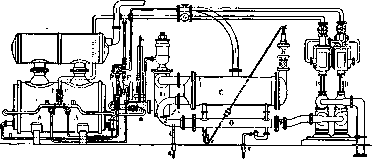
Figure 1. R. Krug's desalination system: AA-boiler; BB-circulation pipe; C-condenser; D-removal of seawater; O-cooler; p-pipe from circulation pump to cooler; gg-steam valve; mm-steam distribution tubes; II-pipe for discharging secondary steam to condenser C; v-pipe for collecting fresh water saturated with gases; K-apparatus for capturing gases released from the circulating water when heated; e-pipe for discharging gases captured by apparatus K to the cooler, where the gases are absorbed by fresh water; It-pipe for removing condensation water from the automatic drain, into which this water enters through the pipe and from the heating battery; PP-feed pump for replenishing water loss in the boiler; ss-pipe for discharging cooling water overboard.
having light from a limited number of portholes, often obstructed by mechanisms, and from the upper skylight. Portholes, often satisfactory in size, are frequently located under the wide sheer strake or in the hull flare of the vessel and therefore provide insufficient light, often reflected from the water surface. Due to the location of portholes in the upper part of the outer bulkhead, and the narrowness of the light opening in relation to the large area and depth of the compartment, the lighting is very uneven, which makes it impossible to express the illumination in accepted coefficients and lux. According to regulations for vessels, the number and size of lighting devices should be such that on a clear sunny day they ensure the possibility of reading newspaper print with normal vision in any place of the compartment. Regulations require that artificial lighting of crew quarters be sufficient for reading at a work desk (not less than 25 lux on its surface). Heating on vessels. In all living and service premises, central heating (steam, water or electric) must be installed, and on small and sailing-motor vessels - stoves or small stoves. Heating must guarantee not less than 17°C in all conditions of vessel operation, and with central heating, provision must be made for temperature regulation in each separate compartment. Pipelines and radiators of central heating must be placed along the sides or outer bulkheads and must be equipped with easily removable protective covers allowing for easy cleaning. In practice, we have on steam vessels mostly steam heating. The disadvantage of such heating on vessels is the excessive heating of pipes, leading to the burning of dust particles on the pipe surface and to the deterioration of air in the premises, as well as rapid cooling of the premises when heating is stopped. Water supply on vessels. Regulations require that vessels be supplied with drinking water during the vessel's stay in port or at a pier from the city water supply. In ports and large piers where there is a city water supply, the latter is conducted to the territory of the port to the line of vessel berths and to the pier. Water intake from the water supply is carried out from water supply faucets using hoses available on the vessel. Sea vessels as a rule are supplied with water supply water. Regardless of the presence of a supply of fresh water on a sea vessel, used for drinking and food preparation, each sea vessel must have a desalination unit. In case of insufficient fresh water on vessels due to long voyages or delays in route (during storms, etc.), the desalination unit is used, which, by distilling seawater, produces water suitable for drinking. Water distillation in the desalination unit is based on the fact that when water turns into steam, it does not capture salts, and then the condensed and cooled steam forms distilled water. Desalination units of the Ton, Krug (Figs. 1 and 2) and other systems are used. The Ton apparatus consists of a cylinder with two pipes ending in the ship's hull; for the inflow and outflow of seawater into the cylinder, several lentil-shaped cups with two pipes - a steam pipe and a drain pipe - are fitted; each cup has a disk in the middle against which the incoming steam jet strikes; the steam spreads over the cup, cooled by the flowing seawater. In improved desalination units, the water obtained is clean and transparent. To improve the taste of distilled seawater in desalination units, devices (aerator, thermotank) (Fig. 3) are installed for saturating the distilled water with air, which, when dissolved in water, gives it a pleasant taste. To give distilled water the properties of ordinary fresh water, inorganic salts are dissolved in the water obtained after distillation: per 1 m³ of water - sodium chloride - 3.8 g, sodium sulfate - 3.4 g, calcium carbonate - 48 g, and sodium carbonate - 14 g. Since seawater distilled in desalination units contains certain volatile substances obtained from the decomposition of sea salts and algae, which spoils its taste, before desalination, the water is treated with lime milk, for which lime milk is mixed with seawater in iron tanks for 1/2 hour, and then steam is passed through it, raising the temperature to 50-60°C. Then the water is passed through a filter filled with pieces of quartz and marble. Water supply of river vessels is mostly unsatisfactory. They use water supply water only at initial and large intermediate piers where there is a water supply. The difficulty of improving water supply on river vessels lies in the fact that a number of piers usually do not have a water supply, and in addition, river vessels due to their special design do not have compartments for storing large quantities of water required for supplying the crew and passengers, the number of which simultaneously reaches 1,000-2,000 people. Water intake from alongside is carried out using a pump or a hand pump. To improve water supply on a river vessel, the following measures are taken: 1. Water intake from the river is permitted only during the vessel's movement, in a deep pool, in the middle of the river, in places indicated by sanitary organizations after preliminary bacteriological examinations and sanitary surveys, where the water is not contaminated by the coastal population, factories, discharge of sewage, etc. 2. The hand pump or pump must be installed on a clean side where there is no possibility of contamination of the side by sewage from toilets, bathhouse, laundry, washroom, etc. These facilities must be installed on the opposite side from the pump. The lower ends of the pump and hand pump must be lowered into the river water to a depth of not less than 7 m, the ends of the pipes must be protected with nets to prevent the entry of various particles. 3. Water taken from alongside must first go to a service tank installed on the bridge; filters are installed with the service tank. It should however be noted that steamship filters usually do not provide reliable bacteriological water purification and only free it from suspended matter. From the service tank, water is distributed through pipes to separate premises: to the kitchen, buffet, as well as to the boiler-desalinator. 4. On a number of cargo-passenger and passenger river vessels, additional tanks are installed for storing water supply water (for drinking and food preparation) with such calculation that the water will last until the next pier where there is a water supply. 5. Water for drinking must be subject to mandatory boiling. Each vessel must have a boiler. The type of boiler-desalinator heated by a coil from 'steam from the boiler is generally accepted on vessels; a pipe from the service tank is connected to the boiler-desalinator for filling it. Special persons from the crew are assigned for water boiling. Sometimes in large ports when it is difficult to install a water supply in remote areas of the port, on island areas, water supply for sea vessels moored in these areas and on the roadstead is carried out using special water-carrying vessels. These vessels are subject to intensive sanitary control. On each sea vessel, a compartment must be allocated for storing a supply of fresh water, based on the calculation of 6 liters for drinking and 6 liters for washing per person per day for the crew and passengers. Fresh water must be placed in special metal tanks, which are part of the vessel's hull or are removable tanks. The inside of the tanks must be cemented, and the outside painted. The tanks must be equipped with devices for measuring the water level, filters, and ventilation pipes conducted to the decks, ending with nets.
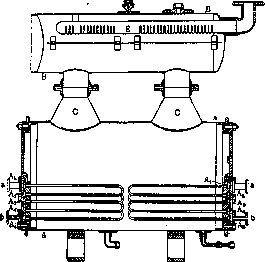
Figure 2. Vertical section of the boiler (AA Fig. 1) of the R. Krug desalination unit: AA - cylindrical body of the boiler; BB - separator connected to the boiler (evaporator) by two nozzles CC; the steam chamber is divided by bulkheads into 5 independent compartments A₁... A₅, collected by a system of heating tubes, as a result of which a continuous circulation of steam is formed, entering the removable heating batteries through steam nozzles aa; nozzles bb serve for removing condensation water formed during steam circulation; the separator BB serves to prevent the carry-over of salty water particles from the boiler, which may occur during intense steam formation; particles of water carried by the steam settle down through openings in the lower part of the horizontally positioned steam discharge pipe E.
for filling and emptying; 2 - air outlet; ±
3-stale air; 4-the cleaning of cisterns must be exhaustventilation. 5-air supply is provided by a special- air duct; 6-flap for- water drainage from ci- closed;ternsterns must be equipped with a cock or a hand or mechanical pump. The location and design of cisterns must allow for their accessible cleaning, washing and cementing inside, as well as prevent freezing of water in them. Water closets on ships are arranged at the rate of 1 unit for every 15 members of the crew; if the crew is accommodated in different parts of the ship, each of these parts must have at least one unit. On sea ships, the number of units for passengers is calculated: 1 unit for every 50 people on ships with up to 500 passengers, over 500 up to 1,000 passengers-1 unit for every 75 people. For a number of passengers over 1,000-1 unit for every 100 people. On river ships-1 unit for every 50 passengers if their number does not exceed 400; for a number of passengers over 400-1 unit for every 100 passengers. Water closets on all ships must be arranged with abundant flushing, for which a special tank, fed by a pipeline, must be installed. On non-steam ships, latrines were previously arranged in the form of a booth hanging over the stern, and when the ship was moored and during towing, these booths were tilted. At present, on non-steam ships, flush water closets of a permanent type are installed. Water closets on ships are arranged in the form of seats or open type. The minimum size of a single water closet should be 1.0x0.8 m. The design and location of water closets should be such that odors from them do not enter the premises; they should have lighting, ventilation and heating. Water closets on different decks should be located as much as possible on the same vertical line and not over living quarters. Washbasins on ships are installed in officers' cabins and passenger soft seats. On all ships, washbasins must be installed in a separate room from toilets. The floor and walls of washrooms up to a height of 1.25 m must be finished with waterproof material. Washbasins must be filled with water from the water supply. At present, washbasins on ships are installed in the form of sinks. Taps for washbasins should be installed at the rate of one per 10 crew members on all ships; for passengers in the following quantity: 1 tap per 15 passengers in soft seats, but not less than 2 taps; for deck and outside cabin passengers-1 tap per 20-25 people for the first 100 passengers; for every subsequent 40-50 deck and outside cabin passengers, one tap is added. Living quarters on ships are arranged in various parts: on river ships on the forecastle, in superstructures, in the hull of the ship; on sea ships-in the hull of the ship, on the upper deck, in superstructure decks, etc. The location of living quarters in the hull of the ship usually has a number of sanitary defects: insufficient natural lighting (due to the limited size of light openings in the hull), the flare of the sides, making cabins uneven and uncomfortable, with the presence of dead corners, air-impermeable walls, moisture formation on glasses, constant accumulation of water under the floor (on river ships), difficulty in arranging ventilation, toilets and washrooms (for the outflow of sewage and dirty water from washbasins, it is necessary to install non-return valves in the vent system, which often break down). On old ships, the crew was accommodated in berths with 10-12 or more people in one berth; the bunks were placed close to each other, and the lower bunks at the same time served as seats for sitting. Food consumption took place in the same berth (there was no separate dining room), drying of clothes was done over the bunks-all this worsened the sanitary condition of living quarters. At present, instead of berths, if it is necessary to accommodate the crew in the hull of the ship, well-equipped cabins (single-deck bunks) for 1-2-4 people are arranged. In addition, separate dining rooms with a red corner, separate rooms for storing special clothing, etc. are now arranged. In the hull of the ship, it is not permitted to accommodate more than 1/3 of the crew. In addition to improving the sanitary-hygienic conditions of crew quarters in new shipbuilding, great attention is paid to improving conditions for passengers, especially in hard and deck seats. For these passengers, satisfactory sleeping quarters, dining rooms, mother and child rooms, and other rooms are arranged. When reconstructing the fleet, it is planned to provide deck passengers with seating. In the part concerning the arrangement of premises on ships, the rules of the USSR Register do not permit the use for crew accommodation: a) premises in which the standards provided for by the rules cannot be maintained, b) premises without natural lighting, c) engine and boiler rooms, galley, buffets, pantry, sanitary cabin, infirmary, d) crew members cannot occupy passenger premises, e) premises containing an unguarded cargo hatch space, f) forepeak and afterpeak*. It is not permitted to use for passenger accommodation: hoods on wheeled vessels, tops of wheelhouses, hold compartments in the bow and stern from collision bulkheads, tops of hatches, premises not properly isolated from engine and boiler rooms, hoods, galleys, baths, laundries, toilets, as well as any premises insufficiently protected from access to fumes emitted by cargo and fuel, cargo holds of ships, premises below the lower passenger deck (premises below the upper deck forward of the collision bulkhead) and others. Kitchens on ships. Each ship must be equipped with separate kitchens, sufficient for preparing food for both the entire crew and all passengers. On non-steam ships and rafts, instead of kitchens, covered hearths are permitted. On passenger ships, a special room equipped with a water supply with good quality water (hot and cold) is allocated for washing dishes. Buffets on ships should be arranged in light rooms and should be supplied with a sufficient quantity of linen; for storing clean linen at the buffet, there should be a special room, dirty linen is stored outside the buffet in special boxes. Cargo transportation on ships. All goods that emit foul odors, infect the air and contaminate the deck (rags, leather, hair, dried fish, etc.) are not permitted to be transported on passenger ships. Goods deemed dangerous by sanitary supervision in sanitary terms may be transported on cargo ships under conditions determined by sanitary supervision. After unloading the goods, the holds are ventilated, cleaned, washed with water and disinfected.-Transportation of animals on passenger ships is permitted only with special permission from sanitary supervision, as an exception, when this livestock is intended for food for passengers and crew during the voyage. Livestock transported on ships must be kept in places inaccessible to passengers, completely separated from cabin, deck premises and from entrances to holds. Loading of animals is permitted only upon presentation of a veterinary supervision certificate.-Maintenance of premises. On passenger and cargo steamships making long voyages, after completing a voyage in one direction, and on other passenger and cargo ships making short voyages, a complete cleaning of ship premises is performed at least once a week. If parasites are present in the premises, disinsection is carried out, if rats are present, deratization is carried out. * Forepeak-irregularly shaped space between the bow of the ship and the last collision bulkhead; afterpeak-the same in the stern. 50 Sanitary measures on board. The entire ship crew undergoes periodic re-examination, and patients deemed by the doctor dangerous to public health are removed from the ship and sent to appropriate medical institutions. Passengers with an obviously sickly appearance are not permitted to board without prior examination by a doctor. Admission of infectious patients to ships is not permitted, except for those taken from technical and surveying ships, provided there is a doctor and a sanitary cabin on board. Seriously ill persons found on board are placed in the sanitary cabin. When an infectious patient is discovered, disinfection of the room where the patient was located is carried out. Travel by persons who might arouse disgust in others by their appearance due to their illness is permitted only in a special compartment. Persons who, due to their illness, may pose a danger to others and cause disturbance (mentally ill), are transported in separate compartments and necessarily with an escort. A patient can be removed from the ship only in places where he can be placed in a hospital. Provision of medical-sanitary assistance on board. According to the standards of sanitary authorities of the RSFSR (Resolution of the Council of People's Commissars of 6/VI1931), ships must have ship doctors or assistant doctors. Ship doctors in their activities follow a special instruction and perform all duties in accordance with the activities of health centers at enterprises.
To assist the physician, two orderlies from the deck crew are provided. On each vessel (steam and non-steam) there must be a medical kit with necessary medicines, bandaging materials, according to the approved NKZdr. list for various types of vessels (passenger, tug, steam, non-steam, boats), disinfection apparatus, disinfectants, sanitary cabin or infirmary (on large sea vessels). Sanitary cabin. On each passenger steamer (river and sea) carrying more than 200 passengers and making voyages of more than 12 hours, as well as on large sea cargo steamers, sanitary cabins are arranged with a number of beds depending on the number of passengers (from 1 to 5 beds). Sanitary cabins are arranged in places isolated from living quarters, mostly in the stern part of the vessel. The equipment of sanitary cabins must be in accordance with sanitary regulations for vessels. Sanitary supervision of rafts. Work on rafts is extremely heavy; in the pre-revolutionary time, raft workers lived for months in the open air, sheltering in a straw shack on bare boards; drinking water was taken by buckets from the river, there were no toilets on rafts, nutrition was dry food (dried roach, cucumbers and bread), which caused enormous incidence of intestinal diseases, a large number of accidents, often ending in the death of the patient. In 1924, sanitary rules were issued regulating all these issues, and certain sanitary standards were established in regard to housing arrangements, hearths for food preparation, improvement of water supply, etc. Supervision over the fulfillment of sanitary rules on rafts is also entrusted to sanitary supervision. - Prevention of epidemics on vessels. Vessels (especially passenger vessels) often serve as a means of spreading infectious diseases both endemic to a given locality and imported (exotic). According to the international sanitary convention (see> 1926), special attention should be paid to preventing the spread of plague, cholera, yellow fever, smallpox, and typhus. Conditions for the occurrence of typhoid fever on vessels sometimes also develop very favorably, leading to ship epidemics. The rules for the sanitary protection of the borders of the USSR provide for a number of measures for quarantine, observation, disinfection and deratization of sea vessels. Deratization of sea vessels must be carried out not only on epidemiological indications, but also systematically at certain times as a preventive measure: for foreign-going vessels 2 times a year, and for coastal vessels 1 time a year.--The most reliable method of deratization on vessels is gassing with hydrogen cyanide1-cyclone B-or sulfur dioxide, and in the latter case it is most expedient to use the Clayton apparatus; chloropicrin can also be used with great effect provided good ventilation at elevated air temperature. The same gases give the best results also for the disinsection of vessels. Wet disinsection gives less reliable results, and it is not recommended to use strongly smelling and flammable substances. Of the solutions for disinfection on vessels, as well as for disinsection, mercuric chloride and soap-phenolic or lysol solutions are more applicable. The greatest importance is attached to the thoroughness and systematicity of mechanical cleaning and disinsection; for transit vessels, as a rule, general disinfection is established at the end of each voyage. On epidemiological indications, upon detection of an infectious patient on board, disinfection must be carried out immediately by the ship's crew under the guidance of the ship's doctor or the first mate. All necessary disinfectants must always be at hand. The administration of the vessel (or the ship's doctor) must notify the nearest sanitary doctor along the route of the infectious disease, informing him of the measures taken and carrying out all his instructions for subsequent measures. For the evacuation of patients from vessels and sanitary supervision of vessels at certain piers, medical observation posts and marine stations are organized in large ports. A vessel having an infectious patient on board must hoist the established yellow flag and before disembarking passengers approach the medical observation post or call a sanitary launch to the roadstead. In special cases during mass epidemics, by special decisions of government bodies, some extraordinary measures may be applied to passenger vessels: not allowing on board without prior sanitary treatment, without vaccinations for smallpox, cholera or typhoid fever, sanitary treatment of all passengers disembarking from the vessel, etc. Preventive vaccinations1for smallpox and typhoid fever are mandatory for the entire crew of vessels of the USSR. Upon detection of smallpox on board, mass revaccination is recommended depending on epidemiological indications. When embarking passengers on vessels, especially at large piers, a representative of sanitary supervision or the watch officer of the vessel must be present in order to identify obviously sick or dangerous to other passengers. (See also Maritime sanitary affairs, Zaton, Deratization.)
A. Metaxa, V. Solovyov. Ship naval hygiene. Its task is to improve the living and working conditions of the ship's crew, since the features of ship architecture and climate, and the conditions at sea create more severe hygienic conditions for life and service on a ship compared to shore conditions. On warships, in addition, there is clutter with powerful movement and combat mechanisms and numerous auxiliary mechanisms, requiring a large number of personnel to operate them with a small free cubic volume. Therefore, on warships, the implementation of sanitary and preventive measures is required to a much greater extent than on merchant ships. On ships of the RKKF, the care for the protection of the health and labor of the sailors lies with the commander and the entire command staff; the entire crew 'is obliged to take care of preserving and strengthening their health and to do everything possible to promote the sanitary well-being of the ship; all crew members must comply with sanitary rules concerning the maintenance of cleanliness of ship premises, personal hygiene, and proper maintenance of beds, linen, and clothing' (Ship Charter of the RKKA Navy). The improvement of ship living conditions and the possible elimination of harmful factors caused by the architecture of a warship is carried out by the sanitary personnel of the RKKF from the moment of construction; mandatory preventive sanitary and construction supervision is provided for by an order of the high command. One of the main tasks of S. g. is to take measures to protect the purity of the air in ship premises and to combat high temperatures on warships. Due to their clutter with artillery and mechanisms, the free cubic volume in living quarters is extremely insufficient; on average, 2.5-4 m3 of free air space per person. In addition, the air temperature in most ship premises is usually high due to the steam mechanisms and steam pipes located in them or in adjacent premises. Free access to clean fresh air is possible only in premises located on the upper deck or directly under it, and moreover, in those premises that have access to the upper deck or side portholes; accesses and portholes are closed in fresh weather, and therefore even in these premises natural ventilation is not always ensured. Ventilation on modern warships and some commercial ships is carried out with the help of mechanical air-moving devices—centrifugal electric fans, which are connected by metal pipelines on one side to the outside air and on the other side to the ventilated premises. Depending on the direction in which the fan blades rotate, either air supply or extraction is achieved. The air exchange per hour is set at 4-10 times for living quarters, and for premises with high temperatures up to 40-100 exchanges. The decision on what kind of ventilation is necessary for each premise—supply, exhaust, or both simultaneously (combined)—is based, on one hand, on the state of the air in the premise, and on the other, on what premises it is directly connected to and what quality of air is in these neighboring premises. The effect of ventilation of ship premises with heated air is not limited to air exchange; the movement of air it produces, varying depending on the speed of exchange, contributes to improving the thermal well-being of people working in conditions of elevated air temperature, creating for them a 'comfort zone.' In those premises where such movement is not achieved to the required degree by the general ship ventilation or where it is completely absent, it is carried out with the help of local propeller fans (wind-driven fans), which by rapid movement of the blades create sufficient air velocity at the place where they are installed. With proper placement of ventilation openings—supply and exhaust—an air exchange is achieved in all parts of the premise and the removal of hot or spoiled air directly from its place of origin. The high velocity of air flow through ventilation pipes and at ventilation openings (up to 10 or more meters per second), caused by the need to ensure a large number of exchanges with small-diameter pipes, requires the installation of rotating nozzles at the ends of the supply ventilation pipeline, allowing the direction of the rapidly flowing air stream in the desired, least disturbing direction for people nearby. For heating the cold air supplied by fans into living and service premises in winter, thermo tanks—chambers with steam pipe coils—are installed in the path of this air. In cases where cooling of the ventilation air is required (when sailing in latitudes with a hot climate), brine cooled by a refrigeration machine is passed through these coils. High-power ventilation, up to 100 or more air exchanges per hour, is installed in engine rooms due to the overheating of the air in these premises by the large hot surface of turbines and steam pipes. When this ventilation is not in operation, the air temperature rises to 60° or more. Even greater power is achieved by the ventilation of boiler rooms, whose main purpose is to supply the required amount of air to the boiler furnaces for burning fuel; in cold weather, this powerful air flow, passing through the people serving the boilers, who are simultaneously exposed to radiant heat from the furnaces, is an etiological factor of cold diseases—professional for ship stokers. Submarines are also served by electric fans; they supply fresh outside air and remove spoiled air when the submarine is on the surface; after submergence, this type of ventilation becomes impossible. The change in air occurring in a submerged submarine is reduced to the gradual accumulation of carbon dioxide exhaled by people, a decrease in oxygen content, an increase in air humidity and its temperature (each person releases 50-60 g of water vapor and gives off about 100 large calories of heat per hour; heat is also released by the electric motors that propel the submarine when submerged). With the accumulation of CO2 up to 3% and a corresponding decrease in O2 to 17%, which occurs after 8-10 hours after submergence, depending on the cubic volume of the submarine and the size of its crew, and with simultaneous complete saturation of the air with water vapor and an increase in temperature, especially when sailing in warm waters, the harmful effects of the resulting air environment begin to manifest in the crew—shortness of breath, which sharply increases with movement or work, and later, with a longer submerged state of the submarine, progressing to a state of asphyxiation. To ensure the possibility of prolonged submersion of the submarine—up to 3 or more days, which may be required by tactical conditions, various methods of restoring the normal composition of the air are used, which consist in the fact that the air of the submarine premises is passed through electric fans through filter cartridges containing a CO2-absorbing composition, and the lack of oxygen is replenished from cylinders in which it is in a compressed state. Heating. In winter, due to the high thermal conductivity of the metal hull of the ship, conditions are created for strong cooling of ship premises, and for their heating, steam heating, and for some premises, electric heating are used. On fleets sailing in latitudes with a moderate climate, heating of premises in cold weather is carried out with the help of ventilation with air heated by thermo tanks. The use of steam for heating ship premises is due to the availability of this heat source on the ship and the possibility of transmitting steam from the ship's boiler to remote parts of the ship; more sanitary water heating is excluded as associated with great clutter of the ship. Steam from the ship's boiler, dried in a separator and passed through a reducing valve (expander) to reduce the boiler pressure to the required working pressure (2-3 atmospheres), enters the heating main and from there into the heating devices installed in the premises, and, after releasing its latent heat of vaporization through their walls, is passed as condensate through the spent steam main for further use as feed water for the boilers.
To eliminate sanitary defects of steam heating and achieve the desired temperature, it is necessary that: 1) the size of the heating surface of the heating appliances corresponds to the volume of the rooms in which they are installed and the cooling conditions of these rooms (adjacent side, similar hatch, powerful ventilation); 2) the steam pressure in the heating system (i.e., the degree of heating of the heating appliances) changes in accordance with the changing outside air temperature and should be as small as possible; 3) in living quarters, heating appliances should be installed in a quantity that allows for turning off some of them for more perfect regulation of heating, and they should be installed in places of greatest cooling—by the side, under the similar hatch, but not at the head of the beds or in places where they can become contaminated. For heating ship compartments at the lowest working steam pressure, it is required that the heating main serves a small area; therefore, instead of one main as was done on previous ships, several are installed, each serving its own area, and each has a reducing valve that allows maintaining different steam pressure in the mains corresponding to cooling. To prevent accidental burns, steam heating appliances are covered with louvered casings, easily removable for periodic cleaning of dust settling on the heating appliances. Water supply. The ability to desalt seawater on ships with steam engines has eliminated the need for long-term water storage, which has contributed to a significant reduction in morbidity. Fresh water of two kinds is taken on board: one that meets basic sanitary requirements—drinking water, and the second for domestic needs—for washbasins, bath, showers, laundry—domestic (washing, shore) water. Accordingly, the ship has separate reservoirs (tanks) for these waters, located in the lower, cooler part of the ship. The inner surface of the tanks is lined with a layer of cement to prevent rusting and the transfer of metal oxidation products into the water; in the cover there is a manhole for access inside the tank during its cleaning. To exclude moments of contamination of water stored in tanks, it is required: 1) that the pump and hose for filling the tank with water taken from shore are not used for any other purposes; 2) the sealing of the manhole closure must be ensured, and to prevent accidental dust from being swept from the tank cover through the open manhole, its edges should be bordered by a rim (coaming); 3) the deck should not serve as a tank cover, because through gaps in the joints of its sheets and through rivets, dirty water from the deck can seep into the drinking water; 4) drainage pipes, let alone sewage pipes, should not pass through the tanks. From the fresh water tanks—drinking and domestic—an iron, galvanized on the inside water pipe leads to places of consumption; water is supplied to the water pipe by a pump, and to avoid its continuous operation, small-capacity tanks—consumption or otherwise called pressure tanks—are installed above the upper deck, into which water from the storage tanks is pumped 1-2 times a day, and from which it flows into the water pipe by gravity. To prevent freezing of water in the consumption tanks, inside them there are copper tinned coils from the steam heating system or domestic steam pipe. The drinking water pipe must be completely autonomous, while the domestic water pipe is connected by a branch with a shut-off valve to the seawater pipe for the possibility of using it when the shore water supply is insufficient. For seawater, only a consumption, i.e., pressure tank is installed for this purpose and for flushing the toilet. Discharging seawater into the shore water pipe is allowed only at sea, i.e., when the purity of seawater is ensured. In cases where the drinking water supply cannot be replenished in time, seawater is desalted in desalination plants installed on the ship. The secondary steam obtained from boiling seawater in coils through which primary steam from the ship's boiler passes is directed to a condenser, and the resulting condensate—desalted water—goes into the drinking water tank. During water desalination, measures are taken to ensure that seawater is not mechanically carried over into the condenser along with the steam formed, for which the appropriate design of desalination plants and compliance with technical desalination rules are required. Lighting. Most ship compartments, service and living, are deprived of natural daylight; daylight in the side compartments of the above-water unarmored part of the ship is insufficient, because to ensure the ship's unsinkability and hull strength, side portholes (windows) are made of small diameter. The lack of daylight, being one of the most significant hygienic shortcomings of ship life, raises the problem of such artificial lighting of ship compartments that would most closely approximate daylight (increasing blue and violet rays in artificial electric light while simultaneously decreasing red and orange ones). Artificial lighting must meet general hygienic requirements (see Lighting). Sufficient illumination is absolutely necessary for those places on the ship where it is necessary to protect people from injuries, for example, from moving parts of machinery in narrow passages. The personnel serving searchlights and strong light signaling devices, as well as those working at oil furnaces, are provided with protective glasses. Timely removal of wastewater, filth, and domestic waste from the ship is carried out by a system of drainage and sewage pipes. Dirty water after deck swabbing and washing it in places where it becomes easily contaminated (galleys, toilets, laundries, etc.) is discharged overboard through scuppers—branch pipes, the upper opening of which is covered with a grid at deck level, and the lower one is discharged overboard somewhat above the waterline and is equipped with a non-return valve to prevent the compartment from being flooded by waves hitting the side. Dirty water from washbasins, baths, laundries, dishwashing systems through drain pipes connecting into drain mains is discharged directly overboard, and from compartments below the waterline or located insufficiently high above it—into dirty water tanks in the hold, from which it is pumped out overboard by a pump. To prevent clogging of drain pipes, settling boxes and water traps are installed in appropriate places; when pipes are clogged, they are blown with steam or under high pressure from the fire pump. Filth from common toilets (heads) and separate water closets is removed overboard by a system of sewage pipes, and in their design provision is made for strong flushing in case of stagnation, which easily occurs when it is impossible to run the pipe vertically throughout its entire length. Drain pipes from urinals are connected to the sewage pipes.—The usual type of ship toilet—a metal trough, in the cover of which there are openings for seats; on the opening connected to the sewage pipe in the bottom of the trough, a disconnecting valve with a rod is installed, by lifting the handle of which the flushing water filling the trough along with filth can be discharged into the sewage pipe and from it overboard. The feeding of the ship's crew depends to a large extent on the quality of food products and the methods of processing them into food. Mass food infections in most cases are caused by sanitary shortcomings in the equipment of ship galleys (kitchens) and food preparation. The main food—bread—is taken from port for the first two to three days of the voyage, after which biscuits or hardtack are issued if the ship does not have a bread-baking oven. The development of refrigeration and modern food preparation and bread baking technology have made it possible to store food products on ships for a long time and to equip galleys in such a way that allows for preparing a variety of foods; while the mechanization of the galley significantly reduces the number of people working in it and thus contributes to less contamination of it. Bakeries on large ships are equipped with mechanical dough mixers and bread slicers and are designed for the daily bread requirement. For cooking liquid food (first course), instead of the previously used boilers embedded in a brick furnace, double-walled steam food-cooking boilers are used, which are heated by steam circulating between the walls of the boiler. For heating stoves, coal or oil furnaces are used, and provision is made for such a device that the galley is not contaminated with coal or oil. The work of most ship specialists is associated with contamination of the body, underwear, and clothing with coal dust, oil, lubricating oils, which, together with increased sweating when working in rooms with high temperature, creates conditions for skin diseases (furunculosis, dermatitis); therefore, the task of Ship Hygiene is to ensure the personal hygiene of the ship's crew.
The number of washbasins is taken to be 10-15% of the crew, and so that all basins can be used simultaneously, the distance between them should be at least 55 cm; for convenience of washing, the upper edge of the tray with a drain pipe installed under the basins should not be higher than 75-80 cm above the deck. To prevent water from splashing when the basins are raised, they are not installed directly on the water supply due to the high water pressure in it, but in the bottom of a local tank into which water is poured. Washbasins in cabins of the type used on shore, with a porcelain or metal bowl connected to the drain pipe. For washing the entire body, baths equipped with showers are arranged on board. On a voyage or when bathing alongside is excluded for any reason, people pour water over themselves on the upper deck, for which a pipe with shower heads is connected to the pressure tank. - Washing of linen is done manually on small vessels, and on large ships in mechanically equipped laundries. Their drying chambers, by their design, can also be used for disinfection of linen and clothing. - On medical care for warships- see Naval Sanitary Affairs. The health of the ship is ensured by the totality of health measures taken; these measures are health education for the entire crew, cultivation of hygiene habits, control over the observance of hygiene and sanitation rules, strengthening of health through physical culture measures, periodic health examinations, timely isolation and treatment of the sick, control over the operation of systems and devices of sanitary importance, and their technical improvement. In order to deepen the preventive principle in the health service of the ship, ship doctors of the RKK Fleet are obliged to study the harmfulness of various types of ship service, the professional diseases characteristic of them, and to study the effect of measures taken to protect HEALTH AND labor.
v- Andreev.
Related articles
Mentioned in
Cite this page
“Ship Hygiene.” Soviet Medical Encyclopedia. English translation of Bolshaya Meditsinskaya Entsiklopediya, 1st ed. (Moscow, 1928–1936), ed. N. A. Semashko. https://sovietmedicalencyclopedia.pages.dev/article/ship-hygiene/