Water Supply
Historical document, translated for reference. It reflects medical knowledge of the 1920s–30s and is not medical advice.
Summary
The article discusses water supply systems in the Soviet Union during the 1920s-1930s, covering sources of water, treatment methods, distribution networks, and public health considerations related to clean water access.
Encyclopedia article (1928–1936)
Water Supply.
I. Water supply of populated places. Purpose and function of water supply. Water supply is the organized and regular delivery to the mass consumer of water of established quality and in a certain quantity, ensuring to one degree or another the needs of the given consumer. Such consumers are: cities, towns, and villages with their populations; factories and plants needing water for workers and production; transport with its large need for steam generation; troops during military operations, etc. The greatest needs for water are in places with a significant settled population, i.e., in cities. They have been the object of abundant water supply from ancient times, and here methods of procuring, conducting, and distributing water have been developed through a long historical, scientific, and technical progress, leading to the modern high state of this branch of sanitary engineering. From here, subsequently, these methods, in a certain refraction and composition, passed to other places of consumption indicated above. Therefore, the characterization of the tasks of city water supply and the methods of solving these tasks not only has an independent significance, but also makes it possible to reveal the essence of water supply in general. Speaking of city water supply, it should be borne in mind that cities are called populated places that are extremely different from each other both in the size of the inhabited surface and in the number of inhabitants, their living conditions, etc. The concept of a settlement is even less definite. These differences cause a great variety in the practical decisions adopted in individual cases regarding the water supply of populated places. But at the basis of all these various decisions must lie the satisfaction of the requirements of public hygiene by means of sanitary-engineering methods with strict consideration of the requirements of sound economics. The hygiene of populated places provides for a series of basic requirements that must be taken into account when installing a water supply. The soil and groundwater must be protected from any contamination and, in particular, from infection by pathogenic bacteria. Water must be delivered in sufficient quantity to satisfy all the needs of drinking, cleanliness, etc., and this water must be chosen extremely carefully and protected from all kinds of contamination. Finally, it is necessary to take measures for the rapid removal of all substances capable of decomposition, in order to protect rivers and other open reservoirs from dangerous contamination. To achieve the goal of sanitation of the city, it is not enough to fulfill one of the specified conditions. They are all necessary in the aggregate and one should strive to implement them simultaneously. Water supply is thus one of the factors of the sanitary well-being of populated places, a factor of extreme importance, but one that can acquire its full significance only with the mandatory implementation of the other measures named above, especially sewerage (see), i.e., the removal of contaminated waters. Without this, with the forcing of the water supply, it is possible not only not to improve, but sometimes even to worsen the sanitary state of the populated place, due to the contamination of it by the enormous amount of resulting dirty waters, which are poorly removed. -- Besides quenching thirst and preparing food, water is used for various domestic needs, including cleaning yards, watering domestic animals, watering gardens and vegetable plots, etc., and in some cases, water is used in homes as a motive force. Many of these needs could be met with water not of such high quality as is needed for drinking, but this would greatly complicate household management. -- Water supply must also satisfy various public needs. Water from water mains is used for sanitary purposes—watering and cleaning streets, flushing storm sewers, etc., for watering trees, feeding fountains, and also in the interest of safety—for extinguishing fires. Then come various industrial needs, so diverse that it is impossible to list them even approximately. There is not a single workshop in which water does not play an important role, not a single factory or plant where it is not used. From the above review of the purposes of water, it follows that cases of its use can, in general, be divided into two categories. In some cases, water is necessary directly for human needs, i.e., as "drinking" water. Concerns for public health impose upon us the obligation to demand in this case that the resulting "drinking" water be completely pure and flawless from a sanitary standpoint. In other cases, where water is used for technical purposes, with the application of heating or chemical actions, the requirements for water qualities may be somewhat lowered. It does not follow from this that we should abandon the effort to obtain, for the indicated purposes, if possible, the purest water, since for some industrial needs and in this respect there are very serious requirements. But they are not equivalent to the requirements presented for drinking water. Thus, for example, for feeding steam boilers, water containing the least amount of salts deserves preference, but the amount of microbes that may be contained in this water is immaterial. Thus, one can view the water intended for supplying cities from two points of view, distinguishing that water which is intended for use for sanitary purposes in the strict sense of the word (and its quality must unconditionally meet the requirements of public health) from that water which is intended for exclusive use for other purposes (and its purity in some cases may not be as important as its quantity). In Germany, these two categories of water have received different names, now generally accepted: "Trinkwasser"—water for drinking, and "Nutzwasser"—water for industrial use. -- The totality of all devices designed to deliver the necessary water for private, public, and industrial needs of a group of dwellings, most often an entire city or its part, a settlement, or several rural settlements, is called a water supply system. Water mains and their classification. Despite the indicated diversity of water needs, hygienists and technicians prefer the single water supply system. Water of the same drinking qualities serves for all types of consumption and is delivered to all residents by a single water main. This system deserves preference for its simplicity, cheapness of initial installation and operation, and ease of maintenance. It proves to be the only expedient one when it is a matter of delivering water to a populated place of small or medium size (and it is necessary to achieve this goal as quickly and simply as possible) and when there are no special obstacles to obtaining a sufficient quantity of water of satisfactory quality from a single source. In large cities, if all their need for water cannot be met by a single water main, it is necessary to use several separate water mains, as well as in settlements where the productivity of the existing water main has been brought to the limit and where, due to the development of the settlement, the need has arisen to turn to an additional water supply. In this case, however, water of the same quality, distributed by a single network of pipes, is used in each part of the city. This is still a system of single water supply. But in some cases, when the water extracted easily and cheaply is of low quality or when obtaining completely pure water is very expensive, it may be appropriate to turn to the system of dual water supply, i.e., to arrange two separate full and parallel networks of pipes, of which one delivers pure water intended for drinking and use in household management, and the other—less good quality water for washing, for supplying fountains, watering streets and other municipal needs, as well as for industrial purposes. This separation of devices, of course, complicates the matter and hinders operation, but it may sometimes turn out to be very advantageous. The choice between these two systems mostly depends on local conditions. From a hygienic point of view, the system of a single water main with water that is impeccably sanitary in relation deserves unconditional preference, because experience has shown that residents do not understand dual-purpose water mains well and often use bad water for drinking, and drinking water for household purposes. The great successes achieved by technology in the matter of artificial water purification, with the aim of giving it good drinking qualities by removing harmful impurities, mineral and organic, and bacteria, have now significantly facilitated the task of city water supply. Dual water supply is now becoming an exception and a rather rare one, while the rule is single, even if from several sources, with proper water purification. Further classification of water mains depends on the source of energy serving to deliver water from the place of its acquisition to the place of consumption. Water mains are usually divided into two large groups: water mains with a natural slope, or gravity, where water is set in motion only by the force of gravity, and water mains with artificial pressure, or pumping water mains, in which water is moved through pipes with the participation of pumps. Water mains of the first category, in which water moves by gravity, without the aid of pumping, can be with a free surface of the flow in the form of channels or tubular with pressure (natural).
Water supply systems of the second category must be tubular. Pumps are ordinarily driven by steam, thermal, or electric machines. In few cases are they driven by hydraulic power, usually for small water supply systems when, under local conditions, a hydraulic ram can be used with success. Sometimes compressed air is also used for lifting water, pre-compressed to the necessary pressure by compressor machines in special reservoirs (boilers). This type of energy is considered especially valuable in cases where one seeks to avoid having such high buildings as water towers. Gravitational and pumped water supply systems partly consist of the same structures, but in pumped systems, the source of water supply does not necessarily have to be higher than the supplied point, as a result of which the grouping of structures can be different than in gravitational water supply systems and more diverse. In exact accordance with the character and location of the water supply source, the location of the city, their mutual distance, methods of water conveyance, etc., one must in each particular case seek such an arrangement of structures and their composition which, while fully ensuring the city's need for water of proper quality, would at the same time be, as far as possible, the most economical in terms of initial cost and operating cost. Among other tasks, it is therefore necessary to take care of the possible use of natural slopes and not to expend mechanical power where the movement of water is possible by gravity. History of Water Supply. Historical monuments that have survived to our time testify that many peoples of antiquity had a rather high conception of the foundations of public health protection through the abundant use of water. Concerns for bodily purity, ablutions, and bathing in "sacred waters" are prescribed by all ancient religions. According to the conditions of the epoch, the rules then had the character of religious prescriptions, but this does not detract from their sanitary significance. Springs and fountains were placed under the special protection of the deity. Very often temples were erected in those places where springs burst forth from under the ground. There is not a single inhabited place in the ancient world whose name has been preserved by history where there are not found traces of special devices, and often very significant ones, for delivering water fit for drinking, or for the removal of harmful waters. Sometimes the construction of these structures was carried out on such grandiose scales and with such conditions of strength and durability that they have survived the most beautiful, most famous monuments of ancient architecture and serve almost as the only indication of the sites of long-vanished cultures. Hygiene as a science establishing the laws and rules of cleanliness and neatness was held in great esteem by the priests of ancient Egypt. From them, without any doubt, the Bible borrowed some of its sanitary prescriptions. The hydraulic knowledge of the ancient Egyptians was very high, and the results of their irrigation-type works still arouse wonder. Fewer monuments relating to the hydraulic activity of the ancient peoples of Asia have survived. However, there is no doubt that among the Assyrians and Persians the art of utilizing water was at a high degree of perfection. On the banks of the Euphrates, as well as on the banks of the Nile, water-lifting machines for watering fields were very widespread. It is very possible that in this country one should look for the origin of the noria, i.e., an endless chain with buckets. A well discovered among the ruins of Nineveh was constructed in prehistoric times. The lake, or artificial reservoir, created there by Queen Nitocris, had such gigantic dimensions that it could receive the 22-day discharge of the Euphrates. For the irrigation of the Hanging Gardens of Babylon, water from the Euphrates was raised by a machine to a height of 92 m and then distributed under pressure through metal pipes. Semiramis said with justifiable pride: "I made the flow of water go according to my will, and my will turned it to where it had to bring benefit; through it I made the parched lands fertile." Nineveh and Babylon were also supplied with a network of real drains. The use of water for the removal of excrement apparently appeared first of all in ancient Asia. The Persians so well understood the necessity of protecting rivers from pollution that their laws forbade throwing human waste into them. The Chinese at all times were skilled in digging deep wells and were early acquainted with the construction of artesian wells. In India, where wells and ponds are very widespread, their origin dates back to deep antiquity. The English, upon occupying this country, found in it many thousands of such structures. In the Madras Province alone, more than 53,000 ponds or artificial reservoirs were counted, and some of these reservoirs are distinguished by colossal dimensions. One of them occupies an area of 20,000 hectares and has a circumference of 48 km. In Ceylon, some valleys are barred by earthen water-retaining dams which surpass in their dimensions the greatest structures of this kind built in our time. Indian medicine, in the Vedic era, was aware of the effect of water on health; it prescribed the cleanliness of dwellings and clothing and attributed healing properties to clean water in general, especially the waters of the Ganges, the "sacred" river of the Hindus. The inclination shown by the Greeks from ancient times toward the extensive use of water in baths and gardens should, in all probability, be classed among the many borrowings made by them from the civilization of the more ancient peoples of Asia Minor and Egypt. The Odyssey already mentions the existence of a double system of canals in the gardens of Alcinous. To one of the heroes of Greek mythology, Hercules, tradition attributes the invention of warm baths. Among the luxurious devices highly valued by the Greeks belong skillfully executed fountains, artistic cascades, and water jets for refreshing the air. Having no means of chemical analysis, the Greeks nevertheless learned to distinguish the relative qualities of various waters. Hippocrates attributes a harmful effect on health to marsh water, as well as to hard water; he even suggests not drinking water kept in cisterns, but praises the use of fresh and, especially, spring water. Various types of pumps were used by the Greeks. In the writings of Herodotus is found the oldest known description of a suction pump consisting of a pipe in which a solid piston moves. The Greeks also used a lift pump with a hollow piston equipped with a valve; most of their ships were equipped with this device. Finally, the invention of the force pump is attributed to the Greek Ctesibius, which appeared 150 years B.C. and consisted of two cylinders and an air reservoir, like our fire pumps. The pump was made of wood, and the pistons were most often made of leather. The Greeks knew how to convey water using wooden troughs or pottery and lead pipes equipped with wooden or metal faucets. The great legislators of ancient Greece did not miss the opportunity to issue regulations concerning the finding and use of water. Solon determined the perimeter up to which the use of a public well should extend. Outside this perimeter, everyone had to dig their own well for their use at a distance of no closer than 2 m from neighboring properties. But if someone, having dug a well to a depth of 20 m, did not find water in it, then he had the right to use water every day, in an amount up to 54 liters, from his neighbor's well. Plato and Aristotle considered it a necessary condition for the protection of public health in every human community to deliver a sufficient quantity of good-quality water for drinking; therefore, they made it the duty of all persons entrusted with the management of public affairs to pay serious attention to this. In ancient Rome, the abundant, reaching the point of extravagance, use of water for public and private needs was considered a necessity. Persons wishing to gain the favor of the people donated significant sums for the construction of new structures for collecting, conveying, and utilizing water. To obtain an abundant amount of water, the Romans spared no effort and did not stop at any obstacles and material sacrifices. The samples of great structures left by them and the remarkable organization of the sanitary service they established made ancient Rome the classical city of water supply and its applications. Baths and bathing establishments were found in Rome and Roman colonies in huge quantities. The greater part of the water delivered by water supply systems was consumed by baths. Hot baths (thermae) appeared, the luxury of which reached remarkable development. Baths became a place of gatherings and entertainment. Some used the bath up to 7 times a day, and Pliny could say that for six centuries baths constituted the entire medicine of the Romans. During the reign of Constantine, there were up to 34 water supply systems, 15 thermae, and 856 public bathhouses in Rome. Such numerous structures and water supply devices of various kinds could, of course, function properly only with the existence of a proper management organization. During the Republic, the management of this matter was entrusted to censors and aediles.
Under the Empire, the water supply was managed by a dignitary bearing the title of curator. In constructing water supply systems, the Romans used predominantly the gravitational type of structures, directing water by gravity, under the action of weight. Pumps and water-lifting machines did not play any prominent role in these devices. The Romans also showed themselves to be true masters in the art of water procurement. They knew how to divert water from rivers and lakes very successfully, collect water from natural springs, locate and utilize underground aquifers, and create artificial springs by means of drainage ditches, which are still found everywhere in the vicinity of Rome. Roman engineers knew the properties of running water excellently, understood the laws of its movement, and knew how to use them. The topographic position of Rome in a vast low-lying plain, at a short distance from the mountains, made them give preference to water pipelines laid above ground in the form of a beautiful series of arcades, which, moreover, had the advantage of acting on the city's inhabitants with their appearance and flattering the vanity of the donors. The elevated water pipelines of the Romans also possessed the merit of making it possible to immediately detect the most insignificant leak and correct it without difficulty, without interrupting or even restricting traffic on the streets. In this they differed greatly from our pipelines lying in the ground. The Romans, apparently, paid more attention to the quantity of water which they delivered with the help of their water pipelines than to its quality. It has been calculated that the amount of water available to ancient Rome must have reached 1,200,000 cubic meters per day, with a population consisting of 300,000-400,000 inhabitants, i.e., reaching up to 40 cubic meters per person. The barbarian invasion of Italy in the 5th century dealt a heavy blow to Rome. Under their rule, laws and habits were completely transformed; soon only ruins remained of the thermae and aqueducts. The Christian church, which gained dominance at this time, completely ignored the sanitary traditions of ancient Greece and Rome. Moreover, it rejected the rules of hygiene as an unbecoming luxury. From this time on, the consumption of water was reduced to the smallest dimensions barely necessary to satisfy the most extreme needs. The consequences of the oblivion to which the rules of hygiene and sanitation, so developed among the ancient Romans, were subjected were not slow to manifest themselves in the most cruel manner and were one of the causes of many diseases that epidemically devastated Europe in the Middle Ages. Long years and a new upheaval in human history were necessary to deliver it from these sanitary disorders. Only from the 15th-16th centuries are new attempts observed to establish water supply in the cities of Europe. The Popes in Italy undertook the restoration of some aqueducts of ancient Rome. The construction of water pipelines assumed significant development in England. All the main parts of London were successively supplied with water pipelines. In 1582, Peter Morice installed a water-lifting machine under the shore arch of London Bridge, which was driven by a vertical water wheel. In connection with this, the first device for conducting water to houses with the help of lead pipes was created. The system introduced in London by Morice was already known and practiced in Germany earlier. Hanoverian brewers installed pumps driven by hydraulic power in 1527; this example was followed by the cities of Hamburg and Nuremberg. In the 17th century, France, being in a period of prosperity, undertook the most significant and remarkable works. Henry IV had pumps installed under the second arch of the Pont Neuf in Paris for pumping water by the action of a vertical hydraulic wheel. They fed the Louvre and the Tuileries Garden. Louis XIII utilized the waters of the Rungis River, which once fed the thermae of the Emperor Julian, and for the conveyance of these waters built the Arcueil Aqueduct above the lower structure remaining from Roman times; its name is assigned to the entire water supply system; thus, Paris received water to feed 14 public water distribution points. Finally, under Louis XIV, filters made of porous stone and air release valves on water pipes were used for particular importance. Financial reforms that made it possible to create joint-stock companies to supply cities with water also acquired special significance. In the 18th century, some of the large joint-stock companies for water supply were founded in London (Chelsea in 1745, Lambeth in 1785, Grand Junction in 1798). The appearance of cholera in Europe in the 19th century drew universal attention once again to questions of public hygiene, all the more so since railways began to be built at this time and the population in large centers grew rapidly. The issues of urban sanitation immediately acquired paramount importance. Water supply and sewerage of cities have since then become the subject of lively discussions and disputes. This movement began first of all in England, and in this country it manifested itself at the very beginning by numerous and diverse applications in practice, thanks to the first Public Health Act (1848). The United States and France were not slow in joining this movement. In the latter, already in the 20th century, the requirement of the law (February 15, 1902) on the preservation of public health became imperative for every community if the mortality in it exceeded the average mortality of France for three consecutive years. Little by little, the sanitation movement embraced all countries, and obtaining an abundant amount of water became an absolute necessity for cities. Its consumption, increasing rapidly, very soon exceeded the widest preliminary calculations. At the beginning of the 19th century, Paris barely had 15 liters of water per person per day, and in the second half of the century, the amount delivered by water pipelines of over 200 liters per day per resident already proved insufficient. In the second half of the 19th century, the number of cities with water pipelines gradually increased. In England and the United States, all cities and even towns already have water pipelines. In France in 1912, out of 647 cities with a population of more than 5,000 people, 505 cities had water pipelines, i.e., about 80%. In Germany, out of cities with a population of 5,000-20,000 people, 74% had water pipelines. Württemberg deserves special attention, in which about 400 populated areas (cities, towns, villages) at the end of the century received a properly arranged water supply; of this number, about 75% are villages with a population of less than 1,000 inhabitants each. In Germany, examples of water pipelines common to several populated areas appear when the construction of separate water pipelines for each of such points would be beyond their means. At the present time, the movement is gradually going deeper and deeper, and there is a tendency to mechanize water supply even to remote farms. Water Supply in the USSR. In Russia, the construction of the first water pipelines began only at the end of the 18th century: in Moscow, the Mytishchi pipeline, and in Tsarskoye Selo, the Tair pipeline, constructed by order of Empress Catherine II. The former, started in construction in 1779, was completed only in 1805. The Tair water pipeline, built in 1787, delivered by gravity from springs near the Taitsy estate about 5 million liters of drinking water for the cities of Tsarskoye (now Detskoye) Selo and Pavlovsk (now Slutsk) until 1905, when it was replaced for the drinking needs of these cities by a new pressure water pipeline from the Orlov springs, built under the direction of Prof. Timonov (1901-05). Very peculiar in its decorative setting is one of the very early Russian water pipelines, the Pulkovo pipeline, built along the highway leading from Leningrad to the village of Pulkovo. The process of development of Moscow's water supply, which has passed through a number of difficult stages, is interesting. The pace of construction of water pipelines in Russia is expressed by the following figures: up to 1861, only 10 water pipelines were constructed; in 1861-71, 19; 1872-81, 33; 1882-91, 31; 1892-1901, 46; 1902-11, 66. In general, in 1913, there were 219 municipal water pipelines in Russia, of which 100 provided a very insignificant amount of water. All Russian water pipelines in 1910 provided 762 million liters of water per day; of this number, 2/3 fell to four cities: St. Petersburg, Moscow, Warsaw, and Odessa. The water consumption per inhabitant was highest in St. Petersburg at 151.686 liters per day. Then came Reval with 139.228 liters, Warsaw with 95.9 liters, 8 cities from 86 to 49 liters, 10 cities from 37 to 25 liters, 38 cities from 25 to 12 liters, and the remaining cities less than 12 liters per day per person. The quality of the water was rarely satisfactory anywhere. Despite all this, the cost of Russian water pipelines was significant, amounting, for example, for Yekaterinoslav to 4 rubles 56 kopecks per daily 12 liters, for Nikolayev to 0 rubles 65 kopecks, for Kolomna to 5 rubles 55 kopecks, for Kozlov to 9 rubles 18 kopecks per daily 12 liters. Russian cities sold water to their consumers with some profit, which from a sanitary point of view does not deserve encouragement, since water, being a most essential item of wide use in human everyday life, must have a minimal cost. The cheapest water was in St. Petersburg at 5 kopecks per 1,000 liters. In 19 cities, the price ranged from 8 kopecks to 12 kopecks per 1,000 liters.
In the rest, it was even higher. According to the sources of water supply among the water supply systems of the USSR, there were recently: river 35.2%, spring 20.7%, ground 10.5%, artesian 13.3%, ground-spring 6.7%, artesian-spring 4.7%, and others; these ratios are continuously changing, but still show the presence of a very significant amount of river water supply. The general current state of city water supply systems in the USSR can be judged by the following brief data (P. S. Belov, A. Surin). In 1924, there was information on 278 water supply systems; by 1926, the number of water supply systems increased to 325, partly due to the construction of new water systems after 1924, and partly due to obtaining data for the first time on water systems built earlier. The number of inhabitants in cities with a water supply was: in 1924, 12.5 million people; in 1926, 14.9 million people; thus, the number of inhabitants living in cities with a water supply increased by 20%. The amount of water supplied per day: in 1924, 700,000 cubic meters; in 1926, 714,000 cubic meters; an increase of 2% with a 20% increase in population. Thus, compared to 1924, there was a certain deterioration in quantitative terms due to the significant population growth in cities. Because of this, the average consumption per resident per day was: in 1924, 55.2 liters, and in 1926, 51.3 liters. Daily water consumption per resident is very small: in 45% of all water supply systems, it ranged from 13 to 36 liters, in 13.2% of water systems, consumption dropped below 6 liters, and in only 5% of all water systems did consumption range from 60 to 84 liters. A comparative judgment on the extremely small capacity of all urban water supply systems of the USSR in 1926 can be made from the following data: the water consumption in all urban water systems of the USSR per day (714,000 cubic meters) constituted 22.3% of the water consumption of the water supply system of the single city of Chicago (3,200,000 cubic meters). The growth of the length of the water supply network (5,144.6 km to 5,693.3 km, i.e., 15.9%), as well as the growth in the number of fire hydrants (24,850 to 28,992, i.e., 16.5%), lagged behind the increase in the number of inhabitants (20%). The increase in the number of water supply taps (2,360 to 3,211, i.e., 36%), as well as the increase in the number of water meters (58,532 to 83,206, i.e., 42.3%), outpaced the growth in the number of inhabitants. The condition of the network improved somewhat, but leakage is still significant and reaches 40-50% in many cities. Connected to the water supply were 18% of all properties. Compared to 1924, there was an increase in the use of ground and artesian waters as sources of water supply (64% against 62%); an increase in the number of water systems filtering river water (71% against 65%); an increase in the use of water chlorination (38 cities instead of 18). A portion of the water systems (3.3%), but predominantly gravity-fed ones, released water to the population free of charge; 4.2% operated without a deficit; 1.8% operated at a loss; 74.5% yielded a profit, the size of which ranged from 5 to 50%. The unsatisfactory sanitary condition of water supply sources, not only river ones but often also underground ones, which was particularly vividly manifested in the Rostov-on-Don water supply catastrophe (1926; see Epidemic jaundice), brings to the forefront the question of protection zones for central water supply sources. At the present time, sanitary protection zones (see) have been introduced in 56 cities, and in the summer of 1928, a decree was issued in the RSFSR on the mandatory introduction of sanitary protection zones for all water supplies. This introduction of protection zones under modern conditions is all the more necessary since, on the one hand, the construction of a significant number of municipal sewage systems is planned, and on the other hand, a very strong development of all branches of industry, including also those that produce a huge amount of wastewater. Among sanitary measures of this kind, it seems necessary to produce systematic sanitary surveys of open water bodies, most important under local conditions, with the aim of establishing their sanitary condition, clarifying sources of pollution and self-purification capacity, on the one hand, and enhancing the consumption of underground waters, on the other, although the use of underground waters for water supply purposes continues to grow from year to year. In 1910, the number of water systems using underground waters constituted 56% of the number of all water systems, and in 1926, 64%, but this can be largely explained by the fact that the construction of water systems embraces more and more cities with a small number of inhabitants, and consequently, with a small daily water demand easily satisfied by underground sources. For large cities, in most cases, the question of underground water supply remains completely open. Along with this, there is an unplanned, completely chaotic use of underground waters, depending on unskilled methods of water extraction; in artesian waters, this often leads to the premature depletion of some water-bearing strata while other strata remain completely unused. Proceeding from this, one must recognize the absolute necessity of hydrogeological studies of underground waters in the corresponding regions of the USSR; these studies must be carried out in a planned manner, in complete coordination with the plan for water supply construction. Among populated areas of the USSR with water systems built recently (10-12 years), the following can be noted: Alushta, Bogorodsk (Nizhny Novgorod Governorate), Bronnitsy, Volokolamsk, Gorki, Dmitrov, Zvenigorod, Ivanovo-Voznesensk, Krasnodar, Mozhaisk, Murmansk, Orenburg, Pavlovo (Nizhny Novgorod Governorate), Sverdlovsk, Tikhvin, etc., and among cities with water systems under construction or expansion—Armavir, Vladivostok, Bukhara, Leningrad, Novorossiysk, Novosibirsk, Ashkhabad, Rostov-on-Don, Stavropol, Stalingrad, Tashkent, Troitsk, Tuapse, Shakhty, etc. Among cities where major transformations or enhancements of the water supply are planned, Moscow and Leningrad stand in first place. Sanitary and technical requirements. A correct assessment of the qualities of water intended for water supply requires the labor of various kinds of specialists—hydrogeologists, chemists, bacteriologists, hydrobiologists, etc. This assessment is the more difficult the more different the sources from which water can be taken to supply the city are, i.e., atmospheric precipitation (rain, snow), land flows and accumulations (lakes, rivers), underground flows and accumulations (spring, ground, artesian waters). The choice of a water supply source or sources therefore requires serious and prolonged investigations. The latter are especially complicated when it is necessary to establish not only the quality of water, but also its quantity, as happens especially often with spring, ground, or artesian water supplies, where the inflow of water fluctuates depending on meteorological and other conditions and where it is necessary through investigations covering the entire cycle of possible changes to be convinced that under the worst conditions the source will provide the required amount of water. The question of how much water needs to be available in a city or settlement per resident does not allow for a general solution. It depends on local conditions—climatic, domestic, etc. Of very great importance is the presence or absence of a complete municipal sewerage system. With an incomplete sewerage system, the average amount of water per resident must be less, since the removal of wastewater without sewerage is associated with such costs that it is never removed to the proper extent, and this water, remaining on the territory of the city, pollutes the soil. Thus, in Moscow before the imperialist war, water from the water supply was released to houses via water meters at 12 kopecks per 100 vedros, which amounted to 5 kopecks for a 40-vedro barrel, and the removal of one barrel of wastewater outside the city cost 2 rubles. Therefore, the installation of an abundant water supply must be tied to the installation of sewerage. For sewered cities with a population from 50,000 to 150,000 residents, the water supply norm is considered to be 50-75 liters of water per day per resident, and for cities with a population above 150,000 residents—75-100 liters. However, many cities in Europe and America go much further, striving to increase water consumption in the interests of public hygiene and cleanliness up to several hundred liters per day per resident. At present, for cities with a million population, the water demand can hardly be considered less than 125-150 liters per day per resident. Greater or lesser water consumption is conditioned by the habits of the population, its way of life and degree of civilization, as well as the loss of water during its delivery due to the imperfection of water supply systems, etc.; this loss can vary within very large limits. If to this is added the useless waste of water due to careless attitudes toward its consumption, it will turn out that the water demand is usually much greater than can be calculated by theoretical calculations. When calculating the expected water consumption in populated areas, it is necessary to keep in mind population growth, since the designed and then constructed water supply system must deliver the required amount of water not only for the time of water system construction, but also a significant number of years later. For the most correct calculation possible, it is necessary to determine the probable population growth for each specific case according to local statistical data. A completely correct solution to such a problem often appears very difficult, since population growth by no means occurs according to the law of so-called compound interest.
It depends on a variety of different causes of a social, economic, and political nature, etc. Among these causes, one of the most important may be the improvement of sanitary conditions of the city itself, for example, supplying water to it. It is very difficult to take all these circumstances into account, but it is necessary to strive for their fullest possible consideration, especially since with sufficiently careful study of the issue, the population figures predicted for the coming years are often justified with sufficient accuracy. As for the period for which water supply structures should be calculated, it must be established on the basis of an economic assessment of market conditions in each particular case (usually 25-50 years). When the need for water for a populated area is known and possible sources of water supply are clarified, it is necessary to make a choice between available water sources and resolve the question of which source to give preference to. At the same time, the sanitary qualities of the water must stand in the first place, provided, however, that its quantity is sufficient. Regarding quality, one should generally give preference to clean groundwater and everywhere that the quantity of this water is sufficient and allows for the possibility of proper expansion of the water supply in the future, i.e., with the growth of the city and its needs, one should settle on extracting groundwater; when considering the issue of water supply for very large cities and the quantity of groundwater does not meet the needs of the population, or when groundwater turns out to be hard or of unpleasant taste and odor, one has to take water for the water supply from rivers or lakes and, in case of unsatisfactory water qualities, take measures to purify and improve it. The amount of precipitation that can be collected in a reservoir intended for water supply depends on the area of the catchment basin (see) and the amount of precipitation. In the USSR, systematic observations of precipitation are carried out by meteorological stations, and a summary of observations is performed by the Main Geophysical Observatory in Leningrad, according to the data of which information can be obtained for all past years (starting approximately from the 1850s). For the design of a water supply, data relating to the driest years are important. The water flow in rivers and streams is most often determined by determining the average flow velocity and multiplying it by the size of the live cross-section; observations need to be daily, systematic, over a number of years. The flow velocity is determined by means of various special devices, for example, current meters, etc. The discharge of springs is most often determined by direct measurement, for example, passing all the obtained water through a spillway and observing the amount of backwater. The most complex is the determination of the amount of groundwater. It is carried out as part of hydrological surveys of groundwater, aimed at clarifying the origin, quantity, and quality of underground water in the studied area. Hydrological surveys of groundwater are divided into 1) preliminary or reconnaissance surveys and 2) final surveys, consisting of a) determining general hydrological conditions by compiling a hydrological plan; b) clarifying local hydrological conditions and the discharge of the underground stream by short-term pumping tests or by determining the width of the capture zone; c) verifying the capacity of the underground stream by long-term pumping of all or part of the required amount of water from test wells located at the site of future catchment structures. At all stages of the process of these surveys, serious attention must be paid to the sanitary side of the matter, not only regarding the satisfactory qualities of the extracted water, but also regarding the presence of causes that could worsen them both in the present and in the future. Under favorable conditions, i.e., when a powerful underground water stream of satisfactory quality is found in the very first stage of surveys, this series of works can be partially shortened; thus, for example, if preliminary surveys, followed by drilling and trial pumping, indicate the presence of a water stream which in its productivity far exceeds the required amount of water, then the compilation of a hydrological plan and subsequent long-term pumping of some part or the full water discharge from trial wells are not done. The survey area depends on its preliminary surveys, the area of the underground and above-ground basins, the amount of water sought, and the requirements imposed on it. If the found water turns out to be unsatisfactory in quality, one has to turn to the waters of other water-bearing horizons or look for another water-bearing area. It is recommended to first capture as large an area as possible with surveys, and then gradually narrow it down. When the general nature of the studied area becomes clear from drilling and observations of wells and some outside observations (water gauge stations on rivers, observations of springs and streams, etc.) to such an extent that it will be possible to outline the intended location of catchment structures, this place must be investigated by all possible methods, up to and including long-term pumping from trial wells located in such a way that some of them can later become part of the final catchment structures. As for the duration of the surveys, it is necessary that observations continue through the entire summer, autumn, and winter; a shorter period cannot give any reliable results, and even a one-year period is not always sufficient. From whatever source, satisfactory in its sanitary qualities, water is obtained for supplying a populated place, it is necessary to protect this source from pollution as much as possible. For this purpose, the aforementioned source protection zone is established and a number of technical measures are taken, varying in different cases.
Figure 1. Scheme of a gravity water supply.
of the spring water collecting reservoir enters filters F, if they are needed, from there into the clean water reservoir R, and then into the distribution network. A settling basin O is usually not needed; if it is needed, it is placed before the filter. A pumped water supply is arranged if the position of the source relative to the populated area does not satisfy the aforementioned (see Figure 2). In this case, water is lifted from the source by pumps of the so-called "first lift," or low pressure (H1) and is pumped by them into settling basins (O), from which it passes by gravity to filters (F), if they are needed, and from there into the clean water reservoir (R). These structures are arranged one somewhat higher than the other so that the difference in water levels is sufficient for the water to pass from one structure to another by gravity. From the clean water reservoir, water is lifted by "second lift" or high pressure pumps (H2), which are almost always installed in the same room (pumping station) as the first lift pumps; these pumps force water into the water tower reservoir. The water tower reservoir can be placed between the pumping station and the city, and all water enters
then into the distribution city network through the reservoir; the pipe leading water from the pump to the reservoir is called "pressure" or "discharge." If the reservoir and the pumping station are located on different sides of the populated area, then the pipe going from the pump to the reservoir simultaneously distributes water along the city, i.e., serves both as a pressure and distribution pipe; such a reservoir is called a "counter-reservoir." If the source is located higher than the populated area, but the difference in elevations is insufficient to create the required pressure in the distribution network, then (see Figure 3) the water passes by gravity through settling basins, filters, and a clean water reservoir (if it needs purification) and is supplied by gravity to the place to which it can be supplied at the expense of the available pressure, for example, to the city limits; here a low-level reservoir is arranged, from which water is pumped (by high-pressure pumps) into the water tower reservoir and the distribution network. In individual cases, one or another of the listed structures may be omitted; for example, water may not need filtration, or the water supply may not have a water tower reservoir when water is supplied directly to the network and fluctuations in consumption are regulated by the variable operation of pumps. If the city is located in an area with a sharply expressed relief and the difference in elevations of various parts of the city is very large, then it is unprofitable to pump all the amount of water required for the city to the height required to ensure pressure in the upper parts of the city, and it is rational to divide
Figure 4.
Figure 5.
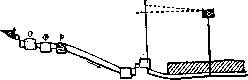
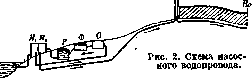
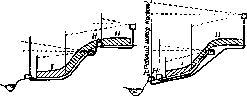
Figure 4. Diagram of a zonal water supply with each zone fed from separate sections. Figure 5. Diagram of a zonal water supply with all zones fed from one station. I-lower zone; II-upper zone; H1, H2-pumps. The city water supply network is divided into separate parts (so-called zones) that have different pressure (see figures 4 and 5). In addition to reducing the capacity of the pumping station and, consequently, reducing operating expenses, division into zones also reduces pressure in the pipes of the lower zone. Normal cast iron water pipes, manufactured by factories according to established sizes, are designed for a working pressure of no more than 10 atmospheres, and therefore, if the working pressure in any part of the water supply network exceeds 10 atmospheres, it is necessary to install pipes with thicker walls (or steel pipes), manufactured to special order, which significantly increases the cost of the pipes. Moreover, increased pressure in the pipes causes more frequent joint damage and, consequently, increases the cost of network repairs. Practice has shown that dividing the water supply into zones with different pressures often proves to be advantageous: for large cities-in the case of elevation differences of various parts of the city from 50 to 80 m, and for small cities (for which pipes with a diameter of about 20 cm are sufficient)-with elevation differences of at least 80 m. Generally, with small water supplies, the inconvenience from increased pressure in the pipes is less noticeable than with large ones, and the complication of the design and operation of a water supply divided into zones causes more inconvenience with small water supplies than with large ones. In doubtful cases, a water supply project should be prepared in two options-with and without division into zones, and the option that proves to be economically advantageous should be chosen. If the city's total water demand exceeds the amount of water that can be obtained from existing good sources (springs, groundwater reserves, etc.), and at the same time there is an abundant source of water of medium quality nearby (for example, a river), then recourse is had to the aforementioned dual water supply mentioned above.
Classification of the main methods of obtaining water for supplying populated areas (partially also for other purposes) can be proposed as follows (see table on pp. 345-346). Cisterns are reservoirs for collecting atmospheric water; they were very common in the ancient world. Now they are still found where there are no other more satisfactory sources of water supply; in some cases cisterns are also used as sources of urban water supply, especially in the U.S.A. The water in cisterns is mostly unsatisfactory from a sanitary point of view.-- Reservoirs (see) for collecting large volumes of atmospheric water are formed by blocking valleys with dams. In this case, special attention should be paid to the extreme importance of detailed and preliminary surveys and investigations of local conditions. It is necessary to determine the size of the basin of the projected reservoir; the amount of falling water, fluctuations in this amount-monthly, annual, multi-year; maximum rainfall discharge; the absorption capacity of the soil of the basin; the amount of evaporation under different conditions; then it is necessary, on the basis of these data, to determine the amount of water that can be collected, variations in this amount depending on different conditions and, generally, the expected regime of the reservoir.
Sanitary conditions Classification of the main methods of obtaining water. Sea water - distillation in special devices I category. a) ditches for rainwater b) cisterns (ordinary for rainwater { filtering I category. water a) reservoirs with water-retaining dams without filters with filters b) with the help of water-lifting \ or water-dividing structures c) with the help of water-retaining dams 2) Obtaining water from lakes IV category. Atmospheric waters 1) Obtaining water from rivers a) simple Underground (groundwater) dy vo- 1. Obtaining groundwater with the help of vertical structures A. Large diameter wells (reservoir) B. Small diameter wells (tubular) a) wells for periodic use (domestic wells) b) wells for continuous 1 use (water supply wells) \ a) driven, or Abyssinian b) drilled 2. Obtaining groundwater with the help of horizontal structures a) open channels b) drainage channels and pipes c) collection pipes d) collection galleries V category. Obtaining water from springs stone wells metal wells Brooklyn artesian

Areas near water sources should also be thoroughly investigated to prevent contamination and infection of water reserves. Obtaining water from streams and rivers, i.e., from streams moving along the earth's surface, requires special structures for capturing and directing water. The design of these structures depends on whether the captured water should be moved further by gravity through a ditch, channel, pipe, or whether it is moved by machines, as well as on whether the entire stream or only part of it is captured. When the amount of water to be diverted is insignificant compared to the flow of an abundant stream, the intake structure consists of a well or chamber placed in the river and connected to the water supply, or even of a single pipe. If the water in the river is not sufficiently clean and its banks consist of easily water-permeable non-erodible soil (sand or gravel), then intakes are not placed in the river itself, but on the bank, at some distance from the river; they consist of drainage devices, and this process is commonly called 'natural filtration'. When a fairly significant part of the flow of an abundant stream is needed, water-dividing or water-lifting structures are made, which divert the desired amount of water into a channel. Dividing structures are made when no preliminary lifting of water is required to divert it from the river. If such lifting is needed, the river is blocked by a water-lifting dam, which, by raising the water level in the river, allows water to be taken from a greater height. Finally, when the required water flow exceeds the low-water flow of the stream, it is blocked by a water-retaining dam, forming a reservoir, and a diversion channel or pipe is made. The dam must have a spillway for floods and must allow cleaning of the backed-up reservoir. Reservoirs of this kind are made on rivers with small low-water flows and make it possible to accumulate water during floods, forming reserves for the low-water period. The types of the dividing structures listed above are very diverse. The general sanitary conditions they must satisfy are as follows: the water intake from a stream or river should be placed away from sources of contamination and infection of the stream water, such as factories, baths, sewers, etc. In large rivers, the intake should be placed in places with the fastest possible current, i.e., preferably away from the shore, avoiding places where lack of speed or backwater promote the accumulation of sediments and floating debris. The intake should, as far as possible, be protected from the entry of floating bodies; for this purpose, gratings, nets, etc. are used. The intake should, as far as possible, take water with the least amount of suspended solids. For this purpose, water is taken at a certain level: either at the surface through a spillway or at a certain depth-through special openings. Sometimes with a variable water level in the river, lake or reservoir, swinging floating pipes are used to capture water at a constant depth, the intake opening of which is at a constant distance from the water surface. The intake should allow easy and convenient cleaning from dirt, which will inevitably accumulate in it despite all the measures mentioned above. In structures open at the top (chambers, channels), this cleaning is difficult. For suction pipes, cleaning is done by means of a water jet under strong pressure: the suction pipe is closed, water from the city network's pressure pipe is forced into it, thereby achieving flushing. If the distance between the mouth of such a pipe and the pumping station is large, it is preferable to construct a well at the pumping station, to which river water flows by gravity through a pipe, and from which pumps already suck the water. Such a well then becomes the place for housing the pumps, and its cleaning takes place without difficulties. Such an intake device is all the more appropriate because with a long suction pipe it is difficult to be sure of the tightness of its joints; through poor joints, groundwater can enter the pipe, often of a suspicious sanitary character. A water intake from a river on which there is navigation should be protected from impact by ships and marked with day and night signs. Finally, measures against destruction by ice flow are also necessary (see figure 6).-Water intakes from lakes (see figure 7) should, in general, satisfy the requirements stated above.
The conditions of their activity are complicated if the populated area is located on the shore of a lake, itself being a source of pollution of its waters. The means of combating this are the removal of the water intake to a great distance from the shore and the intensified protection of the lake from pollution. The simplest method of obtaining groundwater from the aquifer closest to the earth's surface consists in the construction of a well or a group of wells. A well (or group of wells) can continuously provide a quite limited amount of water; if the outflow of water from the well exceeds the inflow, the well can be drained. Therefore, for supplying groundwater to houses and generally for those cases when water is required at certain, more or less significant intervals of time, the most suitable type of well is a large-diameter well having a small depth; its second-rate inflow is small, but its water chamber has a large capacity and provides a reserve of water that can be used intensively during a short period of time. For urban water supply, requiring continuously large quantities of water, it is necessary to seek it in water-rich layers of soil; such are the upper layers in rare cases, since they usually correspond to small basins. Going to a great depth with large-diameter wells is difficult and expensive; moreover, it is not necessary, since the reservoir of the well, no matter how great its diameter, cannot ensure the reliability of water supply with insufficient inflow of groundwater. If the inflow is sufficient, then it can be extracted through a thin tubular well. Therefore, for urban and village water supply, large-diameter wells can be successfully used in relatively rare cases when there is sufficient water inflow in the upper layers; these wells are extremely convenient due to the ease of installing water-lifting equipment in them. Usually several wells are made, connecting them with horizontal pipes or galleries to a central well, from which water is pumped out by machines (see Figure 8). When the required amount of water is small and at the same time it is important to obtain water as quickly as possible, driven metal wells, otherwise also called Abyssinian, American, and instantaneous wells, are used with great success (see Abyssinian well). Drilled wells that supply water from shallow aquifers not under pressure and not capable of rising up the borehole are called Brooklyn wells (see Brooklyn well). If it is necessary to resort to deep aquifers for water supply, an attempt is usually made to find a layer with artesian water, since its water, being under pressure, even if it does not rise above the surface of the earth, in any case can rise significantly in the borehole and reduce the costs for its further lifting (see Artesian well). Springs are water outlets through which underground groundwater flows out onto the surface of the earth. They often flow into a natural reservoir of greater or lesser size. Usually springs flowing out in a certain place form an irregular group of water flows of different strength and size. Therefore, to obtain from springs a sufficient amount of water to supply a populated area, in most cases it is necessary to carry out special works and make special devices with the aim of capturing or tapping the waters. Capture works consist in finding natural underground streams, isolating them, directing their flow, and collecting their discharge. Capture structures must be protected from deliberate pollution by people, from attempts to divert water, from pollution by surface waters, dust, etc., from pollution by insects and animals in general, from the development of vegetation, from the invasion of underground waters of another, poorer quality (see Figures 9 and 10). For these purposes, capture structures are made mainly covered, protected from light, but accessible for ventilation; their walls are lowered to impermeable soil, they are surrounded by drainage ditches, the level of spring water is kept above the level of soil water, finally, around the springs the largest possible area of land is set aside, which is a protection zone inaccessible to outsiders and to animals. It should be noted that all these measures for the protection of spring water, similar to those for groundwater, do not always achieve their purpose. Spring water reaches the springs by little known and difficult to understand paths. Waters of different soil layers can mix through underground cracks and ovals, which are more or less difficult to find. Polluted waters of the upper layers can thus find their way into drinking groundwater and spring water.
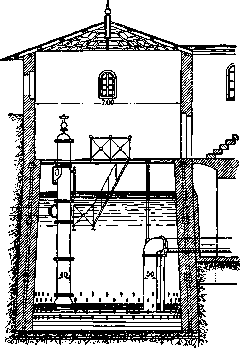
Figure 8. Catchment-collecting well of the city of Krefeld.
and collecting their discharge. Capture structures must be protected from deliberate pollution by people, from attempts to divert water, from pollution by surface waters, dust, etc., from pollution by insects and animals in general, from the development of vegetation, from the invasion of underground waters of another, poorer quality (see Figures 9 and 10). For these purposes, capture structures are made mainly covered, protected from light, but accessible for ventilation; their walls are lowered to impermeable soil, they are surrounded by drainage ditches, the level of spring water is kept above the level of soil water, finally, around the springs the largest possible area of land is set aside, which is a protection zone inaccessible to outsiders and to animals. It should be noted that all these measures for the protection of spring water, similar to those for groundwater, do not always achieve their purpose. Spring water reaches the springs by little known and difficult to understand paths. Waters of different soil layers can mix through underground cracks and ovals, which are more or less difficult to find. Polluted waters of the upper layers can thus find their way into drinking groundwater and spring water.
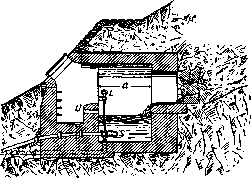
Figure 9. Small spring well for capturing descending lateral springs: a-capture chamber; S-intake cap with mesh; L-shut-off valve on drain pipe; U-overflow.
Therefore, having done everything possible to protect the springs, they cannot be left without further sanitary observation in chemical and bacteriological terms, in order to timely prevent the possibility of harm to the population by the water. Water obtained from various water supply sources in rare cases possesses all the required qualities from it. Often it needs artificial improvement, which is called water purification. The methods of water purification are divided into three groups, differing in the purpose directly achieved by them, namely: 1) methods for removing from water any
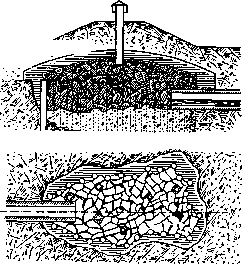
Figure 10. Capture structure with a row of piles and stone riprap.
of suspended (undissolved) particles, 2) methods for destroying pathogenic bacteria in water (water disinfection), 3) methods for changing the amount of certain substances dissolved in water, i.e., improving the chemical properties of water. For removing suspended particles from water, mechanical processes are commonly used: straining through a mesh to retain large particles, settling to precipitate substances heavier than water, and filtering, i.e., passing through various porous substances (most often through sand). Filtration cannot be considered a purely mechanical process, as biological factors also participate in it. In some cases, for better removal of suspended substances, chemical reagents ('coagulants') are added to the water, allowing the processes of settling and filtration to proceed significantly faster than without the addition of reagents (see English filters, American filters). In the methods of this group, when water is freed from turbidity, it is also largely freed from bacteria; however, among the bacteria remaining in the water, pathogenic ones may be present alongside harmless ones, if the water source is heavily contaminated. Thus, these water purification methods cannot always guarantee reliable protection against so-called water epidemics. In the methods of the second group, water disinfection aims to kill the pathogenic bacteria present in the water. For this purpose, methods are used that are either physical, such as boiling water in small quantities and treating it with ultraviolet rays in mass water supply, or chemical, such as ozonation of water or treatment with chlorine and other reagents (see Ozonation and Chlorination of water). Water is usually subjected to disinfection after it is physically clean or has been pre-purified. Disinfection is important for drinking water and is rarely required if the water is intended only for technical purposes. Among the dissolved substances, lime or magnesia (i.e., softening the water) are often removed from water to make it suitable for feeding steam boilers without the danger of water supply pipes becoming clogged with deposits, salts of iron are removed for the same purpose, the content of free acids that corrode lead pipes is reduced, salt water is desalinated, and finally, excess gases are removed from the water or the water is enriched with O2 (air) and sometimes CO2. Most of these processes are important for technical purposes, but some are also significant for the drinking properties of water. Thus, all three main groups of water purification methods do not compete with each other but complement one another. When choosing a water purification method, there is no need to choose between these groups; rather, it must be decided whether the water should be treated by methods of one or more of the main groups. Measures to prevent the development of algae in water basins include protecting the basins from light access, in the absence of which most algae cannot develop, and dissolving a small amount of copper sulfate in the water. The taste of water, depending on gases or dissolved substances, disappears with their removal. The turbidity of water decreases when it is freed from suspended substances. The color of water depends on dissolved or colloidal impurities and is eliminated by chemical treatment, most often by adding coagulants followed by settling and filtration. Purification structures are arranged either near the place where water is obtained or near the place of its consumption; it may be rational to divide them into groups, so that primary purification occurs at the place of water extraction, and final purification at the place of consumption. The decision depends on the conditions of the specific case and the quality of the natural water. From a sanitary point of view, it is desirable that bacterial purification generally occurs as close as possible to the water consumer. Water-lifting and water-pressure structures. If the terrain does not provide natural water bodies that allow water to be conveyed by gravity to the points of consumption, and the proper pressure for water movement through the pipe system is obtained artificially, mechanically (with the help of pumps), then two methods of creating pressure are most commonly encountered in practice: a) creating a system with a water tower that serves as an equalizer of both pressure and water flow (see Figure 11), b) creating a system without a water tower. In recent times many
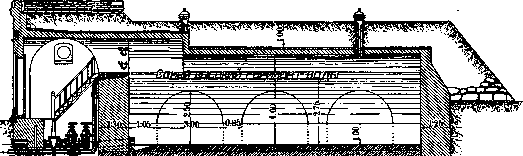
Figure 11. Pressure reservoir of the Weimar water supply. 3 54 water supplies (mainly in the U.S.S.R.) began to be constructed without pressure reservoirs, with water being pumped1 directly into the network of water pipes. However, unfavorable operating conditions for the machines, forcing them to constantly adjust their work to the consumption in the network and thus undergo all its random changes, as well as the requirement for pipes of great strength, in most cases force one to abandon the use of this system in its pure form and to install as an intermediary between the pumps and the network so-called pressure columns, leaving direct pumping of water into the network only during fires for extinguishing them. When regulating pressure by means of pressure columns, the productivity of the machines decreases, and their operation becomes uneven. This unevenness in the operation of the machines is caused by frequent and strong fluctuations in the water level in the pressure column, significantly exceeding those observed in water supply reservoirs. A pressure column or pipe can be replaced by an air bell, which is less prone to freezing and cheaper. Examples of the latter device are the water supplies of Leningrad, Nizhny-Novgorod, Astrakhan, Kharkov, Odessa, etc. The air bell is installed at the beginning of the main line, directly after the pump, and is equipped with a safety valve to prevent excessive increase in pressure in the pipe network caused by the pump's operation, especially with variable water consumption. In certain cases, for proper regulation of operation and consumption, resort is made to the construction of two or even more reservoirs, one above the other, for day and night consumption, as well as for the operation of the water supply during fires and at other times, or to the construction of emergency reservoirs, located near places of greatest water consumption and generally in areas supplied with water with the greatest difficulty (in elevated and in the most remote parts of the city from the main pressure reservoir). These emergency reservoirs, during the period of least water consumption in the network, are filled with water through it, while during hours of greatest consumption they themselves become pressure reservoirs, returning the received water to the network and thus assisting the main pressure reservoir. All water-lifting structures are located as close as possible to the source--river, lake, or artificial reservoir--but in such a way that these structures are protected from flooding by high water during floods. In the simplest case, only one water-lifting building is erected--either at the water source or in conjunction with the water intake building. The water-lifting building should be sufficiently large for the convenient installation of water-lifting machines with all their accessories. Often, before being supplied to pressure reservoirs or directly into the city network, water must first be lifted from the source by other machines! which transfer it to filters or other devices. All buildings of the pumping station and their premises should be located in proper dependence on each other. All premises should be designed as light and of sufficient size, coordinating these dimensions with the planned equipment and taking into account the possibility of expanding the pumping station. Pipe network. Every system of W. requires the construction of a network of water pipes, beginning at the place where pressure is obtained by one or more pipes and gradually branching out more and more. The design of the network is related to the question of choosing a location for the water supply reservoir, with the following main conditions to be observed: a) the height of lifting water from sources to the reservoir should be as small as possible, since any increase in it causes constant excessive fuel costs and requires more powerful machines; b) the distribution of pressure in the network should be as uniform as possible; c) the design of the entire network should correspond to the least cost of its construction and operation; d) in case of damage to one of the main lines at any point, the W. network should not be disrupted to any noticeable extent. The network consists of main, or trunk lines, and branching lines of the 1st, 2nd, and subsequent orders, representing gradual branchings to the last so-called street pipes. Trunk lines should be laid through areas of greatest water consumption and through the highest parts of the city; if it is impossible to run trunk lines through all such parts of the city, lines of the first order should be laid through them primarily before lines of subsequent orders. Trunk lines, and after them lines of the first order, should be laid, if possible, along a downward slope. Street pipes are recommended not to be too long, not more than 400-500 m when fed from two sides; and 200-300 m when fed from one side, because otherwise, with ordinary diameters of street pipes (from 100 to 150 mm), a considerable difference is obtained between the pressures at the ends of the pipe and in its middle, and consequently, a large unevenness of pressure in the network. In addition to the considerations mentioned above, when choosing a location for the reservoir and designing the network, it is necessary to keep in mind the gradual growth of the city, requiring the possibility of increasing water consumption with the least cost of rebuilding the system. In this case, special attention should be paid to increasing the productivity of the network, which can be achieved either by increasing the height of the pressure reservoir and the power of the machines, or by laying new lines of large-diameter pipes, or finally by both methods together. If the city is scattered, the population grows quite quickly and fuel is cheap, it is more economical to increase the conductivity of the network not by laying new pipe lines, which would be expensive with their great length, but by increasing the height of the reservoir. But if the city is densely populated, the population grows slowly and fuel is expensive, it is more advantageous to increase the conductivity of the network by laying new pipe lines. The laying of water supply pipes is done at a depth greater than the freezing depth of the soil, i.e., in our average conditions about 2 m from the surface of the earth. This figure must be kept in mind when designing fire water supplies and fountains. The city water supply network is now almost exclusively made of asphalted cast iron pipes with various connecting parts inserted between them in places where two or more directions connect with each other, as well as at points where house water supply pipes branch off. However, cases occur where black and galvanized iron pipes are used, as well as (for the construction of individual water mains)-riveted pipes from boiler iron and steel, and also from corrugated iron. In addition, in England and especially in North America, cases of using wooden pipes are known. Drilled small-diameter wooden pipes were also used in Russia; one can expect the spread of larger diameter wooden pipes made of staves in our country. The street water supply network passes into house, factory, and other networks connected to it by special branches. The pipelines forming the trunk lines, which branch out into an increasingly branched network, by their very purpose deliver water to various parts of the city for domestic, street, and factory consumption, have a whole series of devices serving this purpose; in addition, there are some other devices along the pipes ensuring the correct flow of water. Devices of water supply pipes can be classified, approximately, as follows: by calibrating the water supply, a calibrated valve passes in each unit of time only a certain amount of water, proportionate
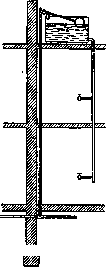
Figure 12.
Figure 13. I. Water dispensing fixtures a) fixtures for obtaining water for various needs b) fixtures for obtaining water for street washing, etc. 1) water for washing, etc. 2) drinking water specially 1) for washing streets proper 2) public closets 3) gutters c) fixtures for obtaining water for watering streets and plantations 1) operating by means of barrels 2) operating by means of fire hoses d) fire appliances II. Protective fixtures III. Water meters a) fixtures for stopping the movement of water or for removing water (faucets) b) fixtures for removing air (air vents) c) fixtures for pressure reduction (safety valves) d) head regulators e) fixtures for preventing water from backward movement (check valves) a) for measuring water consumption in various parts of the network, in order to check its condition b) for measuring water consumption at consumption points for billing records Water supply to consumers can be: 1) continuous, but limited supply, in which the established Figure 12. Scheme of house water supply with a general reservoir in the attic. Figure 13. Scheme of house water supply with reservoirs in floors. average consumption; 2) intermittent supply, delivering to the consumer their entire daily consumption within a few hours and then stopped; 3) the method of unlimited use of water, the consumption of which depends on the will of the consumer. The first two methods are generally unsatisfactory. With the continuous method, the inflow rate is low, and therefore obtaining water by the consumer is extremely slow. With intermittent supply, there is a need for reservoirs or tanks (see) for the accumulation and storage of water (Figs. 12 and 13). In general, with both of these methods, it is desirable to install tanks, usually located in the attics of houses, less often on floors; the installation of these tanks and protecting them from the effects of frost greatly increases the cost of the house water supply. These tanks are also often a place of stagnation, contamination, and even infection of water (dust, insects, rats, etc.), and therefore they are extremely undesirable from a sanitary point of view. With intermittent supply, the cost of the discharge pipe from the tank (from which pipes extending water distribution to floors depart) is added to the installation costs, in addition to the pressure pipe from the street branch to the tank. With continuous limited supply, floor branches can be taken directly from the pressure pipe. Therefore, the most rational method is unlimited use of the water supply, almost exclusively used at present. With this method, there is generally no need for tanks, and the pressure pipe, extending from the street branch and rising into the floors, directly branches out as needed. A certain feature is represented by the water supply of very high houses, where it is necessary to have a reservoir at the bottom and an auxiliary water booster. To regulate the correct consumption of water, prevent useless waste and losses through an unsatisfactory house network, as well as to account for the amount of payment for water, the best method is the installation of house water meters (see figures 14-16). The issue of equipping the water supply network with water meters is of very great importance, because with its correct solution regarding the quantity and quality of water meters and their control, the water economy is put in order. Water losses in the street network and useless waste in house networks are greatly reduced. The savings resulting from this make it possible to direct greater funds to the sanitary protection of water, and thus public health benefits more or less significantly. However, to achieve these goals, it is required that the water meters themselves have a proper design ensuring the accuracy of their readings. The Chamber of Measures and Weights in the USSR takes care of the latter aspect of the matter. The enormous sanitary importance of water requires that it be as accessible as possible to the population in price. Water tariffs must be such that it in no case is a source of income for a city or settlement, i.e., that it is sold no higher than cost. Cost, on the other hand, should be lowered as much as possible by the rational design and operation of the water supply, of course, not to the detriment of the quality of water. These requirements are far from being observed everywhere and always, to the undoubted detriment of public health. Thus, St. Petersburg previously received over 1.5 million rubles in net profit from the water supply. The tendency to obtain large incomes from water supply still exists in some cities of the USSR, mainly for the purpose of obtaining a source of funds to cover expenses for the development of water supply and the installation of sewerage. The correctness of such an order from a sanitary point of view can be disputed.
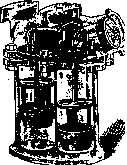
Figure 14. Frager piston water meter (general view).
exclusively applied at present. With this method, there is generally no need for tanks, and the pressure pipe, diverted from the street branch, rising into the floors, directly branches out as needed. Water supply to very high houses presents a certain peculiarity, where it is necessary to have a reservoir at the bottom and an auxiliary water lift. To regulate the correct consumption of water, prevent useless waste and losses through an unsatisfactory house network, as well as to account for the size of the payment for water, the best method is the installation of house water meters (see Figures 14-16). The issue of equipping the water supply network with water meters is of very great importance, because with its correct solution regarding the quantity and quality of water meters and their control, the water economy is put in order. Water losses in the street network and useless waste in house networks are greatly reduced. The savings resulting from this make it possible to direct greater funds to the sanitary protection of water, and thus public health benefits more or less significantly. However, to achieve these goals, it is required that the water meters themselves have a proper design ensuring the correctness of their readings. The Chamber of Measures and Weights in the USSR takes upon itself the care of the latter side of the matter. The enormous sanitary significance of water requires that it be as accessible as possible to the population in price. Water tariffs must be such that it in no case is a source of income for the city or settlement, i.e., that it is sold no higher than cost. Cost itself must be reduced in every possible way by the rational design and operation of the water supply, of course, not to the detriment of the quality of water. These requirements are far from being observed everywhere and always, to the undoubted detriment of public health. Thus, St. Petersburg formerly received over 11/2 million rubles of net profit from the water supply. The tendency to obtain large incomes from water supply exists even now in some cities of the USSR, mainly for the purpose of obtaining a source of funds to cover expenses for the development of water supply and the installation of sewerage. The correctness of such an order from a sanitary point of view may be disputed. Control of construction and operation. The water supply, being a sanitary-engineering structure, requires during its design, construction, and subsequent operation the joint labor of representatives of engineering and hygiene. When choosing a source of water supply and properly assessing its qualities, when establishing methods of artificially changing these qualities, when determining the methods of conducting and distributing water, and so on, only the joint efforts of representatives of engineering and hygiene can lead to the most
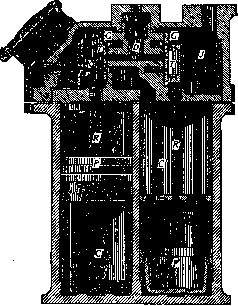
Figure 15. Frager piston water meter (section): C and C'—vertical cylinders; P and P'—pistons; D—water distribution box; G and G'—vertical mirrors; 1, 2, 3, 4—distribution holes; T and T'—slide valves; E—inlet opening; S—outlet opening; J—filter, grate; R and R'—piston rods; K—ratchet wheel.
целесообразным решениям вопроса в каждом частном случае, при надлежащем притом учете экономики. Указанные требования, при обыкновенных условиях создания и эксплоатации водопроводов техническими деятелями, осуществляются путем создания особого сан. надзора или контроля как в период постройки, так и в период использования сооружений. Сан. надзор во время эксплоатации должен быть постоянным и должен иметь соответств. организацию. Важнейшую его обязанность составляют заботы o непрерывном поддержании надлежащих качеств водопроводной воды, доставляемой населению. Сан. надзор осуществляется наблюдением за содержанием зоны сан. охраны источников B. и за сан. состоянием самих источников и водопровода, a, в. особенности, водоочистительной станции, состоит в контроле методов и приемов очистки воды и в непосредственной проверке качеств воды биол. и хим. анализами, повторяемыми периодически и c надлежащей, в каждом случае, частотой. Лабораторный контроль может производиться лабораторией, специально устроенной при водопроводе, или, в зависимости от местных.условий,.какой..дибо другой,

Figure 16. Woltman water meter. 12 389 laboratory outside the water supply, under the supervision of health authorities. The procedure for performing analyses, the scope of analyses, sampling locations, etc. are established by sanitary authorities depending on local conditions and the type of water supply; it is necessary that studies be carried out starting first of all from the reservoir, i.e., from water in its natural state, then in all stages of its purification and at all structures, up to the water consumer's faucet. In the USSR, the People's Commissariat of Health and the People's Commissariat of Internal Affairs have issued a number of regulations in recent years on sanitary and engineering supervision of water supplies (see Water Legislation). For each water supply and individual elements of its treatment facilities, certain purification standards must be developed that meet normal operating conditions of the water supply, so that in case of deviations toward deterioration, corresponding measures can be immediately applied. According to the draft "Guidelines for the Supervision and Maintenance of Filtration Stations for Drinking Water Purification," published by the Permanent Bureau of All-Union Water Supply and Sanitary-Engineering Congresses (Moscow, 1927), the generally accepted requirement is recognized that the number of bacteria in 1 cubic centimeter of purified water should not exceed 100, and the Bact. coli titer should not drop below 300 cubic centimeters.
V. Timonov.
Factory Water Supplies. Factory water supplies are installed for industrial, domestic, and fire protection water needs of factories and plants. They consume water primarily for industrial purposes, with only 5-10% of the total capacity used for domestic needs of the factory and plant population. Since various production processes and power installations require large quantities of water, and moreover soft water, factories and plants are usually built near natural open bodies of water. If necessity forces factories to be built far from such bodies of water, water is delivered to them via pipelines from the nearest rivers, ponded reservoirs, lakes, or springs. When an artesian well is present on the factory or plant premises, its water, being harder than river water but not requiring treatment facilities, is used primarily for drinking and domestic needs of the factory and its population, but not for production purposes. In such cases, the factory district is usually served by two separate water supply systems, one delivering water for industrial purposes and the other for domestic needs. The selection of the location and design of water intake from various sources, equipment of pumping and filtration stations, and laying of the distribution network of water pipes are carried out using the same methods as are customary in the construction of municipal water supplies. The requirements for factory water supplies in terms of quantity and quality of water are very varied and depend on both the type of production and the degree of perfection of its equipment. The largest quantity of water is consumed for steam condensation in power installations and electric power stations. In addition to power installations, significant quantities of water are also required for the production processes themselves. The largest quantities of water in the group of various productions are consumed by textile factories, especially dyeing ones. Breweries require 500 liters of water to produce 1 hectoliter of beer. To process 1 kg of wool into cloth requires 1,000 liters. To produce 1 kg of sole leather requires 70 liters. To produce 1 piece of cotton goods with an average weight of 2.8 kg (7 pounds) requires from 480 to 2,400 liters, depending on the dyeing and production method. On average, dyeing factories consume 1,200 liters per piece of goods. In machine-building plants, each machine consumes 10-45 liters per hour. In coal mines, the amount of water pumped out is 1-10 liters per 1 kg of coal. At gold mines, 20-25 liters of water are used to wash 1 kg of sand. The water requirement for domestic needs can be taken as 40 to 60 liters per day per person, and for each worker in production, 15 liters per shift. -Internal water supply for fire protection should be such that any point in the premises of production and storage buildings can be watered simultaneously by at least 2 streams, each with a capacity of not less than 180 liters per minute. External water supply for fire purposes should be such that residential buildings and their service buildings can be watered simultaneously by at least 2 streams, each with a capacity of not less than 300 liters per minute; production buildings and warehouses for solid flammable materials and liquids in small-capacity tanks - by at least 4 streams; with medium-capacity tanks - 8 streams, and if the factory has large-capacity tanks for storing flammable liquids, fire fighting should be ensured by having at least 14 streams, each delivering not less than 300 liters per minute. Factory water supplies, depending on the purpose of the water supplied, should be equipped with various devices that allow water of appropriate quality to be delivered to the appropriate places. In terms of water quality, condensation water supplies are subject to very low requirements, consisting mainly in retaining large suspended impurities from the water by strainers. Dyeing departments require that the water be transparent and colorless and contain no iron. These requirements are met by aeration and the use of filters. The domestic-drinking water supply requires that the water be not only transparent and colorless but also satisfy sanitary requirements regarding its harmlessness to the health of the population. For feeding steam boilers, water must satisfy the highest requirements in terms of its mineral composition. To avoid the formation of large scale in boilers, water must be soft. To avoid corrosion of boilers, water should not contain much gas. Soft water is required in a number of separate production processes. For example, wool washing requires soft water, because with hard water, the resulting lime and magnesium soap, depositing densely on the fibers, hinders further processing and dyeing. Each German degree of water hardness requires an unproductive consumption of soap in the amount of about 100 g per 1 cubic meter of water. Silk weaving and silk dyeing factories prefer completely soft water, because when hard water is used, calcium salts pass to the raw silk and hinder its processing and dyeing. In starch production, to avoid increasing the ash content of the starch, soft water must be used. In sugar production, the same requirements apply to water, because the salt composition of water hinders the boiling and crystallization of sugar. Light varieties of beer require very soft water. For soaking raw hides, soft water is necessary, because with such water the hide becomes elastic and amenable to cleaning from fats and other contaminants. Carbonic lime is firmly bound to the skin and makes it hard. In all such cases, special devices called water softeners have to be installed. Considering the factory water supply from a sanitary point of view, it should be noted that for economic reasons, filtration stations are installed at these water supplies in many cases not for the entire amount of water used for production, but only for the portion of water used for domestic and drinking water for the factory, which is also used for fire protection. From a sanitary point of view, such separation of water supplies is extremely undesirable. Therefore, sanitary supervision must ensure the most complete isolation of purely industrial water supplies from domestic ones, and observe that only high-quality water from the domestic water supply serving the workers' settlement is piped to all work premises for drinking and to washbasins. To prevent the possibility of using industrial water supply water for drinking and other domestic purposes, in some cases excess doses of Cl could be added to the industrial water supply water, so that this water acquires an unpleasant specific taste and odor, while at the same time becoming bacteriologically harmless. In any case, during epidemics, factory water supplies serving both domestic and industrial needs should supply water that is impeccable from an epidemiological point of view. All necessary equipment and materials for this should be ready, and factory personnel instructed to switch to water chlorination at any time. Control analyses of water should be carried out periodically by sanitary supervision. When calculating water supplies for textile factories, the water consumption for the automatic internal fire protection system of Grinel should also be taken into account, as well as the water consumption for humidifying the air of spinning and weaving rooms. Excessive dryness of air in paper-spinning and weaving factories, sometimes dropping to 24% relative humidity, creates the need for artificial humidification of spinning and weaving rooms. With sufficient humidity in the premises, not only is the quality of the goods improved, but their output is increased by 5-7%. To humidify the premises of these factories, sprayers are installed that spray water in amounts up to 15 cubic cm per 1 cubic meter of space per hour. However, the air humidity should not exceed the limits necessary for production, in order not to create excessively harmful conditions for workers.
V. Drozdov.
IV. Rural water supply. Rural water supply has the task of providing the rural population with good quality water for both drinking and various household needs, and is closely connected with improving the sanitary condition of the village. Since the matter of water supply systems is satisfactorily resolved by the practice of large cities, the question of regulating rural water supply is still little developed. Sources of rural water supply usually consist of dug and drilled wells, springs, rivers, lakes, reservoirs formed by dams, dug ponds, cisterns, swamps, snow pits, etc. When selecting a source for rural water supply purposes, the following are often not fully considered: the hydrogeology of the given locality, the sanitary condition of the chosen site, the quality and quantity of water consumed, etc. Meanwhile, proper rural water supply can be reliably ensured only if, in resolving this issue, the same methods of investigating the area where the source is located and developing certain requirements for the water supply system to be installed are applied as in the design of urban water supply. Water from the above-mentioned sources, in most cases, is extracted manually and delivered to the place of consumption in buckets, pails, or in horse-drawn barrels. With the specified method of water extraction, the population severely restricts its use of water, consuming only the amount necessary to satisfy the most urgent food needs. Meanwhile, in rural life, water is also needed for domestic large and small livestock, for watering vegetable gardens, for extinguishing fires, etc. Dug wells, which are the main source of rural water supply, are usually installed by the population either on the estates of individual houses for personal use or on streets and intersections for public use. The construction and use of dug wells are rarely carried out with observance of sanitary requirements, and therefore water in such wells is often contaminated from the outside, both from careless maintenance of the surface of the ground around and near the well, and through the buckets used for drawing water. When constructing a dug well, it is first necessary to decide which aquifer will feed this well, to establish the recharge area of this aquifer, and to determine the direction of the groundwater flow. It is better to locate the well on a slope of the surface, above residential buildings, and generally farther from places that could introduce contamination into the groundwater flow. It is best to choose a place for the well on a hillock or mound, so that the runoff of rainwater and spilled water is away from the well. A well should not be placed close to a deep ravine. Wells are usually square, i.e., all four sides are equal to 1-1.5 m. The wood used is pine, spruce, alder, oak. The well lining with even, regular, and carefully trimmed corners should be assembled tightly. The lowering of the well lining, depending on local conditions, is done in three ways. The first method is used for clayey and rubble soils and consists in the fact that the rings of the lining, when deepening the well to 50-60 m, are brought up from below and pressed against the upper ones with levers. The second method for shallow wells up to 10-15 m consists in gradually adding new rings to the top of the lining, undermining the earth under the lower ones. The third method is used in loose, watery soils and consists in making the lower part of the lining in the form of a tent 0.3-0.7 m wider than the rest. The lining is lowered by undercutting, with the excavated earth being filled in between the lining and the wall of the ground. The earth filled in around the lining will contribute to a more uniform and gradual lowering of the lining itself, but will not hinder it, as it will remain loose. To protect the well from surface dirty water flowing into it, the completed well should be excavated around it by 0.7 m, to a depth of about 2 m, the soil should be removed and the resulting pit should be filled with fresh, clean clay, compacted tightly, and paved. The clay is heaped against the well lining for settlement. The upper rings are brought up to the height of a person's belt. A canopy must be installed above the well, and the well itself should be covered with a hinged lid. The surface of the ground around the well should be paved for about 3 m. Various devices are used for lifting water. From a sanitary point of view, pumps are preferred. Malfunctions of the well most often occur from the inflow of soil, stagnation of water, and deterioration of the lining. The inflow occurs when sand gets in, when the lining is poorly made and fitted; the water spoils in the well if it is not often drawn and therefore stagnates. If the lining has rotted or become dilapidated, it is necessary to replace some of the rings with new ones. Sometimes in very loose or fluid soils, it is necessary to abandon the removal of the old lining, and then for repair, a new lining is inserted into the old one, if circumstances allow reducing the size of the well. In this case, it is better to use stone or concrete lining. For lining the well, in addition to the wooden lining, concrete or reinforced concrete rings, ceramic socket pipes with a diameter of 750 mm, brick, and rubble stone are used. The installation of these rings is done in two ways: either a shaft is excavated with wooden supports and then the rings are installed inside this enclosure, or the sinking method is used with the well being built up on a wooden support ring with an iron cutting edge. It should be borne in mind that water from a dug well does not provide protection against fires, and therefore, if only dug wells exist in a settlement, artificial reservoirs should be constructed for the use of water to extinguish fires. At the same time, it should be noted that the construction of wooden wells often costs significantly more than concrete ones, especially when rings are mass-produced for the latter. Thus, from a sanitary and often economic point of view, a concrete well is the most desirable, and therefore such wells should be widely promoted among the rural population. Water from great depths is obtained through drilled wells made of iron pipes. Water is lifted from such wells by pumps. It is desirable that no dug or drilled well be constructed without prior consideration of its design details by a sanitary doctor and a hydraulic engineer. Villages that have spring or key waters in their area of location very readily use them for their water supply purposes. If a spring emerges from a mountain in the form of a separate stream, which then turns into a brook, then at the place where the spring emerges in villages, a small depression is usually made, into which a concrete ring, a barrel, or even a basket is placed. The purpose of these primitive devices is to create a small reservoir before the spring's exit, from which the population then begins to draw water. If the spring does not emerge as a separate stream but is located in an aquifer near the surface, then access to the water is opened through a shallow, standard type lined well or through a rectangular, sufficiently large wooden box lowered into the ground and cutting through the aquifer. Water from such reservoirs is scooped out by the population with buckets (which contaminates the water), or the water is conducted by gravity to the populated area through pipes, or it is pumped by a pump. When the sources consist of a series of small weak streams corresponding to the extent of the aquifer, then to use such a source, a transverse wall is constructed along the extent of the aquifer, thereby supporting the flow, raising its level, and creating the possibility of obtaining a continuous stream of water. The clearing of the place where springs emerge, as well as the lowering of their outlets, must be done with great caution so as not to cause depletion or even destruction of the springs themselves. In this respect, it is recommended to conduct a thorough study of their properties and, especially, the conditions of their recharge before the sources are developed. If residential settlements, pastures, dumps, or cultivated fields are located near shallow aquifers, then the use of groundwater from such aquifers for drinking purposes under these conditions is unsafe for the health of the population and therefore may be permitted only when a protective zone is established, preventing the possibility of introducing various pollutants into the aquifer. Care for the protection of spring water from contamination requires that no distribution points be installed near the spring's outlet. The spring or key should be developed so that there is no direct access to it, and water from the developed spring should flow through a pipe, which should be used for filling buckets or barrels. It is better to divert the distribution pipe from the spring for some distance, where the water distribution device can be installed. No less important is the preservation and maintenance of the natural flow in the aquifer.
The finishing of a spring should not cause fluctuations in the water-bearing horizons, and therefore in the finishing, at a certain level, a drain pipe is usually made, which continuously maintains the established flow of the stream. - Use of water from open bodies of water: rivers, dammed streams, ponds, etc., is usually carried out at points close to settlements, often without proper selection regarding their suitability for use purposes. Water from rivers should be taken from places where it is least polluted, i.e., above the location of settlements, in deep places, not close to the shore and with an average flow rate. If water is taken from a place where the current is weak, the water will not be fresh enough, because near such places floating waste usually accumulates and deposits form. When installing a water supply system, the intake pipe should be laid below the low water level of the river by at least 0.75 m. To prevent ice drift from breaking this pipe, it is protected by a fence and covered with rubble stone on top. The same precautions should be taken when taking water from lakes, ponds, etc. The construction of ponds according to local conditions can have the following purposes: 1) supplying the population with water to satisfy all its needs, namely: for domestic purposes, for watering livestock and for extinguishing fires, 2) use of water only for watering livestock, and 3) use of water for extinguishing fires. In many areas characterized by lack of water or often suffering from droughts, ponds represent the only source for satisfying the population's water needs. It is desirable to provide the largest possible capacity of ponds, so that there remains an excess of abundant spring waters as a reserve for the following year, in case of a low-water spring. The minimum volume of the reservoir should exceed at least twice the annual need of the population, calculating this need as an average of approximately 10 cubic meters of water per person and 25 cubic meters per head of livestock per year. The volume of spring snow water depends on the size of the basin dammed by the dam and on the amount of snow accumulated in the given area during the winter. The average height of the snow layer falling during the winter is determined according to data from meteorological stations. The volume of spring snow water is calculated, assuming that 4.5 cubic meters of snow give 1 cubic meter of water upon melting. From the obtained result, about 20% should be subtracted for loss due to absorption of water by the soil of the drainage basin. The place chosen for the construction of a pond should, by its position, represent the greatest convenience when using water and, if possible, satisfy the condition of accumulating the largest reserve of water with the least expenditure on dam construction; therefore, it is most advantageous to locate ponds in wide ravines or gullies, with a small longitudinal slope and with high but gentle banks, allowing convenient access to the pond from all sides; for the construction of the dam, the narrowest place of the ravine is chosen in order to reduce the length of the structure. To make the pond suitable for both human drinking and watering livestock, it is necessary to protect the water in it from accidental pollution and have the following additional structures: ridges and ditches diverting surface coastal water below the pond, special bypass flow ditches for watering livestock and for washing laundry, planting trees along the banks, etc., and in some cases devices for purifying and sterilizing drinking water. - For collecting rainwater from tile or metal roofs of buildings, underground reservoirs-cisterns, with a capacity of 20 to 40 cubic meters, are installed in the lower parts of courtyards. To prevent the first portions of rainwater, which wash dust and all waste from the roof surface, from entering the cisterns, special devices are installed on the downspouts, making it possible to direct the rainwater either to the side or to the cistern as desired. Water from cisterns is pumped out by a hand pump. Some cistern designs have a filter inside, through which the water passes before being used. In waterless places, such as those found in Kazakhstan and others, the population sometimes uses melted snow water throughout the summer. In the matter of constructing rural water supply systems, there are as yet no sufficiently developed data regarding the choice of type of structures, location of the network, determination of the required amount of water, etc., although the rural population in some places has long been using water supply systems to bring water to settlements from distant springs or artesian wells. The All-Union Congress of Sanitary Physicians in 1926 in Odessa adopted the following standards for rural water supply: The amount of water required to satisfy one peasant family or courtyard of 5-6 people should be established, taking into account the local, domestic, and climatic conditions of the given settlement, from 300 to 720 liters per day, assuming that in this amount, approximately 100-150 liters are calculated for people, 150-500 liters for livestock, and 50-90 liters for watering the garden.1 When evaluating the productivity of the source, regarding its suitability for satisfying the entire settlement, the population growth for the next 15-25 years should be taken into account, or the existing population should be conditionally increased by 20% and the required amount of water calculated for it. For fire-fighting purposes in large villages, at least two fire streams should be calculated, each discharging 300 liters, and for small villages and villages-two fire streams of 150 liters per minute each. If a water supply system exists in the settlement, the water reserve in the reservoirs should ensure extinguishing a fire for at least 3 hours. The maximum hourly water consumption in rural life can exceed the average daily water consumption by 5-6 times, and therefore the water storage structures, regulating reservoirs, and carrying capacity of the pipe network should be calculated on this assumption. Central individual or rural group water supply, concentrating technical and sanitary supervision in one place, ensures the population receives the required amount of good quality water for domestic, sanitary, and fire-fighting purposes. - (The accompanying drawing shows details of the water supply system of the village of Alekseyevka, Volsky district.) The construction of a central group water supply to satisfy the domestic and fire-fighting needs of the population costs about 40-50 rubles per resident. The construction of water supply from dug wells with fire ponds costs approximately 24 rubles per resident, of which about 15 rubles are for the construction of wells and about 9 rubles per resident for the construction of ponds. It should be noted that when designing a well water supply in villages, it is sometimes possible not to consider the annual operating expenses for well structures (excluding repayment of the invested capital), since the maintenance of wells is often carried out in the village as part of general labor service. As for the operation of a group water supply system, it is necessary to consider the required annual amount for operating the facility and for maintenance personnel, which can range from 1 to 3 rubles per year per resident. Taking into account the above budgetary and operational considerations, it can be assumed that for many peasant villages, well water supply will have to be maintained for a long time, with special attention being paid to taking appropriate measures to bring it into a sanitary-improved condition.
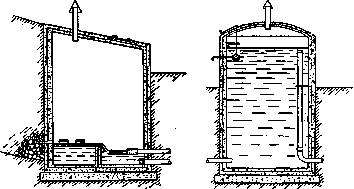
Rural individual or group water supply systems, for the same financial reasons, will have to be constructed first only if it is possible to use springs from which water can be conveyed by gravity, or to use free force for lifting water, such as wind, water, or finally to use the power of domestic animals: horses, oxen, etc. With such a water supply, the rural population will be freed from the unbearable monetary expenditure for operating the facility. Rural water supply systems with artificial water lifting can only be designed in large settlements where the population can afford to pay for the maintenance of the water supply. In such settlements, if their location is favorable, it is also possible to design a rural water supply fed by the water supply of the nearest city, factory, or factory. The awareness of the need to improve rural water supply in the Russian village usually manifested itself previously after outbreaks of epidemics or devastating village fires. In this regard, the former zemstvo institutions showed great initiative by organizing special hydraulic engineering bureaus in various districts,
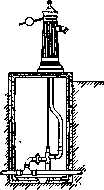
Details of the water supply system of the village of Alekseyevka, Vazarno-Karabulakskaya volost, Volsky district: a-spring capture; b-water distribution basin; c-hydrant.
the improvement of which was the purpose of the examination and improvement of drinking water sources for the rural population. In the work of the hydraulic bureaus, sanitary organizations participated, which collected valuable material in a number of provinces about the state of rural water supply and the influence of one or another water source on population mortality. The technical activity of the bureaus, both in the construction of new water supply systems and in the improvement of existing rural water supply, was relatively weak due to the extremely limited funds allocated for these works. However, it should be noted that zemstvo institutions and government bodies opened credits for the rural population from insurance capital, issued loans from reclamation capital, and also allocated emergency funds for the improvement of rural water supply, which were appropriated by the government for public works in case of crop failure or epidemics. Hydraulic bureaus were opened in Moscow, Kostroma, Kaluga, Voronezh, Nizhny Novgorod, Saratov, Yekaterinoslav, Taurida, and other provinces. The reports of these bureaus, as well as of sanitary bodies on sanitary inspection of rural water supply, provide rich materials, published by provinces in separate issues. Starting from 1923-24, significant similar work was again begun by sanitary organizations of provincial and regional health departments, with the active participation of the People's Commissariats of Health of the republics (publication of relevant rules, plans, programs, assistance with appropriations, etc.). During these years, a number of printed works of individual provinces and regions were published (Moscow, Tula, Voronezh, Ukraine, North Caucasus region, etc.).
V. Drozdov. Rural water supply in the years before the imperialist war developed to such an extent that at the Hygiene Exhibition in Petersburg in 1913, it was possible to create a special section on rural water supply (provinces: Yekaterinoslav, Kursk, Moscow, Nizhny Novgorod, Perm, Ryazan, Saratov, Taurida, Kharkov, Kherson, Chernigov). During the imperialist war, work on water supply was reduced, almost limited to repairs alone, and completely ceased at the beginning of the revolution. By the end of the civil war, rural water supply had again fallen into significant decline, which forced the People's Commissariat of Health and its local bodies, at the beginning of the constructive work, to first of all pay attention to rural water supply. In 1923, a resolution of the Council of People's Commissars of the RSFSR of September 13 'On the carrying out of hydraulic works' was published, which placed the development of a plan for hydraulic works of sanitary-epidemiological importance on the People's Commissariat of Health, and also required coordination of other hydraulic works with the People's Commissariat of Health in order to comply with sanitary requirements. Since in the pre-war period sanitary study of water supply had been conducted in a small number of provinces and, in addition, the state of rural water supply had changed significantly during the war and revolution, health authorities began to carry out a planned survey of rural water supply. On February 26, 1926, a new resolution of the Council of People's Commissars of the RSFSR was published on the report on the activities of the People's Commissariat of Health, which, 'recognizing as the most important tasks in the matter of improving and sanitary improvement of rural areas - improvement of rural water supply, proper planning of settlements and regulation of rural construction', proposes to provincial and executive committees 'to conduct through local sanitary bodies a systematic survey of rural water supply and to develop a plan of measures for improving water supply, first of all, in the most unfavorable areas' and indicates the financial sources for this. The number of provinces that have conducted a survey of rural water supply is very significant: Arkhangelsk, Bryansk, Vologda, Voronezh, Vyatka, Kaluga, Kostroma, Leningrad, Moscow, Nizhny Novgorod, Novgorod, Oryol, Pskov, Saratov, Smolensk, Tambov, Tula, Cherepovets, Yaroslavl, North Caucasus region, Siberia, Ural region, autonomous regions and republics: Kalmyk, Mari, Bashkir, Karelian, Kirghiz, Chuvash. Similar surveys on a large scale have been conducted in Ukraine and in some other republics of the Union. Water supply surveys are conducted simultaneously with geological and hydrogeological studies (Smolensk, Tula provinces), with the development of statistical material on water diseases (Oryol, Nizhny Novgorod, Kostroma provinces), with additional chemical laboratory water tests. A great deal of work on water supply surveys (up to 2,900 villages - 15%) has been done in Siberia, during which hydraulic materials for 20 years were used and developed, as a result of which detailed projects of typical rural water structures were compiled with estimates for each type and sent for guidance to health departments and land authorities. As a result of all this work, hydraulic measures begin to take a planned character with sanitary indications in mind, demonstration structures are built, the construction of wells from concrete rings is introduced (Pskov district, Moscow province, etc.), etc. In the former Saratov province, a detailed survey of rural water supply systems was conducted and detailed drawings from nature were made of all of them and their individual parts. At present, 318 rural water supply systems have been accounted for in the RSFSR, including in Vyatka province - 16 water supply systems, Dagestan republic - 33, Crimean republic - 99, Nizhny Novgorod province - 31, North Caucasus region - 32, Saratov province - 79, etc. (according to data from the sanitary-epidemiological department of the People's Commissariat of Health of the RSFSR). Health departments, land management offices, and planning commissions, relying on the materials obtained by sanitary bodies, develop and implement a plan for improving rural water supply, which is constantly expanding and improving, attracting the attention and initiative of the population itself.
e. Brother. Lit.; Drozdov V., On the question of developing basic norms for the design and construction of rural water supplies, published by the Permanent Bureau of Water Supply Congresses, Moscow, 1926, No. 63; Bragintsev N., Khrustalev A. and Korolev A., The state of rural water supplies in the Moscow province in technical, sanitary and fire-fighting aspects, same publication, Moscow, 1927, No. 67; "Practical guide to the construction of dug wells", same publication, Moscow, 1927, No. 68; "The state of existing rural water supplies in technical, sanitary and fire-fighting aspects in the Leningrad province, Odessa district, North Caucasus region, Sochi district, Tatar and Chuvash republics, Mari region and Kalmyk region", same publication, Moscow, 1927, No. 73; Altaysky Ya., Standard designs and equipment for dug wells, Moscow, 1927; publications of the former Saratov provincial zemstvo administration; "water supply in the Saratov province from a sanitary point of view": issue 2, 1912 - Kozlov D., Volysky district; issue 3, 1913 - Sabaluev V., Tsaritsynsky district; issue 4, 1913 - Felitsyn D., Kamyshinsky district; issue 5, 1914 - Nikolsky V., Kuibyshevsky district; issue 6, 1914 - Dobreytser I., Khvalynsky district; Doliniko-Ivansky V., Water supply of villages in the Tula province, Tula, 1927; publications of other zemstvos: Moscow (works of Sokolov, Rostovtsev and others), Nizhny Novgorod (works of Bragin, A. Sysin, etc., Khonin), Kherson, Taurida, Kharkov and others; reports at the Pirogov congresses of doctors in 1907-11; Narkevich L., Hydraulic engineering, Moscow, 1927; Veltsky A., Agricultural hydraulic engineering, Moscow, 1926; Sparro R., Manual for rural water supply, Moscow-Leningrad, 1927; Maurin E., Water supply of villages, settlements, towns, estates and small urban settlements, Leningrad, 1917; Mchinsky V., Rural water supply, Moscow, 1922; Khetsrov I., Khilenkov V., Danshin B., Berlin B., Materials on water supply of villages in the Moscow district, Moscow, 1924; Kostyukovich-Tizengauzen A., Outline of the hydrogeology of well waters of the Roslavl suburban volost of the Smolensk province, Smolensk, 1926; Danilov F., Water in nature and water supply, Moscow, 1927; Skornyakov E., Peasant water supply, Moscow-Leningrad, 1925; Sinelnikov N., Finding underground waters for rural water supply, Moscow, 1926; ibid., Rural water supply. Wells, Moscow, 1926; Dobrovolsky K., Well construction, Moscow, 1925; Muskat V., How to construct village wells, Moscow, 1928. V. Water supply on transport routes. When arranging water supply on transport routes, one must consider both the needs of the transport itself (ensuring the proper operation of trains, ensuring workshops and premises) and the needs of passengers and employees. The amount of water needed during a day for stations included in the train water supply scheme is expressed as the sum of the following components: 1) the amount of water needed to service passing trains, 2) to service shunting, reserves and locomotive washing, 3) for workshops and office premises, 4) for the needs of transported troops and passengers and 5) for workers and employees living at the station. At other stations, the need for drinking water and water for fire-fighting purposes must be ensured. To guarantee the proper operation of trains even in cases of water supply failure, the latter is arranged either with double equipment (double set of machines, double lines of suction and pressure pipes, with two tanks or one but divided into compartments, and with a main distributing network of a ring system) or with single equipment but on the condition that the distance between water supply points is halved (or, what is the same, the number of water supply points for trains is doubled). Sources of water supply can be natural bodies of water and groundwater. In exceptional cases, the construction of artificial reservoirs is permitted, or water is delivered from other places by constructing water conduits along the line or by organizing imported water supply. The suitability of water for feeding boilers must be determined by chemical analyses, and its suitability for drinking (in case the water supply also serves drinking purposes) is determined by chemical-bacteriological analyses. In cases of incomplete suitability of water for technical or sanitary purposes and the possibility of its improvement, appropriate water purifiers must be installed. Detailed technical requirements in the USSR are provided by special "Technical Conditions for the Design and Construction of Normal Type Main Railways" approved by the NKPS. From a sanitary point of view, the same requirements are placed on drinking water on transport as outside the right-of-way. They are formulated in detail in "Sanitary Rules for Water Supply on Transport" developed by the NKZdrav of the RSFSR. According to data from a sanitary survey of transport, at stations and sidings of the railways of the RSFSR, in 66% of points groundwater serves as the source of water supply and in 34% surface waters, of which surface waters are taken: from rivers in 74%, from lakes in 11%, from ponds in 13%, from swamps in 2%; groundwater: from artesian wells in 8.3%, from springs in 13.2%, from shaft wells in 78.5%. A water supply system has been registered by sanitary doctors in 1,626 points (in 37% of the surveyed stations) and, in addition, 2.5% of stations are connected to water supply systems of neighboring cities, 22% of stations and sidings use imported water supply. The average provision of the transport population with drinking water on railways ranges from 18 to 123 liters, most often from 25 to 50 liters. NKZdrav has developed the following approximate consumption norms: per each employee and member of his family per day, not counting water used in public baths and laundries, in the absence of sewerage - 40 liters, with sewerage - 75 liters, for offices per 1 employee - 12 liters, for duty premises of conductor and locomotive crews - 25 liters, for them with the presence of water closets - 35 liters, in barracks for day laborers per person - 35 liters, in hospitals per bed - 300 liters, in clinics per patient - 6 liters, for cleaning station premises based on 100 sq. m of floor area: in winter - 25 liters and in summer - 50 liters, for cows per day - 60 liters, horses - 50 liters, pigs - 20 liters, sheep and goats - 6 liters, in mechanical laundries per 16 kg of laundry - 750 liters, in hand laundries per 1 laundress - 500 liters or in baths per 1 person - 200 liters. A feature of transport water supply is the so-called imported water supply, when water, in the absence of local sources, is transported from other stations in tanks or barrels by special trains ("water trains") or separate cars attached to other trains. At the destination station, the water is either poured into special reservoirs for further distribution or taken by consumers directly (at small stations). Tanks and barrels for transporting water must be made of metal. All their corners and edges must be rounded. The bottom surface must have a slope to one of the corners, in which an opening for washing is made. The drain cock should be installed at the end opposite this opening. The filling opening of the tank should be closed with a tight lid with a seal placed on it. Cars in which these barrels are placed should be heated in winter. These cars and tanks should not be used for transporting any other liquids or non-potable water. Tanks and barrels must be cleaned, washed and steamed at regular intervals, with a note of this in their sanitary journals. All brushes and scrapers used for cleaning must be set aside for this purpose and stored separately, in proper cleanliness. Reservoirs at stations can be made of concrete, metal and wood, otherwise they must satisfy the same requirements as transport tanks. They must be insulated in winter and protected from overheating in summer. The maximum storage period for imported water is set depending on climatic conditions, the chemical composition of the water and its microflora (in agreement with sanitary supervision). - The supply of boiling water to passengers should be organized at all larger stations with the calculation that the distance between these stations should not be more than three hours of travel. For boiling water, "Titan" system boilers (see) or others are used, or ordinary vats. Taps should have devices to prevent the drawing of hot but not boiling water from them (locks on tap handles, placing them in lockable cases, appropriate design of the boiler itself, etc.). Cooled boiled water is stored in special vessels. Their design should be such that passengers cannot draw water from them with their own utensils or drink by touching the tap with their lips. The use of common cups is also unacceptable. The implementation of the "American" system (individual paper cups) or the installation of "fountains" of various systems, from which a stream can be caught with the lips without touching the tap, is desirable.
S. Kazansky.
VI. Water Supply in Field Conditions. The water supply for military contingents in field conditions, in quantitative terms, should strive to meet general sanitary-hygienic norms and, in any case, should not fall below the minimum that could reduce the combat effectiveness of troops due to an overwhelming feeling of thirst. The minimum amount of water necessary for drinking and elementary sanitary-hygienic requirements is 5 liters per person per day. Special importance is attached to establishing the minimum amount of drinking water carried and transported during a march. The need for water will depend on the severity of the march, the soldier's load, air temperature and humidity, and, most importantly, "water discipline." Under average conditions, American data can be used, according to which a soldier who has quenched thirst before setting out on a march should not resort to his canteen for the first 10 km. For every subsequent 10 km of marching, approximately 1 liter of water is needed to cover losses from evaporation. Marching 20 km without drinking causes not only an increased feeling of thirst but also symptoms of excessive fatigue; marching 30 km without drinking causes severe fatigue symptoms that can be life-threatening if another 10 km is covered without drinking. Depletion of the body's water by 4.5 liters is already dangerous to life. The quality of water should, as much as possible, meet general sanitary standards; reduction is permissible in exceptional cases at the expense of organoleptic properties, but it must absolutely meet the requirements of harmlessness both in chemical and bacteriological respects. Sources of water can be both natural bodies of water existing in the given locality and artificial ones, provided the necessary condition of preliminary thorough sanitary examination of the area and water analysis. The latter is carried out using simplified methods, for example, using Dr. Kamensky's kit, in which all necessary reagents are in the form of precisely dosed tablets. Preliminary examination is carried out by sanitary reconnaissance (see). All places where there are artificial sources of water on a certain section of the position are marked on a map with an indication of the capacity and characteristics of the water source. These maps are transmitted to units arriving for relief. In wartime, there may be cases of deliberate contamination of water sources by the enemy, both with chemical substances and with the carcasses of fallen animals. When constructing new wells, convenience of use is taken into account depending on the location of the unit and their protection from the effects of artillery shells. Springs are widely used, which are as a rule captured. Another source of water consists of water supplies following the military unit in the supply train and replenished at each stage. Experience from the imperialist war showed the advisability of supplying individual units with a cart holding about 250 liters of water and adapted for protection from sun rays. In the British army, collapsible tanks were used, consisting of wooden frames covered with canvas. A third source of water is the individual water supplies that each soldier has in canteens. In most European armies, the capacity of these canteens is 1 liter (1.75 pints). Timely filling of canteens with good quality water, rational use of this supply, and cleanliness of canteens are elements of the "water discipline" of the troops, on which the adequacy of water supply in each individual case depends. The need to use random sources for water supply, the preservation of transported and individual water supplies for several hours, often at high air temperatures, crowding of people, and the impossibility of fully carrying out sanitary measures and personal hygiene—all these factors can cause the development of intestinal epidemics, which is why a feature of water supply in field conditions is the widest possible use of means for purifying and disinfecting water. In the German army during the imperialist war, a "device for preparing drinking water" (from the Hartmann firm in Berlin) was adopted, which quickly filtered, heated to 110°, and relatively quickly cooled 800 liters of water per hour. Another device for disinfecting water in field conditions, which was widely used, were Seitz filters with a specially treated asbestos plate that not only retained turbidity from suspended particles but also most bacteria (large models yield 300-400 liters per hour, small models can be carried by one person as a backpack). Boilers of all systems were also widely used in the last war. In British and American troops, to a greater extent and less in German troops, various installations for disinfecting water with chemical means were widely used, mainly chlorine, mostly with preliminary coagulation and subsequent dechlorination. Chlorine was used either in its pure form or as bleaching powder (high-percentage, well-preserved, and easily soluble bleaching powder) or as sodium and calcium hypochlorite. Dechlorinator—sodium hyposulfite or sodium sulfite or H2O2. In addition to chlorination of large quantities of water, disinfection of individual supplies was used: in the German army "Desazon" (high-percentage bleaching powder and separately a dechlorinator—a compound of H2O2 with urea), in the British army—Boots tablets (sodium bisulfate), in the Russian army—chlorine tablets. Water supply in positional warfare, in general, differs little from water supply in populated areas: all suitable natural sources are used, and if necessary, various types of wells (shaft, Abyssinian, and artesian) are constructed, with widely branched pipeline networks (in one section of the French front, the network laid in the trenches had a total length of 120 km). When constructing trenches, concrete tanks are provided, filled either by the pipeline network or, on advanced positions, by special water carriers (backpack canteens of 20-25 liters). When a defensive battle approaches, all trench water reservoirs are filled first and the individual supplies of soldiers are replenished. In the British army, canvas water containers were used. Where the terrain allows, wells are constructed directly in the trenches themselves. Water supply in maneuver warfare occurs in most cases through existing natural and artificial sources of water (where the importance of sanitary reconnaissance and all methods of water disinfection is increased) or through supply train and individual supplies of disinfected water. The latter play a leading role when maneuvering in territory left by the enemy, where all other sources of water may have been deliberately rendered unusable. The organization of water supply, based on the experience of the imperialist war, is entrusted to a special service (for example, in the Red Army during the civil war to the Central Administration of Military-Hydrological Works) or to special military units that include specialists—engineer-hydrologists, sanitary physicians, etc.—and have the necessary personnel and materials.
A. Saveliev. GP. Permanent Bureau of All-Union Water Supply and Sanitary-Technical Congresses. The Permanent Bureau is an elected executive body of the said congresses, operating in the inter-congress period. The Permanent Bureau, which is part of the State Water Supply and Sanitary-Technical Committee, which is part of the Scientific and Technical Administration of the Supreme Council of National Economy of the USSR, is re-elected at the next congress. The members of the bureau are representatives of cities and various state institutions of all union republics. The presidium of the bureau consists of 17 members. The work of the bureau consists of: 1) carrying out the mandates of the congress, 2) developing initiative issues submitted to the bureau for the next congress, 3) publishing the journal 'Sanitary Engineering', 4) publishing the proceedings of the congress, materials for the next congress, publishing an atlas of drawings, 5) responding to requests received by the bureau from cities and various institutions, 6) examining projects and works of sanitary-technical structures, and 7) participating in the work of other organizations and institutions. In addition to the bureau, the permanent organs of the congresses in the localities are local groups of permanent members of the congresses; such groups are organized by the bureau and work under its guidance in 31 cities of the USSR (up to 1928). The total number of people working in the groups is over 950 people. The groups bring together in the localities, firstly, representatives of various departments and organizations in whose jurisdiction sanitary-technical structures are located, and secondly, representatives of various fields of knowledge related to the resolution of complex issues of sanitary engineering (engineers, sanitary doctors, chemists, biologists, hydrobiologists, etc.). The publishing activities of the bureau and the maintenance of the working apparatus are carried out at the expense of membership fees paid by the members of the congresses - cities, railway administrations, industrial enterprises, etc. The bureau was organized at the I Russian Water Supply Congress in Moscow in 1893. The initiator of the convocation of water supply congresses was engineer V. I. Zuev, the organizer and first chairman of the bureau was engineer N. P. Zimin, who was invariably re-elected to this elected position and held it until his death (1909). During its 35-year period of work, the bureau, in addition to the first congress in Moscow, held 13 more congresses in various cities; among them the latest: XII in Moscow (1922), XIII in Baku (1925) and XIV in Kharkov (1927). Until 1911, the congresses were called 'Russian Water Supply'; in 1911 they were renamed 'All-Russian Water Supply and Sanitary-Technical', in 1925 - 'All-Union Water Supply and Sanitary-Technical'. It should be noted the greatly increased participation of sanitary doctors in the work of the congresses: at pre-revolutionary congresses, sanitary doctors constituted no more than 3-4% of the total number of members; at the XIV congress this percentage grew to 28. The publications of the bureau consist of 75 separate issues; the largest works are published in the issues bearing the name 'Proceedings of the Congress' (from I to XIV); many publications were issued as separate booklets (a series of works on rural water supply, etc.); an atlas of drawings of sanitary-technical structures has also been published (the first series was issued). In the 'Proceedings of the Congress', in addition to the general coverage of most issues of sanitary engineering, various standards, rules, basic provisions and instructions have been established, such as: specifications for cast iron pipes and fittings, specifications for stone-ceramic pipes, methods for testing drinking and waste waters, etc.; rules for simplified sanitary-technical devices in settlements with extensive development; rules for the installation of external and domestic networks in cities; rules for the installation and marking of water meters, installation of street water supply networks, etc., as well as basic provisions for the installation of destructors, waste incineration stations and for the preparation of projects of water supply and sanitation of populated areas. The journal 'Sanitary Engineering' published by the bureau is the only specialized journal in the USSR entirely devoted to the said field of technology.
P. Belov. See also: Abyssinian well, Aqueduct, American filters, English filters, Artesian well, Aeration, Tank, Basins, Water tower, Brooklyn well, Drilled well, Boreholes, Water, Water legislation, Water-lifters, Drains, Reservoirs, Deferrization, Sanitary protection zones, Boiler, Coagulation, Wells, Ozonization. Filters, Chlorination.
Related articles
Mentioned in
Cite this page
“Water Supply.” Soviet Medical Encyclopedia. English translation of Bolshaya Meditsinskaya Entsiklopediya, 1st ed. (Moscow, 1928–1936), ed. N. A. Semashko. https://sovietmedicalencyclopedia.pages.dev/article/water-supply/