Abyssinian Well
Historical document, translated for reference. It reflects medical knowledge of the 1920s–30s and is not medical advice.
Summary
This article describes the construction, operation, and hygienic requirements of the Abyssinian well, a type of tube well used to extract groundwater. It details the equipment, installation process, and limitations of these wells, including their susceptibility to clogging and the need for proper siting to avoid contamination.
Encyclopedia article (1928–1936)
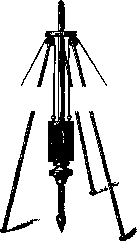
ABYSSINIAN WELL. To quickly reach the upper water-bearing layers of the soil and obtain water from them, a special device is used by driving an iron pipe into the soil. This pipe subsequently forms the frame of the well, the so-called tubular or A. w. They received the name A. w. because they were first applied in Abyssinia during the English campaign in that country. Another name for these wells is Norton's, after the person who proposed them. For the construction of an A. w., an iron pipe with a diameter of usually 25-75 mm is taken, holes with a diameter of 8-12 mm are drilled on its surface in a checkerboard pattern at a distance of 40-50 mm from each other, and a sharp point is screwed onto its end. The pipe is deepened by blows of an iron ram. Much less often the pipe is screwed into the soil. The usual depth of an Abyssinian well is not more than 10 m, but under favorable circumstances (soft soil, experienced workers, etc.) they can reach a depth of 30 m. To pump water from an A. w., a receiving valve is placed in the lower pipe with perforated holes, above them. The pump cylinder is the pipe itself above the suction valve. A piston with a rod is lowered into the pipe, which is connected at the top to an ordinary hand pump. Such a pump can lift water only from a depth of no more than 8-10 m, i.e., to a height of one atmosphere. For greater depths of the well, special pumps are used. The water from a newly constructed A. w. contains a lot of mud and fine sand at first, but then gradually acquires its normal properties. If an A. w. is located in a fine-sand soil, then to protect it from sand, the pipe with holes is sheathed on the outside with a fine copper mesh - a filter. The construction of an Abyssinian well is, in general, very simple, is performed quickly and does not require great experience from the workers. The construction of an A. w., like any other well taking water from shallow water-bearing layers, is permissible only where the soil water satisfies hygienic requirements. A. w. must be located far from all kinds of pollution, especially from privies and cesspools, dump sites, etc.; even in very clean, fine-grained, well-filtering soil, A. w. must not be closer than 10-20 m from these places. If the soil is coarse-grained, stony, then this distance should be increased 2-4 times, and in addition, in case of suspicion of possible pollution from cesspools, a test with fluorescein should be performed on the permeability of the soil. In terms of pollution of soil water, the so-called absorption wells (for liquid waste) always present the greatest danger, and therefore, where such absorption wells exist, the construction of A. w. should be avoided. The depth of an A. w. is desirable to have at least 4 m, since too high a water level in the well indicates a high level of soil water and, consequently, the possibility of its pollution by dirty water seeping from the surface. Compared to ordinary dug wells with a wooden frame, A. w. have the sanitary advantage that their metal walls are watertight and therefore the well is reliably protected from the ingress of surface pollution from the sides. Among the disadvantages of A. w. should be noted the absence of such free reserves of water as are in shaft wells, as a result of which, during rapid pumping of water in fine-grained soil, the amount of it may turn out to be insufficient, since the inflow does not have time to cover the consumption. Furthermore, fine sand gradually clogs the mesh and holes in the pipe, so it is periodically necessary to pull the entire pipe out of the ground for cleaning. For rural water supply, A. w. are applicable where the local water-bearing layer is rich in good-quality water and there are no fears that the well will be frequently clogged with fine sand. When choosing a place in villages for an A. w., one should avoid the close proximity of livestock yards and manure stores. To protect the soil near the well from soaking with spilled water, the soil level around the well is made so high that water drains away quickly from it; in addition, a good paving should be made around the well, and even better a dense concrete platform on a thick clay base should be arranged. For central water supply, A. w. are of little use, since their productivity is small and to obtain the required amount of water it would be necessary to construct a large number of them. The exception represents only areas where there are very large reserves of groundwater, easily subject to pumping, but even in such cases it is better to give preference to more powerful and durable Brooklyn borehole wells, and in addition, by systematic and prolonged pumping of water from test wells, it is necessary to pre-verify that such pumping does not affect the lowering of the groundwater level and the amount of it will be quite sufficient even in the driest time of the year. An example of central water supply by tube wells of small diameter can serve as Frankfurt-am-Main. For obtaining good water in the Frankfurt city forest, in a place protected from pollution, 280 tube wells were constructed, taking soil water flowing in the direction of the Main River valley. The water proved to be of good quality and suitable for drinking as well as for various domestic needs. The well pipes are copper, 50 mm in diameter, equipped with perforated suction pipes with copper mesh, 3-4 m long. When constructing wells, the pipes enclosed in a casing 150 mm in diameter were lowered into the soil, then the casing was removed, and gravel was poured into the resulting cavity. Every 10 wells form a separate group connected by a common pipe to the main collector. Pumping is performed from one general pumping station. Each well gives about 30 l of water per minute, and the entire installation more than 10,000 cubic m per day. A. w. find good application for quickly obtaining drinking water for construction workers, for military units temporarily located in an area where there are no other suitable sources of water supply. The water of A. w. is also often used for various technical purposes, e.g., during the laying of brick and concrete buildings, for steam boilers, etc. When the need passes, the well can be easily removed and, if necessary, installed in another place. An A. w. can last up to 20 years. The cost of constructing an Abyssinian well with a diameter of 75 mm, a depth of 4 m, with a mesh filter, excluding the pumping device, is approximately 250 rubles. With a depth of 10 m or greater and a larger pipe diameter, the cost will increase, approximately to 800-1000 rubles. I. Danilov, I. Ignatov.

Related articles
Mentioned in
Cite this page
“Abyssinian Well.” Soviet Medical Encyclopedia. English translation of Bolshaya Meditsinskaya Entsiklopediya, 1st ed. (Moscow, 1928–1936), ed. N. A. Semashko. https://sovietmedicalencyclopedia.pages.dev/article/abyssinian-well/