Cesspool
Historical document, translated for reference. It reflects medical knowledge of the 1920s–30s and is not medical advice.
Summary
This article from the 1928–1936 Soviet Great Medical Encyclopedia details the construction, sanitary significance, and maintenance of cesspools and privy vaults in unsewered urban areas. It discusses the dangers of soil and groundwater contamination from improper designs and outlines technical standards for creating impermeable, properly ventilated receptacles.
Encyclopedia article (1928–1936)
CESSPOOL, cesspool pit, a receptacle for collecting excrement and urine, located in the ground. Cesspools represent the most widespread method of collecting human waste in unsewered cities of the USSR. Above the cesspool, a privy is constructed, and it may be located either directly above the cesspool or connected to it by a soil pipe. A cesspool intended for collecting household dirty water in unsewered properties is called a slop pit and is equipped with an above-ground part for collecting solid waste (a grating, a tent). The main sanitary requirement for the construction of cesspools is their complete impermeability, which must prevent the seepage of liquid into the soil and the spread of foul-smelling gases into the atmosphere and premises (see Cloacal gases). Most cesspools do not meet these requirements, which is why the soil around them is usually very heavily contaminated. Rubner cites the following data from Wolffhügel, characterizing the contamination of the soil around improperly constructed cesspools; in 1 cubic meter of soil there was: Soil Loss on ignition Organic substances Chlorine Nitrogen Normal Beneath the cesspool 0.052 0.181 0.118 1.257 0.010 0.110 0.014 0.060 Air is also contaminated by the release of foul-smelling gases through the seat hole of the privy into the premises. From this it is clear what great sanitary importance proper construction and maintenance of the cesspool has. It is obvious that the cesspool system, even with the most attentive attitude toward it, cannot replace sewerage, in which waste does not linger near housing and is quickly flushed through pipes beyond the boundaries of the populated area. The efforts of sanitary supervision can only significantly weaken the harmful influence of the cesspool system, but it is usually impossible to completely eliminate it. The most flagrant sanitary abuse in the cesspool system is so-called absorbing wells, which are constructed very deeply, usually to the first water-bearing stratum, without a bottom, with the goal of absorbing waste by the soil. The sanitary harm of such absorbing wells is enormous; they make water from shallow wells completely unfit for use, located even at a considerable distance from them. The possibility of contamination of deeper waters, including artesian waters (for example, the 2nd and partly 3rd horizons in the city of Moscow), is not excluded. In sanitary terms, cesspools with drains, which are constructed for the purpose of settling dense waste and discharging the clarified liquid through pipes or open channels into water bodies, should not receive a better evaluation. Such cesspools are of various systems. Figure 1 shows a cesspool adopted in Leningrad. It is clear that with such a system, unacceptable contamination of open water bodies occurs.
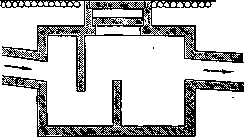
Figure 1. Cesspool with drain.
not connected to sewerage, but having flush closets that produce a large amount of wastewater, the removal of which becomes economically unaffordable for residents. Therefore, from a sanitary point of view, such devices in unsewered properties should not be permitted. A properly constructed cesspool is made of impermeable materials and has no drains. It is recommended to construct cesspools from concrete or reinforced concrete with a wall and bottom thickness of at least 15 cm (for concrete rings a thickness of 12 cm is permissible), from riveted iron painted or asphalted from the inside, from brick (a layer of 1 brick) on cement mortar, plastered from the inside with cement plaster and ironed. Cesspools can also be made of wood, but thoroughly tarred and necessarily from logs (15.5 cm). Wooden and brick cesspools must be insulated from the soil on the outside with a layer of well-tamped beaten clay at least 0.5 m thick. The corners in cesspools are made rounded for ease of cleaning; for the same purposes, it is recommended to make their bottom inclined toward the cleaning hatch. The latter is made double, with earth poured between the two covers. A cesspool constructed in this manner is rendered almost impermeable to liquid, and the soil is not contaminated. However, from time to time it must be inspected by filling it with water and monitoring the drop in its level over the course of a day. The cesspool must be constructed outside the foundations of residential buildings, at a distance of at least 1.5 m from them. The distance from the well must be at least 20 m. Seats in warm privy facilities are connected to cesspools by means of soil pipes (see figures 2 and 3). To remove gases from the cesspool, a ventilation pipe measuring 15x15 cm should be constructed.
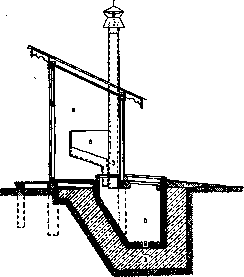
Figure 2. Wooden cesspool: 1-layer of clay;
2-wooden log house; 3-ventilation channel; 4-privy; 5-cesspool; 6-urinal. The pipe needs to be brought out above the roof ridge, supplying the opening with a cowl or deflector and a fly screen. It is recommended to equip the ventilation pipe with an air draft inducer in the form of a special furnace or run it next to heated stoves; in these cases, we will have a so-called flue closet (see Closets). The dimensions of the cesspool are determined from the following data: 1) the amount of waste, 2) the number of inhabitants, and 3) the cleaning intervals. According to Pettenkofer, the accumulation of excrement and urine is approximately 0.46 cubic meters per person per year (other norms also exist). Cleaning of the cesspool must be performed at least once a month. When calculating the dimensions of the cesspool, it is necessary to add about a 30% reserve. The depth of the cesspool should not be more than 3 m, and it depends on the height of the groundwater table. According to Strelkov, a cesspool for 60 people has a volume of 2.80 cubic meters. It is not recommended to construct combined cesspools for excrement and slop water. Such
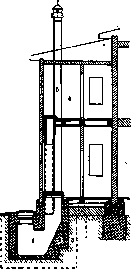
Figure 3. Brick cesspool (cross-section of a two-story house): 1-cesspool; 2-brick; 3-clay; 4-privy; 5-ventilation pipe.
an arrangement increases the dimensions of the cesspool, intensifies the stench, and makes using the cesspool and cleaning it difficult. Proper construction and maintenance of the cesspool are usually sufficient to maintain properties with a cesspool in a satisfactory sanitary condition. Sometimes it is necessary to resort to disinfection of the cesspool and the use of substances that repel flies. For this purpose, the following are used: iron sulfate, potassium permanganate, milk of lime, bleaching powder, tar. Disinfection of waste in the cesspool is not of great importance and cannot replace routine disinfection at the patient's bedside. Combating flies at the cesspool is an important sanitary measure. For the purpose of deodorization (see), the use of peat in the form of powder, with which the contents of the cesspool pits are covered, can be recommended. A peat bedding is arranged at the bottom of the pits. Dry soil and wood charcoal powder can serve the same purpose.
Related articles
Mentioned in
- Absorbing Well
- Abyssinian Well
- Air
- Cemetery
- Cleaning of Populated Areas
- Closets
- Deodorization
- Dining Halls
- DRAINAGE (drainage, the draining of waterlogged areas)
- Harmful Productions
- Irrigation Fields
- Prostitution
- Railway Station
- Sanitation (The word "Sanitation" comes from the French)
- Slop Pit
- Wastes
- Waterborne Infections
- Wells
Cite this page
“Cesspool.” Soviet Medical Encyclopedia. English translation of Bolshaya Meditsinskaya Entsiklopediya, 1st ed. (Moscow, 1928–1936), ed. N. A. Semashko. https://sovietmedicalencyclopedia.pages.dev/article/excreta-pit/