Cleaning of Populated Areas
Historical document, translated for reference. It reflects medical knowledge of the 1920s–30s and is not medical advice.
Summary
This article discusses the system of measures for collecting and removing waste from populated areas, emphasizing its importance for public health and the inadequate state of sanitation in Soviet cities during the 1930s.
Encyclopedia article (1928–1936)
CLEANING OF POPULATED AREAS, a system of measures aimed at collecting and removing by means of removal the refuse that accumulates in populated areas. The removal of sewage by means of sewerage (see) constitutes a separate branch of sanitary engineering and should be considered separately. C.P.A. has primary importance for maintaining the sanitary improvement of cities and towns. The amount of refuse that accumulates in cities and other large centers is extremely large. In the absence of proper cleaning, most of it remains in the soil, polluting it and the groundwater which the population uses. The situation is especially grave in cities that have water supply but lack sewerage, where in addition to solid refuse, garbage, and street sweepings, a huge mass of wastewater must be removed, which is very expensive, as a result of which it is usually impossible to achieve complete removal and neutralization of refuse in non-sewered cities. According to Khlopin, only 10% of liquid refuse is practically accessible for removal, while according to data from the city of Moscow, only 6% is removed from non-sewered properties. In addition to polluting soil and water, poor C.P.A. leads to pollution of the air by gaseous products of decomposition of refuse and by dust from dirty streets. The inadequacy of cleaning is one of the factors in the development of epidemic diseases in populated areas, since refuse is a medium in which pathogenic microbes (typhoid fever, cholera, dysentery, tuberculosis, anthrax, etc.) can remain viable for a long time, and a place for breeding flies. There are observations that rational C.P.A. of refuse leads to a decrease in the incidence of helminthiasis among the population. The sanitary significance of cleaning is confirmed by examples from both Russian and foreign cities, where mortality, morbidity, and epidemic incidence decreased after the implementation of a number of sanitary-engineering measures (sewerage, paving, incineration). Despite the important sanitary significance of C.P.A., in most of our cities it is organized in a very primitive manner, and even large centers in the USSR still lag far behind the cities of Western Europe and America in terms of their improvement. Only in recent years, along with other areas of municipal construction, a number of improvements in the organization of city cleaning in the USSR has begun to be noted. In 1931, the state of affairs is characterized by the following data. In the USSR, 42 cities have sewerage, and in most of these cities it covers only a smaller part of the population. Even such large centers as Moscow and Leningrad are not fully sewered: in Moscow in 1931, there were about 900,000 residents living in houses without sewerage. Leningrad began building sewerage only after the revolution (beginning of operation in 1930). Only in 7 cities of the USSR does there exist a system for removal of solid refuse by municipal services (municipal cleaning), but almost everywhere it is implemented partially, not covering the entire city as a whole, namely: Moscow serves 400,000 people (15%), Leningrad - 300,000 people (18%), Kharkov - 150,000 people (33%), Odessa - 220,000 people (30%), Kiev - 80,000 people (13%), and only Yalta serves 75% of its residents, while Baku serves the entire city completely. Street cleaning remains almost everywhere very unsatisfactory, since in most cases it is carried out by janitors, being the responsibility of individual property owners. The situation is no better with the provision of cities with facilities for neutralizing refuse. Incineration stations exist only in Moscow, Leningrad, Odessa, Baku, and Kiev (closed since 1931), while in other cities there are only primitive dumps. According to data from a survey of 304 cities conducted by the People's Commissariat of Health of the RSFSR in 1926-27, sewage farms exist only in isolated cases (Vologda, Kostroma, Leningrad, Taganrog, Vladimir, Kovrov); 76 cities have more or less proper dump management, while the rest remove their sewage to completely unsuitable places. Moreover, in 79.5% of cities, dumps are located at a distance of no more than 2 km from residential buildings. The situation is no less acute in the cities of the Ukrainian SSR. In 1927, there were only 4 sewered cities in Ukraine, while the number of improved cesspools does not exceed 40% in large cities and 10% in small ones; pneumatic barrels are absent, the transport capacity is insufficient, dumps are not regulated, etc. The June plenum of the Central Committee of the All-Union Communist Party (Bolsheviks) (1931) sharply emphasized the lag of municipal services in Soviet cities behind the overall development of the country, the growth of industry, and the cultural demands of the population. In addition to this reason, common to various branches of urban improvement, in regard to C.P.A., there was also a special reason, consisting in the lack of clear understanding by workers in municipal services of the significance of removal and neutralization of refuse from the point of view of improving the material and living conditions of the urban population, and the underestimation of the importance of cleanliness in the struggle for culture. The resolutions of the aforementioned plenum of the Central Committee CPSU(b) not only state this gap and require a revision of the previous attitude to urban improvement, but also give a concrete program of action for establishing in each of the branches of urban economy in cities, linking the struggle for this program with the general tasks of the socialist reconstruction of cities. In regard to C.P.A., in the said resolution "On the Moscow municipal economy and on the development of the municipal economy of the USSR" given
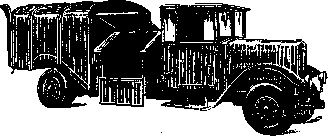
Figure 1.
a very clear directive: 'to launch in 1932 the production of municipal [spraying, garbage (Fig. 1) and other] vehicles, by building appropriate workshops at new automobile plants', particularly in Moscow as a city whose municipal services should serve as a model for other cities; all cleaning work must be mechanized within 2-3 years. This decision puts an end to the underestimation of the importance of C. p. a. and should serve as an impetus for great and fruitful work at the local level to bring our cities into a sanitary condition. This work must be carried out by the municipal services and sanitary supervision on the basis of using in our conditions the latest achievements of Western European and American technology and practice and the maximum degree of initiative from the public and our specialists. Sanitary engineering has made very great progress in recent years in the timely removal and neutralization of refuse. Abroad, standard metal refuse containers have been introduced into the practice of most cities, automobiles and electric vehicles are widely used for the removal of both solid and liquid refuse; many cities (England, Germany, France and the USA) neutralize urban refuse by means of garbage incineration at large, technically well-equipped stations or in domestic garbage incineration furnaces. Along with this, the problem of utilizing urban refuse is also solved either by collecting reusable materials separately from other domestic refuse or at central sorting stations. Street cleaning is done mechanically by means of sweeping, washing and sprinkling machines. These technical achievements became possible only after municipalities began to consider the cleaning of the city from garbage, snow and filth as their direct task. Of the large cities, only Paris retains a system of contracting cleaning operations to a concessionaire in the form of a joint-stock company, which is obliged to remove all domestic garbage and street sweepings daily to 4 garbage incineration and utilization stations. Of the cities that have managed to bring cleaning to a very high level, Cologne can be mentioned, where garbage is removed by the system of replaceable containers (see Garbage) to an incineration station located outside the city, and the containers are washed and disinfected at specially equipped washing-transfer stations. Street cleaning is carried out very thoroughly in Vienna, where it is done by special trains consisting of several washing and sweeping machines. Thanks to proper organization and good operation, the productivity of washing and sweeping machines reaches very high figures (up to 120,000 m2 in 8 hours of work). One of the reasons for the backwardness of our cities in the matter of cleaning must be recognized as the lack among most workers in municipal and sanitary affairs of a clear understanding of the problem of C. p. a. as a unified system of measures aimed at protecting the soil from pollution. Usually cleaning is in a fragmented state in the hands of various organizations that do not bear responsibility for the overall task of maintaining cleanliness in the city (municipal departments, municipal trusts, departments, property owners, private individuals). This same lack of clear understanding of cleaning as a whole also corresponds to the weak development of questions of cleaning in the general system of sanitary-technical knowledge. Until recently, the USSR also lacked higher educational institutions that would train specialists of the appropriate qualification in city cleaning (engineers, technicians, sanitary doctors). Only now can it be assumed that this gap will be filled in view of the establishment of appropriate courses in higher educational institutions (institutes of municipal construction in Leningrad, Moscow, Kazan and Novocherkassk, sanitary-preventive faculties of medical institutes). The creation of the Academy of Municipal Affairs, which is opening according to the resolution of the same June plenum of the Central Committee of the All-Union Communist Party (Bolsheviks), is also of great importance for the development of this work. C. p. a. must include all measures aimed at removing and subsequently neutralizing refuse. In accordance with the modern understanding of C. p. a., it should include the following parts: collection of refuse at the place of its formation, transportation and neutralization. Recently, a fourth element-utilization-has been added to these three. According to the type of refuse, cleaning can be divided into the following sections: 1) cleaning of properties from garbage, 2) cleaning of non-sewered properties from feces and liquid slops, 3) cleaning of streets and squares, 4) removal and neutralization of domestic and industrial animal waste (butcher shops, spoiled food products, animal carcasses), 5) removal and neutralization of other industrial waste. In all stages of cleaning, applicable to all types of refuse, the active participation of the sanitary doctor is necessary. Sanitary requirements come down to the complete removal of all types of refuse, to establishing cleaning schedules, which must be minimal, and to the hygienic nature of the cleaning methods themselves: hermetically sealed containers for refuse, tightly closed vehicles for their removal, as possible complete and rapid neutralization by turning the organic part of the refuse into mineral matter. In addition, from the point of view of hygiene as well as the protection of the health of workers engaged in cleaning, it is necessary to strive for the maximum possible mechanization of all methods of refuse processing. The practice of cities abroad shows that only in those places is cleaning satisfactorily organized where it is a function of urban self-government bodies, just like other sectors of municipal, urban economy (water supply, sewerage, transportation). The worst results are given by the concession system, under which the city hands over the production of cleaning to a concessioner under certain conditions. Finally, the worst results are achieved by leaving cleaning in the hands of individual private organizations, property owners, private individuals. Therefore, the next task for sanitary supervision and municipal services is the organization in all cities of the Union of municipal cleaning. A necessary condition for its implementation is the presence in the system of municipal services of a special body that would be in charge of cleaning and be responsible for it. In addition, it is necessary to have mandatory regulations that make it obligatory for the population to turn to this body for this type of municipal service, i.e., creating a monopoly right for the municipal service on the one hand, and on the other hand imposing corresponding obligations on it. Such a system of municipal cleaning is possible only where municipal services have sufficiently powerful technical means to fulfill this obligation. Cleaning of properties and yards. From all properties without exception, solid refuse and garbage (see) must be removed, and from non-sewered ones-in addition to that-liquid refuse: filth and slops (see Sewering, Privy, Closets). From a sanitary point of view, of all existing systems for removing solid refuse, preference should be given to the daily removal of garbage by the system of replaceable containers. Such a system requires the establishment of unloading stations where containers are changed, washed, and disinfected, which makes it more expensive than other systems. In addition to the system of replaceable containers, the use of vehicles ensuring dust-free transfer of garbage from the container to the vehicle body also fully satisfies sanitary requirements. Both systems require the installation in properties of metal portable containers, covered boxes with a capacity of 80 to 120 liters (for details of these systems, see Garbage). Various types of traction are used for transporting garbage: animal-drawn, automotive, electric locomotives; trams and transportation by water and railway are also used. The type of traction has no sanitary significance; it is only technically important to ensure dust-free transportation of garbage, guaranteeing against its scattering along the way, absence of odor, etc. The further fate of the refuse lies in its neutralization either by incineration (see Garbage Incineration), or by the soil method, or by the 'Beccari' system in thermal chambers where the garbage ferments and decomposes, turning into fertilizer (see Garbage). At present, an attempt is made to utilize garbage to the maximum extent. This is achieved by trying to sort out the valuable parts of the garbage from the general mass either in the houses before its removal or at central garbage utilization stations. In the first case, instead of one, two or three containers are installed at the collection points, depending on whether only reusable materials are collected separately, and also food waste for animal feed. At garbage utilization stations, the garbage is passed on a conveyor, paper is sucked out by a powerful exhaust fan, metal parts are separated by means of an electromagnet, and the rest (bones, rags, glass, etc.) are sorted by hand. The garbage is also sifted to separate fine material that goes for fertilizer or for the production of building materials. In addition, garbage can be used by placing it in hotbeds or turning it into valuable fertilizer by composting.
The removal of solid waste should be done at minimal intervals: preferably daily or every other day, but no more than 5-7 days, taking into account the breeding period of flies. The system for cleaning non-sewered properties should consist of imperceptible receivers: cesspits and refuse pits (see - Cesspit, Refuse Pit). Systems of privies with filling with peat are also permissible. Timely (no less than once a month) cleaning of cesspits and refuse pits and removal of waste in specially equipped vessels, preferably pneumatic ones (see Sewage Disposal), must be ensured. Disinfection of waste is carried out by burying it on sewage farm fields, as well as by processing it into fertilizer. For the latter purpose, peat can be used, which when mixed with it produces peat manure (see Utilization). Finally, for cleaning non-sewered properties, a mixed system is also used, under which waste is transported in barrels to so-called discharge stations (see), from where it is floated through the general sewerage system to the treatment facilities of the latter. Cleaning of streets and squares involves the removal of sweepings and dust from the roadway and sidewalks. The impermeability and smoothness of the roadway are the two basic qualities that make it possible to properly organize cleaning. The best cleaning is provided by improved roadways, which include all types of asphalt, paving stones, clinker (see Paving). All these types of improved paving make it possible to mechanize street cleaning, which is not possible with imperfect coverings: cobblestones, macadam. The design of joints in stone-paved streets is of great importance for fighting dust. For hygienic reasons of streets, it is necessary to require the sealing of joints with tar or cement. It is also necessary that streets be provided with drains, because only with their presence is proper street washing possible. Good drains, proper slope and profile of streets do not allow water to stagnate on the surface of the roadway. - The organization of cleaning is of great importance. The worst results of cleaning are obtained in the case where the cleaning of the roadway lies with the adjacent property owner. This system does not allow mechanization of the cleaning process itself, since the corresponding machines can only be applied along the entire length of the roadway.
Figure 2.
This system also does not ensure simultaneous cleaning, which deprives the measures taken by individual property owners of their significance-. In the cities of the USSR, a mixed cleaning system is used, under which the municipal enterprises are responsible for cleaning only certain streets (squares, embankments, bridges, boulevards, etc.), while the remaining streets are cleaned by housing administrations. Cleaning of sidewalks usually remains the responsibility of the housing administration under all systems. For collecting
Figure 3.
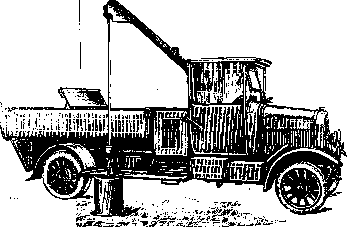
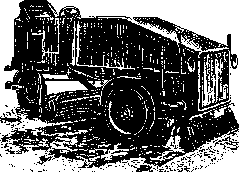
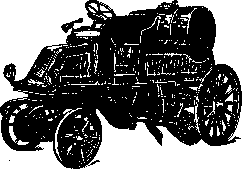
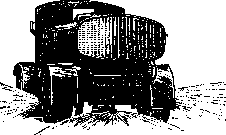
and temporary storage of street sweepings, above-ground receivers (in the form of metal or wooden boxes) (see Incineration) or underground type are installed on the streets. The latter are preferable, as they do not obstruct traffic, are convenient for dumping sweepings, and do not spoil the appearance of the street. The sweepings fall into removable boxes, which with the help of a special device on the vehicle are lifted up and removed to the unloading place (fig. 2). For collecting litter (paper, cigarette butts, etc.) on sidewalks, urns are installed. For manual street cleaning, ordinary brooms and shovels for carrying sweepings are most often used. Smooth roadways allow washing of the street with mops, special rubber brushes that moisten the surface of the roadway, and the sweepings themselves are collected from the brush into the body, so that no dust is produced during their operation. Brushes for washing and sweeping are made of piassava or metal. These brushes wear out quickly and often require replacement. The productivity of such machines is very high - from 8,000 to 15,000 m2 per hour. With manual cleaning, the productivity does not exceed 2,500 m2 per worker in summer and 1,250 m2 in winter. In addition to the daily removal of sweepings from the roadway, special measures are usually required to combat dust. In its simplest form, this is achieved by ordinary watering with water, which is done either from fire hoses or with watering carts. The best results are obtained using watering tank trucks (fig. 5), which give very
Figure 5.
high productivity: up to 75,000 l2 per hour. A good effect is achieved by using certain chemical agents for watering roadways, of which the following can be mentioned: 1) Calcium chloride, which has hygroscopic properties, due to which the surface of the roadway remains moist for a long time; it is used in solutions of various strengths (e.g. 1 kg CaCl2 per 2 l water; 0.33 to 0.40 calcium chloride per 1 l2 of roadway is required). For this purpose, so-called technical fused calcium chloride is used, which is a waste product from the production of soda, acetic acid and some other substances. During experiments in Moscow, it was found sufficient to apply it no more than 4 times in summer; in between, the roadway is watered with clean water once a day; the roadway remained moist around the clock; the cost of application is about 25 kopecks per 1 jh2 in summer. 2) Various emulsions, the purpose of which is to bind dust on the roadway, not allowing it to rise, are widely used abroad. In the USSR, experimental tests were carried out by the Petroleum Institute in Moscow, which gave good results. The emulsion prepared by it consists of tar, technical vaseline, ammonia water, water. According to foreign data, it is considered sufficient to treat the surface with emulsion 2-3 times a year to achieve complete dust control. 3) Bitumen and tar are used mainly for treating the surface of highways (tarred highway, see Paving) and cobblestone streets. There are many methods of tarring. The question of fighting snow and ice in winter is of great importance in the improvement of populated areas. This question is of significance mainly in connection with the task of regulating street traffic. Indirectly, it also affects sanitary improvement (removal of contaminated snow, danger of soil marshiness in spring when snow melts). The usual method of removing snow to snow dumps by horse-drawn transport cannot be considered rational: it requires a large number of workers for raking snow into piles, loading it onto carts, and transportation for its removal. Snow dumps, which are usually arranged within the city limits, on river banks, etc., by spring turn into accumulations of huge masses of contaminated snow and ice, which melt very slowly, and sometimes do not have time to melt before the next winter. The rationalization of this matter consists in the use of a) snowplows that push the snow aside and clear the roadway; b) machines for loading snow into automobiles and c) melting it in special snow melters. Based on a number of observations abroad and in the USSR, for snow melting it is possible to use the heat of waste water (bath, industrial); it is also possible to recommend the use of Finnish-type snow melters, an example of which is the snow melter of the "Fenia" system. To combat ice, breaking up ice with manual or mechanical picks, sprinkling the roadway and sidewalks with sand and ash is used. Cleaning of collective farms and state farms.. It is especially necessary to emphasize the new task that has arisen in connection with the collectivization of agriculture and the creation of large agricultural settlements - the removal and disinfection of waste in rural-type populated areas. In them, cleaning should be inseparably linked with the task of utilizing all types of waste in agriculture: garbage, waste and manure as a source of heat for greenhouses and fertilizer, and food waste as fodder for livestock. As receivers for waste in such settlements, privies arranged over manure pits or near livestock yards can be recommended, then privies with filling of waste with peat, earth, etc. For large buildings of public importance and dormitories, air closets are also quite applicable. Household waste, garbage, with the exception of that used for livestock feed, can be collected in compost heaps for decomposition or used for filling greenhouses together with manure. The system of privies over manure pits, where waste is mixed with manure, peat or earth air closets, as well as composting of waste and garbage significantly facilitate the removal of waste, which can be done under incomparably more hygienic conditions than usual from cold privies and refuse pits. The disinfection of waste, carried out in the process of its use in agriculture, cannot cause objections from a sanitary point of view, since the decomposition of waste in greenhouses, composts, as well as their burial in the ground, when properly managed, are measures that fully meet the interests of hygiene. Some doubt arises from the use of waste in agriculture from a helminthological point of view, therefore in such farms workers must be well instructed in observance of sanitary rules: washing hands, washing vegetables, etc.
Related articles
Mentioned in
Cite this page
“Cleaning of Populated Areas.” Soviet Medical Encyclopedia. English translation of Bolshaya Meditsinskaya Entsiklopediya, 1st ed. (Moscow, 1928–1936), ed. N. A. Semashko. https://sovietmedicalencyclopedia.pages.dev/article/cleaning-of-populated-areas/