Clay
Historical document, translated for reference. It reflects medical knowledge of the 1920s–30s and is not medical advice.
Summary
This article discusses clay as a building material with sanitary properties, its various construction methods, and its therapeutic applications in medicine.
Encyclopedia article (1928–1936)
Clay is a mixture of mineral materials that are products of the decomposition of various rocks, mainly feldspar, with the addition of more or less significant amounts of sand, limestone, magnesia, and generally metallic oxides, of which iron oxides give clay its usual yellow or brown color. Clay often serves as a direct building material in its raw, unfired state, especially in the south. In terms of its basic composition, clay can be considered a completely satisfactory material from a sanitary point of view. It is usually free of organic substances that can rot and release harmful gases. It has sufficient air permeability, i.e., it allows for natural ventilation of dwellings. According to research by K. Ya. Ilkevich, although pure fatty clay without any tempering additives passes air poorly, as it is tempered with additives, its ventilation capacity increases very rapidly: for raw brick, i.e., for clay with sand additives making up 1/6-1/8 of its volume, the rate of air passage is more than twice that of pure clay, and in clay with tempering fibrous additives this rate increases 50 times and even slightly exceeds the rate in fired brick. The thermal conductivity of clay in its usual preparation for construction (i.e., with additives of fibrous substances) is very close to the thermal conductivity of ordinary fired brick. As a component of soil layers, clay has very important significance for the water regime of an area and consequently for its sanitary condition. When located near the surface in the soil, clay increases the humidity of the surface and air (due to the slow absorption of atmospheric precipitation into the soil), if there are no significant slopes in the terrain. When lying at a shallow depth, clay causes a high level of groundwater. At an even greater depth, clay is the underlying layer for the so-called upper groundwater, which is obtained from ordinary wells. Finally, when two clay layers lie at a great depth, with appropriate curvature, deep pressured groundwater is formed between these layers, which is obtained in so-called drilled or artesian wells. Clay-bound, clay-lit, clay-straw construction represents a special type of building erected from clay and divided into the following main types: 1) frame, 2) rammed, 3) raw brick masonry. I. Frame structures consist of a wooden frame coated with clay paste (see Figure 1 and 2). II. Rammed structures are made of clay with various auxiliary materials in temporary wooden forms or boxes, which are usually moved upward during work, and after molding are completely disassembled. Clay or clayey soil is often taken directly from the soil with its natural moisture, and without preliminary preparation (i.e., without wetting and without kneading) is rammed into the forms. Such walls are called 'rammed clay' walls. 'Clay-chaff' walls are erected in the same forms as the previous ones, from clay paste and chaff. Straw-clay-lit walls are erected in ordinary forms from layers of tamped straw. III. Clay walls made from raw brick masonry also come in several types. The most cultured and widespread type of walls from raw masonry are the so-called adobe walls. From clay of medium fatness with additives of fibrous substances, bricks (adobe, kalyp, lempach) are formed, the size of an ordinary fired brick. The sanitary and technical qualities of all clay walls, when properly erected, can be considered quite satisfactory. This follows both from the properties of their main material and from its combination with other materials (straw, wood, etc.); the latter gives the walls considerable porosity, thus accelerating their drying and increasing their natural ventilation.

Figure 1.
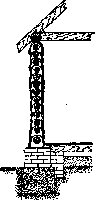
Figure 2.
The main disadvantage of clay walls is their low strength. Even in southern regions with a warmer and drier climate, they serve properly only with frequent periodic repairs of their surface (plastering, whitewashing). However, this rather troublesome repair also has the positive side that it periodically cleans and disinfects the surfaces of enclosures and thereby improves the sanitary condition of dwellings. Another positive aspect of this construction is its low cost and the almost universal availability of local materials. Therefore, this construction has long been the main peasant construction in our southern regions. Clay is also used in the construction of clay-straw roofs. Clay buildings of all the types mentioned above have different prevalence in different regions of the country. Frame buildings of the 'mazanka' type are used mainly in Ukraine and in the Southeast. Rammed clay and adobe walls are very widespread in the southern steppe part of the USSR1 (former Taurida, Kherson, and Yekaterinoslav provinces), in Crimea and in the Caucasus (sakhli). Other systems, being historically later (clay-wooden, clay-chaff, straw-clay-lit), are beginning to spread in the most diverse regions, including the central regions. In the more northern regions with a harsh and humid climate, clay construction is less practical due to the low strength of clays, especially on external surfaces exposed to atmospheric precipitation and temperature changes.
V. Mapping-kiy. Clay in therapy (should not be confused with Bolus alba, see). The type of clay used in sculpture also finds application in medicine. Sculptural clay of gray color is very plastic and has the property of retaining water for a long time. This is utilized by using it as a mass for cooling compresses. For example, in heart diseases, a wet pancake of clay is placed on the area of the heart, which remains cold longer than a linen compress. As the pancake warms up, it is turned over to the other side. In folk medicine, ordinary clay mixed with vinegar is also used for compresses in inflammations, bruises, etc. In its action, such a compress resembles the action of Burrovsk liquid.
Related articles
Cite this page
“Clay.” Soviet Medical Encyclopedia. English translation of Bolshaya Meditsinskaya Entsiklopediya, 1st ed. (Moscow, 1928–1936), ed. N. A. Semashko. https://sovietmedicalencyclopedia.pages.dev/article/clay/