Artesian Well
Historical document, translated for reference. It reflects medical knowledge of the 1920s–30s and is not medical advice.
Summary
An artesian well is a deep well drilled into a confined aquifer where water rises naturally under pressure to the surface without pumping. The article describes the construction methods, equipment, and principles behind these wells, which were first developed in the French province of Artois.
Encyclopedia article (1928–1936)
ARTESIAN WELL. If an iron pipe is inserted into the soil in a vertical direction, the soil is removed from it, and it is extended to a deep aquifer, the water in this pipe will rise above the upper level of this aquifer. Such a pipe, together with equipment for lifting water upward, is called an A. well. The rise of water in the pipe is caused by the pressure that exists in deep aquifers. This pressure is sometimes so strong that the water in an artesian well rises to the surface of the earth and even gushes upward like a fountain. Such wells are called artesian because they were first constructed in the French province of Artois. A. wells are constructed by drilling, for which an iron pipe is screwed into the ground, from which soil is removed with special devices. Depending on the amount of water desired to be obtained, the diameter of the A. well pipe, called a casing pipe, ranges from 100 to 600 mm or more. Drilling of A. wells of small diameters is usually done manually. Wells for larger capacity are made mechanically, with the help of steam engines or internal combustion engines. There are many drilling methods, and they vary depending on local conditions, soil quality, etc. The simplest of them is as follows. From several logs, a special tripod is built, it is covered with boards, and at a height of about 2 m from the ground, a platform is made. Such a structure is called a derrick (a more substantial four-legged derrick is shown in Fig. 1). At the site where the A. well is being built, a square-section pit is dug, 2 arshins on each side. Then an iron pipe is taken, which must be lowered into the ground completely vertically. To the bolt connecting the upper ends of the tripod, a pulley is suspended, through which a rope or wire cable is thrown, with a plumb line tied to the end of the rope or cable, which must pass through the axis of the pipe. At the end of the rope, a tool called a bailer is suspended; the bailer is also made from an iron pipe, about 2 m long; to the lower end of this pipe, a sharp steel ring and a metal valve that opens into the bailer are attached; at the other end, which is open, a ring for attaching the cable thrown over the block is welded on two supports. To the lower end of the casing pipe, a sharp steel cutting tool in the form of a toothed crown (fresnel) is attached, and when such a pipe is placed completely vertically in position, it is screwed into the ground by means of a special clamp, on which the worker leans with his chest. So that the pit dug at the site of the A. well does not collapse, it is lined with boards on the sides and covered on top; in the place where the vertical pipe passes, an opening 15-20 cm in diameter is cut in this covering. A similar opening is cut in the platform of the derrick. Iron pipes are usually 5 m long. The screwing of the pipe is done by one or two pairs of workers; in depend
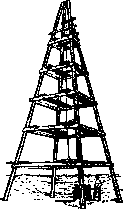
Figure 1.
Due to the hardness of the ground, sometimes greater force is required. The pipe, thanks to the cutter, cuts into the ground and gradually descends. When the upper end of this pipe is already close to the working clamp, another pipe is screwed onto it, and so on. The bailer is used for removing soil from this pipe; for this purpose, it is lowered into the pipe that is cutting into the ground, and with the help of a rope thrown over a pulley (block), it is used to strike the ground, which gradually, through the valve, enters the bailer. To make it easier for the soil to enter the bailer, water is poured into the pipe, after which the soil softens; the bailer periodically fills with soil, then it is pulled out, overturned, and emptied by striking the ground. When the bailer has passed through the ground below the cutter of the casing pipe by 0.5 m, it is left behind and screwing the pipe into the ground is resumed. If the casing pipe reaches rocky ground, then screwing the pipe is stopped and work continues with a special bit and bailer. First, the bailer is untied and an iron bit with a sharp steel tip is attached to the rope. This bit is lowered into the casing pipe and used to strike the stone. After some time, the bit is detached and the bailer is attached again; then the bit is tied on again, and so on—until they reach the water source or soft ground. If there is insufficient water in the well, drilling continues to one of the following artesian aquifers. In Moscow, there are artesian wells receiving water from the first artesian aquifer at a depth of 60-70 m, from the second aquifer at a depth of 120-140 m, and finally from the third at a depth of 200-240 m. In this case, the rock serves as the wall of the artesian well. In most cases, these rocks are limestones, through which cracks of various sizes, filled with water, often pass. When drilling reaches a crack, the bottom bit drops, and water immediately appears in the well, sometimes reaching the surface of the earth and even overflowing above it. Fig. 2 shows one such well, made on the factory yard of the Yartsevsk textile manufactory.—When screwing the artesian well pipe into the ground, a moment comes when it no longer deepens, because the resistance of the soil against the pipe walls is very great. This happens at a depth of 20-30 m. In such a case, a pipe of a smaller diameter (by 50 mm) has to be taken and lowered into the well to the place where the first pipe stopped. The lower end of the new pipe must also have a steel cutter, FIG. 2. because the new pipe will have to be screwed into the ground. It goes without saying that to continue the work, the bailer and bit must also be of a smaller diameter than before. When making an artesian well, it is therefore necessary to reduce the diameter of the pipe two, three, or more times. In such a case, after completion of the artesian well, the smaller diameter pipes are cut off with a special tool slightly above the place where they enter the ground. Thus, the lower end of the smaller diameter pipe will be located 200-250 mm below the upper end of the larger diameter pipe, and the entire well will have a telescopic appearance. If there are ground waters near the drilling site that could contaminate the artesian water, the space between the pipes is filled with iron or lead rings and, in general, is carefully sealed to protect the artesian water from intermediate ground water, which is important from a sanitary point of view. In mechanical drilling, the energy of an engine is used instead of human force, which makes the work faster. Wells of large diameter—500 mm or more—can only be made mechanically. When a large amount of water appears in the well, the productivity of the well is checked by means of a test pumping for at least 24 hours without interruption. During test pumping, it is very important to monitor the water level in the well; if this last drops by a small depth, and the amount of water measured during pumping satisfies the needs of the institution establishing the artesian well, then the matter can be considered completed. Next, the artesian well is equipped with a pumping station. There are several types of artesian pumps, the simplest of which is the ordinary piston pump. If the water level in the well is very high, then an ordinary suction pipe is lowered into the well water. Sometimes the pump has to be lowered into the well, placing it in a special iron pipe. Instead of a piston pump, a centrifugal pump can be lowered into the well, which will be located horizontally on a vertical shaft at the lowest level of the aquifer. This shaft is connected to an electric motor by means of a gear transmission; the turbine is set in rapid rotation, and water is pumped to the surface. Centrifugal pumps were first proposed at the end of the last century by engineer Farko. Since then they have been greatly improved, and even several multi-chamber centrifugal pumps are placed on one shaft, which are still called Farko system pumps. To lift water from artesian wells, when the level is quite close to the surface of the earth, air and pneumatic pumps of the "Mammut" system are also used. Water is delivered to the place of consumption by means of second pumping, and there are cases where artesian water, containing iron salts, becomes turbid due to the blowing of air into it, due to the formation of iron hydroxide in the form of a reddish-brown precipitate. In such a case, preliminary settling of the water is required, and only after such treatment can the water be pumped to places of consumption. Pneumatic pumps are extremely simple in design and have many advantages over other pump systems; their main disadvantage is the low efficiency (15-20%), due to which the operation of such a pump is uneconomical. In recent years, a new type of pneumatic pump of the "Erlift" system has come into use. It is an improved pump of the "Mammut" system. It should be noted that in a fine-sandy aquifer, along with water, fine sand also enters the well during pumping, which is very harmful in piston pumps, as when the piston moves, it gets between the piston and the walls of the pump cylinder. As a result, the efficiency of the pump is reduced, and the pump often has to be repaired. To prevent this, in piston pumps, a special filter is inserted at the bottom of the well, consisting of an iron pipe with holes. Such a pipe is sealed at the lower end, and its surface is tinned with a copper mesh that does not allow fine sands to pass through. From time to time, the well still gets clogged with sand. In such a case, the filter with the pump is removed from the well, and the well is blown out with air using a pneumatic pump. The cost of an artesian well depends on many conditions: the density of the rock (sand, clay, stone, etc.), the cost of labor, materials, etc. The well shown in Fig. 2 at the Yartsevsk textile manufactory, with a diameter of 250 mm and drilled to a depth of 163.5 m, cost 20,000 rubles. The well was built in 1926, and water flows out to the surface at a rate of 4 thousand buckets per hour.—Composition of artesian waters and their sanitary significance—see Artesian waters.
Related articles
Mentioned in
Cite this page
“Artesian Well.” Soviet Medical Encyclopedia. English translation of Bolshaya Meditsinskaya Entsiklopediya, 1st ed. (Moscow, 1928–1936), ed. N. A. Semashko. https://sovietmedicalencyclopedia.pages.dev/article/artesian-well/