Brooklyn Well
Historical document, translated for reference. It reflects medical knowledge of the 1920s–30s and is not medical advice.
Summary
The Brooklyn Well is a drilled well made of screwed-together iron, cast iron, or copper pipes with a diameter of 100-500 mm. Despite its small diameter, it can yield significant amounts of water depending on the aquifer's water-bearing capacity.
Encyclopedia article (1928–1936)
Brooklyn Well, a drilled well made of screwed-together iron, cast iron, or copper pipes, with a diameter of 100-500 mm. It was first used in the city of Brooklyn in the U.S.A. It is also often called a tube well. Despite the small diameter, the Brooklyn Well, depending on the water-bearing capacity of the aquifer, can yield significant quantities of water. Thanks to this, as well as improvements in drilling methods, Brooklyn Wells are currently one of the most common methods for obtaining groundwater. The depth of a Brooklyn Well is approximately 20-50 meters.
The well collects water through the side surfaces of its constituent pipes (see Figure 1), which is why small rectangular or circular holes (10-20 mm in diameter) are made in the walls of the latter. The total area of the holes is determined by the seepage rate of groundwater; it is taken to be very small, ranging from 0.5 to 5 mm per second (rarely more), in accordance with the size of the grains of the soil forming the water-bearing stratum, so that particles of soil would not enter the well with the flow of water. To better protect the well from clogging, the perforated pipes are covered with a so-called filter, which consists of a copper mesh with very small openings (up to 500 per 1 sq cm), so-called serge cloth. The mesh number is chosen depending on the size of the grains of the water-bearing rock.
To construct a Brooklyn Well, first a borehole is made from casing pipes with a diameter slightly larger than the diameter d of the well itself. When the borehole is ready and cleared of soil, the Brooklyn Well, assembled on the surface, is inserted into it and supported on an impermeable stratum; the casing pipes are then pulled out of the ground. Water is drawn from the well by pumps of various systems through a suction pipe a lowered into the well. Additionally, an observation (control) pipe r, usually copper with a small (15-20 mm) diameter, is inserted into the well to monitor the level of groundwater. To access the well, a stone shaft A is constructed, equipped with a ladder or rungs and ventilation. The Brooklyn Well can be considered complete after prolonged preliminary pumping of water.
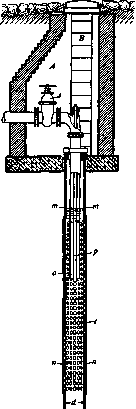
During such pumping, fine soil particles are drawn out of the water-bearing stratum, causing it to be eroded, the more intensely the stronger the pumping. After completion, only large soil particles remain around and surround the well, forming its natural filter. Pumping continues for several days and ends when there are no fine soil particles in the water obtained from the well. Instead of a copper mesh filter, sand-gravel filters are often constructed around the well. In this case, first a borehole is made from large-diameter casing pipes, the assembled Brooklyn Well is lowered into it, the resulting annular space between the well pipes and the borehole is filled with coarse-grained sand or fine gravel, and the pipes are pulled out of the ground. For water supply to cities, several (sometimes hundreds) such wells are constructed; for water supply to individual settlements, estates, hospitals, rest homes, sanatoriums, etc., 2-4-6 Brooklyn Wells are often sufficient. From a sanitary standpoint, it is necessary to prevent the infiltration of contaminated surface water into Brooklyn Wells; infiltration is prevented by sealing, establishing a protection zone (see Sanitary Protection Zones). The cost of a Brooklyn Well depends on the diameter of its pipes, depth, and nature of the soil and can be indicated by approximate figures (5,000-15,000-30,000 rubles).
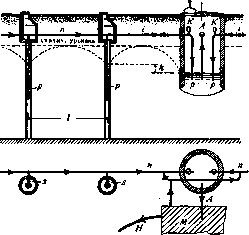
Figure 2. Brooklyn Water Collection: A - collection well; K - air cap; s - gate; M - pumping station; N - water conduit; p-r - siphon; g - siphon slope; h - head loss; l - distance between wells.
Water lifting from Brooklyn Wells is done by means of rod pumps, simple centrifugal pumps, special centrifugal pumps lowered into wells, or by means of compressed air (see Artesian Well). With a relatively shallow occurrence of groundwater, water lifting from several Brooklyn Wells is done according to the following common scheme. Water from Brooklyn Wells flows into a collection well A (see Figure 2) of large diameter (several meters), from which it is pumped by pumps of the pumping station M and through the pipeline N is delivered to points of consumption. The movement of water from Brooklyn Wells into the collection well is accomplished by means of siphon pipes p-r, consisting of vertical parts r, which are lowered inside the well pipes, and horizontal parts p. To start the siphon, it requires 'charging', which essentially consists of removing air from the siphon pipes, which is done either with an air pump or by filling the siphon pipes with water from the pipeline N.
H. Geniev. (Brunn), a histological detail of the structure of the mucous membranes of the renal pelvis, ureters, and bladder, observed in so-called granular (or cystic) pyelitis, urethritis, and cystitis (see), consisting in the formation in the covering epithelium of rounded cellular complexes with subsequent immersion and separation of these complexes into the underlying tissue of the mucous membrane. The size of Brunn's epithelial nests varies from barely noticeable points to a pinhead; inside the nests, cysts are often formed, filled with colloidal or mucous content, sometimes with an admixture of detritus, previously by some authors taken for Sporozoa, the causative agent of this process.
Related articles
Mentioned in
Cite this page
“Brooklyn Well.” Soviet Medical Encyclopedia. English translation of Bolshaya Meditsinskaya Entsiklopediya, 1st ed. (Moscow, 1928–1936), ed. N. A. Semashko. https://sovietmedicalencyclopedia.pages.dev/article/brooklyn-well/