Wells
Historical document, translated for reference. It reflects medical knowledge of the 1920s–30s and is not medical advice.
Summary
Wells serve the purpose of water supply by making accessible from the surface the water-bearing layer located underground. They are categorized into large-diameter (reservoir) wells and tubular wells, with construction methods varying based on soil properties, depth, and wall materials.
Encyclopedia article (1928–1936)
Wells serve the purposes of water supply, having as their objective to make accessible for use from the surface of the earth the water-bearing layer located in depth. Sometimes wells are also used for the discharge of wastewater into deeper soil layers; such wells are called "absorbing"; their construction from a sanitary point of view is unacceptable. Geographically, wells as a method of water extraction are used everywhere where there are corresponding conditions for them, i.e., the presence of accessible groundwater. Wells are usually divided into two main categories: a) wells of large diameter, or reservoir wells; they are also called shaft wells, dug wells, sometimes ground wells, or timbered wells; b) tubular wells (about the latter, see Abyssinian well, Artesian well, Brooklyn well). Reservoir wells have either square or circular cross-section in plan. The lining of the well walls (see illustration) is made with various materials depending on which ones are most accessible and inexpensive in a given locality. Wooden lining is most widespread. Not all wood species are equally good as material for a timber frame; oak is the strongest and most durable; however, it also has a disadvantage: for some time after construction, the water in the well acquires an unpleasant taste due to the dissolution and leaching of tannins from the oak; after some time this phenomenon disappears. Alder and also elm are recommended; pine often gives the water a resinous taste. Birch is considered the least suitable. The disadvantage of wooden frames is their more or less easy destruction, especially in the above-water part, partly due to rotting, and sometimes through the agency of pests: animals and fungi. Besides economic damage, this also leads to sanitary defects: contamination of water in the well through cracks in the frame. Therefore, brick lining on cement or stone lining should be considered much more perfect, although it is significantly more expensive. Stone and fat lime mortar are undesirable as lining materials, since the well water, often containing free CO2, dissolves lime, which causes an increase in hardness. The best material for lining the walls is concrete or reinforced concrete. Iron is used less frequently for lining walls; however, it is suitable only for wells in which the water is quickly replaced, since when water stagnates, soluble iron salts are formed, which spoil the taste. The techniques used in well construction vary depending on soil properties, well depth, wall materials, etc. (see Water supply, rural water supply).
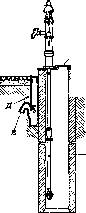
Reservoir well: A - concrete or stone lining on cement; B - insulating layer of clay; C - paving; D - cover; E - drainage shaft; F - outlet from drainage shaft.
The techniques used in well construction vary depending on soil properties, well depth, wall materials, etc. (see Water supply, rural water supply).
From a hygienic point of view, 2 very important measures must be taken to ensure the purity of water in Wells. They depend on the sources and paths of contamination of Wells. All contamination should be divided into 2 groups: 1) local contamination of water in the Well itself; 2) general contamination of the water-bearing layer feeding the Well. Paths of local contamination can be: 1. Seepage of surface water through cracks and imperfections in the walls of the Well; this is facilitated (besides unsatisfactory walls) by the slope of the surface toward the Well, not away from it; waterlogging and contamination of the soil near the Well by washing laundry, watering livestock, etc. 2. Contamination and infection of water by devices used for drawing water; this usually results from the use of individual buckets and ropes, which easily become contaminated both in dwellings and at the Well. 3. Clogging through the outer opening of the crib, if it is not covered.-Factors on which general contamination depends, i.e., contamination through the soil of the water-bearing layer feeding the Well, and with it the water in the latter, are as follows. A. Easy permeability for dirty waters of the soil layer separating the water-bearing layer from the surface; the type of soil plays a predominant role here: sand has the greatest permeability, an admixture of clay reduces the latter, pure clay is completely impermeable to water.-B. The height of the soil layer above the water-bearing layer, consequently the depth of the Well: the greater this covering layer, the more it can retain contaminating substances from percolating surface waters, all other conditions being equal; however, the significance of the depth of the Well for its sanitary characteristics should not be overestimated: contamination of the water-bearing layer due to percolation of surface waters through the soil is a derivative not only of the height of the covering layer but also of its permeability." Therefore, a shallower Well, but one fed by water from the second water-bearing horizon (see Water), is better protected from such contamination than a Well, though deeper, but fed by the first water-bearing layer. The reason is that the water-bearing layer supplying the first of the mentioned Wells has over it a covering from the surface in the form of a water-impermeable layer of clay (underlying the first water-bearing layer); in the second case, above the water-bearing layer there is, although greater, but permeable to surface water, a layer of sandy soil.-C. Territorial relationships between possible sources of contamination (cesspools, manure heaps, contaminated areas of soil, etc.) and the Well. To evaluate this factor, it is often proposed to rely on certain numerical standards; for example, Khlopin gives as the minimum standard of distance from the Well to the source of contamination 10-20 m. The Rural Water Supply Section of the Permanent Bureau of Sanitary-Technical Congresses gives 20 m. However, such standardization should be approached with great caution: at the same distance, the possibility of contamination is far from the same depending on the permeability of the soil, its structure and thickness of the covering layer, as well as on the relief of the latter. Thus, a 20-meter distance by no means protects the water of a shallow Well fed by a water-bearing layer covered only with sand and located below the contamination point; at the same time, this distance protects the water of a sufficiently deep Well, the water-bearing layer of which is covered with a layer of clay, and the Well itself is located above the source of contamination. Therefore, it is much more advisable to be guided by differentiated standards, for example, those proposed by the Prussian Landesanstalt f. Wasser-, Boden- und Lufthygiene. For deep Wells with little water use under good soil conditions, this institute allows a minimum distance of 10 m. For Wells not too deep, used for mass withdrawal, a distance of at least 50 m is required.-It is not possible to propose any other fixed and differentiated standards for different types of Wells for minimum distance from sources of contamination due to the lack of scientifically based experimental data. A distance less than 20 m should be considered unacceptable under any conditions, although even this distance, as indicated above, sometimes does not protect from contamination, and in such cases, based on soil conditions, a greater distance from sources of contamination should be required. The sanitary assessment of water in Wells should be based not only on data from water research (see), but above all on the assessment of the Well itself. In this case, it is particularly important to determine the possibility of water contamination in the Well; depending on the causes and nature of the contamination, the assessment of the water and practical sanitary measures regarding this Well will be different. As for the significance of laboratory water research data for assessing the Well, it should be borne in mind that the method of quantitative bacteriological research-counting the number of colonies grown from 1 cm2-is not applicable for assessing well water: random circumstances completely unrelated to contamination, such as water temperature, its mobility (e.g., due to frequent withdrawal), so sharply affect the number of microorganisms that they do not make it possible to correctly assess well water by this criterion. The greatest importance is attached to the chemical analysis of well water and its examination for intestinal bacilli. Measures against contaminated Wells follow from an analysis of the causes and paths that determine contamination. To prevent contamination of the first kind (the Well itself), the following are necessary: 1. The least possible permeability of the Well lining; the best material is concrete. 2. Isolation of the Well walls from surface water by a layer of clay ("clay lock"); the latter is laid on top around the walls in place of the excavated earth to a depth of up to 2 m and a thickness of 0.5-0.8 m. Such isolation in large measure protects the Well from seepage of surface water through the lining, even if the latter is cracked. 3. Prevention of accumulation of dirt and dirty water around the Well; for this, the surface level around the Well is made higher, and the surface itself is paved with a radius of not less than 2-3 m around the Well. The Well is surrounded by a barrier preventing livestock from approaching closely; for watering, a trough is arranged behind the barrier, and for filling it with water, a gutter from the Well. 4. Equipping the Well with appropriate devices for drawing water: the best is, of course, a pump; if installation of the latter is not possible, it is necessary to install a suitable water-lifting device (see), equipped with a permanent attached bucket. 5. Covering the Well opening with a lid; in the case of installing a tight lid, it is necessary to ensure ventilation of the Well, for which an exhaust pipe passing through the lid is installed. When other devices rather than a pump are used for lifting water and installation of a lid is impossible, one has to be content with installing a canopy over the Well; however, such a canopy should be regarded only as a surrogate for covering. A technically satisfactory sanitary device for a Well is shown in the figure.-To prevent contamination of Wells through water-bearing layers, it is necessary to correctly choose the plot of land for installing the Well; in this case, the conditions of the local terrain, the structure of the soil, the depth of the Well, and its distance from sources of contamination should be taken into account. The area near the Well requires careful protection from contamination; it is necessary to create a small local sanitary protection zone for the Well. Further, it is important to find a water-bearing layer of sufficient depth, and preferably not the first. Wells in relation to which contamination of the water-bearing layer has been established are usually dangerous from a sanitary point of view. If local contamination of the Well is established, then after taking measures to protect the Well from further contamination, it is always necessary to clean it, and sometimes to disinfect it. Cleaning the Well consists of bailing out the water from it to the bottom and then removing the accumulated dirt. For disinfection of the Well, bleaching powder is most often used. The Prussian Landesanstalt f. Wasser-, Boden- und Lufthygiene recommends for 1 m3 of water in the Well 10-50 g of fresh bleaching powder; the latter should be pre-mixed in a small amount of water. The walls of the Well are wiped with a clean mop using chlorinated water from the Well. The chlorinated water is left in the Well for 2 days, after which it is pumped or bailed out until it no longer smells of chlorine. Experimental testing of the effect of such doses of bleaching powder (10-50 mg per 1 l) indicated their complete effectiveness (see also Water Supply). -
Related articles
Mentioned in
Cite this page
“Wells.” Soviet Medical Encyclopedia. English translation of Bolshaya Meditsinskaya Entsiklopediya, 1st ed. (Moscow, 1928–1936), ed. N. A. Semashko. https://sovietmedicalencyclopedia.pages.dev/article/wells/