Fungi
Historical document, translated for reference. It reflects medical knowledge of the 1920s–30s and is not medical advice.
Summary
Fungi are a class of lower or thalloid plants without chlorophyll, consisting of approximately 70,000 species. They reproduce either vegetatively or through sporulation, with higher fungi divided into ascomycetes (sac fungi) and basidiomycetes (basidial fungi).
Encyclopedia article (1928–1936)
FUNGI (Fungi, Mycetes), a class of lower or thalloid plants devoid of chlorophyll (approximately 70,000 species). What is commonly called fungi in everyday life (various mushroom-forming and other fungi) represents only the known parts (so-called fruiting bodies) of some of the most highly organized representatives of this class, while most fungi are less conspicuous and appear either as various growths on substrates containing organic matter (mold) or are so small that they are only distinguishable under a microscope. Such small forms are often called 'molds' in contrast to 'fungi' (larger forms).- The vegetative body of fungi is extremely simple and uniform. It is called the mycelium (or mushroom mycelium) and consists of a system of thin branching filaments, or hyphae, which spread either inside the substrate or on its surface. In lower fungi, the mycelium lacks cross-walls and is, formally speaking, a single highly branched cell with numerous cell nuclei (non-septate mycelium); in higher fungi, the mycelium is divided by cross-walls into a series of cells following one another (septate mycelium; see Figure 3). Special modifications of the mycelium are rhizomorphs and sclerotia. The former are dense, mostly dark-colored cord-like interweavings of hyphae that sometimes reach several meters in length and grow at their ends. Sclerotia are more or less round dense interweavings of hyphae that can withstand drying, wintering, etc., and serve to preserve the fungus from year to year. Sclerotia range from several tenths of a millimeter to 20-30 cm in diameter, with a weight of up to 20 kg (e.g., in some Brazilian polypores-Polyporus sapurema and others). Reproduction of fungi occurs either vegetatively or through specialized sporulation. In the first case, the mycelium simply breaks into individual parts, often into individual oval cells called oidia. A common form of such reproduction is budding (see Yeasts, Blastomycetes). In the case of sporulation, special cells called spores form on specialized branches of the mycelium, which then, when favorable conditions are encountered, germinate into a new mycelium (see Figure 3). In some cases, spores are formed in large numbers inside special containers called sporangia (see Figure 1, b). Such endogenous spores are characteristic of some lower fungi. In other cases (in many lower fungi and especially in higher fungi), spores are formed on the surface of sporulation cells. These spores are called conidia and more often form not singly on conidiophores but in entire groups (see Figures 4 and 5). Frequently, the conidiophores themselves connect into special bundles called coremia. Finally, sometimes a special envelope from an interweaving of hyphae develops around the conidiophores, and thus conidial fruiting bodies are formed (e.g., pycnidia; see Figure 6). As for the spores themselves, in some lower fungi they have the character of zoospores, i.e., they lack a cell wall and are equipped with cilia by means of which they actively move in water (see Figure 2, a), but in the vast majority of cases, fungal spores are clothed in a cell wall and lack active movement. They are spread by air currents and sometimes by insects. A special type of spore are those that result from sexual reproduction. The sexual process in lower fungi, which is very diverse in form, is especially characterized by the fact that the product of fertilization immediately turns into a spore clothed in a thick wall and usually germinating only after a long period of rest (see Fig. 1, d; 2, b). As for higher fungi, here the product of fertilization first grows and forms spores only at the end of its development. These spores in turn differ in mode of formation in different groups of fungi. In some they are endogenous and called ascospores (see Figure 9), while in others they are exogenous and called basidiospores (see Figure 12). Accordingly, higher fungi are divided into two large groups: ascomycetes, or sac fungi (with ascospores), and basidiomycetes, or basidial fungi (with basidiospores). Ascospores and basidiospores rarely form directly on the mycelium, but in the vast majority of cases on special special interweavings of hyphae, often very complex in structure and significant in size and called fruiting bodies. In ascomycetes, in typical cases, special sexual organs-oogonia and antheridia-are formed when the fruiting body is initiated. They fuse with each other, but only their protoplasm mixes, while the cell nuclei do not fuse but only approach each other in pairs. The product of such fertilization, or zygote, then gives rise to a series of thread-like outgrowths called ascogenous hyphae. In them, cell nuclei multiply in pairs and then at their ends asci form, each receiving two nuclei (corresponding to male and female). Here the nuclei fuse, and then the fusion nucleus divides by reduction, giving 8 nuclei, around which 8 ascospores form (see Figures 7, 8 and 9). Simultaneously with the described process of zygote development, it is overgrown with threads of the vegetative mycelium, which form the main mass of the fruiting body (see Figures 7 and 10). The type of development mentioned in ascomycetes is also widely modified here by what is called apogamy. In this case, the sexual organs either do not fuse with each other or are not formed at all, but ascogenous hyphae still form, and development proceeds.-As for basidial fungi, they always develop apogamously. At a certain moment here, ordinary branches of the mycelium fuse and cell nuclei pass from one cell to another. The resulting binucleate cells grow into a whole mycelium composed of binucleate cells. Unlike ascogenous hyphae, here it grows completely independently and has an unlimited lifespan. From it, the fruiting bodies bearing basidia then form completely. These also initially receive 2 cell nuclei each; then they fuse, the fusion nucleus divides into 4, and on the surface of the basidium 4 basidiospores form, to which one cell nucleus each migrates (see Figures 11 and 12). Many higher fungi, along with the main sporulation-sac or basidial-also have purely asexual conidial sporulation and often several that are completely different in appearance. In view of this, one and the same fungus completely changes its appearance at different stages of development. This phenomenon is called polymorphism or pleomorphism of fungi. Thanks to it, many fungi
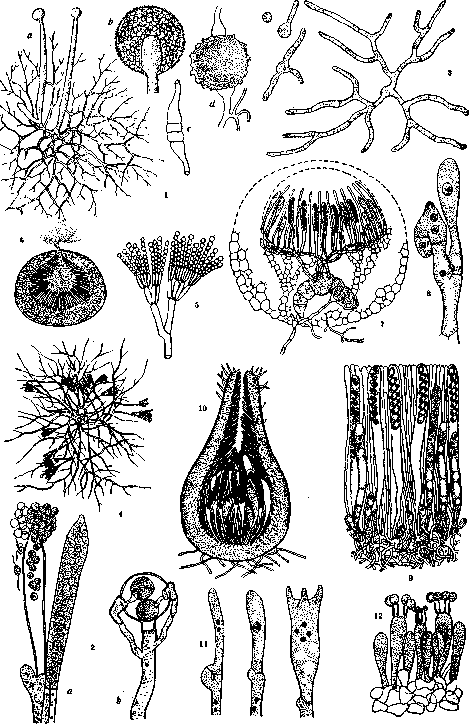
Figures 1-12. Fungi. 1. Mucor: a-mycelium (non-septate) with two sporangiophores; b-sporangium; c-beginning of copulation (isogamy); d-mature zygote. 2. Achlya: a-zoosporangia; b-fertilization (oogamy). 3. Germination of spores and development of mycelium (septate). 4. Penicillium, mycelium (septate) with conidiophores. 5. Conidiophore, more strongly enlarged. 6. Section of pycnidium of Strickeria. 7. Section of fruiting body of Ascobolus with ascogenous hyphae (schematic). 8. Initial stages of development of asci on ascogenous hypha. 9. Asci at different stages of development. 10. Section of fruiting body (perithecium) of Podospora. 11. Development of basidium. 12. Basidia at different stages of development.
IVY
84 have preserved various names, for example, for the ascomycete and this or that conidial state, as they were described earlier, when the genetic connection between them had not yet been traced (for example, the ascomycete state - Eurotium, and the conidial state in the form of the most widespread mold - Aspergillus; see illustration, vol. II, p. 384). Mode of life. As non-chlorophyllous plants, Fungi require nutrition with ready-made organic compounds. Most of them live saprophytically on dead organic substrates, but many are parasites on both animals and especially on plants. Most parasitic forms can also live under saprophytic conditions, and only some are obligate parasites, i.e., they cannot be grown outside a living organism even in artificial culture. This applies to all rust and mildew fungi (Uredineae and Erysiphaceae). Saprophytic Fungi in nature are distributed on humus soil, on fallen twigs, leaves, animal excreta, especially of herbivores - in general, predominantly on plant remains, and conversely, are comparatively little distributed on animal remains. The reason for this preference for plant products is the circumstance that on protein-rich, rapidly decomposing animal remains, fungi cannot withstand competition with faster multiplying bacteria. Fungi (molds) in the environment surrounding man develop predominantly on plant products - on bread, jam, fruits, vegetables, paper (wallpaper) and so on, and from animal products - for example, on slowly decomposing skin. Of other conditions determining the development of Fungi, humidity is of great importance, since most Fungi are poorly adapted to conducting water and protecting against evaporation. Some Fungi are completely aquatic organisms, for example, saprolegniaceous; most, however, form their reproductive organs only in an aerial environment, but require high humidity both in the substrate in which the mycelium grows and in the surrounding air. Light in general has little effect on Fungi, although in some, fruiting bodies do not develop normally in the dark (for example, in some polypores). In relation to temperature, Fungi in general have a fairly wide range of adaptation, and some develop well even at 1-2°C (snow mold - Fusarium nivale). As for parasitic Fungi, their development is determined by both external conditions (especially for reproduction) and the presence of a suitable plant or animal. There are narrowly specialized forms (monophages), which necessarily require a certain species and even variety of host, and indiscriminate forms (polyphages), which develop well on various hosts. Finally, there are also so-called heteroecious parasitic Fungi, which require two strictly defined hosts to complete their life cycle. Many rust fungi are of this type. A special type of living conditions for some Fungi is symbiosis. An example of this is the formation of mycorrhizae, characteristic of most of our trees and many herbaceous plants. Some of the mycorrhizal Fungi exist in nature only under such symbiotic conditions, and moreover, in connection only with certain plants (obligate symbionts); for others, such conditions are not obligatory (facultative symbionts). The distribution of the former, as well as of parasites, is determined by the presence of certain higher plants with which they form mycorrhizae (for example, boletus with birch and aspen, and chanterelle mainly with spruce). Another well-known example of fungal symbiosis is lichens - the result of the cohabitation of Fungi with algae. Apparently, almost all lichen fungi are obligate symbionts and do not occur in a free state in nature. Duration of life. In artificial cultures under suitable conditions (inflow of fresh nutrient material), many Fungi can grow indefinitely for a long time; in natural conditions, due to changes in the substrate, the mycelium of most Fungi, after a short period of growth, passes to spore formation and then dies or at any rate ceases further growth. There are many Fungi with a perennial, theoretically indefinitely living mycelium. For example, many cap Fungi growing on soil. The spore-bearing organs themselves, even massive ones like the fruiting bodies of many cap Fungi, usually have a short existence and die immediately after spore separation, which usually lasts several days and even hours (for example, in the mushroom, spore shedding from the fruiting body lasts 6 days and during this time 16,000,000,000 spores are released). Such short-livedness is characteristic of succulent fruiting bodies, while more dry and woody ones often prove to be quite long-lived. For example, polypores, in which fruiting bodies 10 years old and even older are not uncommon. The speed of development of fruiting bodies depends, of course, on a number of conditions, both external (temperature, etc.) and internal (size and nature of the fruiting body). For example, it is known that in the case of the mushroom, its fruiting bodies mature on average in about 40 days from the moment they are laid underground. In any case, the widespread opinion about the extraordinary speed of development of edible and other Fungi ("grow in one night") does not correspond to the truth. Chemical composition of Fungi. From the point of view of chemical composition, fruiting bodies have been studied mainly, especially of various edible Fungi. Here, about 90% is water. About 10% of the dry matter is ash, which is relatively very rich in potassium and phosphorus and poor in calcium. The rest consists of various organic substances. The cell wall of fungi is almost never cellulose, but at its base lie polysaccharides close to cellulose; mixed with them is a certain amount of nitrogenous substances resembling the chitin of insects. Among reserve carbohydrates, Fungi never contain starch, but are rich in glycogen. Soluble sugars are also widely found: glucose and the rather specific for Fungi trehalose, or mycose (C12H22O11). Mannitol is also often found. Fat is often found, but mostly in small amounts. Among nitrogenous products, proteins are in the first place (up to
FUNGI
20% or more of the dry weight); their decomposition products include urea in large quantities. Nitrogenous bases are of great importance, mostly derivatives of trimethylamine [(CH3)3N]; many of them have sharply expressed toxic properties (muscarine, choline, neurine; also ergotin, cornutin, etc.). True alkaloids have not been found in Fungi. Among the physiological peculiarities of fungi, fermentation and luminescence should be specially noted. The latter is observed in approximately 20 different species of fungi, mostly higher basidial. The luminescence of rotten wood or fallen leaves in nature is most often caused by the mycelium of the honey fungus (Armillaria mellea). The significance of Fungi in nature and human life. Along with bacteria, Fungi play an important role in the cycle of substances in nature. Fungal spores are widely distributed in various natural substrates (1 g of soil contains several thousand or more fungal spores). Under favorable conditions, they develop rapidly and are an important factor in the mineralization of organic materials, especially those that are difficult to decompose, such as cellulose or wood. Here, under aerobic conditions, fungi are even more important than bacteria. Parasitic Fungi are the causative agents of numerous infectious diseases, especially in plants (e.g., smut, rust, powdery mildew, downy mildew of grapes, etc.). Animals are affected by Fungi less frequently. Here one can mention - infection of insects by entomophorous Fungi, death of fish from saprolegnia, as well as a number of diseases of warm-blooded animals and especially humans caused by Fungi (see Parasitic Fungi). Edible and poisonous Fungi. The question of which Fungi should be considered edible for humans and which poisonous cannot be resolved with complete certainty. Much depends on individual properties: there are people who cannot tolerate almost any Fungi, and there are those who can eat even fly agarics without punishment, which cause severe poisoning symptoms in most people. There are also large differences in different countries. Thus, in England they eat almost only champignons, while in France, on the contrary, the circle of edible Fungi is quite wide (up to 100 species); the same is true in Germany. In the USSR, Fungi are consumed in enormous quantities, however, only a few forms find wide consumption. As the most important and universally recognized edible Fungi in our country, one can mention: from higher basidial (cap) fungi - honey fungus (Armillaria mellea), champignon (Psalliota campestris), woolly milkcap (Lactarius tomentosus), birch milkcap (Lactarius pi-peratus), delicious milkcap (Lactarius deliciosus), brown roll-rim (Paxillus involutus), chanterelle (Can-tharellus cibarius), russula (several species Russula), white Fungus, or boletus (Boletus edulis), scaber bolete (Boletus scaber), red bolete (Boletus rufus), slippery jack (Boletus lu-teus, B. flavus, B. granulatus), lurid bolete (Boletus luridus) and others. From ascomycete Fungi - morels (Helvetia and Gyromitra), false morels (Verpa and Morchella). To the ascomycete Fungi also belongs the most valuable Fungus - the French, or black truffle (Tuber melano-sporum) and our less valuable white truffle - Choiromyces maeandriformis. It should be specially noted that the Caesar's mushroom (Amanita caesarea), close to the fly agaric, is found in southern France and Italy. This is the most highly valued fungus of the ancient Romans, which was called 'Boletus' by them. The nutritional value of fungi can be judged by the following table. Substances Water Fungi Delicious milkcap Champignon White mushroom 91.28 91.30 Morel Percentage of dry substance Ash........ Proteins....... Fat........ Sugar....... Mannitol...... Extract, non-nitrogenous substances..... Shell substances 7.12 6.5 7.43 34.28 43.5 41.15 6.74 1.17 1.95 0.88 8.6 5.29 13.74 4.81 6.2 6.81 26.8 31.16 31.43 9.63 6.78 80.96 9.42 31.18 2.39 1.01 6.15 39.06 6.79 In the table, the significant relative content of proteins is striking, from which one could conclude about the high nutritional value of Fungi. However, it should be borne in mind that a part of these proteins is not digestible, and besides, in fresh Fungi, about 90% is water. Under these conditions, the value of Fungi in terms of protein nutrition turns out to be little exceeding that of ordinary vegetables, for example, cabbage. The non-nitrogenous substances of fungi have even less importance. Thus, fungi should be attributed mainly the value of a flavoring agent as a seasoning for lean food, which, when the population's diet consists mainly of plant food, can be considered a significant aid to national nutrition. The concept of poisonous fungi is as conditional as that of edible ones. Undoubtedly poisonous and most dangerous is the death cap (Amanita phalloi-des). This fungus, which is not often found in our country, slightly resembles a champignon in appearance; it differs from the latter in the white color of the gills on the underside of the cap (in the champignon they are reddish) and the presence of a special ring at the base of the stem. Symptoms of poisoning appear here only after 8-12 hours and later manifest as severe pain, vomiting, diarrhea, cooling of the extremities, falling pulse; consciousness is preserved. Attacks are repeated several times and in at least half of cases lead to the death of the patient after 5-10 days. The poisonous principle of Amanita phalloides was considered a special toxin - phallin, or Amanita-hemolysin, which destroys red blood cells. However, a similar hemolysin is easily destroyed by boiling water and is contained in a number of Fungi that can be eaten without harm (e.g., in the honey fungus, some species of Boletus). The active principle of the death cap must be different. It is not destroyed or leached from the Fungus by hot water. It has an agglutinating effect on red blood cells, and when injected into animals, it causes death with characteristic symptoms. On autopsy, hemorrhages (in lymph nodes, in the abdominal and pleural cavities) and fatty degeneration in the liver and kidneys are found. Treatment of poisoning by the death cap is complicated by the late appearance of symptoms of the disease. Laxatives and remedies for the patient's nervous depression are recommended - caffeine, sulfuric ether (but not atropine). Recently, a therapeutic serum against Amanita phalloides has been obtained at the Pasteur Institute in Paris. Other poisonous fungi are not so dangerous and poisonous. 1. Fly agarics - Amanita muscaria and Amanita pantherina. Symptoms of poisoning: vomiting, diarrhea and nervous phenomena in the form of delirium, convulsions. Poisonous principles - myco-atropine (causes the above-mentioned nervous phenomena), muscarine (C5H15N03) and some other bases similar to choline (C5H15N02). Treatment - cleansing of the intestines, sedatives (chloral, bromide); specifically against the action of muscarine (intestinal disorders, sweating) atropine is recommended. (There are also a number of other Fungi containing muscarine and bases similar to it. They also cause diarrhea, decreased cardiac activity and excessive sweating. These include Inocybe rivulosa, several species of Inocybe and others). 2. Many Fungi - toadstools cause acute gastrointestinal disorders; such are some species of Russula, Lactarius, Tricholoma, Ento-loma lividum and others. Symptoms here are mostly detected after 5-6 hours. The poisonous principle has not been studied. 3. Morels. Some species of morels, mainly Helvetia esculenta, contain helvetic acid (a dibasic acid of composition C12H20O7), which has hemolytic properties; it causes hemoglobinuria. Helvetic acid is easily extracted by hot water; therefore, cooked morels, especially in the cooking water, are completely non-toxic. In addition to the poisonous fungi mentioned above, poisoning can also be caused by consuming completely harmless forms, but overripe and especially in a stale state. The resulting processes of putrefactive decomposition of proteins lead to the accumulation of nitrogenous poisonous bases in the fungi, similar to ptomaines. Such poisonings are perhaps most common in our country. Mostly they are not severe. Among other poisonous fungi, ergot should be noted, which has a special application in medicine. Besides ergot, the larch polypore (Poly-porus officinalis) is also used in medicine, known in the pharmacopoeia under the name Agaricus alb us. In folk medicine as a remedy against cancer, Polyporus nigricans Fries, (black growths on birch trunks) is recommended. Main divisions of the class Fungi I subclass - Archimycetes (Archlmycetes), there are about 350 species, either without mycelium or with rudimentary mycelium. Chytridineae - microscopic, mostly aquatic forms. II subclass - Phycomycetes, 550 species with well-developed, non-septate mycelium. 1) Ooraycctes. The sexual process (oogamy) consists of fertilization of the egg by a spermatozoon or an outgrowth of the male organ - antheridium. Mostly aquatic saprophytes or terrestrial parasites. E.g. Saprolcgnia, Phytophthora (potato Fungus). 2) Zygomycetes. The sexual process (zygogamy) consists in the fusion of two branches of the mycelium, not distinguishable as male and female. Mostly terrestrial saprophytes, some - parasites, especially on insects, e.g. Mucor, Empusa. III subclass - Ascomycetes (Ascomycetes), more than 20,000 species; mycelium is septate. The main organ of reproduction is the ascus, or ascomycete.
Almost exclusively terrestrial forms. 1) Protoascineae. No fruiting bodies, e.g., Saccharomyces. 2) Plectascineae. Completely closed fruiting bodies; asci inside them are arranged without any particular order, e.g., Aspergillus, Penicillium. 3) Perisporieae. Fruiting bodies as in the previous ones, but asci inside them lie more or less parallel in a bundle, e.g., Erysiphaceae. 4) Pyrenomycetineae. Semi-closed fruiting bodies, with a narrow opening at the top, e.g., Claviceps. 5) Discomycetes. Open fruiting bodies, asci arranged in a dense layer on their free surface, e.g., Peziza, Helvella (morels). 6) Tuberineae. Mostly large underground fruiting bodies, open in youth, then closed, e.g., Tuber (truffle). IV subclass - Basidiomycetes, over 20,000 species. Mycelium is septate, the main organ of reproduction is the basidium. Terrestrial forms. 1) Ustilagineae (smuts). Basidium (protobasidium) is mostly divided into 4 cells, no fruiting bodies. Parasites. 2) Uredineae (rusts). Basidium (protobasidium) is divided into 4 cells. Besides basidia, they also have a whole series of other spore-bearing structures. No fruiting bodies. Parasites. 3) Hymenomycetes. Basidium (autobasidium) is single-celled with 4 spores. Fruiting bodies are open. Basidia are arranged in a dense layer (hymenium) or directly on their free surface or on special outgrowths. Over 10,000 species. Cap and other edible and poisonous mushrooms. 4) Gasteromycetes. Closed fruiting bodies. Basidia (single-celled - autobasidia) inside them, e.g., Lycoperdon (puffball). Imperfect fungi (Fungi imperfecti), over 20,000 species. Fungi with septate mycelium but having neither asci nor basidia. A temporary group, uniting the conidial states of different (probably mainly ascomycete) fungi, in which the higher (ascocarp or basidiocarp) spore-bearing structure is unknown. 1) Hyphomycetes. Sterile mycelium or more often with conidiophores solitary or collected in bundles, e.g., Cladosporium, Microsporon, Trichophyton and other pathogenic to humans forms. 2) Melanconiales. Conidiophores collected in a dense layer resembling a hymenium. 3) Sphaeropsidales. Conidia develop in special containers - pycnidia, resembling fruiting bodies.
L. Kureanov. Poisoning from fungi is observed when consuming fly agarics (Amanita muscaria s. Agaricus muscarius) and other poisonous fungi (Amanita pantherina, Amanita phalloides), containing an alkaloid toxic to the organism (muscarine, etc.). Severe poisoning symptoms, even with fatal outcome, can be caused by consuming 3-4 fly agarics, which is approximately equal to 0.003-0.005 of pure muscarine. The poisonous effect of fly agarics disappears if they are macerated and boiled in vinegar and this liquid is then poured off. Poisoning from fly agarics is especially often observed among northern peoples (Samoyeds, Chukchi, Kamchadals), who use beverages infused with fly agarics for intoxication purposes. Cases of poisoning are also sometimes observed when consuming morels (Morchella s. Helvella esculenta; see also above). To prevent the possibility of poisoning from morels, only healthy and fresh morels should be used for food, thoroughly cleaned and washed, and the washing of morels should be continued until the water used for washing ceases to become cloudy and remains completely clear and transparent. The main symptoms of most fungal poisonings are salivation, vomiting, colic, diarrhea (sometimes bloody), pupil constriction, visual disturbances and in some cases temporary loss of vision, cooling of the extremities, initially acceleration and then slowing and even stopping of the pulse, difficulty breathing, cyanosis, convulsions, hallucinations, stupor, comatose state and loss of consciousness. - As therapeutic agents for fungal poisoning, the following are used: washing of the stomach and intestines with a 1% solution of tannin or a solution of potassium permanganate (Solutio Kalii hypermanganici 2:1,000), enemas and emetics. Internally, a solution of tannin (3.0 in 30.0 water, a teaspoonful every 10 minutes), black coffee, strong tea. For vomiting - Hoffman's drops (20-30 drops per dose), swallowing pieces of ice. Stimulants - internal and external (mustard plasters). For slowed pulse - subcutaneous atropine. Avoid vinegar and acids. With appropriate measures, fungal poisoning often ends in recovery. - Upon examination: in corpses of those who died from fungal poisoning, dilated pupils, absence of rigor mortis and early onset of postmortem changes are often found. During autopsy, liquid, almost black blood is found, the mucous membrane of the gastrointestinal tract is hyperemic and covered with ecchymoses, sometimes colored purple; the liver is hyperemic and enlarged, with signs of fatty degeneration, sometimes of the nature of acute yellow atrophy of the liver; fatty degeneration is also found in the kidneys, myocardium; scattered hemorrhages are often found in the skeletal musculature, in the liver (hemorrhagic fatty liver - haemorrhagische Fettleber of German authors). In the stomach, remnants of fungi are often found.
D. Russian.
Related articles
Mentioned in
Cite this page
“Fungi.” Soviet Medical Encyclopedia. English translation of Bolshaya Meditsinskaya Entsiklopediya, 1st ed. (Moscow, 1928–1936), ed. N. A. Semashko. https://sovietmedicalencyclopedia.pages.dev/article/fungi/