Autogamy
Historical document, translated for reference. It reflects medical knowledge of the 1920s–30s and is not medical advice.
Summary
Autogamy is a form of sexual process in protozoa where two gamete nuclei within the same maternal cell fuse, representing a simplification of pedogamy. It occurs in some free-living and parasitic protozoa, particularly in the group Cnidosporidia.
Encyclopedia entry (1928–1936)
Autogamy (from the Greek autos-self and gamos-marriage), a term that initially designated any process of self-fertilization, but is now applied exclusively to that form of sexual process in protozoa, which consists of the fusion not of two separate gametes, but only of two gamete nuclei contained within one common maternal cell. A. is essentially a simplification of pedogamy (see), from which it differs only by the omission of one cell division. A. occurs in some free-living protozoa (sun animalcules, algae, and fungi), as well as in parasitic protozoa.
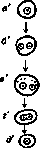
(et
Comparative scheme of autogamy and pedogamy. Pedogamy (a-e): b-formation of two gametes; c-reduction of gamete nuclei; d-fusion of gametes; e-zygote. Autogamy (a'-e'): b'-formation of gamete nuclei (omission of cell division); c'-their reduction; d'-their fusion; e'-zygote. Some cases of autogamy are considered a primitive form of sexual process, while others are regarded as a secondary simplification of the typical sexual process.
Related articles
Mentioned in
Cite this page
“Autogamy.” Soviet Medical Encyclopedia. English translation of Bolshaya Meditsinskaya Entsiklopediya, 1st ed. (Moscow, 1928–1936), ed. N. A. Semashko. https://sovietmedicalencyclopedia.pages.dev/article/autogamy/