Gametes
Historical document, translated for reference. It reflects medical knowledge of the 1920s–30s and is not medical advice.
Summary
Gametes are the sexual cellular elements or individuals that unite during fertilization or conjugation, copulation, and similar processes in animal and plant organisms. In multicellular organisms, they are specialized cells such as spermatozoa and eggs, while in lower organisms, their characteristics vary depending on the morphological features of the sexual process.
Encyclopedia article (1928–1936)
Gametes, sexual cellular elements, or respectively, individuals, that unite during fertilization, or respectively, during conjugation, copulation, and similar processes in animal and plant organisms. In multicellular organisms (animals, higher plants), gametes are specialized cells—spermatozoa and eggs; in lower animals and plants (Protozoa and Protophyta), the nature of G. varies depending on the morphological features of the sexual process. A) During copulation—the complete and final fusion of two whole individuals, which is observed, for example, in heliozoans (Actinophrys) and in some flagellates (Scytomonas; see figures)—G. correspond morphologically to the whole individual, and the process of fusion of such individuals-gametes is called hologamy. B) During conjugation—a temporary connection of the bodies of two individuals, typical of infusorians—a mutual exchange and fusion of parts of the micronucleus occurs. Here, the gametes are precisely these fusing micronuclei. In some cases, these micronuclei are clearly differentiated in terms of sex even from a morphological standpoint (see figure /), but for the most part they are distinguishable only physiologically. C) Some
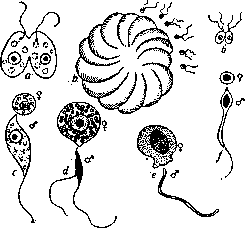
Gametes: a-Scytomonas subtilis (flagellate)-hologamous copulation; b-Polystomella crispa (rhizopod)-vegetative form producing flagellate isogametes; b'-copulation of isogametes; c-Stylorhynchus longicolis (gregarine)-copulation of anisogametes; d-Eimeria Schubergi (coccidia)-copulation of anisogametes; e-Plasmodium vivax-copulation of anisogametes; f-Cycloposthium bipalmatum (infusorian)-male and female micronuclei-correspond to anisogametes. Protozoa and Protophyta form small sexual individuals-G. (see figure 6). If these G. are morphologically indistinguishable, they are called isogametes; otherwise, they are called anisogametes. Differentiation between male and female G. is possible only in cases of obvious anisogamy, which is observed in its most perfect form in the formation of sex cells of higher organisms, as well as in Protozoa and Protophyta in cases where their G. morphologically resemble an egg, respectively, spermatozoon, as, for example, the G. of various sporozoans (Sporozoa), including the malarial plasmodium (see figures c,d,e). Sometimes morphological data does not allow detection of sexual differences between G.; in these cases, the latter may be detected by physiological characteristics—more mobile and active G. are considered male, passive ones female. The process of formation of G. is called gametogenesis. G. are formed from gametocytes through the reduction division of their nuclei. Thus, oocytes and spermatocytes of higher organisms are essentially gametocytes. Gametocytes for the most part also differ in terms of sex—female gametocytes are richer in nutritive inclusions in the plasma, their nucleus has a looser structure (poorer in chromatin) and has a relatively smaller volume than male gametocytes.
G. Epstein. GAMMA(γ)-RAYS, one of the three types of rays emitted by radioactive substances [see Radioactivity, Alpha(α)-rays, Beta(β)-rays]. In their nature, γ-rays are identical to X-rays, but have a wavelength many times shorter. The ether origin of γ-rays and their similarity to X-rays was proven by experiments with diffraction when γ-rays pass through crystals. Gamma-rays have the following effects: 1) they ionize air and gases through which they pass, 2) they act on photographic plates, 3) they cause fluorescence of certain substances, 4) they have a biological effect. The chemical reaction that occurs when substances are irradiated with γ-rays explains their biological effect. Different cells of the organism vary in their sensitivity to the effects of γ-rays; the most sensitive are cells of an embryonic nature, which also include tumor cells. These cells break down most easily under the influence of γ-rays. The effect of γ-rays, just like that of X-rays, which differ only in having a longer wavelength, is used in medicine for treating malignant cancerous and sarcomatous growths. Recently, due to their ability to penetrate through metals, γ-rays are used for examining metals by the Laue method. This forms the basis for the industrial application of γ-rays. For details on the properties of γ-rays, see textbooks on radiology.
Related articles
Mentioned in
Cite this page
“Gametes.” Soviet Medical Encyclopedia. English translation of Bolshaya Meditsinskaya Entsiklopediya, 1st ed. (Moscow, 1928–1936), ed. N. A. Semashko. https://sovietmedicalencyclopedia.pages.dev/article/gametes/