Chromosome Crossing-Over
Historical document, translated for reference. It reflects medical knowledge of the 1920s–30s and is not medical advice.
Summary
This article explains the theory of chromosome crossing-over, proposed by T. Morgan to account for genetic linkage phenomena that contradict Mendel's law of independent assortment. It details the historical development of the concept, including the work of Bateson, Punnett, and Morgan, and discusses the relationship between genetic mapping and cytological observations.
Encyclopedia article (1928–1936)
CHROMOSOME CROSSING-OVER, a theory proposed by T. Morgan to explain phenomena that contradict the law of independent assortment of traits in crossbreeding (see Mendelism). Similar phenomena were first studied by Bateson and Punnett (W. Bateson, R. Punnett, 1906) in the sweet pea (Lathyrus odoratus): when crossing a plant carrying two dominant traits (AB) with a plant possessing two recessive traits (ab), the offspring of the 2nd generation (F2) showed a phenotypic segregation not in the ratio of 9AB: 3Ab: 3aB: 1ab, but such that the AB and ab forms were significantly more numerous, and the Ab and aB forms were less numerous than expected. Bateson and Punnett assumed that this was explained by the fact that instead of the theoretically expected equal number of gametes of all types (1AB: 1Ab: 1aB: 1ab), gametes of the AB and ab types are formed in significantly larger quantities (xAB: 1Ab: 1aB: xab; where x>1). This phenomenon was called gametic coupling, as it was assumed that the dominant genes A and B tend to enter the gamete together. When crossing the original type Ab x aB, numerical ratios in segregation were discovered that forced the assumption that, on the contrary, gametes Ab and aB are formed in larger quantities (1AB: xAb: xaB: 1ab; x>1). This phenomenon was called gametic repulsion; it was assumed that here the dominant genes more often enter different gametes. Coupling and repulsion can be either complete or partial. With complete coupling (1AB: 0Ab: 0aB: 1ab) or repulsion (0AB: 1Ab: 1aB: 0ab), rare gametes are not produced at all, and in segregation, the phenomenon of spurious allelomorphism is observed, since the offspring result in ratios numerically similar to a monohybrid cross (with coupling—3AB: 1ab; with repulsion—1Ab: 2AB: 1aB). The degree of coupling and repulsion is a value more or less constant between every two genes exhibiting these phenomena. To explain these phenomena, Bateson and Punnett proposed (1911) a highly artificial theory of reduplication, according to which gametes in hybrids are formed in unequal numbers due to a difference in the rate of division between cells containing the original and new combinations of two genes. In 1911, Morgan proposed an explanation for this mysterious phenomenon based on the further development of the chromosome theory of heredity. Correns (Correns, 1902) had already assumed that genes are located in chromosomes in a specific linear order. De Vries (de Vries, 1903) developed these views in more detail, additionally making the assumption that homologous chromosomes exchange genes. Finally, Boveri (Boveri, 1902, 1903) definitely admitted that genes transmitted together (i.e., exhibiting coupling) are localized in the same chromosome, and that they can be separated by exchange between homologous chromosomes. Janssens (Janssens, 1909) proposed a chiasmatypy scheme for the process of exchange between chromosomes (Fig. 1). This scheme was used by Morgan and his associates to interpret the phenomena of "coupling" and "repulsion" observed in the fruit fly Drosophila between several hundred studied genes. At the present time, it has been established that genes transmitted together, i.e., exhibiting linkage between themselves, are localized in the same chromosome. All genes localized in one chromosome form a so-called linkage group. In view of this, the number of linkage groups for each species is a constant value and is equal to the number of chromosome pairs of the species complex, i.e., the haploid number. In the case where the linkage between the studied
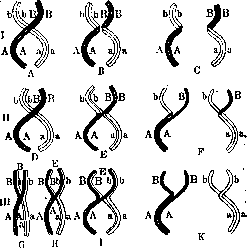
Figure 1. Scheme of chiasmatypy: I—scheme of simultaneous exchange of both strands of each of the complex chromosomes ("four-strand crossing-over"); II—scheme of exchange of one of the strands of each of the complex chromosomes ("two-strand crossing-over"); III—interpretation of observed cytological pictures while denying the chiasmatypy hypothesis.
genes is not absolute, they can enter different gametes in a certain percentage; this occurs due to an exchange between homologous chromosomes that takes place before the reduction division. This exchange is called chromosome crossing-over. The study of the percentages of exchange between many genes of the same chromosome revealed the following regularity: "if a, b, and c denote three genes and if the linkage ratio ab and bc is known, then the ratio a to c is a function of the sum or difference of ab and bc." Thus (in Drosophila), the genes for yellow body color and white eyes, being together in the chromosome, enter different gametes in 1.2% of cases, while the genes for white eyes and forked veins—in 3.5%. If one investigates the percentage of crossing-over between the gene for yellow body color and the gene for forked veins, one obtains 4.7%, i.e., exactly the sum of the previously obtained values. Sturtevant (Sturtevant) (1913) and partly Muller (Muller) established that this regularity is explained by the linear arrangement of genes in the chromosome and that the percentage of crossing-over is a function of distance. In view of this, it is possible to construct a chromosome map, i.e., to express the relative distances of genes linearly. The percentage of crossing-over between two genes can have any value from 0% to 50%, since at 50% an independent distribution of genes is already observed. Meanwhile, the summation of the percentages of crossing-over of all genes linearly located in chromosomes usually gives values greater than 50 and even 100. This is explained by the phenomenon of the so-called double crossing-over: if we observe the exchange of a group of genes A-b-C, then in the case of simultaneous crossing-over between A and b and b and C, gametes of such a type will be obtained as if no exchange had occurred between A and C: AbC and aBc (Fig. 2). Therefore, if genes A and C are so far apart that double crossing-overs can occur between them, then the percentage of A and C entering different gametes will not be equal to the sum of the percentages A+B+C, but less than the latter by the value of the percentage of double crossing-overs. Double crossing-overs can occur
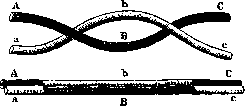
Figure 2. Scheme of double chromosome crossing-over.
inversions of a part of the chromosome by 180°. All these facts suggest that the percentage of crossing-over as a function of distance cannot be given an absolute value. Indeed, Muller and Painter (1928), during a cytological study of cases of deletion of a large part of a chromosome, discovered that a chromosome genetically equal to approximately only 1/10 of the whole turned out to be cytologically equal to about 1/4 of an intact chromosome. Finally, the latest data from Dobzhansky (Th. Dobzhansky, 1929, 1930) also showed that, although genetic data do not entirely coincide with cytological data regarding the distance between genes, the linear sequence of genes has been brilliantly confirmed (Fig. 3). The cytological processes underlying chromosome crossing-over should currently be considered unresolved. The Janssens chiasmatypy hypothesis, supported by Morgan, according to which at one of the stages before reduction division, chromosomes cross over in pairs and wrap around each other, break at the points of crossing, and then the broken segments reconnect, having exchanged with each other, is considered unproven by the majority of cytologists (Fig. 1). Seiler (Seiler, 1922) put forward another theory of chromosome crossing-over, according to which chromosomes at early stages consist of separate free segments
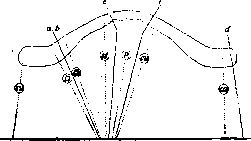
Figure 3. Comparison of the genetic (lower horizontal line) and cytological (above) map of the arrangement of genes in the third chromosome of Drosophila melanogaster based on the study of experimental breaks of chromosome parts under the influence of X-rays. The dashed lines indicate the comparative locations of genes in both maps; a, b, c, d, and e—sites of experimental chromosome breaks; ru—roughoid; D—Dichaete; th—thread; st—scarlet; p—peach; cu—curled; ca—claret.
that combine freely and then associate into whole chromosomes. But the lack of clarity regarding the cytological foundations of chromosome crossing-over in no way shakes modern genetic concepts in the field of the chromosome theory of heredity.
Related articles
Cite this page
“Chromosome Crossing-Over.” Soviet Medical Encyclopedia. English translation of Bolshaya Meditsinskaya Entsiklopediya, 1st ed. (Moscow, 1928–1936), ed. N. A. Semashko. https://sovietmedicalencyclopedia.pages.dev/article/chromosome-crossing-over/