Mendelism
Historical document, translated for reference. It reflects medical knowledge of the 1920s–30s and is not medical advice.
Summary
This article outlines the foundational principles of genetics established by Gregor Mendel in 1866, detailing his experiments with pea plants and the discovery of dominant and recessive traits. It explains the Mendelian laws of segregation and the concept of hereditary factors that determine inheritance patterns.
Encyclopedia article (1928–1936)
MENDELISM, the totality of regularities discovered by G. Mendel, which at the present time lie at the foundation of the science of heredity. Mendel's work appeared in 1866 in the little-known "Proceedings of the Society of Naturalists" in Brünn. In this work, Mendel formulated his famous laws of heredity with exceptional clarity. The full significance of the Mendelian laws was appreciated only later; until 1900, Mendel's work was forgotten. Before the confirmation of the validity of Mendel's laws, the doctrine of heredity represented a heap of disparate facts, and attempts to give coherence to empirical materials and interpret them were of a purely speculative nature. Such speculative constructs in the field of heredity were the theories of Darwin, Nägeli, Weismann, and others (see Heredity). The success of Mendel, who sets forth the basic laws of the transmission of traits to offspring in almost modern terms, was based on the author's great research talent, the successful choice of object, and a completely new approach to the problem. Instead of studying the influence of parents on offspring in the entire totality of their traits, Mendel began to analyze the inheritance of individual traits. Mendel conducted his experiments on peas, choosing for this seven pairs of its traits (seeds round and wrinkled, yellow and green, flower color white or purple, etc.). Plants with different traits were crossed by Mendel, and it turned out that in the hybrid of the first generation, the trait of one of the parents manifested itself. In the hybrid, there are hereditary factors from both parents, but only one of them manifests as a trait, while the other is in a hidden state. The manifesting trait, which suppresses its partner, Mendel called dominant. Of the pairs of traits cited above, the dominant ones proved to be: round shape, yellow seed color, purple flower color, etc. When crossing hybrids with each other, Mendel observed in the second generation the appearance of those traits that were hidden in the first-generation hybrid. These traits, which popped out from under the dominant ones, Mendel called recessive. For example, when crossing round-seeded hybrids, Mendel obtained 7,324 seeds in the second generation. Of these, 5,474 were round and 1,850 were wrinkled. In the experiment on the inheritance of seed color, Mendel obtained 6,022 yellow and 2,081 green seeds among 8,103 seeds, etc. Analyzing the figures of trait segregation in the second generation, Mendel made a brilliant discovery, which amounted to the fact that he grasped a simple ratio in the empirical numbers. Mendel noticed that for one seed with a recessive trait, there are three with a dominant one. The ratio 3D : 1R is the famous formula of Mendelian segregation. Studying all descendants of the second generation, Mendel establishes that among the dominant individuals, 2/3 are completely similar to the hybrid parents and produce segregation in the offspring in a ratio of 3D : 1R. One-third among the dominant ones is completely constant and produces offspring only with the dominant trait. The recessive group also turns out to be completely constant. Thus, the analysis of hybrid offspring shows that, in essence, segregation proceeds in a ratio of 1 : 2 : 1, if one takes into account the hereditary properties of the descendants, and not just their traits. To explain these regularities of trait inheritance, Mendel proposed a hypothesis about hereditary factors. Denoting the factor of the dominant trait by the letter A and the recessive one by a, Mendel depicts the course of inheritance during crossing in the following way. Parents A x a, hybrid-Aa. The hybrid obtained in the first generation carries the factor a in a hidden form; its trait corresponds to factor A. Studying the transmission of both factors from the hybrid to subsequent generations, Mendel extremely ingeniously proves that during the formation of the hybrid's germ cells, factor A enters half of them, and factor a enters the other half. Paired factors never enter the same gamete, but always segregate. If this is so, then the crossing of hybrids, according to Mendel, is depicted in the following way: hybrids Aa x Aa, pollen cells of hybrids A, a, egg cells.
A * a descendants of hybrids AA + Aa + Aa + aa. It is easy to verify that this is the ratio 1:2:1 or 3:1, if one takes into account only the external appearance of the hybrids, without considering their behavior in subsequent generations. Continuing his experiments, Mendel also studied the simultaneous inheritance of two pairs of traits. For example, one parent was taken with round and yellow seeds, and the other with wrinkled and green ones. The hybrids obtained from them possessed two dominant traits, i.e., they were round and yellow. From the hybrids, offspring were obtained in which all four possible combinations of the original traits were present: 315 round and yellow, 101 wrinkled and yellow, 108 round and green, and 32 wrinkled and green. However, if in this complex segregation one studies the segregation for each individual pair, the following is revealed. In total, there are 315 + 108 = 423 round, 101 + 32 = 133 wrinkled, 315 + 101 = 416 yellow, 108 + 32 = 140 green. It is easy to notice that each pair of traits segregates in a ratio of 3D : 1R. This proves that each pair of traits is inherited completely independently of the other, and the resulting more complex segregation during the inheritance of two pairs of traits is the result of a combination of two independent segregations. This is easy to verify. If one takes the group 101 or 108 (they are practically equal) as 3 in the complex segregation, then 315 must be equated to 9, and 32 must be equated to 1. In this way, the second famous Mendelian formula for the segregation of two pairs of traits is obtained in the form of the ratio 9D1D2 + 3D1R2 + 3D2R1 + 1R1R2. This ratio, as already indicated, is the result of the independent combination of the segregations of each pair of traits, and in fact: (3D1 : 1R1) (3D2 : 1R2) = 9D1D2 + 3D1R2 + 3D2R1 + 1R1R2. It is also necessary to dwell on Mendel's greatest generalization, which bears the name of the hypothesis of the "purity of gametes." Mendel showed that in a hybrid, an alternative distribution of determinants occurs. The hybrid Aa forms half of the gametes with the determinant A and the other half with the determinant a. By virtue of this, when crossing the hybrid Aa x aa, the ratio 1Aa + 1aa is obtained in the offspring (such a cross is usually called a backcross). At the same time, both determinants, while being in the hybrid simultaneously, do not mix in any way and do not change each other. The determinant A is just as capable of causing yellow color as it was when it was not in the hybrid, and the determinant a has not lost in any way its ability to cause green color, despite the fact that it is in a suppressed state in the hybrid. Based on all the facts obtained, Mendel established three basic laws: 1) the law of predominance, or dominance; 2) the law of segregation of hybrid traits, whereby each pair of traits segregates completely independently of the other, and 3) the hypothesis of the purity of gametes, i.e., the hypothesis of the independence and stable constancy of individual determinants. These three (or rather, the latter two) most important propositions laid the cornerstone for the foundation of the modern science of heredity, but this happened 35 years after the publication of Mendel's work. The reasons for the untimely assessment of Mendel's laws were, firstly, the assumption that Mendelian laws were valid only in the specific case of pea crossing, and secondly, the innovation in the concept of the transmission of individual traits and the general state of science at that time. In the era when Mendel was establishing his laws, nothing was definitively known about the material carriers of heredity. Only five years later, in 1870, E. van Beneden proved that the egg is a true cell composed of plasma and a nucleus. Only by the end of the 19th century were the material carriers of heredity investigated, which turned out to be the chromosomes of the nucleus. By this same time, the period of great speculative theories of heredity ended, which had created the idea of individual hereditary determinants and created all the necessary prerequisites for the experimental period of the science of heredity. All this led to the fact that only in 1900 did three researchers—Correns, Tschermak, and de Vries—completely independently of each other come very close to the discovery of Mendelian laws and discover Mendel's forgotten work. From that moment to the present time, there has been a powerful development of the science of heredity, which asserts that its regularities are universal, since they extend to all organisms consisting of cells with a chromosomal structure of nuclei. Proofs that Mendel's laws extend to all plants and animals, including humans, were obtained by the experimental science of heredity as early as the first decade of the 20th century. At the same time, it was recognized that Mendelian regularity is a complete analogue to the regularities of chromosome transmission from generation to generation. Chromosomes, as studies of the second and third decades of the 20th century have shown quite precisely, contain hereditary determinants responsible for one or another trait of the organism. Hereditary determinants received the name of genes at the suggestion of the Danish scientist Johannsen (1909). From the point of view of the chromosomal theory, Mendelian regularities appeared in the following form:
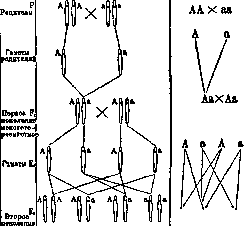
AA Aa Aa aa
The designations P (parental) and F (filial) were proposed by Bateson, one of the famous early Mendelians. At his suggestion, organisms possessing identical hereditary factors (AA and aa) are now called homozygotes, and those with different ones (Aa) are called heterozygotes. The alternative segregation of hereditary factors in a hybrid, which was largely mysterious to Mendel, in which half of its gametes received A and the other half a, turned out to be based on the mechanism of reduction division, in which only one chromosome from each pair enters the gametes. At the present time, Mendelism is filled with a vast amount of factual content and is, at the same time, significantly detailed. Segregation involving only one pair of traits is now called monohybrid, with two pairs—dihybrid, then trihybrid, etc.; in general terms—polyhybrid. To derive formulas for dihybrid segregation (and any other), a method called the Punnett square is used (see Punnett square). Segregation takes a different form when crossing a diheterozygote (AaBb) with a homozygous recessive form (aabb). The diheterozygote forms 4 types of gametes (AB, Ab, aB, ab), while the recessive forms only one type (ab). According to the Punnett square, we see that in this cross, four different phenotypes are obtained in equal ratios. The segregation formula will be 1AaBb : 1Aabb : 1aaBb : 1aabb, in general terms 1:1:1:1. If we study segregation in trihybrid segregation, we obtain the following ratio: (3 + 1)3 = 27 + 9 + 9 + 9 + 3 + 3 + 3 + 1; in tetrahybrid segregation, the ratio will be (3 + 1)4, etc. Correns established for the first time that the formula for dihybrid segregation corresponds to the binomial series 32 + 2(3 × 1) + 12, and it is perfectly clear that segregation of any complexity has the form of a binomial (3 + 1)n, where n is the number of pairs of segregating traits. However, the segregation formulas we have described are ratios of phenotypes, i.e., a division into groups by traits. If one takes into account the hereditary structure of organisms, it is perfectly clear that the formulas will be more complex, since several genotypes are usually hidden under one phenotype. For example, in dihybrid segregation in the phenotype OAB we have: 1AABB, 2AaBB, 2AABb, 4AaBb. In the phenotype OAb—1AAbb, 2Aabb; in OaB—1aaBB, 2aaBb; and in oab—aabb. The formula by genotype in dihybrid segregation therefore has the form: 1AABB + 2AaBB + 2AABb + 4AaBb + 1aaBB + 2aaBb + 1AAbb + 2Aabb + 1aabb (see Punnett square). It is easy to see that the genotype formula for dihybrid segregation is a combination of two independent monohybrid formulas (1AA + 2Aa + 1aa) (1BB + 2Bb + 1bb). Therefore, the formula by genotypes for segregation of any complexity (by analogy with the phenotype formula) has the following form: (AA + 2Aa + aa) (BB + 2Bb + bb) (CC + 2Cc + cc)... etc. However, the classical formulas of Mendelian segregation (by phenotype) can change significantly with different types of gene interaction. For example, in the presence of a lethal gene that manifests itself in the heterozygote as some trait, the monohybrid segregation formula, instead of 3:1, takes the form 2:1, because among AA + 2Aa + aa, the AA category dies due to the presence of the lethal gene in the homozygous state. With intermediate manifestation, the formula has the form 1:2:1. For example, when crossing long-eared and earless sheep, the entire first generation turns out to be short-eared (Aa); in the second generation, 25 AA (long-eared) + 50 Aa (short-eared) and 25 aa (earless) are obtained. Due to the presence of intermediate manifestation for some traits, at the present time, one speaks not of the law of dominance, but of the law of uniformity of the first generation. This uniformity can be achieved due to the dominance of one trait over another or due to the presence of intermediate inheritance. All cases of changes in the dihybrid formula from one type of gene action or another are presented in the following table (see article 792). As the table shows, we have 7 basic types of changes in the dihybrid segregation formula. The first type of change can be illustrated by the following example. Crossing red horned cows with a white hornless bull produces all hornless-roan offspring in the first generation. The second generation breaks down into the following six groups: 6 roan-hornless (4AaBb + 2AaBB), 3 white-hornless (2AABb + 1AABB), 2 roan-horned (2Aabb), 1 white-horned (1AAbb), 3 red-horned (2aaBb + 1aaBB), and 1 red-hornless (1aabb). The action of a lethal gene is seen from the following example. Crossing chickens that are diheterozygous for the frizzled gene, which is also recessively lethal, and the white color gene (AaBb x AaBb) will yield the following F2: 6 frizzled-white (since out of 9 AB, 2AABb and 1AABB died), 2 frizzled-black (out of 3, 1AAbb died), 3 white-smooth, and 1 black-smooth. The principle of cryptomeria boils down to finding certain genes in a hidden state and their manifestation only in combination with other factors. For example, crossing a black horse with a chestnut one (in which the gene for bay color is hidden) produces all bay offspring. In the case of crossing a black horse with a chestnut one that does not have the cryptomeric factor for bay color, all offspring turn out to be chestnut. The offspring of the bay horses in the first case are divided into 3 groups: 9 AB (bay), 3 Ab (black), and 4 chestnut (1aabb and 3aaB). In the case of epistasis, one dominant gene covers another. For example, in rabbits, the factor for gray color is epistatic over the factor for brown. By virtue of this, from diheterozygous forms (AaBb), three categories of descendants are obtained: 12 gray (9 AB + 3 Ab), 3 black (3 aB), and 1 brown (1ab). In the case of cryptomeria of two genes, the presence of one trait or another is determined by the action of two genes. For example, brittleness in barley is determined by the combined action of two genes, and when crossing non-brittle barley (AAbb) with non-brittle barley (aaBB), we obtain brittle (AaBb). F2 from such plants yields 9 brittle (AB) and 7 non-brittle (3aB + 3Ab + 1ab). In the case of polymeric inheritance, we encounter genes acting in the same way. For example, the black color of oat husks is determined by two factors (A and B). When crossing two such black ones, AAbb x aaBB, in the first generation we also obtain black ones (AaBb). In the second generation, we obtain two phenotypes: 15 black (9 AB + 3 Ab + 3 aB) and 1 white (1ab). Finally, in cases of linkage, we obtain 3:1, because here, in essence, monohybrid segregation is occurring, because the two factors lie in the same chromosome. Of all the described types of gene interaction, the principle of polymerism (see) is of particular interest. Many very important traits are transmitted according to this type of inheritance of equivalent factors, such as, for example, the length of a corn cob, the live weight of rabbits and chickens, and the fineness and length of wool in sheep, etc. In humans, according to Davenport's data, height is determined by equivalent factors; skin color is also determined by them. Apparently, human temperament and abilities have a number of equivalent factors at their core. A special combination of these factors apparently determines a person's talent, etc. In general, humans turn out to be an exceptionally rich object in terms of the number of features determined by dominant or recessive genes, which are entirely subject to Mendelian laws of inheritance. Along with the study of normal human traits, such as the inheritance of eye, hair, and skin color, skull shape, physique, voice, height, isohemagglutination, etc., the study of the Mendelian nature of many very important pathological forms is being conducted. For example, among skin diseases, as Siemens points out, we have naevus Unna, neurofibromatosis, freckles (dominant inheritance, dark pigmentation epistatically covers the predisposition to freckles), xeroderma pigmentosum (recessive), eczema, ichthyosis congenita (recessive), psoriasis, atheromas (dominant), etc. Among eye diseases, the most interesting is the inheritance of refractive anomalies; it is also known that cataracts are inherited almost always as a dominant trait; then retinitis pigmentosa (recessive) and color blindness (recessive, sex-linked) are inherited (see Heredity), etc. Among many other pathological forms, nervous diseases are of great interest. Here, the role of Mendelian analysis turns out to be so great that Davidenkov thinks it possible, on the basis of hybridological analysis, to establish a biological classification of nervous disorders, which cannot be achieved on the basis of clinical and anatomical analysis. This classification, according to Davidenkov, should become a "catalog of genes." A huge number of pathological features of humans turn out to belong to Mendelian traits. Stomach ulcers, diabetes, bronchial asthma, predisposition to tuberculosis, spasmophilia (decreased function of the parathyroid glands), cleft lip, and brachydactyly, etc., turn out to be hereditary.
The list of hereditary characteristics in humans is unusually large, and, as is sometimes pointed out, in terms of the richness of Mendelian genes among mammals, perhaps only the dog can compare with man. For those genes whose inheritance has been studied, it turns out to be possible to predict with accuracy both the course of inheritance of each of them in subsequent generations and all its combinations with other genes. In this sense, one speaks of the control of gene combinations, which is based on the knowledge of the laws of Mendelism. A remarkable example of the conscious creation of a new complex combination of genes is the production of the new 'Chantecler' breed of chickens. In 1908, a 'project' was outlined for an industrial-type chicken adapted to the living conditions in Canada. Thanks to a series of skillful crosses, this breed was created as a combination of genes from a number of different breeds. For the study of the inheritance of one trait or another, as well as for the study of the hereditary content of a given organism (since recessive genes can hide under the cover of a dominant phenotype, and from the crossing of two completely healthy parents we obtain a child burdened with a hereditary affliction, e.g., feeble-mindedness, by virtue of the fact that both parents were heterozygous), there exists an entire system of techniques, which has received the name of Mendelian, or genetic, analysis. Mendelian genes apparently concern absolutely all features of the organism (including the human one). In the case of a severe disturbance in the development of the organism, a given factor acts as a lethal gene, while in all other cases we discover it as an ordinary Mendelian factor. Thanks to the independent combination of a large number of independent Mendelian factors, an enormous diversity of hereditary combinations is realized. For humans, with their 48 chromosomes, combinative variability can proceed with enormous diversity. During the formation of gametes from 24 pairs of chromosomes, reduction division creates 4,096 combinations. In each marriage, the number of possible types turns out, therefore, to be equal to 16,777,216 (4,096 x 4,096). In each family, 3-4 combinations turn out to be realized, but the enormous diversity of hereditary types of humans within a given population is the result, mainly, of combinative variability. Lit.: Mendel G., Experiments on Plant Hybrids, M.-P., 1923; Stages of Mendelism, collection edited by A. Sapegin, M., 1923; Bateson W., Mendel's Principles of Heredity, Cambridge, 1930; Fischer E., Versuch einer Genanalyse des Menschen, Zeitschr. f. indukt. Abstammungs-u. Vererbungslehre, p. 127-234, B. LIV, 1930; Kammerer P., Gregor Mendel u. seine Vererbungslehre mit Rücksicht auf ihre Bedeutung f. d. med. Wissenschaft, Wien. med. Wochenschr., 1910, p. 2367; Morgan T., Sturtevant A., Muller H. a. Bridges C., The Mechanism of Mendelian Heredity, N. Y., 1923; Punnett R., Mendelism, L., 1922; Strohmeyer W., Die Bedeutung des Mendelismus f. d. klin. Vererbungslehre, Deutsch. Klin., Jahrg. 14, Ergänzungsband III, p. 331-388, 1919; Wilson J., A Manual of Mendelism, L., 1916. See also the literature for the articles Mendel and Heredity.
Related articles
Mentioned in
Cite this page
“Mendelism.” Soviet Medical Encyclopedia. English translation of Bolshaya Meditsinskaya Entsiklopediya, 1st ed. (Moscow, 1928–1936), ed. N. A. Semashko. https://sovietmedicalencyclopedia.pages.dev/article/mendelism/