Meniere's Syndrome
Historical document, translated for reference. It reflects medical knowledge of the 1920s–30s and is not medical advice.
Summary
This article from the 1928-1936 Soviet Medical Encyclopedia discusses Meniere's syndrome, detailing its history, clinical presentation involving vestibular and cochlear disorders, and the evolution of its understanding from a specific disease to a symptom complex.
Encyclopedia article (1928–1936)
MENIERE'S SYNDROME (Meniere's disease, morbus apoplecticus Meniere), a syndrome consisting of vestibular and auditory disorders, developing in the form of an acute stroke and having a tendency to recur. The first descriptions are found as early as the beginning of the 19th century in Itard and others. The onset of the disease in the form of an acute stroke (with vomiting and sometimes even with loss of consciousness) suggested to the early observers the idea that in such cases they were dealing with some kind of cerebral affliction. These cases were interpreted precisely in this way for several decades until 1861, when the Parisian physician Meniere expressed the idea of a connection between the clinical picture and a lesion of the labyrinth. Apparently, this was influenced by the fresh impression of Flourens' experimental work on the physiology of the labyrinth. Meniere arrived at this localization of the process based on an analysis of symptoms in a number of clinical cases, and he determined its nature—hemorrhage into the semicircular canal—based on a single autopsy. Meniere's work was a great success, his conception quickly became generally accepted, and only much later, when his works were subjected to careful study and criticism, did the curious fact come to light that the so-called "classic" observation of Meniere with autopsy is apparently the author's error: clinically, the case was likely acute meningitis. Apparently, Meniere's discovery belongs to the category of so-called "genial errors," i.e., such conceptions where the author arrives at correct constructions by an incorrect path. A number of authors introduced the term "Meniere's disease," meaning by this the development of morbid phenomena in the form of an acute stroke in a subject with a previously healthy ear apparatus. Then, the created term began to be gradually filled with different content: some authors, including Charcot, began to call "Meniere's disease" clinical pictures where a combination of signs characteristic of acute cases appeared in subjects with ear afflictions as one of the episodes of the latter. Such an expansion of the initial definition secretly contained a transition to understanding the discussed picture as a syndrome with various pathogeneses. Such an understanding, initially hidden, over time acquired a clear formulation: the concept of "Meniere's disease" as a nosological unit disappeared and was replaced by the term and concept of the "Meniere symptom complex," a syndrome with different pathogeneses, but the same localization of the process in the vestibular apparatus. The accumulation of material then showed that there are a number of clinical types of Meniere's syndrome, which differ quite noticeably from one another either by the absence of certain symptoms or by a different degree of their intensity, or by the course and development of the clinical picture. It turned out that both the pathologico-anatomical substrate, and the etiology, and the nosological entity can vary (hemorrhages into the labyrinth and infectious inflammation). With such a diversity of components, their sum—the concept of the syndrome—began to lose its integrity: the latter became so vague that people began to speak simply of "Meniere's symptoms" in the most diverse processes in the ear apparatus and nervous system. The time for a final synthesis on all these issues has not come even now. Only one thing became clear: Meniere's disease as a nosological unit does not exist, and at most one can speak of Meniere's syndrome. But if we turn to the clinical characterization of the syndrome, vague and inaccurate, then the situation here becomes much more difficult: to outline its boundaries clearly and definitely, to say what belongs to Meniere's syndrome and what does not, is a matter of a largely conventional nature. The clinical characterization of Meniere's syndrome acceptable at present should include the following features: the onset of the disease with an acute attack (morbus apoplecticus Meniere—labyrinthine stroke); a tendency to the repetition of such attacks or seizures, which presupposes the presence of an interictal state; characteristic clinical pictures for both the seizure and the interictal state. The onset of the disease, i.e., the first attack, develops acutely, more often during the day, less often at night, sometimes upon awakening. The patient suddenly experiences dizziness, nausea and vomiting, tinnitus, and deafness, occasionally for a short time a slight clouding of consciousness. Sometimes this is preceded by a period of precursors of varying duration (from a few minutes to several hours): general weakness or, conversely, motor agitation, palpitations, vasomotor and secretory disorders (cooling of the extremities, pouring sweat), darkening in the eyes, paresthesia in various parts of the body. The attack itself lasts a variable time: from a few minutes to several days. Most attacks last several hours or the greater part of the day, resembling migraine attacks in this respect. Then all phenomena gradually subside to one degree or another until the formation of the picture of the interictal state, and so matters stand until a new attack. The frequency of attacks is different: from several a day to one a year or even less often. This also determines the duration of the interictal period. The picture of the seizure is composed of vestibular and cochlear symptoms: 1) dizziness (vertigo ab aure laesa) as a rule is very strong and is accompanied by a feeling of rotation of objects. Most of the time, objects during the entire illness move in one direction—e.g., from right to left. Much less often in different attacks the direction of movement is also different. As an exception, it changes during a single attack. Sometimes the rotation of objects in one direction is not felt, but everything surrounding sways from side to side like a pendulum. Somewhat less frequently, a feeling of rotation of one's own body is observed, more often—around the longitudinal axis, less often—around the transverse axis. Sometimes, in addition, there are such sensations as the bed sinking somewhere downwards, occasionally lifting it upwards, oblique standing of objects. Absolute immobility with eyes closed reduces dizziness. Patients often very emphatically underline the role of the most complete relaxation of muscles: the slightest tension of them nullifies the effect of closing the eyes.—2) Swaying when walking. At the height of the attack, walking and standing are completely impossible; the patient falls down immediately. Towards the end of the attack or with milder forms of the disease, patients can walk with their legs apart, leaning towards the diseased ear, swaying like cerebellar patients. Some note that in a well-known room they walk well, but badly on the street. Swaying is especially pronounced on turns or during a sudden stop. Romberg's sign is present.—3) Nystagmus is more often directed towards the diseased ear, less often to both. Constant nystagmus causes painful flickering in the eyes and the inability to read or do anything. In addition, the non-parallelism of the visual axes arising from this produces diplopia lasting for seconds, or even polyopia. Occasionally, deviation of the eyeballs and forced head postures are observed.—4) Nausea and vomiting are observed very often, but not always, mainly at the height of the attack or even towards the end of it (resembling migraine). In addition, some patients have no nausea at all or almost none, and vomiting occurs easily and painlessly. All these are symptoms from the vestibular nerve. The second half of the seizure picture is made up of disorders from the cochlear nerve.—5) Deafness can be bilateral and unilateral. Its intensity can fluctuate within wide limits: from such that is practically imperceptible and appears only with a detailed special study, to almost absolute hearing loss. If deafness also exists in the interictal time, it worsens during the seizure. Less often, such an aggravation occurs before the attack or after it, and during the attack, hearing, conversely, improves. Detailed otiatric examinations of auditory function in Meniere's disease showed that the hearing acuity in such patients almost continuously fluctuates both during the attack and in the interictal period. Regarding the volume of hearing, things stand as follows: the upper boundary in fresh cases is little changed, but as the disease progresses, it decreases, i.e., a dropout of the upper end of the tone scale occurs. There is a tendency to fluctuations. The upper boundary of the tone scale sometimes falls at a time when whispered hearing and bone conduction increase, while the lower boundary expands. Sometimes, however, the upper boundary rises (the upper edge of the tone scale expands), while whispered hearing drops, and the lower boundary rises (the lower end of the tone scale narrows). The lower boundary is almost always raised, i.e., the lower end of the tone scale is as if cut off. In addition, this boundary fluctuates almost all the time. Air conduction is shortened. Bone conduction presents all variations: normal, prolongation, shortening. Rinne's sign is mostly positive, occasionally negative.—6) Tinnitus is observed in the overwhelming majority of cases on one side, sometimes on both. If it persists in the interictal time, it increases during the attack. The character of the noises is diverse, but most often it is a uniform hum resembling the hum of the wind or the hum of a train, an airplane, etc. Other types of noises are observed less frequently, and only as an exception—musical tones.
Autophonia and diplacusis are not infrequently observed. All the listed disorders from both branches of the eighth pair constitute the main part of the seizure picture. In addition to them, symptoms of another order are also observed. 7) Changes in consciousness. Complete loss of consciousness is rare and lasts only a short time. Much more frequently, there is some dulling and the depression that is physiologically normal during severe vomiting. 8) Headaches of various types and varying intensity are observed most often at the height of the attack or after it. However, even in the interictal period, subjects with Meniere's disease suffer from frequent headaches. 9) Sympathetic disorders consist of rushes of blood to the head, sometimes pallor of the face, profuse sweats, and tachycardia. In the interictal period, the patient may be completely healthy or at least practically healthy: there may be minor disorders that are discovered only by a doctor during a careful special examination. However, more often some residua persist, but to varying degrees. Mainly this relates to hearing, which is somewhat impaired. Then comes tinnitus, which not infrequently persists to a weak degree all the time. Then come vestibular disorders, which can persist in the interictal period in the form of some static uncertainty: patients are generally prone to dizziness, somewhat insecure in walking and generally in all motor acts. Course of the disease. The total duration of the affliction ranges within very wide limits: from several weeks to several decades. The final outcome can be of all kinds: complete recovery, improvement, incurable state. Pathological anatomy, pathogenesis, etiology. If from all the anatomical material we select those cases whose clinical picture fits into the framework given above, we can say that the anatomical basis of Meniere's syndrome is predominantly vascular processes of a known type in the labyrinth—hemorrhages and emboli (internal auditory artery). The question of thrombosis remains unclear, but the analogy with cerebral pathology, as well as the frequent presence of arteriosclerosis in subjects with Meniere's syndrome, makes this possibility probable. As for hemorrhages, if we exclude traumatic cases, they are observed mainly in general diseases and blood diseases. These primarily include leukemia, high degrees of anemia, scurvy, syphilis, diabetes, nephritis, etc. Hemorrhages are localized in Rosenthal's canal, between the osseous spiral lamina, in the semicircular canals, and in the cochlea. Around the hemorrhage, reactive inflammation develops, and later—epithelial atrophy, scars, ossification, and accumulations of blood pigment. The mechanism of hemorrhage is usual—the presence of changes in the vascular walls, on the one hand, and fluctuations in blood pressure, on the other. Hence the development of the disease in connection with coughing fits, straining during constipation, vomiting, sneezing, and the like. Of course, endogenous mechanisms of blood pressure increase are also very probable, the fact of whose existence has become undeniable since the study of hypertension became more precise. The mechanism of the development of the disease after trauma, air concussions, during airplane flights, and the like is analogous to the mechanism of traumatic hemorrhages. Emboli occur in endocarditis, extensive thromboses, and the like. Air emboli are encountered during work in caissons. The assertion is very widespread that, besides the labyrinth, the picture of Meniere's syndrome is also produced by diseases of the roots and nuclei of the eighth pair. The fact of the existence of processes in both branches of the acoustic nerve is beyond doubt—it has been proven anatomically, but the corresponding clinical picture in diseases of the eighth pair noticeably differs from the described Meniere's syndrome: Meniere's symptoms can arise (and then in atypical forms) against the background of progressive deafness. If we compare the data of pathological anatomy with the clinic, the mechanism of the first attack becomes understandable by itself. The various types of the final outcome of the disease are also understandable: recovery corresponds to the complete resorption of the focus and subsequent regeneration of damaged tissues; partial recovery corresponds to mild residual changes; an incurable state presupposes severe secondary changes. Only the mechanism of repeated attacks remains unclear. The play of vasomotors was assumed, which brought the repeated attacks of Meniere's disease closer to the well-known repeated attacks in cerebral arteriosclerosis. The repetition of the primary process—hemorrhage—in the altered vessels of the inner ear was also assumed. Recently, a number of researchers have drawn attention to the connection of attacks with fluctuations in water metabolism: impoverishment of the organism in water due to restriction of drinking, prescription of diuretics, and the like improves the disorders. Hence the idea that repeated attacks are caused, if not by edema in the crude sense of the word, then by a certain degree of tissue hydration in the auditory apparatus. The described picture speaks of an acute vascular process in the labyrinth of a subject with a previously healthy auditory apparatus. But cases are much more frequent when the patient has a chronic ear affliction (e.g., otitis media) and develops circulatory disorders in the labyrinth with a picture similar to Meniere's syndrome. As already mentioned above, the boundaries of Meniere's syndrome are conventional, and many consider cases of the latter category to be Meniere's syndrome. However, for the purpose of demarcating clinical units, it is more convenient to speak of Meniere's symptoms in otitis, labyrinthitis, etc. [Meniere's syndrome without ear disease is designated by Frankl-Hochwart as pseudo-Meniere]. Differential diagnostic signs can serve as: 1) the presence of a chronic ear process in the anamnesis long before the outbreak of the acute attack; 2) objective changes in the auditory apparatus, which does not happen in pure cases of Meniere's syndrome (changes in the tympanic membrane, etc.); 3) the course of the disease, bearing the character of predominantly remissions rather than sharply expressed attacks with interictal periods. Inflammatory processes in the labyrinth—labyrinthitis of various origins—essentially should give elements of Meniere's syndrome, which itself is an expression of a process in the labyrinth, but the difference in the character of the primary process and its etiology makes clinical demarcation relatively difficult: aside from the difference in the conditions of the onset of the disease, labyrinthitis is characterized by a more uniform course, without a sharp difference between the pictures of the seizure and the interictal state. The successful term "status meniericus" is more suitable for labyrinthitis than Meniere's syndrome. Therapy. In the acute stage—rest, lying with eyes closed, ice on the head. Internally—quinine (0.1) and bromine (1.0) three times a day. After a week—iodine in usual doses. From the end of the 3rd week—sweating therapy. Sometimes lumbar puncture yields good results. Recently, subcutaneous injections of adrenaline (1 : 1,000) in doses of 0.3-0.5 have been praised, and where this does not help, intravenous infusions of Euphyllin: a solution of 0.48 : 10.0 slowly (3-5 minutes) injected into the vein. Sometimes a second infusion is made the next day. French authors (Babinski) propose making repeated lumbar punctures with an interval of one to two days; a small amount of fluid (10 cm3) was released, or if it came under high pressure, slightly more. By such treatment, it was possible if not completely cure the patient, then improve his condition for a long period. The necessity of treating the underlying disease goes without saying.
M. Zakharchenko. MERALGIA PARAESTHETICA (from Greek meros — thigh and algos — pain), or the Bernhardt-Roth symptom complex (named after the authors who described this symptom complex simultaneously, but independently of each other), an isolated lesion of the lateral cutaneous nerve of the thigh. A characteristic symptom of this condition (as its title indicates) is not the simple pain sensation usual for neuralgia, but one accompanied by various paresthesias (burning, crawling sensations, prickling). The following is typical for meralgia paraesthetica: sharp pains appear only when standing and walking, and their intensity is in direct dependence on the duration of standing and walking. In some patients the pain is stronger when standing, in others — conversely; with bent limbs (when sitting or lying down) the pain usually passes quickly, sometimes momentarily, but when lying on the back with extended legs it appears again; the nerve itself is not sensitive to pressure; paresthesias precede the pain. In contrast to the periodicity of the pains, paresthesias exist constantly, i.e., they are also observed with bent limbs. The territory encompassed by paresthesia usually corresponds to the anatomical area of distribution of the lateral cutaneous nerve of the thigh (see figure), but sometimes variations are observed both in the direction of increase and decrease of typical boundaries. Upon objective examination of the affected area, in the majority of cases a decrease in cutaneous sensitivity is established, usually not reaching significant degrees, and sometimes, conversely, there is a greater or lesser pronounced hyperesthesia. The development of the disease is most often slow. Localization is usually unilateral; with bilateral localization, several years may pass between the onset of pains on one side and the other. The course of the disease is very prolonged. The etiology of meralgia paraesthetica has not been established with sufficient certainty. Statistics show that this symptom complex occurs in elderly individuals. Among etiological factors, trauma from surrounding tissues stands in first place: pressure from a pendulous abdominal wall, abdominal tumors, the pregnant uterus. In some cases, meralgia paraesthetica is a referred symptom in diseases of the sigmoid colon, pelvic organs (prostatitis), as well as trauma from the outside: by trusses, hard objects carried in the pocket (metal cigarette case, keys, etc.). It must be noted that the natural anatomical conditions of the location of the lateral cutaneous nerve of the thigh — the bend over the iliac crest, passage under the inguinal ligament, tension of the fascia lata — must be taken into account, since they are factors through which general morbid states of the organism (arteriosclerosis, gouty diathesis) manifest in the form of isolated local symptoms. Occupation may also predispose to the disease; certainly meralgia paraesthetica occurs more often in individuals leading a sedentary lifestyle. Data on pathological anatomy are meager, since they are composed of few autopsies, in which phenomena of perineuritis with degenerative changes in nerve fibers were found. The described disease belongs to the category of persistent ones, showing no fluctuations in its course and difficult to treat with methods usual for neuralgia, which is explained by the difficulty of determining the etiological factor. However, as modern therapy of neuralgia persistently seeks a base in the analysis of metabolism, possibilities for individualized causal treatment are also opening up in relation to meralgia paraesthetica (anti-gout medications, iodine preparations, etc.). Sometimes good results are obtained from local d'Arsonvalization and massage. In cases clear with respect to traumatism from surrounding tissues and regions — surgical assistance.
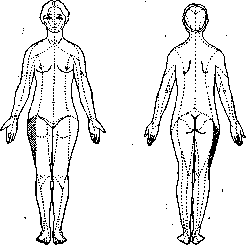
part of the large intestine, pelvic organs (prostatitis), as well as trauma from the outside: by trusses, hard objects carried in the pocket (metal cigarette case, keys, etc.). It must be noted that the natural anatomical conditions of the location of the lateral cutaneous nerve of the thigh — the bend over the iliac crest, passage under the inguinal ligament, tension of the fascia lata — must be taken into account, since they are factors through which general morbid states of the organism (arteriosclerosis, gouty diathesis) manifest in the form of isolated local symptoms. Occupation may also predispose to the disease; certainly meralgia paraesthetica occurs more often in individuals leading a sedentary lifestyle. Data on pathological anatomy are meager, since they are composed of few autopsies, in which phenomena of perineuritis with degenerative changes in nerve fibers were found. The described disease belongs to the category of persistent ones, showing no fluctuations in its course and difficult to treat with methods usual for neuralgia, which is explained by the difficulty of determining the etiological factor. However, as modern therapy of neuralgia persistently seeks a base in the analysis of metabolism, possibilities for individualized causal treatment are also opening up in relation to meralgia paraesthetica (anti-gout medications, iodine preparations, etc.). Sometimes good results are obtained from local d'Arsonvalization and massage. In cases clear with respect to traumatism from surrounding tissues and regions — surgical assistance.
Related articles
Mentioned in
Cite this page
“Meniere's Syndrome.” Soviet Medical Encyclopedia. English translation of Bolshaya Meditsinskaya Entsiklopediya, 1st ed. (Moscow, 1928–1936), ed. N. A. Semashko. https://sovietmedicalencyclopedia.pages.dev/article/menieres-syndrome/