Noise
Historical document, translated for reference. It reflects medical knowledge of the 1920s–30s and is not medical advice.
Summary
This article from the 1928–1936 Great Medical Encyclopedia examines the physical nature of noise and its various detrimental effects on the human body, including physiological impacts on circulation, digestion, and the nervous system, as well as occupational hearing loss.
Encyclopedia article (1928–1936)
NOISE, an irregular (aperiodic) sound consisting of a large number of simple tones of varying pitch and intensity. Its main difference from a musical sound is that there is no regular numerical relationship between the vibrations of the individual tones, and the entire vibration as a whole has a clearly defined disorderly character. Accordingly, the sensations produced by noise are also disorderly and chaotic. The fact of the harmful effect of noise on the human body is currently considered established with complete certainty, and the forms of this effect are diverse. Under the influence of noise, an increase in pulse and respiration rate and an increase in blood pressure are observed, which can occur even when the noise does not reach consciousness. Kennedy, observing changes in intracranial pressure in people with skull injuries, established that the latter can increase almost fourfold compared to the norm under the influence of sudden noise. Smith and Laird studied the effect of noise on stomach contractions. For this purpose, the authors inserted a rubber balloon into the stomach of the test subjects and, using a rubber tube connected to it, inflated the balloon to a pressure of about 10 cm of water column. Then the change in this pressure, which occurred parallel to the peristaltic movements of the stomach, was recorded on a rotating drum of a kymograph, and the curves obtained under normal conditions were compared with those under the influence of noise. It turned out that noise, if it reaches 80 decibels, causes a general decrease in the number of contractions, as well as a decrease in the amplitude of each individual contraction; these phenomena, although to a lesser degree, are still observed at a noise level of 60 decibels. Koribel established that under the influence of noise, there is a change in the volume of the spleen, kidneys, and lungs—a phenomenon that is interpreted as a reflex of these organs to noise excitation. The central nervous system reacts to noise with objective and subjective symptoms of exhaustion, which in turn is the result of over-irritation and overwork. Goetz and Key established that the degree of irritating effect depends not only on the greater or lesser loudness of the noise, but also on how often it appears; furthermore, noises produced by humans and machines are much more irritating than natural noises (e.g., the noise of the sea, a thunderclap, etc.). Finally, low sounds are irritating less than high ones. According to experiments conducted in the psychological laboratory of Colgate University (USA) and the National Institute of Industrial Psychology (London), it has been established that noise causes a number of mental and physiological disorders in the body, such as insomnia, timidity, slowed mental reactions, and decreased attention. The last two factors are circumstances contributing to an increase in traumatism. According to the experiments of some Soviet and foreign researchers, under the influence of noise, energy expenditure in the human body increases, and excess energy is spent on distraction from the disturbing action of noise, i.e., without direct benefit. The result is a decrease in working capacity, for which some factual and experimental data have already been collected. As an example, we can point to the work of Japanese researchers Obata and Morita. They took 24 elementary school students and 8 adults as experimental subjects, and all these persons were given simple work consisting of copying text, simple arithmetic calculations, etc. Into the room which served as the place for the experiments, the researchers introduced artificial sounds and noises, and as a result, the speed of work invariably dropped. Of the greatest interest both in theoretical and practical terms is the effect of noise on the auditory organ. Physicians had long been aware of the fact that working in a noisy profession entails the gradual development of hearing loss and deafness. Toynbee was the first in 1862 to publish a work in which he pointed out that all riveted workers of a machine-building plant examined by him had a severe degree of hearing loss. Since then, a number of other works have appeared containing data on the state of hearing in persons who have worked for a more or less long time in various noisy workshops. Based on these works, Navyazhsky compiled a diagram (Fig. 1) showing 16 noisy professions and indicating the percentage of persons with impaired hearing falling to each profession. As for the degree of deafness, it depends on the length of service and age of the workers, as well as on so-called predisposing factors such as heredity, syphilis, alcoholism, infectious diseases, etc. Histological studies of the temporal bone in persons who worked for a long time in noisy production were carried out by Habermann, Brühl, and Zange, and these studies established degenerative and atrophic changes in that part of the auditory apparatus which serves for the perception of sound vibrations. Experiments on white mice, guinea pigs, and many other animals were carried out by a number of authors: Wittmaack, Siebenmann, Popov, and others. These experiments established that when exposed to sufficiently strong sounds and noise, degenerative and atrophic changes occur in the auditory apparatus of experimental animals, which are more sharply expressed the more intense and prolonged the acting sound or noise is. Then it turned out that high
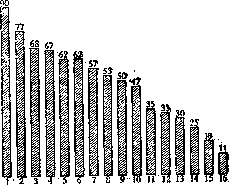
Figure 1. Percentage of persons with impaired hearing among various noisy professions: 1—boiler makers; 2—weavers; 3—nail makers; 4—blacksmiths; 5—crushers; 6—chasers; 7—railway workers; 8—motor testers; 9—coppersmiths; 10—locomotive engineers; 11—tinsmiths; 12—roving tenters; 13—warpers; 14—printing workers; 15—ring spinners; 16—drawing frame tenters.
sounds possess a greater damaging capacity than low ones. Finally, it has been established that the localization of anatomical changes has a selective character, because in the initial stage of the degenerative process usually only that part of the auditory apparatus which serves for the perception of high sounds turns out to be affected. The mechanism of the harmful effect of noise on the auditory apparatus consists in the following. The organ of hearing, just like the organ of vision, has the ability of adaptation. Therefore, the ear can function normally both with weak sounds and with strong ones, provided that the intensity of the latter does not cross a certain defined limit at which the adaptive capacity of the ear turns out to be already insufficient. Adaptation is based on the fact that as the intensity of the sounds affecting the auditory apparatus increases, the sensitivity of the latter decreases; consequently, adaptation is to a certain extent a protective function, but it is far from sufficient, because the sensitivity of the ear can decrease due to adaptation by no more than 10 times, while the sound power can exceed the normal limit (see below) by tens and hundreds of thousands of times. Thus, in the presence of powerful sounds and noise, the normal functioning of the auditory apparatus is excluded, and signs of its fatigue are discovered, of which the most important is the weakening of auditory capacity. The latter does not bear a persistent character, and following the cessation of the sound that caused fatigue, the normal state of hearing is restored within a period of time ranging from several minutes to several hours. However, such overfatigue of the auditory organ, if it repeats over long periods and without proper breaks, i.e., under circumstances that take place in noisy industries, does not pass unpunished, and earlier or later those trophic changes mentioned above occur in the ear. The fatiguing nature of different sounds is not identical. This is illustrated in Fig. 2, where the dashed lines show the curves of equal fatigue for hearing. Here, frequencies (from 62.5 to 8,000 hertz) are plotted on the abscissa, and values of sound energy on the ordinate. Consequently, the dashed curves depict which energy fluxes at different frequencies possess equal fatigue. We see that as one transitions from low sounds to high ones, fatigue grows—a circumstance that is in agreement with the above-mentioned results of experimental studies. Thus, the limit beyond which signs of fatigue begin to appear will be smaller for high sounds and larger for low ones. For a tone of 1,000 hertz, which is adopted in acoustics as the standard sound, the normal limit can be considered 70 decibels; towards low sounds this limit, as already stated, increases and at a tone of 62.5 hertz reaches 80 decibels; conversely, towards high sounds the limit decreases and at a tone of 8,000 hertz constitutes only 40 decibels. A decibel is the generally accepted acoustic unit of measurement. Its main feature is that it represents not an absolute unit of measurement, but a relative one. The entire decibel scale consists of 130 units, with 3×10⁻⁴ bars taken as 0 (the lower boundary of the scale) (a bar is a unit of sound pressure corresponding in its magnitude to one-millionth of atmospheric pressure). The upper boundary of the scale corresponds to 1,000 bars. The lower point is the weakest sound that can still be felt by the normal human ear (the so-called hearing threshold), and the upper point is the most intense sound at which one gets no longer an acoustic sensation, but a painful one (the so-called pain threshold). All 130 divisions of the scale are uneven: each subsequent division (in the direction from the lower boundary to the upper) is 12% larger than the previous one. Thus, 1 decibel denotes an amplification of sound pressure above the hearing threshold by 12%, or by 1.12 times; 2 decibels—an amplification by 1.122; 5 decibels—an amplification by 1.125, etc. Consequently, counting in decibels gives relative figures rather than absolute ones, which corresponds to the physiological properties of the ear, which also registers only relative increases in sound power; at the same time, the percentage of amplification registered by the ear as one felt step is approximately equal to 12%, i.e., corresponds to 1 decibel. The measurement of sounds and noise itself can be carried out either in a subjective way (the audiometer method) or objectively (the acustimeter method). In the first case, an artificial sound is supplied to the investigator's ear by means of a telephone receiver, which can be increased or decreased at will until it gives a sensation equal in intensity to the measured sound. Since artificial sounds undergo preliminary calibration and their loudness is known, they ultimately characterize the subjective intensity of the measured sound or noise. As for the objective method, it consists in the fact that sound vibrations are converted into electrical ones by means of a microphone, and these latter, having been amplified by means of a tube amplifier, are then fed to a microammeter, from the readings of which the physical strength of the noise is judged. In addition to the intensity of noise, it is also necessary to know its frequency composition. This task is accomplished by means of oscillographic recording of sound or by the method of resonant circuits, as well as by a number of other methods. Numerical characteristics for various noises are given below (Fig. 3). The most effective means of combating noise is the elimination of the source of noise itself. For example, the joining of metal surfaces until recently was carried out everywhere by means of pneumatic riveting, which is a very noisy and harmful process ("boiler-makers' deafness"); now technology has created almost silent electric welding and hydraulic riveting, which are gradually displacing pneumatic riveting. Along with the noisy steam engine, at the present time there is a silent steam turbine. In the Gabler loom, the production process is altered in such a way that the shuttle, the impacts of which are the main source of noise, is absent, and as a result, the said loom works much quieter, etc. If a change in the technological process or redesign of machines is impossible, recourse is made to sound insulation and sound absorption. By sound insulation is understood protection against the transmission of sound waves

1 I
Figure 3. Noise level (in decibels) generated on the street by various sources: 1 - steamboat whistle; 2 - automobile horn; 3 - fire siren; 4 - police whistle; 5 - street loudspeaker; 6 - truck and streetcar; 7 - bus; 8 - automobile. oscillations, and this transmission is effected due to the sound permeability of walls or through the material parts of the structure. Transmission can also take place as a result of direct air communication. If the question concerns airborne vibrations, the insulating capacity of solid bodies is directly proportional to the product of the density of the given body and the speed of sound in it. If, however, we are dealing with material vibrations, the relationship is inverse. Thus, in the second case, the best insulator is air, for which the above-mentioned product is 0.44, and in the first, steel (product 39,780). As for sound absorption, it serves as a means of reducing the reflection of sound waves from walls, ceilings, and floors, because reflection contributes to an increase in sound pressure at the locations of so-called antinodes. In order to achieve the greatest possible sound absorption, various materials and finishing layers are used, such as felt, fibrolite, celotex, exponsite, mineral wool, etc. In addition to the above, as a measure to combat the harmful effects of noise, various "anti-noises" are used, which have the purpose of protecting the auditory organ from the entry of sound oscillations. Anti-noises block the path mainly only to low sounds, since high sounds penetrate well into the inner ear through the bone as well. Therefore, taking into account that high sounds in the pathological sense are of much greater importance than low ones, one cannot expect particularly large practical results from anti-noises. The fight against noise of street origin currently constitutes a serious problem of municipal hygiene. The noisiness of modern urban life and, to a lesser extent, rural life is primarily a consequence of the rapidly progressing mechanization of means of transport, means of production, and means of defense. Therefore, the noise problem has attracted increased attention in recent years. In Western Europe and the USA, an extensive literature has already accumulated, which illuminates the indicated problem from theoretical and practical points of view. In all large cities, permanent committees for the fight against noise function, and intensive work is underway to study noise, on the one hand, and to find practical means to combat it, on the other. In the USSR, the study of and fight against noise is carried out by a number of institutions: the Leningrad Institute of Labor Organization and Protection, the All-Union Electrotechnical Institute, the Leningrad Electrophysical Institute, the Ear, Throat, and Nose Clinic of the Military Medical Academy, and others. To unite and coordinate the work carried out by all institutions, the first conference on the study and fight against noise was convened in February 1935, which posed a number of important questions to the central authorities, namely: 1) the development of mandatory regulations on the setup and maintenance of industrial establishments from the standpoint of protecting workers from the effects of noise hazards, 2) the training of specialists in the fight against noise, 3) the production of equipment necessary for the study of noise, 4) the organization of the production of sound-absorbing and sound-insulating materials. A permanent interdepartmental committee for the fight against noise has so far been organized only in Leningrad. In Moscow, under the Scientific Council of the People's Commissariat of Health, there is a permanent anti-noise commission. Studies have shown that street noises reach an extremely high intensity; in the central parts of New York, noises reach the intensity of Niagara Falls. Rational design of pavement, automobile tires, regulation or prohibition of disorderly street signals (streetcar bells, automobile horns), sound insulation of buildings, etc. - all this is part of the system of measures currently implemented to varying degrees in a number of US cities and partly in Europe.
Related articles
Cite this page
“Noise.” Soviet Medical Encyclopedia. English translation of Bolshaya Meditsinskaya Entsiklopediya, 1st ed. (Moscow, 1928–1936), ed. N. A. Semashko. https://sovietmedicalencyclopedia.pages.dev/article/noise/