Tonevariator
Historical document, translated for reference. It reflects medical knowledge of the 1920s–30s and is not medical advice.
Summary
The tonevariator is an electronic vacuum tube generator of sound oscillations used in surdototherapy for testing and exercising hearing. It produces pure tones with continuously variable frequency and intensity, designed for diagnostic and therapeutic purposes in otology.
Encyclopedia article (1928–1936)
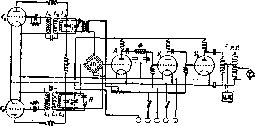
TONEVARIATOR, an electronic vacuum tube generator of sound oscillations, used in surdototherapy for testing and exercising hearing. Properties of the T. required for the specified field of application: 1) sinusoidal nature of the produced oscillations (pure tones); 2) continuous change in frequency in the range from 50 to 10,000 oscillations per second (hertz); 3) change in sound intensity over wide limits (from the threshold of hearing to the threshold of unpleasant sensation); 4) stability; independence of frequency and sound intensity from internal and external conditions. Main parts of the T.: the generator proper, amplifier, and output device. The basic part of the instrument—the generator—has the task of producing an electric current with the specified frequency range and is built on the principle of beats. To form electrical beats, two currents of different frequencies are superimposed on each other, as a result of which a sawtooth curve of current is formed with an amplitude that changes with a frequency equal to the difference in frequencies of the main currents. A similar phenomenon is observed in acoustics, when two sound sources of different pitch create beats, which are understood as the alternating reinforcement and weakening of sound. To form beats in the T., two high-frequency generators are used, one of which has a fixed frequency of 100,000 hertz, the other variable with frequencies from 90,000 to 100,000 hertz (Fig. 1 and 2). The change in frequency of the latter is produced by changing the capacity of the air condenser in its oscillatory circuit. Thanks to the use of beats of high-frequency generators, first, continuous change in frequency is achieved, and second, change in frequency by one control organ over the entire required frequency range. The resulting beat current is fed to a detector tube, after which the sound frequency is obtained, audible in the telephone. According to requirements, the frequency range of the T. is divided into two areas: low tones, from 50 to 2,048 hertz, and high tones, from 2,048 to 10,000 hertz. Due to the insufficient electrical power developed by the generator part, a tube amplifier with two stages of amplification is connected after the detector. The amplifier has the task of equally amplifying all frequencies of the entire frequency range of the T., without distorting the shape of the current curve produced by the generator part. The amplifier in turn works on the output device,
having the purpose of converting electrical oscillations into sound with the possibility of adjusting sound intensity. This task is performed by the telephone and volume regulator. To maintain stability in sound intensity, the output of the instrument is controlled by a voltage indicator. When manufacturing the T., it is provided with frequency calibration, giving the dependence of frequency on the divisions of the frequency scale. Checking the calibration in operation is performed by comparing the sound in the telephone at a certain division of the scale with a tuning fork at 512 vibrations (C2). The described construction of the T. is suitable both for investigating hearing and for exercising it. The T. specially for exercising hearing is produced in a simplified type with motor drive of the condenser-frequency regulator. This eliminates the need for manual rotation of the frequency regulator when giving the procedure. Power supply for the T., used for hearing research, is provided by storage batteries, while the T. for exercises can also be powered from the lighting network, since in this case the requirement for instrument stability is not essential. When installing the T., a dry room with uniform temperature is chosen, remote from powerful electrical power devices. The T. has found application in the fight against deafness as a therapeutic and diagnostic apparatus. The relative simplicity of handling it and the speed of operation give substantial advantages over other methods of testing hearing, for example by means of tuning forks. The T., manufactured by the Leningrad Scientific-Practical Institute for Diseases of the Ear, Nose, Throat, and Speech, cost 2,500 rubles. Abroad there are also instruments similar to the T. The closest instrument in properties, known under the name oto-audion, is manufactured by the firm Audion-Krafft (Germany).
Figure 1. Schematic diagram of the tonevariator of the Leningrad Scientific-Practical Institute for Diseases of the Ear, Nose, Throat, and Speech: G1-fixed generator; G2-variable generator; L1-grid coil; L2-anode coil; L3-coupling coil; C1-condenser for tuning; C2-condenser for setting frequency (frequency regulator); P-switch of frequency scales; MS-coupling bridge; D-detector tube; F-filter for blocking high frequencies; U1, U2-amplifying tubes; R.G.-volume regulator; I.N.-voltage indicator; T-telephone receiver.
Figure 2. External appearance of the tonevariator for hearing testing.
The frequency range of the T. is divided into two areas according to requirements: low tones, from 50 to 2,048 hertz, and high tones, from 2,048 to 10,000 hertz. Due to the insufficient electrical power developed by the generator part, a tube amplifier with two stages of amplification is connected after the detector. The amplifier has the task of equally amplifying all frequencies of the entire frequency range of the T., without distorting the shape of the current curve produced by the generator part. The amplifier in turn works on the output device, having the purpose of converting electrical oscillations into sound with the possibility of adjusting sound intensity. This task is performed by the telephone and volume regulator. To maintain stability in sound intensity, the output of the instrument is controlled by a voltage indicator. When manufacturing the T., it is provided with frequency calibration, giving the dependence of frequency on the divisions of the frequency scale. Checking the calibration in operation is performed by comparing the sound in the telephone at a certain division of the scale with a tuning fork at 512 vibrations (C2). The described construction of the T. is suitable both for investigating hearing and for exercising it. The T. specially for exercising hearing is produced in a simplified type with motor drive of the condenser-frequency regulator. This eliminates the need for manual rotation of the frequency regulator when giving the procedure. Power supply for the T., used for hearing research, is provided by storage batteries, while the T. for exercises can also be powered from the lighting network, since in this case the requirement for instrument stability is not essential. When installing the T., a dry room with uniform temperature is chosen, remote from powerful electrical power devices. The T. has found application in the fight against deafness as a therapeutic and diagnostic apparatus. The relative simplicity of handling it and the speed of operation give substantial advantages over other methods of testing hearing, for example by means of tuning forks. The T., manufactured by the Leningrad Scientific-Practical Institute for Diseases of the Ear, Nose, Throat, and Speech, cost 2,500 rubles. Abroad there are also instruments similar to the T. The closest instrument in properties, known under the name oto-audion, is manufactured by the firm Audion-Krafft (Germany).
Medical application and clinic. The T., like other types of instruments built on the type of so-called electrical sirens—oto-audions, audiometers (see),—constitutes at present only an accessory of acoustic laboratories and audiometric equipment of ear clinics. Its widespread dissemination is hindered by relative high cost, complexity of design, and insufficient portability; nevertheless, a great advantage of the T. is that in hearing research it is possible to obtain with very little time expenditure sounds of desired pitch and intensity over almost the entire range of human hearing, moreover sounds relatively pure (devoid of overtones). A further benefit consists in that when determining the threshold of auditory sensitivity, a gradually intensifying sound can be used, which to a certain extent eliminates the harmful influence of adaptation and fatigue and makes the counting of data more precise. These properties of the instrument make it especially valuable for those cases of hearing research when we are interested in obtaining a complete profile of it, or the sensitivity curve of a given hearing. To compose such a curve, or otherwise the auditory relief, the height of the threshold of sensation is measured by means of an oto-audion for a series of tones, approximately at intervals of one octave or even better through one fifth. On specially graphed paper a series of corresponding points are plotted and connected by a continuous line; usually in healthy people a more or less symmetrical curve is obtained, indicating the greatest sensitivity of hearing to sounds in the treble zone of the tone scale (approx. 1,000-2,000 vibrations per sec.) and a decrease in sensitivity in the bass and ultramusical zone, reaching zero in the area of the lower and upper limits of hearing. In patients the profile may also be symmetrical, though lowered over the entire curve, or asymmetrical. For example, in diseases of the inner ear, a sharper decrease in acuity of hearing may be found in the upper half of the tone scale. In some cases an even more irregular curve is obtained with depressions or even complete breaks. Such anomalies indicate more severe forms of damage to the hearing apparatus and are characteristic of deaf-mutism with remnants of hearing or generally with afflictions of the sound-perceiving parts of the hearing apparatus. Furthermore, the instrument can be conveniently used for a series of researches in acoustic physiology, when it is necessary to have a continuously acting and easily adjustable source of sounds, for example when studying the question of fatigue of hearing, bone conduction (for which a special vibrating apparatus is connected to the oto-audion), binaural ability, etc. Thanks to additional apparatus—amplifier, microphone, and telephone headphones—electrical sirens make it possible to use them for detecting simulation of deafness and for determining remnants of hearing in severe degrees of its reduction. The therapeutic application of the T. is based on the possibility of obtaining by means of this instrument prolonged sound exposure of desired intensity on the weakened organ of hearing, likened to the action of massage ('acoustic massage','reduction','activation' of hearing). Indications are: underdevelopment of hearing, various types of dry catarrhs of the ear, otosclerosis and auditory neuritis of various etiologies. The course of treatment usually lasts 2-3 months, after which a break of the same duration is made. The success is evaluated by authors differently. According to Belogolovov, a good result (with improvement of hearing not only according to the indications of the instruments but also for everyday speech) was obtained in approximately one-third of the cases studied,
V. Vojacek.

Related articles
Cite this page
“Tonevariator.” Soviet Medical Encyclopedia. English translation of Bolshaya Meditsinskaya Entsiklopediya, 1st ed. (Moscow, 1928–1936), ed. N. A. Semashko. https://sovietmedicalencyclopedia.pages.dev/article/tonevariator/