Acoustics
Historical document, translated for reference. It reflects medical knowledge of the 1920s–30s and is not medical advice.
Summary
This article from the 1928–1936 Soviet medical encyclopedia defines acoustics as the study of sound, covering its general, physiological, atmospheric, architectural, and musical aspects. It explains the physical principles of sound generation, propagation, and characteristics such as amplitude, period, and wavelength.
Encyclopedia article (1928–1936)
ACOUSTICS (from Greek akouo—I listen), the study of sound, one of the oldest and most developed branches of physics. Acoustics can be divided into 1) general, 2) physiological, 3) atmospheric, 4) architectural, 5) musical. General acoustics studies the processes of the origin and propagation of sound. Sound arises from the vibrations of some body, called a transmitter (vocal cords during speech, air in the oral cavity during whistling), is transmitted through air, water, or another substance at a certain speed, and is captured by one receiver or another (ear, microphone). The propagation of sound occurs at different speeds for different media, but regardless of the character and pitch of the sound, unless the latter refers to very powerful ones (explosions of large quantities of gunpowder). Substance Speed of sound in m/sec. Substance Speed of sound in m/sec. Air at 0°
...
Sea water 349
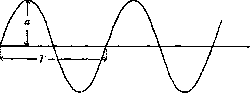
at 15°C. Wood 3,000–4,000. The speed of sound in the human body and animals, apparently, has not been determined by anyone, but is likely close to the speed of sound in water as the main constituent part of the body. The features of sound are determined by the character of the vibration of the sounding body, noted best on a graph similar to that used for recording a patient's temperature. Time is plotted on the horizontal axis in an arbitrary scale, and the deviation of the considered point of the sounding body from the equilibrium position is plotted on the vertical axis—upward if it is directed in one direction, downward if in the other. Examples of different curves obtained in this way are shown in the drawings. Figure 1 depicts the so-called
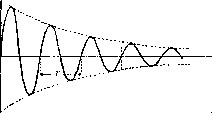
Fig. 1. Simple sound. A—amplitude of vibration; T—period. Sinusoidal vibration. The curve goes smoothly, without sharp ends, and completely resembles the geometric curve known as a sinusoid, which is why such vibrations are called sinusoidal; the corresponding sounds are called pure or simple; similar vibrations are performed by the prong of a tuning fork, any point of a string, air particles during certain flute sounds, etc. The greatest deviation from the equilibrium position is a—the so-called amplitude of vibration; the time after which the vibration begins to repeat is called the period of vibration. Strictly speaking, the amplitude of a tuning fork decreases over time, although very slowly; the graph of the tuning fork's movement in enlarged form is depicted in Fig. 2. By slightly pressing the prong of the tuning fork with a finger, one obtains a sound exactly as depicted in the figure. A similar movement
Fig.
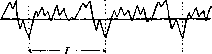
Vibration of a strongly damped tuning fork; 2'—period. The telephone membrane performs [this] at the moment of closing or opening the direct current supplying it; the ringing (ticking) of a pocket watch is the same. Figure 3 shows the form of vibration of air particles at the mouth pronouncing the sound "a". As we see, the vibrations here are very complex, but still correctly repeat after the period has elapsed. Such a sound is called complex; theory shows that in this case, the vibrations can be considered as the sum of individual simple vibrations of different periods, namely, equal to T, T/2, T/3, etc., whereby each vibration exists or, more accurately, can be considered present without interference from others and does not interfere with them itself (principle of superposition of vibrations). Sounds,
Fig. 3. Complex sound; T'—period.
having a clearly expressed period are called musical sounds or tones; those not having a definite period are called noises (knocks, hissing, rustling, many consonants). Knowing the period of vibrations, one can calculate the number of vibrations of the sounding body in 1 sec. and vice versa. The form of vibration is closely connected with the timbre of the sound and represents its objective characteristic. Likewise, individual simple vibrations, its components, fully characterize the sound, whereby the lowest of them is called the fundamental tone, and the others—the first, second, etc. overtones. The magnitude of the amplitude represents the objective characteristic of the intensity of sound, the number of vibrations in 1 sec.—the objective characteristic of the pitch of sound. — Sound waves. The movement of the vibrating body is transmitted to the surrounding medium and forms compressions and rarefactions in it, which, striving to equalize, scatter from the sound source in all directions at the speed of sound. The arrangement of compressions and rarefactions is shown in Fig. 4. Places of equal compressions and rarefactions are called the wave surface; in this case, these surfaces are spherical. The distances between two successive compressions or rarefactions are called the wavelength and are usually denoted by λ. Between the number of vibrations per second of the sounding body (N) and the wavelength (λ) there exists a simple relationship Nλ=v (v—speed of sound), allowing one to calculate the third from two experimentally determined quantities. Sound waves are longitudinal, for the vibrations of the medium particles transmitting the sound occur in the direction of sound propagation perpendicular to the wave surface. — Sound energy. Compressions and rarefactions in sound waves cause the transmission of sound energy from the sounding body to the surrounding
sounding telephone; dark shading—compressions, light—rarefactions. λ (wavelength)—distance from rarefaction to rarefaction or from compression to compression.

medium. The amount of energy passing in 1 second through an area of 1 sq. cm, located parallel to the wave front (surface), is called the sound intensity at that point in the medium where this area is located. There is an important relationship between the amplitude of the oscillation of the medium's particles (A) and the sound intensity (E): E = 1/2 * p * v * w^2 * A^2 (p is the density of the medium, v is the speed of sound in it), which allows one to calculate the amplitude from the sound intensity or vice versa; another important relationship: E = P^2 / (2 * p * v) (P is the pressure amplitude in the medium). From this, we see that sound intensity is proportional to the square of the displacement amplitude and the square of the pressure amplitude. Often, especially in American literature, sound intensity is characterized precisely by the pressure P, expressed in dynes. The total amount of sound energy emitted by a body in 1 second is called its sound power; for example, the average sound power of speech is 125 ergs per second. Another important concept is sound loudness, by which is understood the ratio of the intensity of a given sound to the intensity of the same sound attenuated to the threshold of audibility. In view of the fact that this ratio is usually large, its logarithm is indicated. For example, the loudness of a sound with a pitch of 500 oscillations per second and so strong that it causes a painful sensation in the ear is 10^20 or 20 (20 = lg10^20), whereas the intensity of this sound is 10^12 ergs per second, and the intensity of the same sound, attenuated to the threshold of sensation, is 10^-8 ergs per second. Hence the loudness is 10^20. Reflection and refraction of sound obey the same laws as light if the reflecting and refracting surface is large compared to the wavelength of the sound; otherwise, the phenomenon is distorted by so-called diffraction—the scattering of sound at the edges. Interference of sound. The oscillations of air particles at the point where two sound waves meet are equal to the sum of the individual oscillations (the principle of superposition of waves). Therefore, if two waves of equal intensity and equal length are moving towards each other, then at points where displacements opposite in direction meet, the air does not move (nodes), while at other points, where consonant oscillations meet, the oscillation of air particles is particularly strong (antinodes). The distance between nodes (or antinodes) is equal to half the wavelength. The whole phenomenon has been named standing waves. Experimentally, standing waves are best obtained in the so-called Kundt's tube—a tube closed at one end, 3-5 cm in diameter, with lycopodium powder inside. Sound waves produced at the open end are reflected at the closed end and form standing waves; the lycopodium powder is swept by the movement of the air from the antinodes to the nodes; by measuring the distance between the nodes, we find the half-wavelength, and from this, knowing the speed of sound, we can calculate the number of oscillations per second.
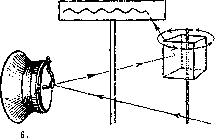
Transmitters and receivers of sound are quite diverse. The simplest of them are a string, a tuning fork, a bell, etc.; they perform damped (decreasing over time) oscillations. Undamped oscillations are performed by a telephone and a loudspeaker, powered by an alternating current of any period, a flute, an organ pipe, etc. Almost every transmitter has its own period of oscillation, that is, being excited by a push, like a tuning fork, it performs many gradually damped oscillations with a perfectly definite period, which is why the sound it emits has a perfectly definite pitch. Conversely, if sound waves fall on such a transmitter, it can be set into oscillation under their action, but only if the sound waves have a period equal to the transmitter's own period. The transmitter in this case is called a resonator, and the phenomenon itself is called resonance and has an important application for the analysis of complex sound. By placing different resonators in the area where sound waves pass and noting which of them 'respond' to these waves, we thereby determine which periods of sound are included in the composition of these waves. The most common form of resonator is a sphere and a cylinder with an opening (Helmholtz resonator). With the help of such analysis, it has been established that most transmitters (throat, trumpet, violin, etc.) produce very complex sounds with many overtones. The purest and most stable sound in terms of pitch is given by a tuning fork, which explains its wide application. The study of the composition of a complex sound can be performed, in addition to analysis by resonators, as indicated above, by studying the shape of the oscillation, but this requires complex mathematical analysis, for the facilitation of which there are numerous tables, as well as a special device called a harmonic analyzer. Experimentally, the shape of the oscillation can be recorded by a membrane with a small mirror. The sound being studied falls from the left onto a small horn covered by a membrane; the oscillations of the latter are transmitted to a small mirror, oscillating on a horizontal axis; a beam of light directed at the mirror therefore experiences movement in the vertical direction upon reflection; then it falls on a mirror cube rotating on a vertical axis, as a result of which the beam reflected from the cube moves in the horizontal direction. On the wall or a photographic plate, the light spot describes a curve giving the shape of the oscillation.
Physiological acoustics deals with the study of the perception of sound by the organs of hearing and the formation of sounds by the organ of speech, with the object of study being almost exclusively man. Physiological acoustics has developed quite significantly in recent times, mainly due to the work of American and partly German physicists, who worked for the most part in contact with doctors and physiologists. They have studied very thoroughly the acuity of hearing for the healthy and diseased ear, determined quantitatively the smallest values of sound energy at the limits of perception for various frequencies; the masking of one sound by another; listening with two ears—and have given an explanation for our ability to find the direction from which a sound comes; the boundary of the applicability of the Weber-Fechner law; numerous analyses of vowel speech sounds have been performed (see Speech); the study of consonants is only just beginning. However, despite the numerous works produced, the physics of the ear is still very insufficiently known, and the generally accepted theories are controversial. Atmospheric acoustics is still in the initial stage of development, which is due to the complexity of atmospheric conditions for the propagation of sound. In addition to a clear understanding of the origin of echoes and the influence of wind on the propagation of sound, atmospheric acoustics has recently studied the origin of so-called zones of silence—areas of inaudibility of sounds of large explosions, beyond which the sound is audible again. Architectural acoustics has developed in recent times to such an extent that it makes it possible to design halls and auditoriums with good acoustics without error and indicates correct methods for correcting rooms with poor acoustics. Methods of sound insulation have also been fully clarified. Musical acoustics considers musical systems, that is, certain relationships between sounds serving artistic purposes, and is not, strictly speaking, a branch of physics, if we exclude the theory of musical instruments, which is still little developed despite ancient and extensive practice.
Lit.—Khvolson, Course of Physics, vol. II; Bragg, The World of Sound, Giz, Moscow, 1927; Drysdale, Marine Underwater Signaling, 'Advances in Physical Sciences', vol. V, 1925; Andreev, Acuity of Hearing, 'Journal of Applied Physics', vol. I, 1924; Lifshits, Architectural Acoustics; Belyavsky, Musical Acoustics; Rzhevkin S. N., Hearing and Speech in the Light of New Research, 'Advances in Physical Sciences', vol. VII, 1927.
Related articles
Mentioned in
- Absolute Pitch
- Audiometer and Auditorium
- Auditory Pathways
- Biological Physics
- Facial Nerve (facial nerve, the seventh pair of cranial)
- Glioma
- Membrane (or pellicle, a thin plate made of some)
- Meningioma
- Microphone
- Physics
- Resonance
- Resonator
- Sanitary Engineering
- Skoda
- Sound
- Sound Conduction
- Stadium
- Swallowing Sounds
- THERMODYNAMICS
- Tonevariator
Cite this page
“Acoustics.” Soviet Medical Encyclopedia. English translation of Bolshaya Meditsinskaya Entsiklopediya, 1st ed. (Moscow, 1928–1936), ed. N. A. Semashko. https://sovietmedicalencyclopedia.pages.dev/article/acoustics/