Interference
Historical document, translated for reference. It reflects medical knowledge of the 1920s–30s and is not medical advice.
Summary
A detailed explanation of the physical phenomenon of light interference, its wave-theory basis, and its application in scientific instruments like the Löwe interferometer for chemical and biological analysis.
Encyclopedia article (1928–1936)
INTERFERENCE of light manifests as a violation of the rule of addition of intensities when two beams emerging from one and the same luminous point meet. Two light beams propagating from different luminous points always reinforce each other upon meeting, and their intensities are added (the principle of superposition of intensities). Conversely, if one forces two rays emerging in different directions from one luminous point to intersect (by means of mirrors, prisms, lenses, etc.), then upon meeting, the rays will mutually weaken in some places and abnormally reinforce in neighboring ones. If rays of equal intensity intersect, then at some points they completely extinguish each other, and at neighboring ones they create an intensity four times greater than the intensity of each of the component rays.
Rays capable of interfering are called coherent. Interference is fully explained by the wave theory of light: it may happen upon the meeting of two waves that the crest of one wave is superimposed on the trough of another, and the waves weaken one another.
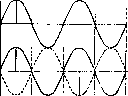
FIG. 1.
Upon the meeting of two waves, the crest of one wave is superimposed on the trough of another, and the waves weaken one another (Figure 1); conversely, when crests coincide, the waves are reinforced, the amplitude becomes doubled, and the intensity (proportional to the square of the amplitude) becomes quadrupled. Two different atoms emit waves independently of one another in separate pulses. If at a given moment at some point the waves from two independent atoms have such a path difference that they reinforce each other, then at another moment they will mutually weaken; therefore, on average, no interference will be obtained. Conversely, two rays corresponding to one and the same wave of one and the same atom will intersect throughout the entire experiment with one and the same path difference and, consequently, will produce distinct interference. In the field of sound and radiotelegraph waves, it is possible to ensure that two sources (e.g., two tuning forks or two antennas) emit waves all the time with one and the same phase difference. In this case, waves from two different sources will produce interference, i.e., they will be coherent. A substantial difference of light consists in the fact that two primarily emitting atoms cannot produce coherent waves. Interference phenomena account for the colors of thin films (soap bubbles, oil on water), as well as the so-called Newton's rings, observed during the passage of light through the thinnest layers of air between a plate of mirror glass and a slightly convex lens; the same explains the origin of colored bands observed when pressing a cover slip in counting chambers for blood. If one places a photographic plate or a white screen in the region where interference occurs, or observes this region through an appropriate eyepiece, alternating light and dark bands, rings, or spots will be revealed (depending on the setup used). Figure 2 shows a diagram of a simple interference experiment. A wave from a luminous point S passes through two slits a and b to a lens, which collects the rays at p. In the case of illumination with homogeneous (monochromatic) light, sharp interference bands arise at p. Light bands are located at those places where the path difference of the interfering waves is equal to a whole number of waves (i.e., an even number of half-waves); dark ones are where the path difference is equal to an odd number of half-waves (i.e., the crests of one wave coincide with the troughs of another). The distance between the bands depends on the wavelength λ and on the angle at which the rays converge: the smaller λ and the angle of convergence, the wider the bands are spaced. The interference pattern shows what the path difference is at different points of the observed plane. If for any reason the path difference of the meeting waves changes, the interference bands will shift; upon a change in the path difference by λ, a dark band will be replaced by a light one and vice versa. Thus, in the interference pattern, we have an extremely sensitive means for detecting minute changes in path difference, and numerous applications of interference are based on this. The path difference depends on the following causes: 1) the geometric arrangement of the setup, 2) the refractive index of the medium in which the light propagates, and 3) the wavelength λ. Interferometers are instruments in which changes in the interference pattern are used for quantitative measurements. Corresponding to the three indicated causes changing the path difference, interferometers can also be divided into three groups: 1) instruments for measuring length, inclination, quality of polishing of optical systems, etc.; 2) interference refractometers; 3) interference spectroscopes. Recently, interference refractometers have begun to be frequently used in the field of physiology, medicine, and sanitation. The sensitivity of interference refractometers, with proper construction, can exceed the sensitivity of the most perfect refractometers built on the principle of total internal reflection by hundreds of times. Figure 3 shows a diagram of the Löwe interference refractometer, manufactured with various modifications by optical firms (in particular by Zeiss) and frequently used in chemical and biological research. As can be seen from Fig. 3B, light from a collimator with a slit passes further through two slits; in this way, two coherent beams are obtained. The rays then encounter a double chamber K in their path. One compartment of the chamber can be empty or filled with air or water; the gas or liquid being investigated is placed in the second compartment. The coherent rays, having passed each through its own chamber, then encounter two compensation plane-parallel plates, of which one—P1—is fixed, and the other can be slightly rotated by means of a special lever with a precision screw. The rotation of P2, as is clear from Figure 3C, increases the thickness of the glass traversed by the light, and consequently the path difference. The double chamber K occupies only half of the field of view (Figure 3A); in the other half, both rays pass directly through the air. The refractometer
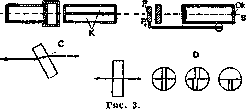
has an eyepiece with fifty-fold magnification. To increase the brightness of the pattern, the front ocular lens is made cylindrical; it shortens the interference bands arising at the point where the rays meet. If a body with the same refractive index is in both compartments of chamber K, the bands in the upper and lower parts of the field of view (Figure 3D) are located identically. However, a minute change in the refractive index in one of the vessels is sufficient for the bands to shift or disappear from the field of view entirely. To restore the normal position, it is sufficient to turn the plate P2 slightly. The angle of rotation, read on a drum connected to the screw, serves as a measure of the refractive index. The Löwe interferometer is manufactured in a portable form. Interferometry provides a very convenient and fast method for detecting the slightest changes in the composition of a given gas or liquid. Therefore, it has found application, for example, for constant monitoring of the composition of air in mines or in production. Hirsch applied interferometry to detect the splitting of proteins in the Abderhalden reaction. Recently, interferometry has been proposed instead of simple refractometry for the determination of proteins in serum.
Related articles
Mentioned in
Cite this page
“Interference.” Soviet Medical Encyclopedia. English translation of Bolshaya Meditsinskaya Entsiklopediya, 1st ed. (Moscow, 1928–1936), ed. N. A. Semashko. https://sovietmedicalencyclopedia.pages.dev/article/interference/