Refractometry
Historical document, translated for reference. It reflects medical knowledge of the 1920s–30s and is not medical advice.
Summary
Refractometry is a method for measuring the refraction of light rays passing from one medium to another. This article describes various refractometers used in medical and biological research, particularly for determining protein content in biological fluids.
Encyclopedia article (1928–1936)
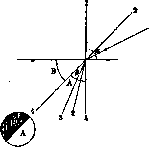
REFRACTOMETRY (from Latin refringo - I break), a method of measuring the refraction (see) of a light ray passing from one medium into another. When determining the refractive index with a refractometer, i.e., an instrument that measures refraction, air is almost always used as the first medium. The measurement of refraction with the refractometers described below is based on measuring the limiting angle of refraction. The largest angle of incidence α (Fig. 1) of a ray passing in the first medium (less dense) is 90° - ray 4; it enters tangentially to the surface separating the two media. At this point, the angle of refraction β < 90°; the denser medium is illuminated only from the perpendicular of incidence 1 to the angle of refraction corresponding to an angle of incidence of 90° (β); in Fig. 1, A it is called the limiting angle of refraction. When the angle of incidence exceeds 90°, the ray passes into the second medium and no longer refracts but undergoes total internal reflection; a sharp line separating one half (A) from the other (B) does not appear in the field of view of the measuring instrument. Consequently, the limiting angle of refraction is at the same time the limiting angle of total reflection. For each refracting medium, the limiting angle represents a strictly defined value. The angle β is determined as follows: -N - sin90° sinβ - "" ~~ sin0 (N = refraction in the second medium), sinβ = ^' The refractive index N is determined by measuring the angle β.
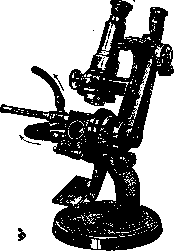
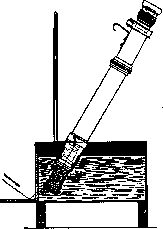
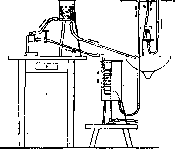
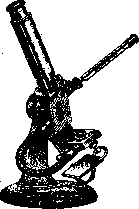
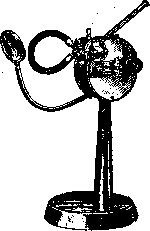
When measuring with a refractometer, it is necessary to take into account the temperature and the source of light used (its wavelength); measurements are usually referred to the D-sodium flame. Measuring instruments. In practice, two apparatus are most widely used: the Abbe refractometer (Fig. 2), and the immersion refractometer (Fig. 3). With the first, it is possible to determine the refractive coefficient within the range of nD = 1.30-1.70, and it is also possible to determine it in viscous liquids and solid substances. Accuracy up to 1-2 units in the 4th decimal place. The immersion refractometer allows measurement of nD = 1.325-1.492; it is simpler and gives clearer results than the Abbe instrument; it is very good for physiological research of liquids. Accuracy ±3.7 units in the 5th decimal place. The path of light rays in the refractometer is shown in Fig. 4. In the case of small amounts of liquid, auxiliary prisms (Fig. 3) are used, on the surface of which a few drops of liquid are placed. There is a series of variable auxiliary prisms with different refractive indices. To maintain a constant temperature, a special device with a heating spiral is used; its design is clear from Fig. 5 (the same device is also used for other refractometers). The data obtained when reading the scale are listed in special tables.
The Abbe refractometer (Fig. 2). Daylight falling on the mirror passes through the double prism into the telescope connected to a sector on which divisions are marked. Arrows indicate the direction of water flow maintaining uniform temperature (see above).
The Butter refractometer of Wollny (Fig. 6) for determining the refractive index of solid and liquid oils is a simplified Abbe refractometer. It consists of a heated Abbe double prism and a telescope closely connected to it. The colored boundary line of the limiting angle of reflection formed in the field of view is achromatized for viewing by means of a specially constructed glass prism. The refractive index of liquid oils is usually determined at 25°; that of solid oils is predominantly determined at 40°; fats that solidify at higher temperatures are determined at the minimum temperature at which the fats remain liquid; the result of observation is then converted to readings at 25° or 40°.
The refractometer for sugar and liquid oils (Fig. 7) is used for mass testing in the production of sugar juices of various concentrations and for liquid oils. To protect against external influences in production, the telescope except for the eyepiece is enclosed in a case. With this refractometer, the refractive index can be determined in the range from 1.330 to 1.540.
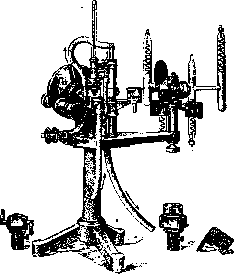
The Pulfrich refractometer (Fig. 8). With this instrument it is possible to 1) determine the refraction and dispersion of liquid and solid substances at room temperature, 2) measure at higher temperatures the refraction of both liquids and solid substances that become liquid at higher temperatures, 3) measure differences in refraction and dispersion of liquids and solid substances that differ little from each other in their optical properties (used as a differential refractometer). The accuracy of measurement is up to ±1 in the 4th decimal place for the refractive index and ±1-2 in the 5th decimal place for dispersion and all difference measurements. The principle of determination is the same - measurement of the angle of total reflection. To determine dispersion, measurements are made with a sodium flame and with the red, green, and blue lines of a hydrogen Geissler tube.
The interference refractometer, see Interference.
G. Yu. Gefter. The number of rays passing through a layer of liquid depends on its refractive properties, resp. on its refractive index. The degree of refraction in each liquid is determined by the quantity, size, and physical state of the particles dissolved in it. In biological liquids (serum, tissue juices, trans- and exudates), the determining factor for refraction is the quantity of proteins as high-molecular-weight substances. Salts and dissolved crystalloids play a significantly smaller role. Thus, in practice, the refractive index of serum, with the relative constancy of its salt composition, quite accurately indicates the quantitative content of proteins in it. A necessary condition for refractometric research is the constancy of temperature of the liquid under study throughout the test.
Technique. In physiology and pathology for determining the refractive index in small amounts of liquid, the immersion refractometer of Pulfrich (Figs. 3 and 4) is most widely used. The diagram shows how the rays passing through the liquid are collected by the prism and read by means of an optical system with a graduated scale located inside the instrument. With the presence of a second "auxiliary prism" (Fig. 3), it is possible to determine refraction in a layer of liquid 1 mm thick, for which only one drop of serum is sufficient. This device makes it possible to carry out serial investigations (5-6 or more in succession) in a short period of time. The liquid under test together with the lower part of the refractometer is placed in a water bath with constant temperature (usually 17.5°).
Individual divisions of the scale visible in the eyepiece of the instrument correspond to optical constants.

determined index of refraction. Reis compiled tables of protein content in plasma, serum, and other fluids based on their refractive index. These data are suitable for practical purposes, however they are not absolutely accurate, since the index of refraction depends not only on the quantity of proteins in percent, but also on the ratio of their individual fractions (globulins, albumins, fibrinogen) (see table). 78 Table for listing units of the immersion refractometer scale in % protein (at t°=17.5°). (According to Reis.) Serum * Ex- and transudates Index of re- fraction I Scale numbers Protein in % Scale numbers 1 Protein: in % 1 1.31275 40 3.91 45 0.77 | 1.31313 4.16 0.97 1.31350 4.33 1.18 1.31388 4.60 1.58 . 1.34125 4.81 1.59 1.34163 5.03 1.80 1.34500 4; 5.25 2.0i 1.31537 5.17 2.21 1.31575 5.68 2.42 1.34612 5.90 2.62 1.3165Э 6.12 2.83 1.31587 6.31 3.01 1.34724 6.55 3.21 1.34751 6.77 3.45 1.31793 6.98 3.65 1.34835 7.20 3.85 1.34873 5> 7.12 4.07 1.34910 7.63 4> 4.27 1.31917 7.85 4.48 1.34981 5Э 8.06 4.68 1.35021 8.28 4.89 1.35058 8.49 5.10 1.35095 8.71 5.30 1.35132 8.92 5.50 1.35169 9.14 5.70 ' 1.35205 9.35 5.90 1.35212 9.57 5L 6.11 1.35279 9.78 6.31 1.35316 9.99 5! 6.51 1.35352 10.20 6.71 1.35388 10.41 6.91 * nD of dest. water = 1.33320; йпВ of non-protein. guest, elements = 0.00277; ЛпВ 1% protein = = 0.00172. Determination by means of a refractometer of the quantity of proteins due to its speed and comparative accuracy has found wide application. In particular in physiol. experiment and in various diseases (nephritis, nephroses, myxedema, edematous disease, heart decompensations, anemias, diabetes insipidus) it appears important to repeatedly study albumin-emia, for which a refractometer is used. The quantity of protein in serum is also a direct derivative reflection of its water content. R. therefore became one of the most common methods for determining the degree of hydremia (see.) in the study of water exchange in the body. In normal conditions the refractometric index of serum fluctuates between 55 and 63 on the Pulfrich refractometer scale, which corresponds to protein content from 7.2 to 8.9%. An extremely low index (down to 44 and less) is observed mainly in true hypalbuminemias (for example in nephrotics) and in relative dilutions of blood (Congestive edema, abundant drinking). High protein content is mainly observed in blood thickenings (dry eating, diabetes insipidus), however it is sometimes also observed in nephritides. R. can also be used for rapid recognition of exudates and transudates, as well as for determining proteolytic strength, resp. quantity of pepsin, trypsin-kinase, etc. (see also Blood-proteins).
m. vovei. Various food substances are also refractometrically investigated: milk with respect to fat, milk sugar, degree of dilution of milk with water; fats and oils, beer, malt extracts, etc. In technical ! chemistry oils, tar, petroleum, petroleum products, etc. are refractometrically investigated; | in the sugar industry methyl alcohol, ethyl alcohol.-In analytical laboratories-for precise determination of concentration of various aqueous solutions, for investigation of crystals. R. became a method in the study of the structure of organic compounds. By processing tissues according to the Spalteholz method, it is possible to determine the index of refraction in them. This makes it possible to study more finely histological relationships in normal tissues, as well as changes in various organs in pathological conditions.
Related articles
Mentioned in
Cite this page
“Refractometry.” Soviet Medical Encyclopedia. English translation of Bolshaya Meditsinskaya Entsiklopediya, 1st ed. (Moscow, 1928–1936), ed. N. A. Semashko. https://sovietmedicalencyclopedia.pages.dev/article/refractometry/