Hypermetropia
Historical document, translated for reference. It reflects medical knowledge of the 1920s–30s and is not medical advice.
Summary
Hypermetropia is an anomaly of refraction where the eye is too short for its refractive system, causing light to focus behind the retina. The condition is partially compensated by accommodation, but can lead to visual fatigue and other complications.
Encyclopedia article (1928–1936)
HYPERMETROPIA (hypermetropia, hyperopia), an anomaly of refraction consisting of a mismatch between the length of the eye and the focal distance of its dioptric apparatus, whereby the eye proves too short for its refracting system. As a result, a parallel beam of light, the point of convergence of which in the eye serves as a measure of the correctness of the eye's construction, is focused in the hypermetropic eye behind the retina, while on the retina, which is located ahead of the point where the rays converge into a single point, a circle of light dispersion is obtained; in other words, the hypermetropic eye does not see clearly objects that send parallel rays, i.e., objects that are very small compared to the distance at which they are from the eye, as is the case in a normal emmetropic eye. If the hypermetropic eye is unable to focus parallel rays coming from infinity on the retina, it is even less able to focus diverging rays on the retina, sent by objects that are at a certain finite distance from the eye. Such rays produce even larger circles of light dispersion on the retina, and objects from which these rays come are seen by the hypermetropic eye even worse. Thus, the hypermetropic eye, due to its construction, is accommodated neither for distant nor for near objects, and strictly speaking, the term H. is essentially incorrect: the hypermetropic eye sees neither far nor near well; far vision is seen well by the emmetropic eye, near vision by the myopic eye. These shortcomings of the hypermetropic eye are corrected by accommodation, i.e., the physiological ability of the eye to increase its refraction by increasing the refractive power of the lens. This additional refractive power is a physiological correction that can make the hypermetropic, disproportionately constructed eye artificially proportional, i.e., accommodated to infinity. In this case, accommodation is self-correction, self-regulation of H., and the vision of the hypermetropic eye at any given moment depends entirely on the degree of H. and the strength of accommodation the eye possesses: the eye sees better the less its H. and the greater the volume of accommodation, and vice versa. If accommodation can compensate for hypermetropia, the eye sees well at a distance and appears emmetropic. If accommodation is insufficient for this, the eye will be hypermetropic, i.e., it will see poorly at a distance. From this it is clear that H. naturally splits into two parts: that part which is covered by the physiological, habitual strain of accommodation, and that part for which accommodation is insufficient. The first is called latent hypermetropia (hypermetropia latenta), since the hypermetropic eye does not reveal it due to self-correction, the second is manifest hypermetropia (hypermetropia manifesta), i.e., not covered by the strain of accommodation. This part of H. is expressed by reduced vision and is detected by a convex lens applied to the eye. The strongest convex lens with which the best vision at a distance is obtained shows the degree of this manifest hypermetropia. Latent hypermetropia, which strictly speaking should not practically concern the physician, is detected only by objective research methods (skiascopy, ophthalmoscopy, etc.), which give all hypermetropia (hypermetropia totalis), i.e., the sum of manifest and latent hypermetropia. It goes without saying that if the entire H. does not change or changes almost not at all during a person's entire life, then the ratio between latent and manifest H., which is in complete dependence on the volume of accommodation, constantly changes; the continuously decreasing with age volume of accommodation determines that the amount of latent hypermetropia decreases with age, while manifest increases. Latent hypermetropia with age turns into manifest, which eventually becomes equal to the entire H. This purely physiological phenomenon produces the impression of increasing H. with age and is taken as a gradual deterioration of vision: the higher the H., the worse the vision without correction even at a distance. From what has been stated, it is clear that an uncorrected hypermetrope sees well only thanks to accommodation: it is in a state of constant, continuous greater or lesser strain in him. Where in the emmetrope and myope the accommodative muscle is inactive, in the hypermetrope it is already working; as for the eye positions in which the emmetrope, and even more so the myope, accommodates, i.e., regarding positions to near objects, then in these cases the hypermetropic eye requires new reserves of accommodation, which are given to it with difficulty, and perhaps, depending on the degree of hypermetropia and age, are completely inaccessible. It is therefore not surprising that in anatomical examination, hypermetropes always have a more powerful, hypertrophied ciliary muscle (especially in its circular fibers) than emmetropes, and even more so myopes (see Figure 1). It is therefore not surprising either the frequent complaints of hypermetropes about accommodative asthenopia (see), sometimes weak, sometimes severe, reaching the most severe headaches and complex, distant neuroses and loss of working capacity. It is also not surprising the fact that hypermetropes, living with their habitual spasm of accommodation or correction with glasses corresponding to manifest H.; often feel complete visual disorders with any exhausting diseases, after high temperatures, infectious diseases and any other significant disturbances of equilibrium in the body, the habitual self-correction is disrupted, and vision falls until the accommodatory apparatus is corrected again. In hypermetropes, binocular vision has enormous importance, or rather, the correct non-strabismic eye position, in view of the complete mismatch that exists in hypermetropes between convergence and accommodation. Already with parallel eye position at a distance, in infinity, when convergence equals 0, hypermetropic eyes, made artificially emmetropic, give a greater or lesser amount of accommodation, depending on the degree of H. This amount of accommodation is a constant excess over convergence in all further eye positions. If for example a hypermetrope of 3 diopters looks at a distance, he has not yet begun to converge, but already gives 3 diopters of accommodation. If the same hypermetrope starts reading a book at the usual distance of 33-35 cm, he gives
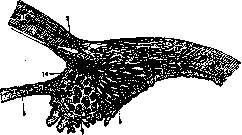
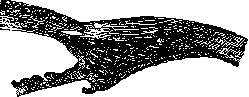
Figure 1. A-ciliary muscle of a hypermetropic eye: 1 - cornea; 2 - Schlemm's canal; S and i - sclera; 5 - inner border of m. ciliar.; 6 - inner connective tissue layer of the ciliary body; 7 - Müller's muscle; 8 - basis of the choroid; 9 - pigment epithelium; 10 - Fontana's spaces. B-ciliary muscle of a myopic eye. (After Ivanov.) 3 metro-angles of convergence and already 6 diopters of accommodation. Such a mismatch between convergence and accommodation puts the hypermetrope in an extremely difficult position. If the hypermetrope taken as an example, while reading a book, wanted to set his accommodation according to convergence, i.e., would give only 3 diopters of accommodation, then his eyes, looking at the book located 35 cm from him, would be set to infinity, and he would see the book in circles of light dispersion. If, on the contrary, this hypermetrope wanted to set his convergence according to accommodation, i.e., would give 6 metro-angles of convergence, then his eyes would be converged to a point 16-17 cm away from the eye, while the book is at 33-35 cm, in other words, he would again see the book only in circles of light dispersion. Only the strongest impulse to binocular vision, only the colossal ability to fusion (fusion apparatus) extricates the hypermetrope from the difficulty, and he does not squint. The slightest violation of the fusion apparatus, the slightest difference in visual acuity of both eyes or other changes in one eye, sometimes barely perceptible, give strabismus,-and this strabismus is usually convergent. Moreover, one eye is set according to convergence, the other according to accommodation. It is rare to find a hypermetrope (even of weak degrees, and even more so of medium and strong) who would not have this strabismus in a latent state. The impulse to binocular vision or proper correction with glasses covers it; the slightest violation reveals it. This true convergent strabismus of hypermetropes should not be confused with the often observed with medium and weak degrees of H. apparent strabismus, which is usually divergent. This visual deception of the observer depends on the so-called angle γ, i.e., the angle between the visual line going from the fixed object to the yellow spot (i.e., the one along which the eye actually looks) and the optical axis passing through the centers of the refracting surfaces and the center of the pupil (i.e., the one along which the
hypermetropic eye \
/
usually positions \
/
the observer seems to see l l
the eyes deviated outward, o
o while both visual „ l.
the lines are established- Fig. 2. 00-optical axis; zl-ny are completely correct visual lines, and they intersect at the fixation point, i.e. there is no strabismus (see figure 2).-Regarding visual acuity, i.e. the visual ability of the retina, it can generally be said that full visual acuity is found in mild hypermetropes, in moderate ones-almost never, and in strong ones-rarely. Insufficient visual acuity and the complete inability to correct one's refraction anomaly even with maximum accommodative effort are the reason for the strange behavior that strong hypermetropes exhibit when reading. Contrary to all expectations, such a hypermetrope, even without any glasses, when trying to read brings the book right up to the nose, like a very strong myope. Without sufficient accommodation, the hypermetrope completely ignores it and only cares about forming the largest possible image on the retina, which to a certain extent he achieves by bringing the book very close to the eyes.-That hypermetropia is more than any other refraction a congenital condition-in this no one doubts. Few also doubt the role of heredity in the origin of D.-To assess the significance of D. in life, in choosing a profession, etc., two circumstances should be taken into account. 1. Hypermetropia is associated with glasses, and sometimes even more than one pair. In view of this, hypermetropes are not suitable for those professions in which wearing glasses is absolutely unacceptable. This question becomes particularly acute with regard to pilots. If pilots really must have full visual acuity without any lenses, then probably hypermetropia will in general be an obstacle to aviation service. A young hypermetrope, thanks to a large reserve of accommodation, can easily give unit vision without any correction. But there are data indicating that during ascent this self-correction decreases or even disappears, i.e. hidden hypermetropia becomes manifest, and vision decreases. A hypermetrope who had unit vision on the ground no longer has it in aerial work. 2. Very fine work, performed only with very close approach of the object to the eyes, due to lack of accommodation, which is used to correct hypermetropia, and sometimes also insufficient visual acuity, is very difficult for moderate and strong hypermetropes, and often completely inaccessible. Prevention. According to modern teaching, hypermetropia develops in the fetal period, and at present there are no data on what environmental conditions of parents before conception, during conception or during pregnancy could be the cause of such an anomaly of eye development. The professional and domestic conditions causing the transition of 'hidden' D. to manifest have not been clarified. But eliminating the inconveniences that hypermetropia brings in life, and preventing all unpleasant, and sometimes very severe asthenopic phenomena and neuroses that arise on the basis of hypermetropia-is a quite achievable task. Correct, frequently checked and strictly individualized correction with glasses gives the patient complete relief. In general, for a hypermetrope it should be the rule to constantly wear glasses (convex) that fully correct all manifest hypermetropia. The need to replace glasses and their strength is established strictly individually depending on age, nature of work, etc. Constant wearing of glasses covering manifest hypermetropia should begin at the earliest possible age. This prevents many childhood neuroses, promotes the development of visual acuity, and very often eliminates convergent strabismus, to which the hypermetrope is prone due to discord between two naturally allied acts-accommodation and convergence. As hidden hypermetropia becomes manifest, it becomes necessary to strengthen the glasses for both constant wear and for study, because convex glasses in this case replace the missing work of the accommodative apparatus. In normal conditions this occurs with age. But accidental causes that weaken accommodation cause the need for an urgent change of glasses.
Related articles
Mentioned in
Cite this page
“Hypermetropia.” Soviet Medical Encyclopedia. English translation of Bolshaya Meditsinskaya Entsiklopediya, 1st ed. (Moscow, 1928–1936), ed. N. A. Semashko. https://sovietmedicalencyclopedia.pages.dev/article/hypermetropia/