Anastigmat
Historical document, translated for reference. It reflects medical knowledge of the 1920s–30s and is not medical advice.
Summary
An anastigmat is an optical lens composed of multiple elements that produces sharp, undistorted images even for points far from the optical axis. This article explains how anastigmatic lenses correct for astigmatism of oblique incidence that occurs in ordinary lenses when viewing objects at angles.
Encyclopedia article (1928–1936)
ANASTIGMAT, an objective consisting of several lenses and possessing the property that it gives a sharp, undistorted image even of those points that lie far from the optical axis. Ordinary optical lenses, however, suffer from a defect called astigmatism (see) which consists in that images of points lying far from the optical axis are stretched into lines. Anastigmatic glasses are glasses in which 'astigmatism of incidence' is to some extent eliminated. Biconvex and biconcave glasses, the most common even today for the correction of ametropic eyes, have a very large defect, since they provide good vision only when the eye looks vertically through the center of the glass. When the eye rotates behind the glass, however, and begins to look obliquely through it (see Figure 1), vision is greatly disturbed due to the resulting 'astigmatism of oblique incidence'. The further in this rotation the eyes move away from the center of the stationary glass before them, and the stronger the refractive power of the glass, the greater will be the degree of 'astigmatism of oblique incidence' and consequently the worse will be the vision. For a biconvex glass of 6 D when looking through its edge, this astigmatism reaches an enormous magnitude of 4.81 D. A plano-convex glass of the same power will have somewhat less astigmatism: 2.13 D; however, this is still very great. Therefore, the task of modern optics is to find forms of glasses that would give good images even with oblique views through them; in other words, the rotation point of the eye, which remains stationary during all rotations of the eye and is located about 25 mm from the back surface of the corrective glass (the distance from the back surface of the glass to the apex of the cornea is on average 12 mm and from the cornea to the rotation point is 13 mm), must be taken into consideration. Glasses in which 'astigmatism of oblique incidence' is eliminated, i.e., A.e., usually have the form of convexo-concave glasses (see Figure 2), and if the convex surface of the glass has a steeper radius, then the entire glass will act as a convex lens, its power being equal to the difference between the refraction of the convex and concave surfaces; if, however, the concave surface has a steeper radius of curvature, then the entire glass will act as a concave lens. Even periscopic glasses, one surface of which always has one and the same fixed radius of curvature of 40 cm, have less 'astigmatism of oblique incidence': for the specified glass of 6 D it will be 1.48 D; of course, this is still a considerable amount. Much better will be the so-called 'half-mussel-like' glasses (Halbmuschelglaser), which also, similarly to periscopic glasses, have one fixed radius of curvature, but a steeper one - 9 cm; for a +6 D glass, the 'astigmatism of oblique incidence' at the edge will be only 0.15 D. However, only 'pointal' glasses of Ostwald - flatter ones, and Wollaston - more curved ones (see Figure 3) can be considered completely satisfactory; they do not have a fixed radius of curvature and for each glass of the required refractive power both radii of curvature are determined separately. For the same +6 D glass, the 'astigmatism of oblique incidence' at the edge will be only 0.03-0.02 D. Such glasses are produced by various firms under various names: 'Punctalglaser' - Zeiss's, 'Iso-krystar' - Busch's, 'En-Gee Menisken' - Nitsche u. Gunther and many others. Such glasses can be made up to -25 D and +7.5 D. Thus, the extreme limit for concave glasses is quite sufficient. As for convex glasses, this extreme limit will also usually be sufficient for cases of congenital hypermetropia; however, for the correction of aphakics, where stronger convex lenses are required, these glasses cannot satisfy and one has to resort either to combinations consisting of several lenses - a minimum of 2 (incidentally, this system is little used) or else prescribe aspherical glasses (see).
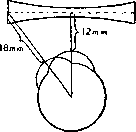
Figure 1. Old form of spectacle lens.
already periscopic glasses, one surface of which has always one and the same fixed radius of curvature of 40 cm, possess less 'astigmatism of oblique incidence': for the specified glass of 6 D it will be equal to 1.48 D; of course, this is still a considerable amount. Much better will be the so-called 'half-mussel-like' glasses (Halbmuschelglaser), which also, similarly to periscopic glasses, have one fixed radius of curvature, but a steeper one - 9 cm; for a +6 D glass, the 'astigmatism of oblique incidence' at the edge will be only 0.15 D. However, only 'pointal' glasses of Ostwald - flatter ones, and Wollaston - more curved ones (see Figure 3) can be considered completely satisfactory; they do not have a fixed radius of curvature and for each glass of the required refractive power both radii of curvature are determined separately. For the same +6 D glass, the 'astigmatism of oblique incidence' at the edge will be only 0.03-0.02 D. Such glasses are produced by various firms under various names: 'Punctalglaser' - Zeiss's, 'Iso-krystar' - Busch's, 'En-Gee Menisken' - Nitsche u. Gunther and many others. Such glasses can be made up to -25 D and +7.5 D. Thus, the extreme limit for concave glasses is quite sufficient. As for convex glasses, this extreme limit will also usually be sufficient for cases of congenital hypermetropia; however, for the correction of aphakics, where stronger convex lenses are required, these glasses cannot satisfy and one has to resort either to combinations consisting of several lenses - a minimum of 2 (incidentally, this system is little used) or else prescribe aspherical glasses (see).
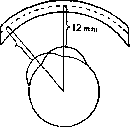
Figure 2. New form of spectacle lens.

much better will be the so-called 'half-mussel-like' glasses (Halbmuschelglaser), which also, similarly to periscopic glasses, have one fixed radius of curvature, but a steeper one - 9 cm; for a +6 D glass, the 'astigmatism of oblique incidence' at the edge will be only 0.15 D. However, only 'pointal' glasses of Ostwald - flatter ones, and Wollaston - more curved ones (see Figure 3) can be considered completely satisfactory; they do not have a fixed radius of curvature and for each glass of the required refractive power both radii of curvature are determined separately. For the same +6 D glass, the 'astigmatism of oblique incidence' at the edge will be only 0.03-0.02 D. Such glasses are produced by various firms under various names: 'Punctalglaser' - Zeiss's, 'Iso-krystar' - Busch's, 'En-Gee Menisken' - Nitsche u. Gunther and many others. Such glasses can be made up to -25 D and +7.5 D. Thus, the extreme limit for concave glasses is quite sufficient. As for convex glasses, this extreme limit will also usually be sufficient for cases of congenital hypermetropia; however, for the correction of aphakics, where stronger convex lenses are required, these glasses cannot satisfy and one has to resort either to combinations consisting of several lenses - a minimum of 2 (incidentally, this system is little used) or else prescribe aspherical glasses (see).
Ostwald
Wollaston
Related articles
Mentioned in
Cite this page
“Anastigmat.” Soviet Medical Encyclopedia. English translation of Bolshaya Meditsinskaya Entsiklopediya, 1st ed. (Moscow, 1928–1936), ed. N. A. Semashko. https://sovietmedicalencyclopedia.pages.dev/article/anastigmat/