Anastomoses
Historical document, translated for reference. It reflects medical knowledge of the 1920s–30s and is not medical advice.
Summary
This article defines anastomoses as connections between blood vessels, nerves, or other anatomical structures. It traces the historical development of the term from ancient Greek medicine to its 17th-century validation by Malpighi and describes various types of vascular and neural connections.
Encyclopedia article (1928–1936)
ANASTOMOSES, anastomosis (from the Greek ana-stomoo—I provide with a mouth), a junction, a very old anatomical term borrowed by Galen from Erasistratus (3rd century B.C.), who, to explain the outflow of blood from arteries which, according to the ancients, contained "pneuma" (air), hypothesized the existence of connections between veins (containing blood) and arteries, which was first proven in 1661 by Malpighi. At the present time, this term denotes: 1. A connection between veins, arteries (or lymphatic vessels), which is observed the more frequently the smaller they are and the further they are from the heart; in the fetal period, there are anastomoses also between large vessels (ductus arteriosus). Anastomoses can be transverse and oblique, they can shorten to a simple opening connecting adjacent vessels; in some cases, vessels that have resulted from division into two branches merge again with each other or branched small ones flow back into a large one; finally, by way of
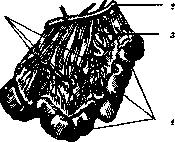
Anastomoses of arteries in the mesentery of the small intestine: 1 - anastomoses of mesenteric arteries; 2 - main arterial trunk; 3 - mesentery; 4 - loops of the small intestine.
anastomoses, vascular networks and so-called "miraculous" networks (rete mirabile) are formed. 2. It is incorrect to call connections between nerves that do not possess a lumen anastomoses, where bundles of nerve fibers fully or partially join an adjacent nerve, or where, in the connecting branch, there occurs an
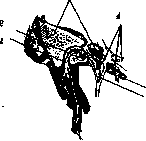
Anastomosis of the facial nerve with the trigeminal: 1 - facial nerve; 2 - tympanic membrane; 3 - pyramid of the temporal bone; 4 - trigeminal nerve; 5 - semilunar ganglion of the trigeminal nerve; 6 - anastomotic branch, the so-called chorda tympani.
formation of crosses between fibers with the
formation of crosses between fibers with the
anastomosis simplex and mutua, i.e., simple and mutual anastomoses; by way of anastomoses, so-called loops and plexuses (ansa et plexus) arise.
Related articles
Mentioned in
Cite this page
“Anastomoses.” Soviet Medical Encyclopedia. English translation of Bolshaya Meditsinskaya Entsiklopediya, 1st ed. (Moscow, 1928–1936), ed. N. A. Semashko. https://sovietmedicalencyclopedia.pages.dev/article/anastomoses/