Haemorrhoidal Arteries
Historical document, translated for reference. It reflects medical knowledge of the 1920s–30s and is not medical advice.
Summary
This article from the 1928-1936 Soviet Great Medical Encyclopedia details the anatomical origin, course, and branching of the superior, middle, and inferior haemorrhoidal arteries supplying the rectum, alongside their anastomoses and significance.
Encyclopedia article (1928–1936)
HAEMORRHOIDALES ARTERIAE, haemorrhoidal arteries (from Greek haima - blood and rheo - to flow), arteries of the rectum. They originate: 1) from the inferior mesenteric artery (a. mesenterica inferior), which gives the most significant trunk - the superior haemorrhoidal artery; 2) from the hypogastric artery (a. iliaca interna) - the middle haemorrhoidal arteries; 3) from its branch, the internal pudendal artery (a. pudenda int.) - the inferior haemorrhoidal arteries. The superior haemorrhoidal artery (see figure) extends downward along the rectum, forming anastomoses with lower-lying vessels in the submucosal tissue of the rectum, reaches the cutaneous region of its perineal part, and gives branches (along with the middle one) to the prostate gland or vagina. - The middle haemorrhoidal artery supplies the lower section of the pelvic part of the rectum, gives branches to the muscle lifting the anus (m. levator ani), the prostate gland, and the seminal vesicles (or vagina); however, branches to the rectum may be absent (Waldeyer).
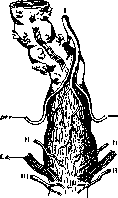
Diagram of the blood supply of the rectum (posterior view): I - art. haemorrhoid. sup.; II - art. haem. media; III - art. haem. inferior; per. - peritoneum; La. - m. levator ani.
The inferior haemorrhoidal arteries (usually anterior and posterior) pass through the adipose tissue of the ischiorectal fossa (fossa ischiorectalis), vascularize the muscles that raise 1) the anus and 2) its external sphincter (sphincter extern.), as well as the skin surrounding the anus. Anastomoses between the haemorrhoidal arteries are of great practical importance (small twigs of the middle sacral artery - a. sacralis med. - anastomose with the two superior ones). Regarding the variants of these arteries, there are indications in the classical work of Krause (W. Krause) and in Tikhomirov.
P. Karuzin. HAEMORRHOIDALES VENAE, veins of the rectum. The arrangement of the haemorrhoidal veins generally corresponds to the arteries; there are: one superior haemorrhoidal vein, two middle ones, and several inferior ones, as well as small twigs to the sacral venous plexus. All these veins anastomose with each other through the haemorrhoidal plexuses: the internal (submucosal) and the external (located under the fascia). In adults, the internal haemorrhoidal plexus usually contains tangles of venous vessels in the area of the folds of the mucous membrane (so-called valvulae sinuum rectalium), depressions of the rectum with their expansions, which give rise to the formation of nodes. In the perineal part of the rectum, a ring of such venous tangles is formed (annulus haemorrhoidalis), which Waldeyer considers the norm. From the submucosal plexus, thicker trunks arise, ascending (in the columnae rectales Morgagni) in the longitudinal folds of the mucous membrane located above the anus; penetrating the muscular coat, they enter the external haemorrhoidal plexus. From it originates the superior haemorrhoidal vein, flowing into the inferior mesenteric vein of the portal system. The middle haemorrhoidal veins also originate from it, draining blood from the bladder, prostate gland, seminal vesicles (vagina) from the plexus vesico-prostaticus (v. vaginalis). From the submucosal plexus, from the muscles of the perineal section of the rectum, the anal sphincter, and the skin, blood is diverted via the inferior haemorrhoidal veins into the internal pudendal veins (system of the inferior vena cava). Thus, a connection is established between these two systems, and a decompression of the portal vein is achieved. Lit.: see Haemorrhoidales arteriae.
Related articles
Cite this page
“Haemorrhoidal Arteries.” Soviet Medical Encyclopedia. English translation of Bolshaya Meditsinskaya Entsiklopediya, 1st ed. (Moscow, 1928–1936), ed. N. A. Semashko. https://sovietmedicalencyclopedia.pages.dev/article/haemorrhoidal-arteries/