Zygomatic Bone
Historical document, translated for reference. It reflects medical knowledge of the 1920s–30s and is not medical advice.
Summary
This article describes the anatomy, development, and function of the zygomatic bone, a paired facial bone that connects the facial and cerebral skulls. It details the bone's surfaces, processes, ossification centers, and its role in distributing chewing pressure.
Encyclopedia article (1928–1936)
ZYGOMATIC BONE, os zygomaticum (syn. os jugale, s. malare, s. suboculare, s. pudicum, s. hypopium), a paired, flat, quadrilateral bone of the facial (visceral) skull, which fastens the latter to the cerebral skull. The zygomatic bone absorbs the pressure of the jaw apparatus during the biting of food and the act of chewing, evenly distributing this pressure to adjacent bones, and, by connecting the maxillary bone with the frontal, temporal, and sphenoid bones, creates a solid support for it. By their size, shape, and the angles formed with the anterior surfaces of the maxillae (dext. et sin.), the ossa zygomatica determine the size and shape of the face in connection with sex, body type, individuality, race, and age. On the body of the zygomatic bone, three surfaces are distinguished: 1) the buccal (facies malaris) with the most prominent part, the tuber malare (s. zygomaticum); 2) the temporal (f. temporalis), concave, forming part of the anterior wall of the temporal fossa; 3) the orbital (f. orbitalis), narrow, participating in the formation of the lateral and inferior walls, as well as the margins of the orbit. The body of the zygomatic bone is connected by a suture (sutura zygomatico-maxillaris) with the processus zygomaticus of the maxilla; and by two processes: 1) the proc. fronto-sphenoidalis (s. frontalis) with the proc. zygomaticus of the frontal bone (sut. zygom.-front.) and with the anterior margin of the greater wing of the sphenoid bone (sut. spheno-zygom.); 2) the proc. temporalis with the proc. zygomaticus of the temporal bone (sut. zygom.-tempor.), forming with it the so-called zygomatic arch (see) (see figure). On the temporal margin of the proc. fronto-sphenoidalis, in 50% of cases (in Europeans), a protrusion is noted, called the proc. marginalis (Soemmeringi). The zygomatic bone closes the lateral angle of the fissura orbitalis inf. Near the maxillary suture on the facies orbitalis, there is an entrance opening of the canalis zygomatici (foramen zygom.-orbitale) for the passage of the eponymous branch (n. zygomaticus) of the II branch of the trigeminal nerve. The canal inside the zygomatic bone bifurcates (as does the nerve), opening with one exit orifice on the facies temporalis (for. zyg.-temporale) and the other on the f. malaris (for. zyg.-faciale). Often the canal begins with two independent openings, giving rise immediately to two separate canaliculi. The zygomatic bone consists mainly of compact substance with a small amount of spongy substance. In the part connecting with the os maxillae, the zygomatic bone covers the sinus maxillaris; sometimes a protrusion from the latter extends into the zygomatic bone in the form of a recessus zygomaticus sinus maxillaris. At the lower margin of the facies malaris, an inconstant tuberositas malaris is noted (the site of attachment of part of the m. masseter). From the facies malaris of the zygomatic bone, besides the m. masseter, one head of the m. quadratus labii sup. (caput zygom.) and the m. zygomaticus originate. In the primordial skull (see), the zygomatic bone appears membranous, ossifying according to the type of other so-called dermal bones of the visceral skull. Paired centers of ossification (the 1st for the proc. fronto-sphenoid. and the 2nd for the body and other processes) appear in the 9th week (according to Toldt), on the 56th day (according to Mall and others), by the end of the 2nd or beginning of the 3rd month of fetal life (Braus). The connection of the os zygom. with the os maxillae and with the os temporale is phylogenetically primary and early.
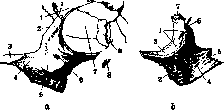
Os zygomaticum. a-from the outside: 1-processus zygomaticus ossis frontalis; 2-processus fronto-sphenoidalis; 3-processus zygomaticus ossis temporalis; 4-processus temporalis ossis zygomatici; 5-facies malaris; 6-foramen zygomatico-faciale; 7-lamina papyracea ossis ethmoidalis; 8-foramen infra-orbitale; 9-os lacrimale. b-zygomatic bone from the inside: 1-foramen zygomatico-orbitale; 2-facies orbitalis; 3-connection with the maxillary bone; 4-facies temporalis; 5-processus temporalis; 6-probe in the foramen zygomatico-temporale; 7-processus fronto
sphenoidalis.
while the connection with the os frontale and os sphenoidale is for the first time well-defined only in primates (Gegenbaur). In mammals, the proc. fronto-sphenoidalis does not fully develop, and instead of a narrow fissura orbit. inf., one depression is observed, uniting the orbit and the temporal fossa.- Anomalies. The absence of the zygomatic bone has been observed very rarely; more often, a zygomatic bone divided into two parts (os malare bipartitum), as well as into three (os malare tripartitum), is seen. For some mammals, such a subdivision of the zygomatic bone into parts is constant. Independent diseases of the zygomatic bone have no practical significance. Often, the zygomatic bone is secondarily drawn into inflammatory processes occurring in the vicinity, for example, in osteomyelitis of the upper jaw (see Jaws), B. Uskov. LAXATIVES. According to Kravkov's definition, laxatives are substances that cause more frequent and more liquid stools than normal. This definition, however, cannot be considered exhaustive, since a number of agents that cause stools normal in frequency and consistency in cases of constipation are also classified in the group of laxatives. The laxative effect is achieved by: 1) direct stimulation and acceleration of peristalsis (irritation of Auerbach's plexus); 2) reduction of water absorption from the intestinal contents (osmotic influence); 3) increase in the secretion of the intestinal wall (bordering on its irritation); 4) changing the consistency of stools by introducing non-absorbable oils, simultaneously with the lubricating influence of the latter on the intestinal wall. Besides the mechanism of action of various laxatives, the site of application of this action is important for the character of the effect. According to Meyer-Gottlieb, we distinguish: 1) agents that cause a decrease in water absorption in the entire intestine (osmotically acting substances: poorly absorbable salts, e.g., sulfates, calomel); the action occurs after 1-20 hours without rumbling and colic; 2) agents possessing a predominantly motor effect on the small intestines (castor oil, colocynth, resins); the action occurs after 2-4 hours with rumbling, but without pain; 3) agents that cause an increase in peristalsis of the large intestines (sulfur, anthracene derivatives, phenolphthalein); the action occurs after 10-15 hours without rumbling, but often with pain; to this list of agents acting chemically, it is necessary to add: 4) agents acting exclusively mechanically, producing, due to their swelling, an increase in the physiological irritation that causes peristalsis (agar-agar, flaxseed), or softening the consistency of feces and lubricating the intestine (paraffin oil). Intestinal action occurs after 12-48 hours and does not differ from normal bowel evacuation (formed stool). This scheme is not without weak points due to the fact that, on the one hand, for the majority of laxatives we have a combined action of different factors and on different sections of the intestine, and on the other hand, even to this day we encounter contradictory assessments of the mechanism of action of many laxatives by different authors. This is explained by the absence of a unified, absolutely reliable methodology for determining the character, strength, and localization of the laxative action. Even the choice of animal is associated with significant difficulties. The white mouse, very common as an object for testing laxatives, according to Fühner, turns out to be insensitive to a number of laxatives, such as phenolphthalein, sulfur. In rabbits, according to Alessandri, cascara sagrada, jalap, and gamboge turn out to be ineffective. Other animals, like the cat, possess such an easily excitable intestine that the data obtained cannot always be transferred to humans. According to the strength of action, laxatives are divided into: 1) aperitiva, lenitiva, emollientia, eccoprotica (mild laxatives), agents that cause a stool approaching normal without pain; 2) purgativa, laxantia, cathartica (laxatives), giving a liquid or mushy stool; 3) drastica (purgatives), strongly acting substances that cause violent peristalsis with pain and liquid stool. Unfortunately, usually with an increase in action, the irritating effect on the intestinal mucosa also increases. Of course, this division is also not without flaws, since the strength of action also depends on the dose of the laxative. Therefore, in the future, a classification by chemical composition will be adopted (as far as possible).-A. Inorganic compounds. 1. Salts of alkali and alkaline-earth metals. This includes salts which, with good solubility in water, are poorly absorbed by the intestine and exert an action on it throughout its entire length (Kravkov). Their action is based mainly on the slowing of absorption and depends on the character of both the anion and the cation. Regarding anions, absorption decreases in the order: Cl > Br > NO3 > SO4 > PO4. Regarding cations: K > Na > Ca > Mg. This group includes: Natr. sulfuricum (see Sodium), Magnesium sulfuricum (see Magnesium), Carlsbad salt (see), Natr. phosphoricum, Na2HPO4+12H2O (dose 15-40.0 for an adult), Magnesia usta, MgO, insoluble in water [in teaspoons (1 tsp = 0.5 g) several times a day], Magnes. carbonicum (see Magnesium). Laxative mineral waters containing Na2SO4, MgSO4 along with NaCl, NaHCO3, and CO2: Batalinsky spring (Pyatigorsk), among foreign ones—Hunyadi János, Seidlitz, Apenta, Carlsbad, Marienbad. 2. Calomel (see). 3. Sulfur (see). B. Organic compounds. 1. Acids and their salts. Organic acids, such as tartaric, citric, malic, lactic, etc., as well as their salts, also exert a laxative effect based on the principle of slowing resorption, to which is added an increase in peristalsis. The laxative effect of fruits is explained by the presence of these acids. In the latter, the mechanical action of fiber is also added.-Preparations: Tamarinds (see), Pulpa Prunorum—plum pulp (as a constituens for laxative electuaries). Salts act more intensely: Kalium tartaricum, Kalium bitartaricum, Kalium natrio-tartaricum (see Potassium), Pulvis aerophorus laxans (Seidlitzensis) [consists of 2 powders: in one, Rochelle salt (7.5 g) and soda, in the other, tartaric acid; upon dissolving both powders, an effervescent drink is obtained], Magnes. citricum, Magnes. citricum effervescens, Magnes. carbonicum, MgCO3—see Magnesium. The action of all these laxatives is based on the reduction of absorption.-2. Sugars: the principle of their action is the same as that of organic acids, which are partially formed from them in the intestine. This includes: Saccharum lactis, lactose, 15.0-30.0 in a glass of water in the morning on an empty stomach, a very mild laxative; Manna (see).- 3. Oils: castor oil (see), croton oil (see), olive oil (see), sesame oil (see), etc.-4. Anthracene derivatives: emodin, trioxymethylanthraquinone, and chrysophanic acid (dioxymethylanthraquinone), rhubarb (see), buckthorn (see), senna leaves, aloe (see). From senna and cascara sagrada, preparations for subcutaneous administration have been obtained: sennatrin and peristaltin, which are of significance in postoperative constipation and intestinal paralysis. Along with natural laxatives of this group, synthetic anthraquinone derivatives (exodin, purgatin) are also used. 1,8-dihydroxyanthraquinone—istizin—deserves special attention, which in doses of 0.15-0.6 exerts a good laxative effect. This product is a byproduct in aniline production and needs only purification. 5. In terms of action, phenolphthalein (see) is close to anthraquinone derivatives.-6. Glycosides and acid anhydrides of unknown composition: podophyllin (see), jalap (see), scammony (see), colocynth (see).-7. Agents with mechanical action: Semen Psylli, seeds of Plantago Psyllium—fleawort seed, small brown seeds that swell easily in water. For intestinal sluggishness, 10-20 g daily at night in dry form, washing down with water or allowing to swell in water for some time. Flaxseed (see) is used similarly, as is agar-agar, which, by swelling in the intestine, creates physiological irritation that stimulates intestinal peristalsis. On this basis, tragacanth and bassorin were introduced into therapy. Klöcker, determining the swelling capacity of various substances with a special methodology, established that while flaxseed, when swelling, increases in volume by 2 times, agar-agar gives a 5-fold increase; the preparation Normacol, consisting of bassorin, increases by 37 times. Regulin contains 15% Extr. Cascar. sagrad. fluid. (according to Paulsen, up to 25%). Normacol contains an admixture of Extr. Rhamni Frangulae, and only Normacol-special does not contain this admixture. A major competitor to swelling substances in recent times has become paraffin oil. The principle of its action consists in softening fecal masses and in a lubricating effect on the intestinal wall. Lanczos, on the basis of his experiments on the cat, attributes a truly laxative action to paraffin oil, beginning already in the small intestines.
However, these indications lose their persuasiveness if one considers that the doses used by Lanczos (25 cm3) are so large that, when transferred to a human, they would correspond to doses on the order of 1 liter per intake. Some interest is presented by Lanczos's indications regarding the toxic properties of insufficiently purified oil. Noorden notes that in some cases the softening effect of the oil recedes into the background. The oil does not distribute evenly in the fecal masses but remains on their surface, often being excreted through the anus separately from the latter, and does not provide a laxative effect. This circumstance, as well as the disgust experienced by patients when taking the tasteless but oily mass, forced a transition to the administration of oil in the form of emulsions. A portion of these emulsions pursues purely taste-related goals. Another portion (agarol) represents stable emulsions (with agar-agar according to the method of Krause), which pursue the goal of uniform distribution of the oil in the intestine. Indeed, according to Lowe, the introduction of agar noticeably (by 25%) improves the effect. However, in agarol, the authors considered it necessary to introduce small, in themselves ineffective doses of phenolphthalein for reinforcement. The preparation obstinol is an emulsion of oil with tragacanth and gum arabic and is produced both with and without the addition of phenolphthalein. The number of preparations constructed according to the principle of those mentioned is counted in many dozens, and they have almost displaced preparations with the swelling principle from the market. To the group of laxatives (L. a.) that apparently act via a hormonal pathway belong: hormonal (see), neohormonal, free from albumoses, and Eu-hormonal (Zweig), free from choline. Klee and Grossmann proposed the intravenous administration of choline (see). A laxative effect is also had by hypophysin subcutaneously, and especially intravenously. According to Mayer and Vogt, 4-6 cm3 of hypophysin in 500-1,000 cm3 of physiological saline solution is administered intravenously (in cases of postoperative intestinal paralysis). In these same cases, physostigmine (Physostigminum salicylicum) is used subcutaneously in a dose of 1/2-1 mg. Indications and contraindications. 1. For the removal of harmful food substances, poisons, and toxins. For this purpose, Ol. Ricini, saline laxatives in low concentrations, and calomel are most suitable. 2. For short-term constipation—saline L. a., Ol. Ricini. 3. For chronic constipation—vaseline oil, agar, flaxseed, psyllium seed. In stubborn cases—L. a. of the anthracene derivative series: rhubarb, frangulin, senna. Saline L. a. are not indicated for long-term use in view of the developing catarrhal phenomena. 4. For postoperative intestinal paresis—physostigmine. 5. For severe constipation that does not yield to other L. a.—aloe, podophyllin, gamboge. 6. To accelerate the resorption of edema and exudates—saline L. a. (in high concentration), calomel. 7. In cases of coprostasis (deposits in the rectum), it is not laxatives that are indicated, but enemas. L. a. are contraindicated: 1) in inflammatory conditions of the intestine and local inflammations of the peritoneum; 2) strong L. a. (drastica) are contraindicated during pregnancy, menstruation, and in cases of general weakness of the organism; 3) in diseases of the kidneys, phenolphthalein, isticin, and drastica are contraindicated.
Related articles
Mentioned in
Cite this page
“Zygomatic Bone.” Soviet Medical Encyclopedia. English translation of Bolshaya Meditsinskaya Entsiklopediya, 1st ed. (Moscow, 1928–1936), ed. N. A. Semashko. https://sovietmedicalencyclopedia.pages.dev/article/zygomatic-bone/