Olive Oil
Historical document, translated for reference. It reflects medical knowledge of the 1920s–30s and is not medical advice.
Summary
Olive oil is obtained from the pulp of olive fruits (Olea europaea L.), a tree cultivated since ancient times in southern Europe and northern Africa. The article describes different methods of extraction and qualities of oil obtained through various pressing techniques.
Encyclopedia article (1928–1936)
OLIVE OIL (Oleum Olivarum) is obtained from the pulp of the fruits of the olive tree, Olea europaea L., var. sativa (family Oleaceae), a tree 6-10 m in height, cultivated since time immemorial in southern Europe and northern Africa. The wild (naturalized) olive, a variety of Oleaster, represents a spiny shrub. The olive tree is very long-lived, reaching an age of 1000 years or more. At present, the olive is cultivated in California, in Northern Australia, and in the USSR on the southern coast of Crimea. Unripe olive fruits (drupa) contain little oil, are rich in mannitol, are green in color, and as a food product are known under the name "olives"; while the ripe fruits, having a black-violet or violet-blue color, are called "olives", contain much oil and contain no mannitol at all. Ripening of olives occurs in southern Europe in November; in Italy and southern France the main harvest takes place from September to December. Ripe fruits contain 20-30% oil; the fleshy part of the fruit (mesocarp parenchyma) is richest in it, containing up to 55% oil; the stone of the fruit contains only up to 6%, and the kernel (seed) up to 13% oil. By quality, the oil from the mesocarp is most valued. Therefore, when obtaining the highest grades of oil, the stones with the seed in them are first removed; then the olive pulp is crushed, the resulting mash is placed in special bags and subjected to moderate pressing without heating; in this way the best oil is obtained - light yellow with a greenish tint, of delicate, pleasant taste and pleasant weak aroma; it is known in trade under the name of Provence oil [Oleum Olivarum provinciale (VII), or virgineum, huile vierge of the French], since this variety is produced mainly in the vicinity of the cities of Aix and Grasse in French Provence. The same method of obtaining olive oil is used in the vicinity of the cities of Genoa and Lucca in Italy. The cakes obtained from the first pressing are mixed with hot water and by pressing (without heating) in a press, yellow, more fragrant, less delicate in taste, but still very good table oil of the second pressing (huile de deuxieme expression of the French or olio lavato of the Italians) is obtained. Further, by using a heated, powerful hydraulic press, green, unfit for food due to unpleasant odor and taste olive oil [Oleum Olivarum viride vel commune (VII)] is obtained, known under the name of wood oil; this oil is suitable for making plasters, ointments, for burning, soap making and other technical purposes.
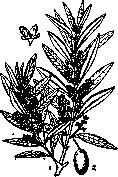
Olea europaea L.: l-
branch with flowers; 2- fruit; top left - flower. purposes. From the pomace obtained from pressing green olive oil, as well as from immature or spoiled olives, a brown oil of very unpleasant odor and sharp rancid taste is pressed out (huile fermentée). The fifth grade of olive oil is the so-called infernal oil (huile d'enfer), obtained from the pomace by steeping with water for months, collecting the oil that floats to the surface of the liquid. This dark brown oil with a repulsive odor is suitable for lubricating machine belts and for the production of cheap soap; similar oil is obtained from rotten olives and other residues; it is called turnant oil (huile de turnante) and is used in technology (e.g. in the textile industry). Oil obtained from dried waste and residues of pressing by extraction with carbon disulfide is called sulfur oil. The bulk of edible table olive oil is obtained from ripe olives, which are usually ground together with the stone and kernel. In medicine for internal and subcutaneous administration, the best grade of olive oil is used - provence oil, and as a substitute for it - the best table olive oil of the first (cold) pressing. In the spectroscope, oil gives only the first specific absorption band for chlorophyll between B and C (observation by V. A. Tikhomirov); this band is absent in unbleached olive oil (by filtering through animal charcoal or by the action of direct sunlight). Olive oil does not dry in the air, is easily soluble in ether, benzene, chloroform, carbon disulfide and petroleum ether, and is slightly soluble in alcohol. The higher the grade of oil, the more liquid triolein C3H5(C18H33O2)3 (solidifies at -6°) it contains and the poorer it is in solid tripalmitin C3H5(C16H31O2)3 and triarachin C3H5(C20H39O2)3. The best provence oil contains up to 70% triolein and about 5% liquid trilinolein (E. Schmidt), and the remaining 25% consists of solid glycerides of palmitic and arachinic fatty acids and free fatty acids (varying amounts); however, there are indications of the presence of mixed glycerides of the same acids in olive oil. The constants of the best olive oil - see Fats, table; acid number according to F VII not higher than 4.49. Testing olive oil for impurities: Belier reaction for seed oils - see Fats; Halphen reaction for cottonseed oil (Ol. Gossypii); Boudouin reaction for sesame oil (Ol. Sesami), elaidin test (according to FUP), test for complete saponification, test for presence of cruciferous oils (see Fats); test for bleached oil according to F VII (Kreiss reaction). It should be noted that in the elaidin test, olive oil gives the hardest mass of elaidic acid compared to all other known oils. If olive oil is pure, then after 2-10 hours, its mixture with nitric acid and water, shaken sufficiently vigorously, divides into 2 layers: the upper one is a solid white or greenish mass and the lower one is a colorless or slightly colored liquid. Peach oil (Ol. Persicarum) in this test gives a solid layer of orange or reddish color, while cottonseed, peanut, poppy, and sesame oils give a solid layer of more or less brownish color. Drying oils, as well as mineral oils, in the elaidin test give only a greasy but not solid layer. Provence oil is used in medicine internally by the tablespoon several times a day per se or in the form of an emulsion for hemorrhoids, chronic catarrhs, poisonings and lead colic as a laxative. Provence oil, when introduced through a duodenal tube, is also the best means of obtaining enhanced contraction of the gallbladder and secretion of so-called "gallbladder" bile (see Duodenal tube). In connection with this, its use (1 tablespoon 2-3 times a day) in cholecystitis and in some cases of gallstone disease is fully justified. When provence oil is introduced into the stomach, duodenal contents are reflexively thrown into it (Volhard's "test breakfast"). Therefore, provence oil has also been proposed in doses of 50.0-60.0 in the morning on an empty stomach and 1-2 more times during the day against excessive secretion of hydrochloric acid in the stomach. To improve the taste, 1-2 drops of peppermint oil are added to provence oil. Externally, provence oil is used for rubbing in rheumatism, scarlet fever, and tuberculosis as a folk empirical remedy. For subcutaneous injections, olive oil is used as a food substance when nutrition is not through the mouth. Provence oil intended for injections is freed from impurities of free acids by washing it with alcohol. Provence oil is externally used in the form of enemas, liniments, ointments and plasters. F VII prescribes the preparation of gray mercury ointment and also medical soap with provence oil. Provence oil replaces almond oil if it is not available, oleosa (F VII) and for injections. Provence oil and olive oil of the first and second cold pressings have extremely wide, worldwide distribution as a food fat. The use of olive oil in technology is small due to its high cost; as a lubricating oil it has been replaced everywhere by mineral oil. In olive oil, especially in provence and table oil, cases of lead salt content have been observed; bottles of high-grade olive oil are usually sealed over the cork with a beautiful lead capsule; lead, oxidizing or combining with traces of oil seeping through the cork, gives salts which, when uncorked, can get into the oil and serve as a cause of poisoning. Lead also gets into olive oil from the solder of the tin containers in which high-grade olive oil is often transported. The presence of lead is detected by extracting it from olive oil with nitric acid, evaporating the extract to dryness and testing the aqueous solution of the dry residue with reagents (H2S gives a black precipitate, KI gives a yellow and K2CrO4 gives an orange-yellow precipitate, insoluble in acetic acid). Simple olive or wood oil (Oleum Olivarum viride, vel. commune, F VII) is olive oil of the third (hot) pressing and differs from provence and table olive oil by a more pronounced green tint, unpleasant odor and taste (often rancid), slightly increased specific gravity (0.915-0.920) and increased acidity (acid number up to 9.0). Except for the acid number and specific gravity, wood oil must meet all other requirements of F VII for provence oil. In addition, wood oil must according to F VII be tested for the presence of copper, which is not allowed even in traces; copper is detected according to F VII. Wood oil is most often adulterated with mineral oil, which is given the smell and color of wood oil; this adulteration is detected by the test for complete saponification with caustic alkalis: mineral oil is not saponified by alkali. For the same purpose, the determination of the iodine number (see Fats) can be used, which in wood oil reaches 90; mineral oil does not combine with iodine. Not mixed with mineral or other oils and not colored with copper salts, wood oil is used in medical and pharmaceutical practice for the preparation of lead and melilot plaster (F VII). It is used for enemas in veterinary practice, serves as a substitute for other oils, e.g. in Liniment, volatile, Ol. Comphorae, Ol. Hyoscyami and other ointments, oils, liniments and plasters.
H. Kornilov. OLIGEMIA, oligaemia (from Greek oligos - small and haima - blood), or proper hypovolemia, decrease in the total quantity or mass of blood, a phenomenon that apparently occurs comparatively rarely. In those cases where O. occurs, it is most often caused by a decrease in the number of red blood cells - oligocytosis, because a decrease in the amount of plasma is extremely quickly restored by the body (see Blood, total blood mass). Such true O., or oligocytic hypovolemias, are observed in chronic hemorrhages, anemia in kidney patients (Tareev) and during relapses in pernicious anemia.
Related articles
Mentioned in
Cite this page
“Olive Oil.” Soviet Medical Encyclopedia. English translation of Bolshaya Meditsinskaya Entsiklopediya, 1st ed. (Moscow, 1928–1936), ed. N. A. Semashko. https://sovietmedicalencyclopedia.pages.dev/article/olive-oil/