Ointments
Historical document, translated for reference. It reflects medical knowledge of the 1920s–30s and is not medical advice.
Summary
Ointments are semi-solid preparations used for application to external body surfaces. They consist of bases mixed with medicinal substances, with varying consistencies from semi-liquid to almost solid, and can be classified into four groups based on their properties and absorption characteristics.
Encyclopedia article (1928–1936)
Ointments, in the broad sense of the word, are substances whose aggregate state allows them to be used for application to the external surfaces of the body. In the narrower sense, M. (Unguenta) include medicinal preparations or forms of a greasy or soft consistency—from semi-liquid, like butter, to almost solid (beef tallow), which soften or partially melt at body temperature. A single substance rarely serves as an ointment; such homogeneous ointments include vaseline, lanolin, pork, beef, or mutton tallow. Usually these substances enter into the composition of ointments only as bases (constituents), pharmacologically more or less indifferent, to which medicinal substances are added. With a significant admixture of powdered substances (this limit is conventionally taken as 25%), ointments acquire a pasty consistency and are called pastes (from Latin pasta—dough). When preparing prescriptions for complex ointments, it is necessary to consider what effect the ointment is intended to have. According to Zumbusch, ointments are prescribed in the following cases: a) as a means only for covering (an isolating cover to protect areas from external agents); b) as carriers (receptors) of substances acting on wounds (locally or with absorption through damaged skin); c) as carriers (receptors) of substances for action through intact skin; d) for action on diseased skin (in the latter case, an incorrectly chosen ointment base can cause harm); e) ointments are applied not only to the skin but also to mucous membranes (eye ointments) and to hair (pomades). Ointments are applied for longer periods when it is intended to remove thick crusts, scales, etc., or for the action of medicinal substances to considerable depth. Ointments may also have very short-term use—for massage, for removing foreign substances soluble in fats, etc. As for the penetration of ointments or substances contained in them through intact skin, only easily volatile substances (iodine, mercury and its volatile compounds, essential oils) and substances soluble in lipoids (free alkaloids, chrysarobin, naphthol, resorcinol, pyrogallic acid, sulfur, salicylic acid, phenol, etc., to a lesser extent) are apparently absorbed. Substances penetrating through fatty membranes (iron chloride, iron sulfate, lead acetate, lead subacetate, etc.) are absorbed less. Salts not possessing the above properties are not absorbed. By adding keratolytic substances (phenol, resorcinol, soaps, salicylic acid, etc.) to ointments, absorption can be enhanced and deep action can be achieved for substances that do not penetrate intact skin. It is even possible to achieve penetration of aqueous solutions (e.g., salt solutions) by preliminary loosening of the epidermis (compresses, fomentations, baths) or removal of fat by thorough washing of the skin with chloroform, gasoline, ether, or strong alcohol. Strong and prolonged rubbing can lead to absorption, apparently due to disruption of the protective coverings; at the same time, microscopic particles of ointment can be pushed into the sebaceous and hair follicles and sweat ducts, where they can be absorbed. Substances insoluble in lipoids (potassium iodide, sodium salicylate, etc.) under normal conditions do not penetrate intact skin, but for example, iodine, released by oxidation in the air from potassium iodide, penetrates as a volatile and lipoid-soluble substance. Since ointment bases can alter the conditions of action of medicinal substances included in them, promoting or hindering their absorption, and sometimes exhibiting their own action, it is clear how important the correct choice of a suitable base for each ointment is. To facilitate the choice of base, commonly used bases are divided into 4 groups according to their properties: 1st group of bases—vegetable and animal fats, soaps, fatty acids, plasters; 2nd group—lanolin and wax (fat-like substances of animal origin); 3rd group—vaseline and mixtures of liquid and solid paraffin, ceresin (fat-like substances of mineral origin); 4th group—water-soluble bases. The properties of individual groups are as follows. 1) Substances of the 1st group easily decompose with the release of fatty acids; therefore they are suitable only for preparing ointments for a short period or for preparing ointments containing preservatives, and are not suitable for preparing ointments containing strong acids, alkalis or easily reducible substances, such as potassium permanganate or silver nitrate salts (unless the release of metallic silver in the ointment itself is intended, as in Mikulich's ointment), salts of chromic acid and peroxides (e.g., magnesium, zinc, etc.); with prolonged storage, they are also unsuitable for ointments containing salts of heavy metals, salts of iodine, bromides and iodides. 2) Substances of the 2nd group are difficult to decompose, which constitutes their advantage over the first group. Lanolin is especially suitable, which can be mixed with water in amounts up to 150% of its own weight without harm to its ointment-like consistency. 3) Substances of the 3rd group do not decompose even under the influence of strong chemical agents, but they absorb extremely little water. Sometimes mixtures (alloys) of the second and third groups are used as a base, for example lanolin with vaseline, and a mixture is obtained that has the advantages of the first group regarding water absorption but does not contain an easily decomposable base, which is very important when preparing ointments for the eyes and other delicate organs. 4) Substances of the 4th group are soluble in water, therefore not greasy; they allow the introduction of a significant amount of water or aqueous solutions into ointments. These include a) tragacanth mass, which dries relatively quickly, consisting of a solution of tragacanth in glycerin with an admixture of water; in case of admixture of metal oxides, e.g., zinc oxide, ointments are obtained that very quickly form a dense dry crust on the skin (skin lacquers), b) gelatinous masses with water and glycerin, c) starch masses. The so-called "glycerin ointment" (F VII) consists of 7 parts starch and 93 parts aqueous glycerin. Such a base is not suitable for preparing ointments with iodine, since iodine with starch forms a compound.
MAZI. Water-soluble bases are unsuitable for preparing O. with significant amounts of substances under the influence of which starch, gums or proteins are precipitated (e.g. with alcohol). Glycerin bases with gelatin, agar-agar, starch or tragacanth are most often used for preparing jellies for external use (see Ealoderma). Properties of some individual materials (Zumbush, R. Rapp).-1) Fresh and good quality lard is easily spreadable; it does not irritate at all, is relatively easily washed off with soap and absorbs medicinal substances well. Equivalent to it (but more expensive) are mixtures of pure wax or spermaceti with neutral oils and fats.- 2) L anolin is suitable for O. containing large amounts of aqueous liquids, but due to its dense consistency it must be mixed with other soft bases. Lanolin is used in eczema, as it does not irritate the skin.-3) Vaseline (white or yellow), so-called "American", is widely used; it is avoided in eczema, as it may contain skin-irritating kerosene. In cases of skin peeling, crusts, etc., where fats facilitate the removal of dead particles, vaseline acts weakly. Both vaseline and lanolin are unsuitable for hair ointments (pomades) or hairy skin, as they are almost impossible to wash off with soap and water. In addition, they are difficult to remove from linen.-4) Paraffin O. ("artificial vaseline") is a poor ointment base, as it irritates the skin and other tissues and is inconsistent in texture; it mixes poorly with medicinal substances and thus hinders their action. This base is taken for dressings on large areas of the body when other bases are too expensive, and also in cases where the ointment comes into contact with pus, gangrenous ulcers, etc., when it is important that the ointment base does not decompose.-5) G l-ycerin O. is easily washed off, but a high glycerin content in O. is not indifferent and can lead to skin irritation, and even more so to mucous membranes. The medicinal substances included in O. act through their surface, as it comes into contact with the skin. For more intensive action of medicinal substances, efforts are made to provide them with a larger active surface; substances soluble in lipoids act more energetically in this case; F VII gives the following instructions in this regard: insoluble and powdery substances are triturated in small amounts with almond oil, liquid paraffin, but in large amounts with part of the melted base, and only then the remaining amount of the latter is added. This same method should also be applied to substances soluble in the given base, if they are prescribed in quantities exceeding their solubility, or if such a large amount of foreign solvent is required for their dissolution that the percentage content of the components of O. would undergo substantial change.- Trituration of the components of O. should be as thorough and prolonged as possible to obtain the finest possible particles; the size of these particles, according to Dieterich's (E. Dieterich) research, in well-prepared ointments varies between 6.75 μ (finest zinc oxide) and 263 μ (boric acid).- Soluble substances, taken for O. in small amounts, are triturated with a suitable solvent (water, glycerin, alcohol) and then fat is mixed with them. Extracts are added in dissolved form - opium, triturated with glycerin or with weak alcohol, alkaloids and iodine are previously triturated with alcohol. Essential oils and volatile substances are directly mixed with ointments; F VII makes an exception to these rules for substances that can exhibit both local and general action, namely-for resorcinol, zinc sulfate and tartar emetic. Although these substances are soluble in water, they are only triturated with the ointment base or almond oil, which hinders their absorption. However, with regard to at least the first two substances, certain reservations should be introduced: for example, zinc sulfate is part of an eye O., according to Unna, and in this case, as well as in other similar cases, it must necessarily be dissolved in water. Apparently, the indication of F VII should generally be applied only in cases when the said substances are prescribed in high concentration, or when O. is intended for application to large areas of skin.- The grinding of substances that can be obtained fresh by precipitation is successfully replaced (according to Schweis-singer) by preparing these substances in the form of precipitates with observance of such conditions that amorphous precipitates are obtained, and if possible, particles close in size to colloidal particles, which are immediately collected on filters, pressed, and while still moist mixed with the base. Thus, it is possible to prepare O. with yellow mercury oxide, white precipitated mercury, bismuth nitrate, precipitated sulfur, dermatol, etc. In the USSR, ointments are not prepared by this method; the German pharmacopoeia includes ointments with freshly precipitated mercury oxide and with amidochlorine mercury.- In pharmaceutical practice, the preparation of mercury O. is usually singled out due to the difficulty of distributing metallic mercury in the base. Mercury must be distributed so that even when examined under a magnifying glass (linear magnification, usually 6-fold) mercury globules cannot be detected. To obtain O. with metallic mercury, first so-called ethiops is prepared from mercury by prolonged trituration of mercury with slightly heated anhydrous lanolin (extinctio-extinguishing of mercury), i.e. a very concentrated mercury O.; after this, ethiops is diluted with the base (fat) to obtain the required mercury content.- When prescribing ointments with water, glycerin or alcohol, the following figures for the ability of different bases to absorb these liquids should be kept in mind (Schroe-der, van der.Wielen): Composition of ointment base I", "100 parts of ointment base |", "they absorb |", "water | rINa ' 70°-no Anhydrous lanolin .", "! +5 parts yellow wax", "15-20 » zo:-ss »; about 5» 95 parts lard + +5 parts anhydrous la", "20-27 » about S0»; 12-17 » Vaseline (america", " i anhydrous lanolin", " sesame oil +", " | +30 parts yellow wax)", "ill", "The ability of bases to absorb water can be increased either by chemical treatment of the base or by adding substances that retain water in an emulsified state in oil. The first principle was implemented by Wratschko (F. Wratschko): prolonged heating to high t° of vaseline with glycerin changes the vaseline so much that it acquires the property of absorbing a significant amount of water. The second method is based on the observation that fat-like substances containing sterols (lanolin, lecithin) are capable of absorbing large amounts of water,- retaining it in the form of an emulsion. Therefore, bases such as eucerin were proposed - paraffin O. with the addition of 5% meta-cholesterol (extracted with gasoline from saponified lanolin). Other emulsifiers, such as pectin substances in physiol (Physiol), soap (10%) and gelatin (5%) in resorbin, soap and sodium caseinate in mitin, borax in some cold creams contribute to the formation of stable water-in-fat or fat-like emulsions.- The question of the emulsional nature of O. was raised by the Hamburg dermatologist Unna, who assumed that oil-in-water emulsions (where water forms a continuous medium and fat is in the form of separate droplets) are cooling (Kiihlsalben, Cold-cream); as it turned out, this property is also possessed by water-in-fat emulsions (C. Moncorps). Preparation in the pharmacy is usually done in glass mortars to distinguish them from mortars for internal use, for which porcelain mortars are used. For large-scale production, there are machines of mainly two types: mortars with mechanically moving pestles (fig. 1) and mechanically moving spatulas (knives for removing O. from the walls of the mortar and pestle) or else drums with balls, as for mixing powders; in the latter, O. are prepared in a molten state. For preparing O., mixers are also used; for O. with powdery ingredients or mercury O., special-shaped mortars or rollers (salt paint mills) are used. Finished O. in large quantities are sometimes passed through ordinary paint mills, in which even small lumps of prematurely solidified base are quickly ground by rapidly rotating millstones.- The packaging of O. and pastes is done in barrels, most often", "Fig."
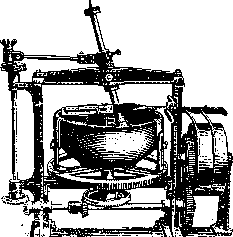
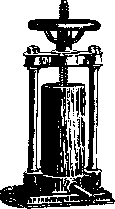
Ointment pestle for large-scale production; porcelain; in 'retail sale' they are sometimes sold in wooden boxes (which is impractical, as the latter quickly become greasy) or in small tin containers. Ointments are also sold in tin, aluminum, or tin-lined (but not lead) tubes. Filling of tubes is done by squeezing the ointment through a tube of appropriate thickness into an empty tube; for this purpose, 'sausage machines' (Fig. 2) of various designs are used. The filled tubes are clamped with pincers that remove excess ointment. For transferring ointments into jars and scraping them from the walls of mortars, iron (nickel-plated) or flexible spatulas and appropriately cut pieces of clean, uncolored bristol board, celluloid sheets, horn, or the like are used. It is necessary to consider the possible influence of the container walls on the composition of the ointment: metal boxes, tubes, jar lids, etc. are particularly unreliable in this respect, as they are acted upon by compounds of heavy metals, alkalis, acids, and even soaps and fats contained in the ointment. Some ointments (mercury) are sold in glass tubes with graduations, plugged with a cork piston, (Fig. 3). Dosed ointments are dispensed in waxed paper or soft gelatin capsules containing weighed doses of the ointment. It should, however, be borne in mind that the dosage of ointments applied to intact skin is problematic. In Russian practice, the so-called 'spread ointments' introduced by Unna have not been adopted; ready ointments are spread in an even layer on leather, bookbinding cloth, or gauze and pieces of the required size are cut out. For dispensing, the spread side is covered with waxed or paraffined paper. Spreading is done by passing the materials through machines in which the ointment is slightly heated and constantly stirred, or else the ointment is spread manually, cold, with flat spatulas. The difficulty in preparation, and above all in storage and dispensing of spread ointments, combined with their insufficient advantages over convenient spread plasters, has not ensured recognition for the form of spread ointments. Liniments are also classified as ointments, representing emulsions of water in liquid oil. (In a broader sense, liniments are generally understood as liquid ointments, usually containing soap.) The F.U.N. includes three liniments. A mixture of equal parts of linseed oil with lime water (in which soap is formed from fatty acid with calcium hydroxide, retaining excess water in an emulsified form) - the so-called Linimentum Calcis (lime liquid ointment). A mixture of 3 parts of sunflower oil with 1 part of 10% ammonia spirit is called Linimentum ammoniatum or Linimentum volatile (volatile ointment); it contains ammonium soap and excess ammonia spirit in an emulsified form in oil. The third preparation - Linimentum Saponis rubefaciens, s. Spiritus Saponis rubefaciens, s. Balsamum weimarense (Weimar balsam) - belongs essentially to alcoholic soaps (see below). All liniments, like emulsions in general, are not durable; therefore, their preparation in reserve is not rational. Vayogens, or vazoliniments, are liniments with ammonium soap, in which fat is replaced by a mixture of oleic acid (ammonia is introduced in an amount insufficient for its complete binding) with vaseline oil. Linogens, in which vaseline oil is replaced by linseed oil, retain water in the emulsion even better. Due to their content of excess fatty acids, these preparations allow the addition of not too strong acids (salicylic, benzoic) and even iodine, the introduction of which into soaps or alcoholic soaps is associated with a significant change in their effect. Simple solutions of soap in alcohol (with the addition of medicinal substances) are also classified as ointments, called alcoholic soaps. The simple alcoholic soap according to F VII is a 25% alcoholic solution of potassium soap, which in turn is made from sunflower oil, whereas the alcoholic soap of some foreign pharmacopoeias contains sodium soap. 'Spiritus Saponis kalini Hebrae' according to F VII also contains potassium soap (in an amount of 60%) with the addition of lavender oil. When containing solid soap in an amount of 10% or more, these solutions at room temperature harden to the consistency of jelly, and at body temperature they melt. Such jellies are called opodeldoc ('Opo-del-doctore' of Paracelsus). Due to their easy absorption, such opodeldoc masses are used for rubs where the fastest possible action is required. Substances soluble in alcohol (creosote, guaiacol, essential oils, resins, etc.) are added to the base; the opodeldoc is poured into warm jars and quickly cooled. Slow cooling results in crystalline deposits of soap or stearin.
Figure 2.
Drying ointments on the skin, as well as solutions of resins, rubber, etc. in volatile solvents are called skin lacquers. Leaving a film on the skin, more or less flexible and continuous, they are used as protective coverings or to ensure prolonged intensive action of medicinal substances. Among the lacquers, the more commonly used are: lacquer from mastic with turpentine or other balsam, in strong alcohol or ether; traumaticin (Traumaticin), a 10-12% solution of white gutta-percha in chloroform; collodion, ethyl collodion, and others can also be included here. All these substances can be mixed with medicinal substances; to give them elasticity, fatty (castor) or mineral (vaseline) oil or balsams (copaiba, turpentine, etc.) are added to them. The application of these preparations with a brush is simple and neat, which is their advantage over plasters and ointments. Ointments used in cosmetics are usually prepared on very soft (greasy) bases containing emulsified liquid (creams), or on water-soluble bases (jellies). As fatty bases here, in addition to vaseline, vaseline oil, and lanolin, alloys of delicate vegetable oil (almond, olive, apricot, etc.) with 10-15% wax and the same amount of spermaceti can be used. For perfuming cosmetic ointments, essential oils (bergamot, lavender, rose, etc.) in amounts from 0.1% to 1% or fragrant substances from the perfume industry (essences for perfumes) are used. For coloring to the color of the skin, carmine (up to 0.1%) or aniline dyes (eosin, Sudan III, etc.) are used. Sometimes ointments are colored green with oil-soluble chlorophyllan (chlorophyll).
Figure 3. Graduated tubes for dosing ointments. 1-cork.
The quality control of ointments reduces to chemical determination of the composition corresponding to the prescription and to establishing the homogeneity of the mixture, the proper fineness of powdery ingredients, and the absence of decomposed fats or foreign impurities, and especially to detecting partial or complete replacement of Named: Adeps suillus depuratus - purified lard Adeps suillus benzoatus - lard with benzoic acid Lanolinum anhydricum - anhydrous lanolin Lanolinum hydricum - hydrous lanolin * Linimentum ammoniatum - volatile ointment * Linimentum Calcis - lime liquid ointment Linimentum Saponis rubefaciens - Weimar balsam Mixtura oleoso-balsamica Hoffman's balm Oleum camphoratum - camphor oil Oleum Hyoscyami - henbane oil Sapo viridis - green soap Spiritus camphoratus - camphor alcohol Spiritus Formicarum - formic alcohol Spiritus Lavandulae - lavender alcohol Spiritus saponatus - alcoholic soap Spiritus Saponis kalini Hebrae - alcoholic soap of Hebra Spiritus Sinapis - mustard alcohol Unguentum camphoratum - camphor ointment Unguentum Cantharidis - cantharides ointment Unguentum ceratum - wax ointment * Unguentum Cetacei - spermaceti ointment * Unguentum diachylon - lead ointment of Hebra Unguentum Glycerini - glycerin ointment Composition Melted, washed, and dehydrated lard; melting point 36-46°C Purified lard 99 parts, benzoic acid 1 part Purified wool fat; melting point 38-42°C Anhydrous lanolin 70 parts, water 30 parts Sunflower oil 3 parts, ammonia spirit 1 part Linseed oil 1 part, lime water 1 part 5% turpentine extract from cantharides 20 parts, camphor alcohol 80 parts, alcoholic soap 208 parts, ammonia spirit 12 parts; Essential oils: orange blossom, bergamot, clove, lemon, rosemary, and thyme 1 part each, Peruvian balsam 1 part

4 parts, alcohol 240 parts. Camphor 1 part, sunflower oil 9 parts. 10% extract from henbane leaves using sunflower oil. Potassium soap from hemp or sunflower oil. Camphor 1 part, alcohol (about 74°) 9 parts. 25% formic acid 5 parts, alcohol (70-71°) 95 parts. Lavender oil 1 part, alcohol (75-76°) 99 parts. Solution of about 20% potassium soap in alcohol about 70°. Approximately 60% solution of green soap in alcohol about 70° with lavender oil. 2% solution of essential mustard oil in 90° alcohol. Purified lard 65 parts, yellow wax 15 parts, camphor 20 parts. Spanish flies and turpentine each 2 parts, euphorbia 10 parts, lard and sunflower oil each 20 parts, yellow wax 10 parts. Yellow wax 1 part, sunflower oil 3 parts. White wax 1 part, spermaceti 2 parts, almond oil 7 parts. Lead plaster and white vaseline each 1 part. Wheat starch 7 parts, glycerin 93 parts (water-7 parts - is evaporated). Therapeutic application. Neutral base for Ointments (I category). The same; benzoic acid provides greater stability and gives the fat an acidic reaction. Neutral base for Ointments (II category). The same. Causing redness (counter-irritant) liquid Ointment (rubbing). For lubricating fresh burns. Strongly irritating (counter-irritant) liquid Ointment (rubbing). Pleasant smell, weakly irritating rubbing. Weakly irritating (counter-irritant) rubbing. Rubbing with questionable analgesic effect. Marked soap with weak keratolytic effect and alkaline reaction; admixture or base for Ointments (I category).
: Weakly irritating (counter-irritant) rubbing. The same. Pleasant smell, weakly irritating rubbing. Alkaline, weakly irritating liquid soap. The same. Used mainly as soap for washing the skin, hair, etc.; rarely as a component in rubbings. Strongly irritating (counter-irritant) rubbing. Weakly irritating (counter-irritant) Ointment. Strongly irritating agent in veterinary practice. Neutral base for Ointments (I category). Gentle neutral base for Ointments (I category); spoils quickly. Weakly disinfecting and astringent Ointment; recommended for eczema and weeping ringworm. Water-soluble, gelatinous base for Ointments (IV category). Prepared for a short time.
Name. Composition. Therapeutic application. Unguentum Hydrargyri album-white mercury Ointment. Unguentum Hydrargyri cinereum-gray mercury Ointment. * Unguentum Hydrargyri oxydati-eye Ointment (yellow). * Unguentum Kalii jodati-Ointment with potassium iodide. * Unguentum leniens-cold cream. * Unguentum Plumbi subacetici-lead Ointment. * Unguentum Plumbi tannici-Ointment for bedsores. Unguentum sulfuratum compos.-compound sulfur Ointment. Unguentum sulfuratum simplex-simple sulfur Ointment. Unguentum (sulfuratum) Wilkinsoni-Wilkinson's Ointment. Unguentum Terebinthinae-turpentine Ointment. Unguentum Zinci-zinc Ointment. * Unguentum Zinci salicylicum-Lassar's salicylic. Vaselinum. Vasolimentum-vasoliment (vasogen). Vasolimentum jodatum-iodovasogen. Amidochloride of mercury 1 part, white vaseline 5 parts, anhydrous lanolin 4 parts. Mercury 30 parts, anhydrous lanolin 5 parts, olive oil 1 part, purified lard 40 parts, purified beef tallow 24 parts. Yellow oxide of mercury 49 parts, mercury 1 part, yellow vaseline 5 parts. Salicylic acid 2 parts, oxide of zinc and starch [or (from 1929) talc] each 25 parts, yellow vaseline 48 parts. Mixture of hydrocarbons-product of petroleum distillation; melting point 35-40°. Oleic acid 3 parts, 10% solution of ammonia in strong alcohol 1 part, yellow vaseline oil 6 parts. Pure iodine 1 part, liquid vasoliment 9 parts. 10% potassium iodide in vasolino-lanolin base. Spermaceti Ointment with 10.8% glycerin. Lead (basic) acetate and glycerin each 10 parts, anhydrous lanolin 25 parts, wax Ointment 55 parts. Lead (basic) acetate 10 parts, tannin 5 parts, anhydrous lanolin 45 parts, yellow vaseline 40 parts. Purified sulfur and zinc sulfate each 10 parts, laurel oil 3 parts, anhydrous lanolin 20 parts, yellow vaseline 57 parts. Purified sulfur 1 part, purified lard 2 parts. Chalk 10 parts, purified sulfur and liquid tar each 15 parts, purified beef tallow and green soap each 50 parts, water 4 parts. Purified turpentine 1 part( purified lard 4 parts. Oxide of zinc 1 part, white wax 1 part, benzoic acid 8 parts.
Ointment antiseptic. In syphilis; in small doses for cosmetic defects (freckles, redness of the skin); reliable remedy against parasites in hair and linen (lice). ; Ointment used in syphilis ("frictions"); diluted 2-5 times with fat-against parasites (lice and fleas), under the common name "neapolitan" (Ung. Neapolitanum).
\ In eye practice- disinfectant Ointment.
| Ointment for obtaining slow action of iodine (slowly released under the action of oxygen in the air): in scrofula, enlarged glands, etc.
; Gentle neutral base for | Ointments (I category).
| Weakly disinfecting and astringent | remedy. For bruises, | bedsores, contusions, burns, washing.
| The same. Action astringent.
\ Disinfectant Ointment with the action \ of sulfur. For scabies, psoriasis, eczema.
The same. The same, excluding eczema. Weakly irritating (counter-irritant).
Weakly disinfecting and astringent Ointment. For eczema, ringworm, minor wounds, abrasions, contusions. The same. Neutral base for Ointments (III category). Prepared for a short time by saturating fatty bases with non-saponifiable paraffins or vaseline. Official in the VII edition are the following bases and Ointments (see table). The internal use of ointments occurs when using glycerin Ointment for gluing pills or for emulsifying substances in pap and etc. Mercury Ointment (with 85.7% Hg) is used instead of metallic mercury in pills and oil suspensions; in the latter also for parenteral administration. Base for rubbings containing ammonia soap, with alkaline reaction and weakly keratolytic and irritating effect. The same, but with the action of iodine; a gentler substitute for iodine tincture for external use. In scrofula, enlarged glands; as a counter-irritant for pleurisy, inflammatory processes and so-called. ^1it.: State Pharmacopoeia of the USSR, 7th edition, corrected printing, M., 1929; K o b e r t R., Methods of prescribing drugs and prescription, Odessa, 1914; O b e r g a r d I., Technology of dosage forms. M.-L., 1929; M o p s o g r s C, Investigations on pharmacology and pharmacodynamics of ointments, Arch. f. exper. Pathol. u. Pharmakol.. 3. CXLI, 1929 (ref. Pharm. Zeitung, 1930, № 30-31); R a p p R., Scientific pharmacy in prescription and extemporaneous preparation, B., 1929.
Related articles
Mentioned in
Cite this page
“Ointments.” Soviet Medical Encyclopedia. English translation of Bolshaya Meditsinskaya Entsiklopediya, 1st ed. (Moscow, 1928–1936), ed. N. A. Semashko. https://sovietmedicalencyclopedia.pages.dev/article/ointments/